-
The Powerful Chinese AI Strategy: How a Nation Turned Restriction Into Resolve (Part 1)
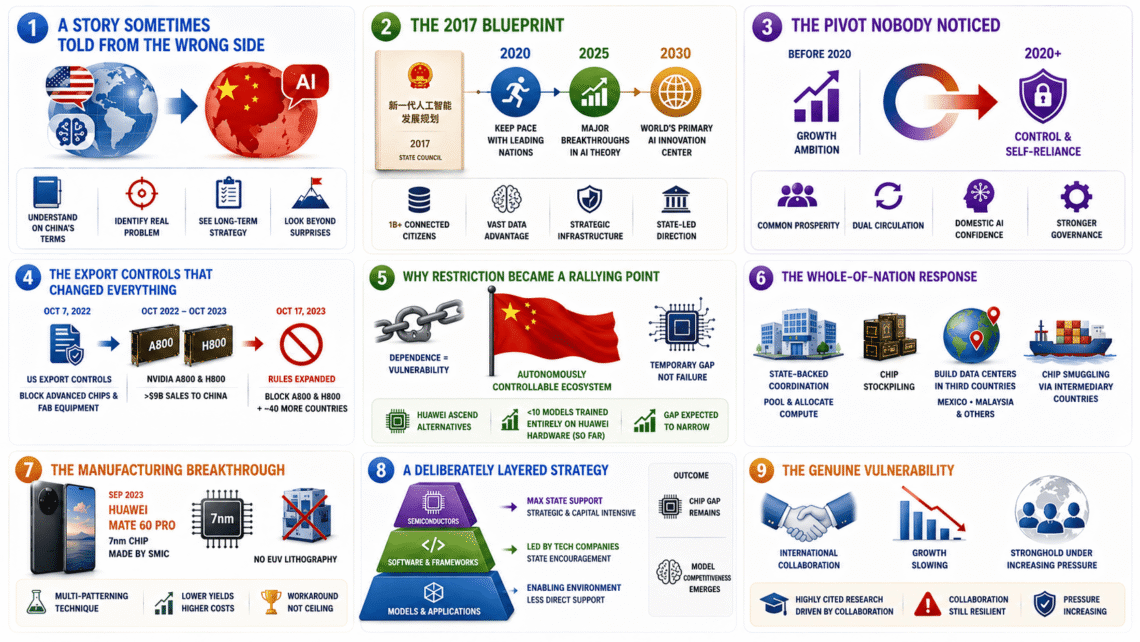
This is Part 1 of a three-part series examining Chinese AI development from a genuinely Chinese vantage point. Part 1 traces the origins of the Chinese AI strategy, the philosophical shift from ambition to self-reliance, and the export control regime that reshaped everything. Part 2 will examine the specific companies, labs, and scientists who executed this strategy. Part 3 will look at where China is heading over the next five to ten years.
A Story Sometimes Told From the Wrong Side
Most coverage of Chinese AI treats it as a reaction to American innovation. DeepSeek gets framed as a surprise. Huawei’s chips get framed as a workaround. This series takes a different approach. It asks how China itself understands this journey, what problem its leaders believe they are actually solving, and why the country’s AI strategy looks the way it does today. Understanding the Chinese AI strategy on its own terms requires starting well before DeepSeek existed, well before ChatGPT existed, in a 2017 policy document that set the entire direction in motion.
-
The Alarming $18 Billion Meta Teen Safety Settlement: Will 10 Years of Rules Actually Protect Kids?
A White Flag After Three Years of Denial
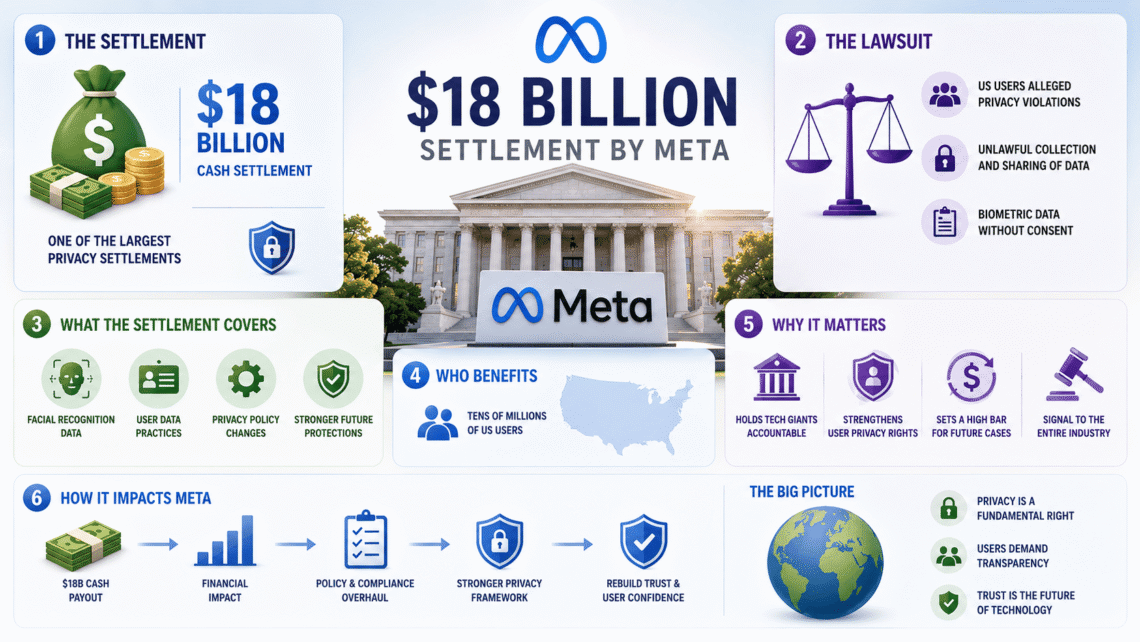
Meta waved a white flag on Wednesday. That is how TIME described the moment the company agreed to pay roughly 18 billion dollars to settle claims it deliberately hooked teenagers on Instagram and Facebook. The Meta teen safety settlement ends a legal battle that began in October 2023. It comes just over a week after a trial started in California. Four states were seeking as much as 1.4 trillion dollars in damages.
Matthew Bergman, founder of the Social Media Victims Law Center, called the moment vindication. “Meta has been steadfastly arguing that its platforms are not addictive,” he said. “That it didn’t do anything wrong.” The settlement suggests otherwise, even though Meta admits no wrongdoing.
-
The Powerful Nvidia LLM Impact and its 5-Year Reign
The Chip Nobody Saw Coming
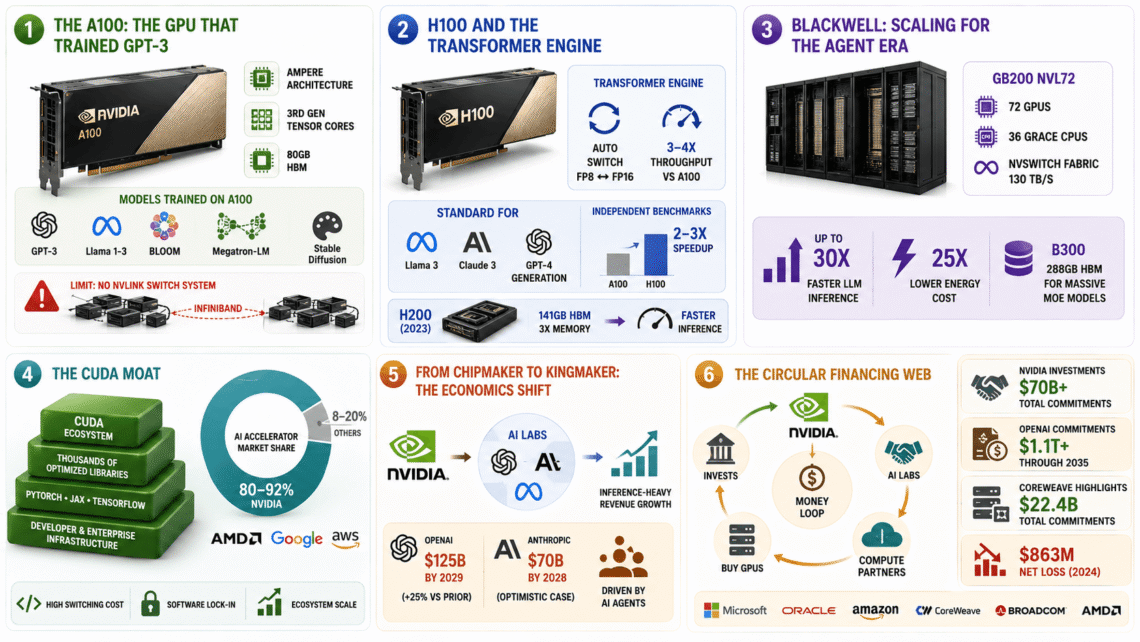
In May 2020, Nvidia announced a GPU built for data centers, not gaming rigs. Few people outside chip design circles paid much attention. That chip was the A100. Within three years, it became the single piece of hardware most responsible for the modern LLM boom. Understanding Nvidia LLM impact over the past five to ten years means tracing a story that runs through silicon design, software lock-in, and finally, staggering financial engineering. Each stage built directly on the one before it.
-
The Critical Economics of AI Data Centers: A Breakdown of Cost, ROI, and Lifecycle Risk
The Number Every CFO Is Now Modeling
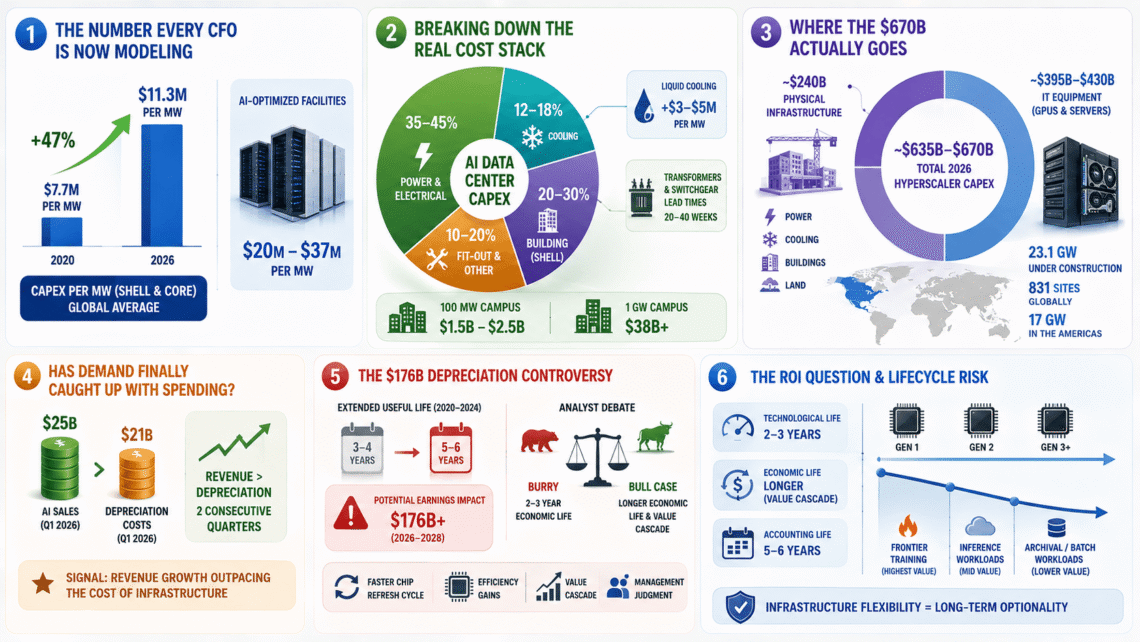
Understanding AI data center economics in 2026 requires starting with a single figure that has become the industry’s most consequential benchmark, capital expenditure per megawatt of deployed capacity. That number has moved fast, and the direction of travel explains most of the investment story unfolding across this blog’s recent coverage of the sector.
-
Inside the Powerful Wave of AI Data Center Protests Sweeping Small-Town America
125 Cities, One Saturday
Last month, protesters showed up in 125 cities across the USA on a single Saturday to demonstrate against data centers, either proposed or already under construction. It was a coordinated day of action that NPR’s 1A programme described as a genuine turning point in how visible this movement has become. This was not a scattering of isolated local disputes.
It was a nationally coordinated wave, and it reflects a sentiment that pollsters keep confirming with increasing precision. A June 2026 survey from Echelon Insights found that voters opposed building an AI data center in their community by a margin of 62 percent to 27 percent, and even after respondents were shown additional messaging emphasizing the economic and technological benefits, opposition remained at 58 percent.
-
The RAD Coding Technique That Astonishingly Predicted Vibe Coding 40 Years Before It Existed
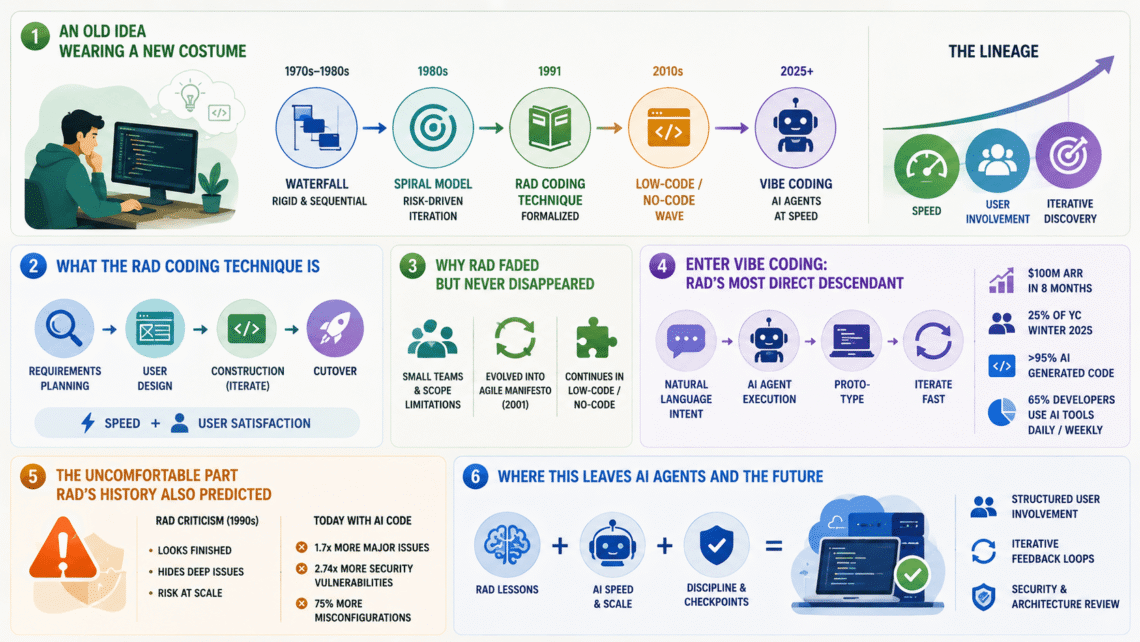
An Old Idea Wearing a New Costume
Every generation of software developers tends to believe its most disruptive innovation arrived from nowhere. Vibe coding, the practice of describing intent in natural language and letting an AI agent handle the execution, feels genuinely new, and in its literal mechanics it is. But the underlying philosophy driving it, prototype fast, involve the user immediately, treat requirements as something discovered through iteration rather than specified perfectly in advance, is considerably older than the transformer architecture powering today’s coding agents.
-
The Explosive Rise of Data Center Opposition: Inside America’s Fight Over Who Pays the Price (Part 2)
This is Part 2 of a two-part series examining the current affairs debate surrounding AI data centers. Part 1 examined the case that these facilities function as genuine strategic national assets. Part 2 examines the rapidly intensifying data center opposition movement sweeping the country, the specific harms driving it, and the growing legal and political push to hold operators directly liable.
A Movement That Crossed a Threshold in 2026
Part 1 of this series took seriously the argument that AI data centers function as genuine strategic infrastructure. That argument has not disappeared. But it now sits alongside a second, equally well-documented reality that no honest account of this current affairs debate can minimize. Data center opposition has become, in the words of one recent analysis, the most bipartisan issue since beer.
-
AI Data Centers: The Critical Strategic Assets Powering America’s Next Industrial Revolution (Part 1)
This is Part 1 of a two-part series examining the current affairs debate surrounding AI data centers. Part 1 examines the case that these facilities function as genuine strategic national assets, comparable in economic significance to the automobile industry’s rise a century ago. Part 2 will examine the mounting community opposition, the growing calls to hold data center operators directly liable for local harm, and where this genuinely difficult policy tension is likely headed.
An Investment Scale That Demands Serious Analysis
Nearly 800 billion dollars in hyperscaler infrastructure spending in a single year, examined in detail in this blog’s recent five-part series on AI economics, is not a number that exists in a vacuum. It represents a deliberate, sustained national and corporate bet that AI data centers constitute genuine strategic infrastructure, not merely a speculative technology fad. Morgan Stanley’s own 2026 market research puts this framing directly: artificial intelligence is no longer just a disruption theme, it is emerging as a strategic asset, central to economic competitiveness, military capability, and energy planning, with nearly 3 trillion dollars in AI-related infrastructure investment expected to flow through the global economy by 2028.
-
The Essential Guide to Using Agentic AI Effectively While Avoiding Costly Failure (Part 2)
This is Part 2 of a two-part series examining agentic AI in depth. Part 1 traced the term’s origin and rapid emergence into the defining technology story of 2025 and 2026. Part 2 examines how agentic AI can actually be used effectively, the specific patterns separating successful deployments from the substantial share already documented as failing, and where the technology is heading next.
A Sobering Statistic That Demands Attention
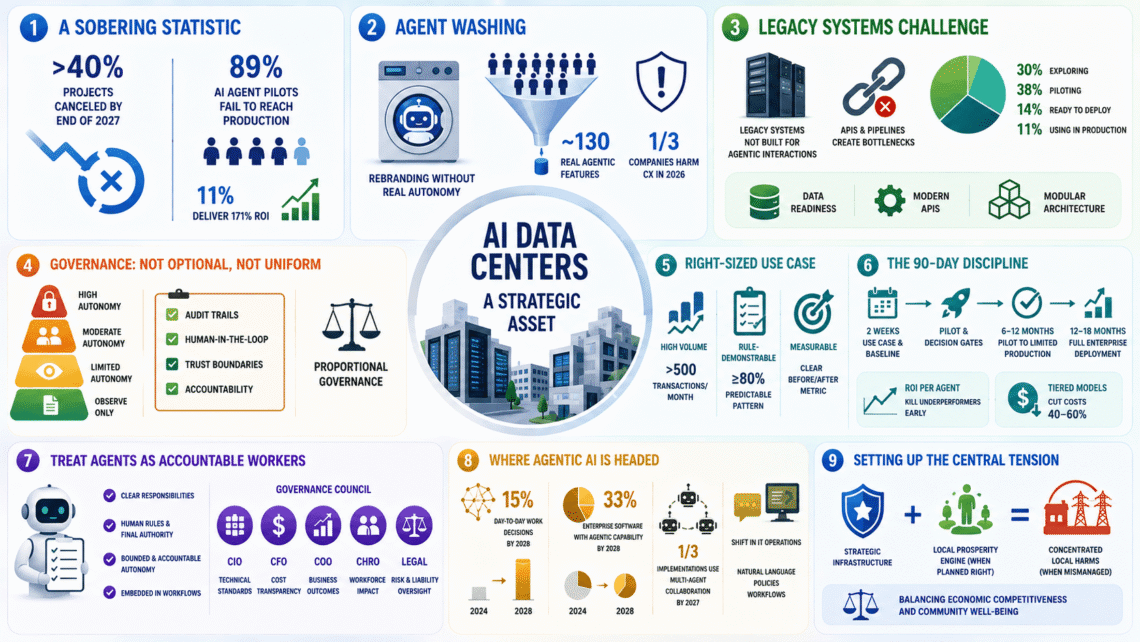
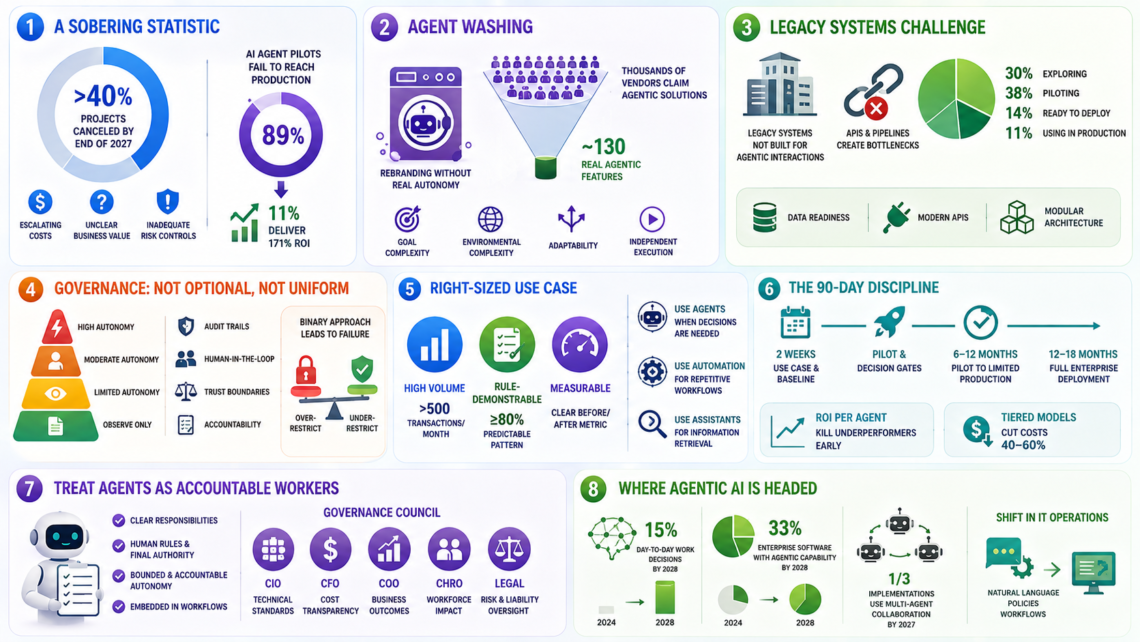
Part 1 of this series traced agentic AI from a psychology term through Andrew Ng’s 2024 reframing to Google’s formal declaration of an agentic era. That trajectory could easily suggest a technology on an uninterrupted upward path. The reality on the ground is considerably more complicated, and any honest guide to using agentic AI effectively must begin with the failure data rather than skip past it. Gartner, based on a poll of more than 3,400 organizations actively investing in the technology, predicts that over 40 percent of agentic AI projects will be canceled by the end of 2027, due specifically to escalating costs, unclear business value, or inadequate risk controls.
-
The Powerful Rise of Agentic AI: Tracing Its Origins and Explosive Emergence (Part 1)
This is Part 1 of a two-part series examining agentic AI in depth. Part 1 traces the term’s origin, defines it precisely, and follows its rapid emergence from academic obscurity to the defining technology story of 2025 and 2026. Part 2 will examine how agentic AI can be used effectively, the frameworks separating genuine success from costly failure, and where the technology is heading next.
A Word Borrowed From Psychology, Repurposed by Engineers
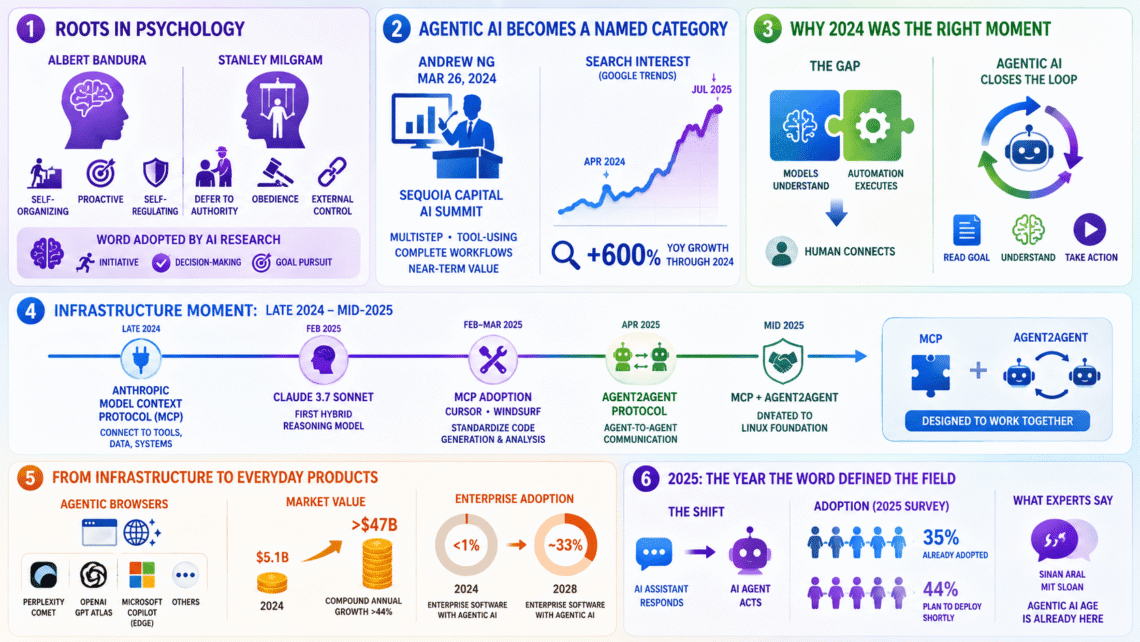
Before agentic AI became one of the fastest-growing terms in enterprise technology, agentic already had a settled meaning in an entirely different field. Psychologist Albert Bandura used the word to describe individuals who are self-organizing, proactive, and self-regulating, people who shape their own circumstances rather than merely reacting to them.
Stanley Milgram, in his famous obedience experiments, used the same root word differently still, describing an agentic state in which individuals defer their own judgment to an external authority. Both meanings, self-directed initiative and the capacity to act rather than simply respond, would eventually converge, decades later, into how the AI research community adopted the term.
The AI field itself began using agentic in the 2010s, applying it to software systems exhibiting qualities analogous to human agency, initiative, decision-making, and independent goal pursuit. But this early usage remained confined almost entirely to academic papers and specialist research circles. Merriam-Webster’s current definition, able to accomplish results with autonomy, used especially in reference to artificial intelligence, reflects how thoroughly the term has since migrated from psychology into everyday technology vocabulary, a migration that happened remarkably fast once it began in earnest.
The Moment Agentic AI Became a Named Category
While the underlying research concepts trace back decades, the specific framing of agentic AI as a distinct, named category with strategic significance has a more precise point of origin. Andrew Ng, the Stanford professor and AI pioneer, is widely credited with coining and popularizing the term in its modern usage at the Sequoia Capital AI Summit on March 26, 2024, arguing specifically that multistep, tool-using systems capable of executing complete workflows might deliver more near-term economic value than simply continuing to scale ever-larger foundation models.
This was a genuinely consequential reframing. It shifted the industry conversation away from a narrow focus on model size and benchmark scores, and toward a different question entirely, what these systems could actually accomplish when given the ability to act, not merely respond.
Google Trends data confirms just how sharply this reframing caught on. Interest in agentic AI as a search term remained minimal for years, then spiked sharply beginning in April 2024, immediately following Ng’s talk, and continued climbing to reach its peak popularity in July 2025. A separate industry analysis found search volume for the term increasing by more than 600 percent year on year through 2024, a growth curve that mirrors, and in some respects exceeds, the public fascination that greeted ChatGPT’s own release in late 2022.
Why 2024 Was the Right Moment, Not an Arbitrary One
The timing of agentic AI’s emergence as a distinct category was not coincidental. It reflected a genuine technical gap that had become obvious to practitioners across the industry roughly simultaneously. By 2024, many organizations had reached the same realization from independent directions. Large language models could understand human intent far better than any prior technology, and separate automation tools could reliably execute repeatable, predefined steps, but these two capabilities lived in entirely separate parts of the workflow, disconnected from one another. Work moved forward only when a human being manually connected the interpretation step to the execution step, reading a model’s output and then personally performing whatever action it recommended.
This specific gap, models that understood but could not act, and automation that could act but could not understand, is precisely what agentic AI was built to close. Rather than stopping at interpretation, as a standard chatbot does, agentic systems were designed to read a goal, understand its surrounding context, and then carry out the necessary actions directly within a live system, closing the loop that had previously always required manual human intervention.
The Infrastructure Moment: Late 2024 Through Mid-2025
Understanding why agentic AI moved from a promising concept to genuine production reality requires tracing a specific sequence of infrastructure milestones that unfolded across roughly eighteen months. In late 2024, Anthropic introduced the Model Context Protocol, an open standard allowing large language models to connect to external tools, databases, and live systems in a consistent, predictable way, examined extensively elsewhere on this blog. This single development is widely regarded as the key inflection point that made agentic AI practically deployable at scale, since it gave models, for the first time, a reliable and standardized way to reach beyond generating text and actually act upon the world.
The momentum continued to build rapidly through the first half of 2025. In February 2025, Anthropic released Claude 3.7 Sonnet, described as the first hybrid reasoning model on the market, and the Model Context Protocol specification itself gained widespread adoption across development tools including Cursor and WindSurf, which integrated it directly to standardize code generation and repository analysis.
In April 2025, Google introduced a complementary protocol, Agent2Agent, addressing a distinct problem from MCP, not how a single agent connects to external tools, but how multiple separate agents communicate and coordinate with one another. Crucially, the two protocols were designed from the outset to work together rather than compete, and by later in the year both had been donated to the Linux Foundation, cementing them as genuinely open, vendor-neutral industry standards rather than proprietary experiments controlled by any single company.
From Infrastructure to Everyday Products
These underlying protocol developments translated into visible consumer and enterprise products with striking speed. By mid-2025, agentic browsers began appearing across the industry, tools including Perplexity’s Comet, OpenAI’s GPT Atlas, Microsoft’s Copilot integration within Edge, and several others, each reframing the humble web browser from a passive window for displaying information into an active participant capable of completing entire tasks independently, such as booking a vacation directly, rather than merely helping a user search for flight options and leaving the actual booking to them.
The market figures accompanying this product wave were substantial by any measure. The market value of agentic AI reached approximately 5.1 billion dollars in 2024, and industry analysis from Capgemini projects that figure will exceed 47 billion dollars, growing at a compound annual rate above 44 percent. Perhaps more tellingly, in 2024 less than 1 percent of enterprise software included any agentic AI capability at all. By 2028, analysts expect close to a third of all enterprise software to incorporate it, a genuinely dramatic penetration curve for any enterprise technology category to achieve within a single decade.
2025: The Year the Word Defined the Field
By the close of 2025, agentic had become, in the words of one widely circulated year-end industry retrospective, the one word that captures the life of artificial intelligence in 2025, a term that transcended mere buzzword status to become the defining characteristic of how organizations and individuals actually experienced AI throughout the year. Where 2023 and 2024 had been dominated almost entirely by generative AI’s ability to create text, images, and code upon request, 2025 marked a genuine transition, from AI functioning as a responsive assistant waiting to be asked, toward AI functioning as an autonomous actor capable of completing complex, multi-step tasks with minimal continuous human direction.
MIT Sloan management professor Sinan Aral captured the state of the field succinctly in early 2026, stating plainly that the agentic AI age is already here, noting that agents are already deployed at scale across the economy performing all kinds of tasks. A spring 2025 survey conducted jointly by MIT Sloan Management Review and Boston Consulting Group found that 35 percent of surveyed organizations had already adopted AI agents in some form, with a further 44 percent expressing concrete plans to deploy the technology in short order, figures that place agentic AI among the fastest enterprise technology adoption curves ever measured.
Google Formalizes the Shift at I/O 2026
The clearest institutional confirmation that agentic AI had moved from emerging trend to defined industry era arrived at Google I/O 2026, where Sundar Pichai and the Google DeepMind team did not simply announce new models in the manner of prior years, but explicitly reframed what AI itself is meant to do going forward.
The shift they articulated was specific and deliberate, moving away from smarter chatbots and improved search results, toward AI that takes genuine initiative, executes multi-step tasks independently, and works on a user’s behalf without requiring continuous hand-holding throughout the process. The distinction Google drew was precise and worth repeating exactly, a chatbot answers, an agent does, a formulation that captures the entire conceptual shift this article has traced in a single, memorable sentence.
Where the Definition Stands Today
Current academic and industry consensus increasingly frames agentic AI not as a fixed, binary classification but as a continuous spectrum, a concept researchers now call agenticness, defined as the degree to which a system can adaptably achieve complex goals in dynamic environments with limited direct supervision. This spectrum encompasses four measurable dimensions, the complexity of goals a system can pursue reliably, the complexity of the environments it can operate within, its capacity to adapt to genuinely novel or unexpected circumstances, and its ability to execute independently with minimal ongoing human intervention.
OpenAI’s own internal framing treats agentic as a gradual continuum rather than a strict yes-or-no category, meaning that as any given system’s capabilities along these four dimensions cross a sufficiently high combined threshold, it naturally transitions from being simply an AI tool into being recognized, functionally, as agentic AI.
This nuanced framing matters considerably for how organizations and individuals should think about the technology going into Part 2 of this series, since it clarifies that adopting agentic AI effectively is not a matter of flipping a single switch from non-agentic to fully autonomous, but rather a matter of deliberately choosing how far along this spectrum any given task or workflow genuinely needs to sit.
Conclusion
Agentic AI’s journey from a niche psychological term, through decades of quiet academic development in robotics and multi-agent systems research, to Andrew Ng’s specific 2024 reframing, and finally to Google’s explicit declaration of an agentic era at I/O 2026, represents one of the fastest conceptual migrations in recent technology history. What makes this trajectory genuinely significant, rather than merely another cycle of industry buzzword inflation, is that it was accompanied at every stage by concrete, verifiable infrastructure milestones, the Model Context Protocol, Agent2Agent, and the resulting standardized ecosystem, each addressing a specific, previously unsolved technical gap between AI systems that could understand and automation that could act.
Part 2 of this series turns from this historical account toward the genuinely practical question this trajectory raises for any individual or organization today, how agentic AI can actually be used effectively, which specific patterns separate the deployments generating real, measurable value from the substantial share already documented as failing to deliver on their promise, and where this technology is realistically headed over the next several years.
Part 2: Using Agentic AI Effectively, coming next in the Current Events series.