-
5 Powerful Ways the Agentic AI Operating System Is Already Replacing Windows as You Know It
The Computing Paradigm That Is Quietly Already Here
For four decades, the fundamental interaction model of personal computing barely changed. You opened an application, you told it exactly what to do through menus and clicks, and it did precisely that and nothing more. In 2026, that model is being dismantled in real time, and not by a speculative research lab but by the world’s largest software company shipping code directly into hundreds of millions of machines.
At Microsoft Build 2026, CEO Satya Nadella stood on stage and declared plainly, we are moving from AI that assists you to AI that acts on your behalf, framing Windows as the first truly agentic operating system, woven into Windows, Azure, and everything in between. The agentic AI operating system is no longer a thought experiment. It is currently rolling out.
Understanding exactly how far this shift has already progressed, what remains genuinely speculative, and what a fully realized agentic AI operating system would mean for how humans relate to their own computers requires separating concrete, shipping technology from the more ambitious, still-unrealized vision Microsoft and its competitors have articulated for the remainder of the decade.
One: The Kernel Itself Is Being Redesigned Around Agents
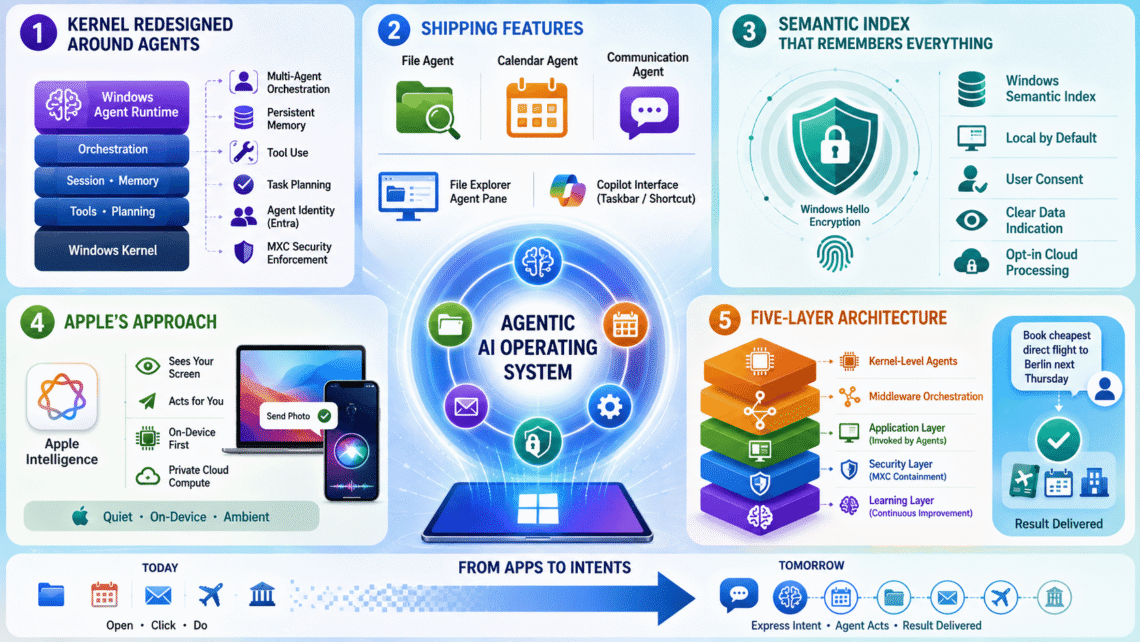
The single most significant technical shift underlying the current agentic AI operating system rollout is architectural rather than cosmetic. Microsoft is not simply adding a chatbot to the taskbar, as it did with earlier Copilot integrations that drew considerable user backlash. The company has embedded a new Windows Agent Runtime directly into the operating system, a system-level orchestration layer providing session management, persistent memory, task planning, tool use, and coordination between multiple simultaneous agents, all built directly into the OS itself rather than bolted on as a separate application. Windows chief Pavan Davuluri described the ambition explicitly, framing Windows as no longer a passive platform but an active participant in work and life.
The security architecture underlying this shift deserves particular attention, since it directly addresses the most obvious objection to an agentic AI operating system, that granting AI system-level access to files, applications, and hardware sounds catastrophically risky. Microsoft’s answer is a policy-driven execution layer called MXC, which allows developers to define precisely what any given agent can access, files, networking, system resources, specific applications, while Windows itself enforces those restrictions at the kernel level rather than trusting the agent’s own behavior.
Every agent operates under its own Entra-backed identity, isolated from the user’s desktop, clipboard, and input devices unless explicitly granted access, with all activity attributed and auditable. This containment model is what makes a genuinely agentic AI operating system plausible for enterprise and security-conscious users rather than remaining a novelty confined to consumer experimentation.
Two: File Organization and System Maintenance Are Already Shipping Features
The specific capabilities envisioned for a mature agentic AI operating system, automatically organizing files, searching content based on natural language rather than exact filenames, and handling routine system maintenance, are not purely speculative. They are shipping in early form right now. Microsoft’s initial release includes purpose-built agents for common tasks, a Calendar Agent, a File Agent, and a Communication Agent, accessible through an updated Copilot interface that can be pinned to the taskbar or summoned by keyboard shortcut. File Explorer itself now includes a dedicated agent pane offering real-time file analysis directly within the file browsing experience.
The longer-term vision Microsoft has articulated publicly for this agentic AI operating system extends considerably further than these initial agents. The stated ambition is a Windows that proactively manages routine computing tasks entirely on its own initiative, organizing photos without being asked, summarizing long email threads automatically, suggesting draft replies before the user has finished reading, and pre-loading applications based on the user’s own historical behavior patterns, anticipating what the user is about to need rather than waiting to be instructed.
This is precisely the file organization, content search, and predictive assistance envisioned as core functions of a genuinely intelligent operating layer, already moving from roadmap to early production release within a single calendar year.
Three: The Semantic Index That Remembers Everything, Carefully
For an agentic AI operating system to genuinely learn from user activity and act intelligently on the user’s behalf, it needs persistent memory of what the user has actually done, a capability that raises the sharpest privacy questions in this entire transition. Microsoft’s answer is the Windows Semantic Index, a personal semantic index encrypted specifically with Windows Hello biometric authentication, designed to enable persistent agent memory and context without simply storing a raw, unencrypted log of everything a user has ever done, a lesson learned directly from the well-documented privacy backlash surrounding the earlier Windows Recall feature.
The privacy framework attached to this memory layer is genuinely load-bearing for whether an agentic AI operating system can achieve mainstream trust rather than remaining confined to enthusiast early adopters. Microsoft has committed publicly to a strict user consent framework, with all data processing defaulting to local, on-device execution unless a user explicitly opts into cloud processing for a specific task, and clear visual indication whenever any agent touches personal data.
Whether this framework proves robust enough to satisfy privacy advocates and regulators once deployed at true consumer scale, well beyond the current early preview population, remains one of the most consequential open questions determining how quickly a genuinely agentic AI operating system reaches mass adoption.
Four: Apple Is Building the Same Vision Through a Different Door
Microsoft is not alone in pursuing this transition, and the contrast with Apple’s approach illustrates two genuinely different philosophies converging on a similar destination. Apple Intelligence, running largely on-device thanks to Apple’s own silicon, pursues a considerably quieter, more understated version of the agentic AI operating system concept, functioning less like a visible chatbot interface and more like an invisible extension of the existing interface itself.
Siri, in its current iteration, can genuinely see what is displayed on a user’s screen and act on it directly, sending a specific photo to a specific contact without the user needing to name the file or navigate to it manually, while most processing happens entirely locally, with cloud computation reserved specifically for the heaviest reasoning tasks through what Apple calls Private Cloud Compute.
This divergence between Microsoft’s visible, chat-forward agent interface and Apple’s quiet, embedded ambient intelligence represents two legitimate architectural bets on what an agentic AI operating system should actually feel like to use day to day, one that foregrounds the agent as a distinct entity the user directly converses with, and one that dissolves the agent so thoroughly into the existing interface that using it barely feels like invoking AI at all.
Which philosophy proves more durable and genuinely preferred by ordinary users, rather than power users and early technology adopters, will likely take several more product generations to determine conclusively.
Five: The Five-Layer Architecture Pointing Toward the OS Disappearing Entirely
Beyond the specific products currently shipping, researchers studying this transition have proposed a more general five-layer architectural framework for understanding where the agentic AI operating system concept is ultimately heading. Kernel-level agents handling low-level resource scheduling and hardware coordination, a middleware layer orchestrating communication between agents and system services, an application layer where traditional software still technically exists but is increasingly invoked by agents rather than directly by users, a security layer enforcing the kind of containment and permission boundaries Microsoft’s MXC system already implements today, and a learning layer that continuously refines the entire stack’s behavior based on accumulated user interaction patterns over time.
The genuinely speculative but technically coherent endpoint this architecture points toward is a computing experience in which the traditional application layer becomes almost entirely invisible to the ordinary user. Rather than opening a calendar application, a payment application, and a travel booking application separately to plan a trip, a user of a mature agentic AI operating system simply expresses an intent directly, book the cheapest direct flight to Berlin next Thursday, and the underlying agentic layer interprets that intent, coordinates every necessary service automatically behind the scenes, and delivers a completed result.
The application layer continues existing beneath this interaction, but the user increasingly interacts with the agent interface itself rather than navigating between individual applications one at a time, a genuine inversion of four decades of established computing convention.
What Remains Genuinely Uncertain
A rigorous, hype-free assessment of the agentic AI operating system concept requires being explicit about what remains unresolved rather than treating this transition as a foregone conclusion. Early real-world testing has already surfaced rough edges, one prominent technology journalist reported his own Scout agent, Microsoft’s always-on Copilot agent, sending an email composed as a single unformatted run-on sentence, a small but telling reminder that autonomous execution without adequate human review still carries genuine, practical failure modes well short of any catastrophic scenario.
Security researchers have specifically emphasized that continuously running local agents require carefully intentional isolation, since developers and users alike need genuine, verifiable control over exactly what any given agent can access, and confidence that those specific controls will actually hold under real-world conditions rather than merely on paper.
Standardization across the industry represents a further genuine obstacle. For an agentic AI operating system on one device to coordinate meaningfully with an agent running on a user’s phone or within a separate smart home ecosystem built by an entirely different company, the industry needs shared, interoperable protocols, an challenge directly analogous to the Model Context Protocol standardization discussed extensively elsewhere on this blog, extended now to the considerably higher-stakes context of operating system level agent coordination across competing vendors with genuinely divergent commercial incentives.
Conclusion
The agentic AI operating system is not a distant, purely speculative vision confined to research papers and product roadmaps. It is a concrete architectural shift already embedded directly into the Windows kernel, shipping in early form to real users, and being pursued through a parallel but philosophically distinct path by Apple simultaneously. File organization, proactive system maintenance, and natural language content search, the specific capabilities this article set out to examine, are already moving from aspiration to early production reality within a single calendar year, considerably faster than most observers would have predicted even eighteen months ago.
What remains genuinely open is not whether an agentic AI operating system arrives, but rather how quickly it matures past its current, occasionally rough early implementation, how convincingly the privacy and containment framework holds up once deployed at true mass scale, and how thoroughly the traditional application layer that has defined computing since the earliest graphical interfaces ultimately recedes behind an intelligence layer that, for the first time in computing history, is designed to act on a user’s behalf rather than simply waiting patiently to be told exactly what to do next.
-
Solving the Critical Data Wall: How Continual Learning LLM Systems Could Improve Everything
A Constraint That Points Toward a Deeper Problem
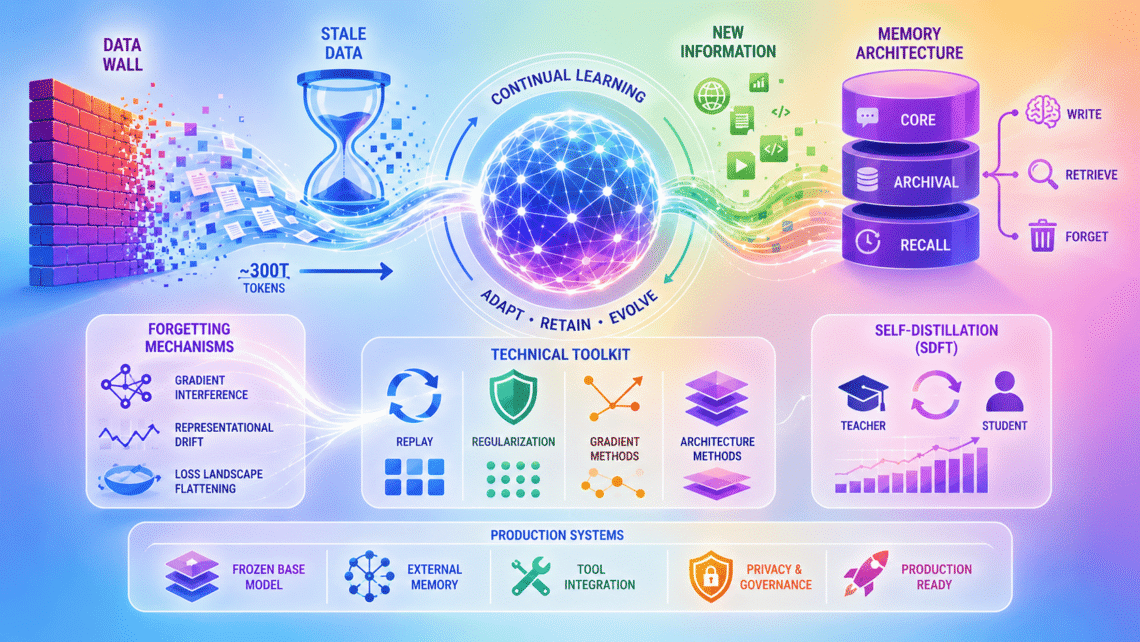
Part 2 of this blog’s recent series on the future of LLM technology established the data wall as a genuine, near-term constraint, Epoch AI’s estimate of roughly 300 trillion usable tokens of human text, against a frontier model’s growing appetite that could soon exceed even the entire unfiltered internet. But the data wall is, in an important sense, a symptom of a deeper architectural limitation rather than a standalone problem. Today’s large language models are trained once, on a fixed snapshot of data, then frozen and deployed.
Any genuinely new information the world produces after that training cutoff simply does not exist for the model, unless it is manually retrained from scratch at enormous cost, or fed in temporarily through a context window that vanishes the moment the conversation ends. A continual learning LLM, a model capable of genuinely absorbing new information after deployment without needing to be retrained wholesale, is widely regarded by researchers as the most promising structural answer to both the data wall and the deeper staleness problem it exposes.
Understanding whether continual learning LLM research is close to a genuine solution, or merely a promising research direction still years from production reliability, requires examining the specific technical obstacle that has defeated this goal for decades, the progress researchers have made against it through 2025 and 2026, and the production systems already attempting practical, if partial, workarounds.
Catastrophic Forgetting: The Obstacle That Has Defeated Every Prior Attempt
The central technical obstacle blocking a genuinely reliable continual learning LLM has a name that dates back to 1989: catastrophic forgetting, the sharp decline in performance on previously learned tasks that occurs when a neural network is trained on new data. The mechanism is straightforward to describe even if it has proven stubbornly difficult to solve. When a model updates its parameters to fit new information, those gradient updates can overwrite the specific weights that were critical for performing earlier tasks well, since knowledge in a transformer is distributed across billions of parameters in a highly entangled way, with no clean, isolated module for any single fact or skill that could simply be protected while everything else updates freely.
A comprehensive 2026 mechanistic analysis, examining twenty state-of-the-art models ranging from 109 billion to 1.5 trillion parameters, including GPT-5.1, Claude Opus 4.5, and DeepSeek-V4-Pro, identified three specific, distinct mechanisms driving this forgetting. Gradient interference in attention weights disrupts 15 to 23 percent of attention heads specifically in lower network layers, correlating directly with early-stage forgetting. Representational drift causes measurable degradation in intermediate layer representations.
And loss landscape flattening around prior task minima makes the model’s previously learned solutions unstable and easily dislodged by subsequent training. Troublingly, earlier research found that the severity of forgetting actually intensifies as model scale increases within certain parameter ranges, the opposite of what one might hope, since larger models start from a stronger initial performance baseline that has further to fall.
The Discovery That Reframed the Entire Problem
A genuinely important development shaping the continual learning LLM research agenda through 2025 and 2026 has been the discovery that a significant portion of what researchers previously labeled catastrophic forgetting may not represent genuine, permanent knowledge loss at all. Multiple independent research teams have converged on what is now called spurious or pseudo forgetting, evidence that performance degradation on previous tasks often stems from the model’s instructions failing to properly activate its inherent capabilities, rather than the model having genuinely lost those capabilities.
In several documented cases, performance believed to have been permanently destroyed by continual training could be restored simply through appropriate prompting, demonstrating that no actual forgetting had occurred at the level of the model’s underlying knowledge at all.
This reframing matters enormously for continual learning LLM research, because it suggests that at least part of the historical forgetting problem may be a task inference and instruction-following issue rather than a fundamental limitation of neural network memory itself. Researchers working from this framing have proposed a specific mitigation, a Freeze strategy that stabilizes task alignment specifically, since their controlled experiments demonstrated that maintaining task alignment matters more for preventing apparent forgetting than simply protecting raw factual knowledge retention.
The Technical Toolkit Currently in Development
Beyond the spurious forgetting reframing, continual learning LLM researchers have converged on four broad categories of genuine, complementary technical approaches, each addressing the underlying problem from a different angle.
Replay-based methods, widely considered the closest thing to a gold standard in the field, work by periodically retraining the model on a curated sample of prior task data alongside new data, ensuring old knowledge continues receiving reinforcement even as new knowledge is introduced. The genuine engineering challenge here is selecting a representative, sufficiently diverse replay buffer without needing to store or retrain on the entire original training corpus, a constraint directly connected to the data wall problem discussed earlier in this blog’s technology forecasting series. A promising 2026 refinement generates replay data synthetically, directly from the model being trained itself, reducing the storage burden considerably while preserving the stabilizing effect.
Regularization-based methods constrain how far specific parameters are allowed to drift during new training, protecting weights identified as critical to prior task performance. Gradient-based approaches, including a 2026 technique using gradient orthogonality for efficient domain adaptation, work by selecting new training data specifically chosen to minimize conflict with the gradients that encode previously learned knowledge, addressing the interference problem at its root rather than only after the fact.
Architecture-based approaches take a structurally different path entirely, using techniques such as parameter-efficient fine-tuning, low-rank adapters that can be trained on new information while the original backbone model remains entirely frozen and undisturbed. A 2026 technique called Low-Rank Circuit Projection has shown particular promise here, mitigating forgetting with genuinely minimal additional training overhead, an important practical consideration for any continual learning LLM system intended for frequent, ongoing updates rather than occasional retraining.
Self-Distillation: A Particularly Promising 2026 Development
Among the specific techniques to emerge in 2026, self-distillation fine-tuning, SDFT, deserves particular attention for how directly it addresses the practical deployment problem facing continual learning LLM systems today. Many organizations currently avoid the forgetting problem entirely by isolating each new task into a separate fine-tuned model or adapter, a workaround that increases costs substantially and adds meaningful governance complexity, since teams must continually retest every isolated model to avoid regression across an ever-growing set of fragmented, task-specific variants.
SDFT offers a genuinely different approach, using the model’s own in-context learning ability to generate on-policy training signals directly from demonstrations, with the same model playing both teacher and student roles during training. In sequential learning experiments, this approach enabled a single model to accumulate multiple skills over time without the performance regression that had defeated earlier sequential fine-tuning attempts, establishing on-policy distillation as a genuinely practical path toward the kind of accumulating, rather than fragmenting, continual learning LLM behavior the field has been pursuing since the late 1980s.
Memory Architecture as a Practical, Deployable Answer Today
While the deep technical research into solving catastrophic forgetting at the weight level continues, a parallel and considerably more mature engineering approach has already reached production deployment, treating continual learning as a memory architecture problem rather than purely a weight-update problem. Rather than updating the model’s parameters at all, these systems give a fixed, frozen base model access to external, persistent memory that it can read from and write to across sessions.
The most sophisticated production implementations now maintain three distinct memory tiers, core memory that sits directly in-context and is editable by the model itself, archival memory stored in an external, semantically searchable vector store, and recall memory, an indexed conversation history the model can query when needed. The model controls its own memory actively through tool calls, writing important facts to core memory, offloading less immediately relevant information to archival storage, and recalling specific details as the current task requires.
Mem0, a widely adopted memory layer that emerged in 2025, combines semantic consolidation, merging related information and resolving conflicts, with intelligent forgetting that deliberately deprioritizes stale or low-relevance entries, and has demonstrated accuracy gains of up to 26 percent over plain vector retrieval in benchmark testing.
This memory-based approach to continual learning LLM behavior sidesteps the catastrophic forgetting problem entirely by never actually modifying the base model’s weights at all. Its tradeoff is equally important to understand honestly, it provides the experience of a system that remembers and adapts, without providing genuine parametric learning, the kind of deep, generalizable knowledge integration that comes specifically from updating a model’s weights rather than simply retrieving relevant text at inference time.
What Production Teams Are Actually Building Toward in 2026
The practical question facing engineering teams building continual learning LLM systems today is no longer whether to support some form of ongoing learning, users increasingly expect deployed agents to remember and genuinely improve over interactions, but rather which specific combination of these techniques best matches a given system’s required update frequency, privacy constraints, and acceptable compute budget.
A February 2026 open-source release packaging memory-based continual learning as a drop-in software development kit for any LLM agent signals that this particular approach, external memory rather than weight modification, has matured into genuinely production-ready infrastructure considerably faster than the deeper parametric learning research.
Broader industry analysis places continual learning squarely among the handful of critical technical transitions expected to reshape production AI through the remainder of 2026, alongside agentic workflows maturing beyond demonstration stage and hybrid architectures increasingly replacing pure Transformer designs, a pattern directly consistent with the architectural convergence trend documented in this blog’s recent LLM technology forecast.
Conclusion
A genuinely reliable continual learning LLM, one that can absorb new information indefinitely, at the level of its actual weights rather than merely its external memory, without catastrophically degrading previously learned capabilities, remains an unsolved research problem as of mid-2026, not a deployed reality. But the honest, evidence-based picture is considerably more encouraging than that framing alone suggests. The spurious forgetting discovery has reframed a meaningful portion of the historical problem as an instruction-following issue rather than genuine, permanent knowledge loss.
Self-distillation and gradient-orthogonal training methods are showing genuine, measurable progress against the remaining, authentic forgetting that does occur. And memory-augmented architectures already provide production teams with a practical, if partial, answer available today, one that sidesteps the deepest technical challenge entirely by keeping the base model frozen while giving it genuine, persistent, actively managed memory instead.
Whether the deeper parametric version of continual learning LLM research matures into production reliability within the next several years, or whether memory-augmented architectures prove sufficient for the vast majority of practical use cases regardless, is likely to be one of the more consequential open questions determining how the data wall constraint, and the broader staleness problem underlying it, ultimately gets resolved.
-
The Critical Future of LLM Technology: A Hype-Free Forecast for the Next Five Years (Part 2)
This is Part 2 of a two-part series taking a rigorous, hype-free look at large language model progress. Part 1 examined what actually drove LLM development history over the past decade, scaling laws, algorithmic efficiency, and the unresolved reasoning debate. Part 2 turns to the specific pipeline of techniques currently in development and offers a grounded forecast for the future of LLM technology through roughly 2030.
Forecasting Without the Marketing Department
Part 1 of this series established the two forces that genuinely drove LLM capability forward over the past decade, compute scaling and algorithmic efficiency, alongside a third, newer axis, inference-time reasoning, that emerged only in the past two years. Any credible forecast of the future of LLM technology must build directly on that evidence base rather than product roadmap slides, and must take seriously a specific, quantifiable constraint that has received too little public attention relative to its actual significance, the finite supply of human-generated text itself.
The Data Wall Is Real, and It Is Closer Than Most Coverage Admits
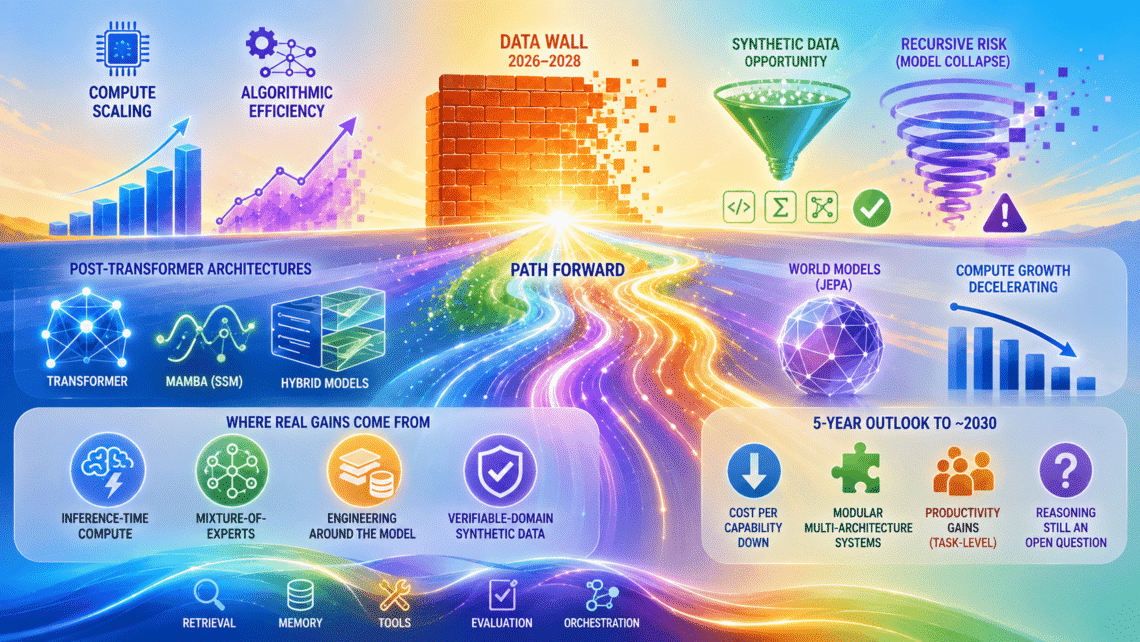
The single most consequential, best-evidenced constraint shaping the future of LLM technology over the next several years is what researchers call the data wall. Epoch AI’s careful analysis estimates the effective stock of high-quality, usable human-generated public text at roughly 300 trillion tokens, adjusted for quality and deduplication. That figure sounds enormous until it is set against actual consumption. GPT-4 was trained on somewhere between 6 and 13 trillion tokens.
A frontier model trained in 2026 using the compute available at facilities such as the Abilene Stargate site, running at roughly 240 tokens per parameter, a ratio pushed considerably higher than the original Chinchilla-optimal 20 tokens per parameter as labs squeeze more value from every available token, would want approximately 400 trillion tokens, a figure that already exceeds the entire unfiltered Common Crawl dataset.
The consensus estimate across multiple independent research groups places genuine exhaustion of easily accessible, high-quality public text somewhere between 2026 and 2028, with Epoch AI’s own analysis suggesting the timeline could compress toward the earlier end of that range if labs continue overtraining smaller models on repeated data passes, a practice already well underway. This is not a distant, speculative constraint. It is arguably the single most binding limitation on the pure scaling paradigm that dominated the first half of LLM development history, and any serious forecast of the future of LLM technology must treat it as a near-term engineering reality rather than a theoretical curiosity.
Synthetic Data: A Real Tool With a Real Failure Mode
The industry’s primary response to the data wall has been synthetic data, using models to generate additional training material rather than relying solely on scraped human text. Adoption has moved considerably faster than even optimistic 2022 forecasts anticipated. Microsoft’s Phi-4 model was trained on 400 billion synthetic tokens spanning fifty distinct dataset types and scored 91.8 percent on AMC math benchmarks, outperforming considerably larger models trained primarily on human text. Nvidia’s 320 million dollar acquisition of Gretel AI signals how seriously infrastructure providers now treat synthetic data generation as core, durable business infrastructure rather than a temporary stopgap.
But synthetic data carries a genuine, well-documented failure mode that any honest forecast of the future of LLM technology must address directly rather than glossing over. Recursive training, using one generation of model output to train the next generation of the same model family without careful filtering, causes measurable model collapse, a progressive narrowing of output diversity and a degradation in the model’s grip on the genuine statistical structure of real-world language and knowledge.
The critical distinction researchers now draw is between replacing human data wholesale, which reliably degrades model quality over successive generations, and accumulating synthetic data as a targeted supplement, filtered and verified specifically for tasks with checkable, verifiable answers such as mathematics, code, and structured reasoning, where synthetic data has shown genuine and repeated success. The future of LLM technology almost certainly depends on this distinction being respected rigorously by every major lab, since the alternative, an AI industry inadvertently training its most important systems on a slowly collapsing diet of recycled AI output, represents a genuinely serious and underappreciated risk.
The Post-Transformer Architecture Race
A second major front shaping the future of LLM technology involves the underlying architecture itself. The Transformer’s core self-attention mechanism, examined extensively elsewhere on this blog, carries a fundamental computational cost, its complexity scales quadratically with sequence length, making extremely long contexts, legal contracts, genomic sequences, entire codebases, computationally expensive in a way that becomes genuinely impractical at scale.
State Space Models, particularly the Mamba architecture and its recent Mamba-3 iteration published in March 2026, address this directly by replacing attention with a mechanism inspired by classical control theory, achieving linear rather than quadratic complexity with respect to sequence length while maintaining an explicit, continuously updated hidden state that functions as a form of persistent memory. Critically, the future of LLM technology is not shaping up as a clean architectural replacement, Mamba entirely displacing Transformers, but rather as convergence toward hybrid designs.
Nvidia’s Nemotron 3 family, released in April 2026, explicitly alternates between standard attention layers and Mamba-2 state space layers within the same model, a design chosen specifically because long-context efficiency has become increasingly critical as more LLMs get embedded into agentic systems that require maintaining and reasoning over increasingly long working contexts. Industry practitioners tracking this shift have been notably measured in their assessment, treating each new architectural release as a practical question, does this change agent loop cost, prompt caching efficiency, or cost per session, rather than as a revolutionary leap, a sober framing worth adopting for any credible forecast.
World Models and the LeCun Bet
A more architecturally radical thread shaping the future of LLM technology comes directly from the reasoning critique examined in Part 1. Yann LeCun’s Joint Embedding Predictive Architecture, JEPA, represents a genuinely different bet, one where the model learns to predict abstract representations of its input rather than predicting raw pixels or tokens one at a time, an approach LeCun argues is dramatically more efficient and more capable of producing something closer to genuine world understanding than token-level autoregressive prediction can achieve. Image and video variants, I-JEPA and V-JEPA, have already shown promising results, and a language-focused variant, LLM-JEPA, began circulating in research circles in September 2025.
Whether JEPA-style world models genuinely displace autoregressive transformers within the forecast window of this article, or remain a productive but secondary research direction, is precisely the kind of question where honest forecasting requires acknowledging genuine uncertainty rather than false confidence.
What seems considerably more likely, based on the pattern already visible in hybrid Transformer-Mamba designs, is that the future of LLM technology converges toward modular, multi-architecture systems, distinct specialized components, efficient long-context backbones, world-model style planning modules, memory-augmented systems capable of accumulating knowledge across interactions, combined deliberately within a single deployed system, rather than any single architecture winning outright and displacing all competitors.
Compute Growth Is Slowing From Its Recent Peak
A frequently overlooked but genuinely important input to any credible forecast of the future of LLM technology is that raw compute growth itself, while still substantial, is decelerating from its most extreme recent trajectory. Detailed compute accounting shows frontier training system capacity increasing roughly 160-fold across four years, or approximately 3.55 times annually, a blistering pace, but one that current chip price-performance trends, improving at roughly 1.39 times annually after inflation adjustment according to Epoch AI, cannot sustain indefinitely without continued, extraordinary capital investment of the kind examined in this blog’s recent five-part series on AI industry economics.
When the data wall constraint, the synthetic data ceiling, and a compute growth trajectory that must eventually moderate are considered together, serious forecasters increasingly anticipate a genuine slowdown in pure pretraining scale gains sometime after 2028, a specific, dated prediction considerably more grounded than vague talk of an approaching technological plateau.
Where the Real Gains Will Actually Come From
If pure pretraining scale is approaching genuine physical and data constraints, where does the future of LLM technology’s next wave of capability improvement actually come from. The evidence assembled across both parts of this series points toward four specific, already-visible directions rather than speculative breakthroughs.
Inference-time compute, examined in Part 1, will almost certainly continue growing as a share of total capability gains, even as its own scaling exhibits the latent saturation trend documented in the 2026 reinforcement learning literature, meaning gains will likely become more expensive to extract even as they continue.
Mixture-of-Experts architectures, which activate only a fraction of total parameters for any given input, will continue to improve the ratio of genuine capability to compute cost, a trend already visible in models like Nemotron 3, which pairs MoE sparsity with hybrid Mamba-Transformer layers specifically to maximize this efficiency.
Engineering built around the model, retrieval systems, persistent memory, tool use, structured evaluation, and orchestration across specialized sub-models, is where practitioners closest to production deployment increasingly locate the genuine, durable competitive advantage, precisely because effortless capability gains purely from scaling a single monolithic model are ending, a conclusion directly consistent with the AI ROI findings from our five-part economics series, where the companies capturing real value were those redesigning workflows around AI rather than simply deploying a bigger model.
And targeted, verifiable-domain synthetic data, mathematics, code, formal logic, structured reasoning, will continue delivering genuine capability gains precisely because these domains allow automated verification of correctness, sidestepping the model collapse risk that makes wholesale synthetic replacement of general text so dangerous.
A Grounded Five-Year Outlook
Bringing the full evidence base from both parts of this series together, a genuinely hype-free forecast for the future of LLM technology through roughly 2030 looks considerably more modest, and considerably more interesting, than either extreme position commonly advanced in public discussion. Costs per unit of capability will very likely continue falling, driven by the well-documented three to four times annual algorithmic efficiency gains established in Part 1, MoE sparsity, and hybrid architecture efficiency, even as headline frontier training runs continue costing more in absolute terms due to sheer scale.
Complexity will increasingly shift from monolithic scale toward modular, multi-architecture systems combining efficient long-context backbones, specialized reasoning modules, and persistent memory, rather than a single architecture simply growing larger indefinitely. Productivity gains will very likely continue showing the pattern documented in Part 1’s rigorous economic research, real and measurable at the task level, but persistently capped by how effectively humans and organizations integrate these tools into actual workflows, a human and organizational bottleneck rather than a purely technical one.
And the deeper question of whether these systems achieve anything resembling genuine human-style reasoning, as opposed to increasingly sophisticated and useful pattern matching, will very likely remain genuinely unresolved throughout this entire forecast window, continuing to divide serious, credible researchers rather than being definitively settled by any single benchmark or model release.
Conclusion
The future of LLM technology, examined honestly and against the specific, quantified evidence assembled across this two-part series, is neither the smooth, inevitable glide path toward artificial general intelligence that some industry marketing suggests, nor the dead end that the most dismissive skeptics predict. It is something more specific, more constrained, and ultimately more useful to understand precisely, a technology approaching genuine, well-documented physical and data limits on its original scaling paradigm, responding with real, measurable, but imperfect engineering solutions, synthetic data, architectural hybridization, inference-time reasoning, that each carry their own specific tradeoffs and failure modes.
Whether that combination proves sufficient to sustain the pace of capability improvement the public has grown accustomed to watching since 2020, or whether the field genuinely decelerates as several credible forecasts now anticipate sometime after 2028, is a question this series cannot resolve definitively today. What it can offer, and what the marketing narrative surrounding this technology so rarely does, is a precise, evidence-grounded account of exactly which forces will determine that answer, and why.
This concludes our two-part series on LLM development history and the future of LLM technology. Explore Part 1 for the full account of the past decade.
-
The Critical Truth About LLM Development History: A Decade of Progress Without the Hype (Part 1)
This is Part 1 of a two-part series taking a rigorous, hype-free look at large language model progress. Part 1 examines what actually happened technically over the past decade, separating genuine algorithmic breakthroughs from marketing narrative. Part 2 will examine the specific techniques currently in the pipeline and offer a grounded forecast for the next five years.
Separating the Signal From a Decade of Noise
Ten years of large language model development have produced a genuinely confusing public narrative, one part remarkable engineering achievement, one part carefully managed marketing, and one part unresolved scientific dispute among the researchers who actually build these systems. This two-part series sets out to examine LLM development history the way a rigorous engineering post-mortem would, using measured, published, peer-reviewed evidence rather than product launch keynotes, and being explicit about where genuine scientific disagreement still exists among serious researchers.
The honest starting point is that two distinct forces drove all measurable progress across this LLM development history, and conflating them, as popular coverage routinely does, obscures rather than clarifies what actually happened and what is likely to happen next.
Force One: Raw Compute Scaling
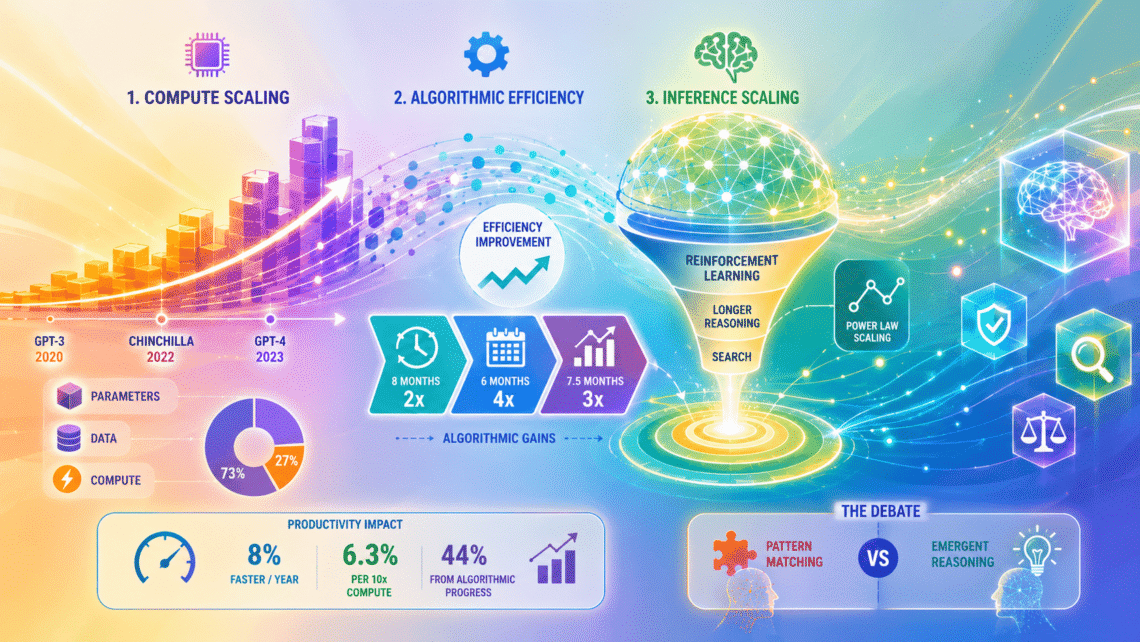
The dominant narrative of early LLM development history was straightforward and, for several years, empirically accurate. OpenAI’s 2020 scaling laws, authored by Jared Kaplan and colleagues, established that model performance improved predictably as a power law function of parameters, dataset size, and training compute.
The practical conclusion drawn from this research was specific and consequential: given a fixed compute budget, the optimal strategy allocated roughly 73 percent toward parameters and only 27 percent toward data, meaning build the largest model you can afford and do not worry excessively about data volume. GPT-3, a 175 billion parameter model trained on just 300 billion tokens, a ratio of roughly 1.7 tokens per parameter, was a direct product of this thinking and became a genuine sensation.
This phase of LLM development history proved short-lived once subjected to more rigorous testing. DeepMind’s 2022 Chinchilla paper, examined extensively elsewhere on this blog, demonstrated that Kaplan’s original scaling laws had significantly underweighted the value of training data relative to parameters. The compute-optimal ratio, Chinchilla established, was closer to 20 tokens per parameter, not 1.7, meaning GPT-3 scale models trained under the earlier Kaplan regime were substantially undertrained relative to their parameter count.
This single correction, more than any subsequent architectural innovation, explains much of the capability jump between the GPT-3 and GPT-4 generation of models, a fact that receives considerably less public attention than it deserves given its outsized practical impact on LLM development history.
Force Two: Algorithmic Efficiency, the Quieter and More Important Story
The genuinely underappreciated thread running through LLM development history is algorithmic efficiency, improvements that let a model achieve a given performance level using dramatically less compute than an earlier approach required, entirely independent of simply buying more hardware. Multiple independent research efforts, using different methodologies, have converged on a strikingly consistent estimate. Epoch AI’s analysis found that training compute required to reach a fixed performance threshold has halved approximately every eight months.
Anthropic CEO Dario Amodei separately estimated the figure at roughly four times per year. A 2025 paper titled Price of Progress, isolating algorithmic gains specifically from open models to control for competitive effects, independently estimated algorithmic efficiency progress at approximately three times per year. Three independent methodologies converging on halving times of eight months, six months, and seven and a half months respectively is a genuinely rare degree of empirical agreement in a field this contested, and it represents one of the more solid, well-evidenced conclusions available about LLM development history to date.
A more rigorous 2025 academic framework distinguishes between compute-dependent and compute-independent algorithmic advancements specifically to avoid conflating these two forces, since compute-dependent improvements only become significant at scales far beyond their original conception, while compute-independent improvements raise efficiency uniformly across every scale. This distinction matters directly for forecasting, since it clarifies that some techniques currently discussed as breakthroughs will only meaningfully matter once frontier labs deploy compute budgets an order of magnitude beyond what is currently available, while others are already delivering their full benefit today.
The Third Axis Nobody Anticipated: Inference Scaling
Perhaps the single most consequential shift in LLM development history over the past two years has been the emergence of an entirely new axis of scaling that the original Kaplan and Chinchilla frameworks never accounted for. From 2020 through 2024, frontier progress was governed almost entirely by training scale, larger datasets, larger models, larger training compute budgets. Over 2024 and 2025, the field added a fundamentally different second axis, inference scale, also called test-time compute, spending considerably more computation at the moment of generation itself, through longer deliberation and search-like reasoning strategies, to raise problem-solving performance, sometimes more cost-effectively than simply training a larger base model in the first place.
This bifurcation genuinely reframes what counts as progress within LLM development history, and it explains a pattern that confused many observers through 2025, models with similar or even smaller parameter counts than their predecessors nonetheless posting dramatically better performance on hard reasoning benchmarks, purely because they had learned, through reinforcement learning on verifiable outcomes, to generate longer, more structured internal reasoning traces before committing to a final answer.
The 2026 academic literature on reinforcement learning post-training scaling has since found that this inference-time scaling follows its own distinct power law relationship between test loss, compute, and data, structurally similar to pretraining scaling laws but with a critical difference, reinforcement learning post-training exhibits a latent saturation trend, meaning that while larger models do achieve higher learning efficiency during this phase, the returns diminish measurably faster as scale increases than they do during pretraining itself. This finding matters enormously for Part 2 of this series, since it suggests inference scaling cannot simply be scaled indefinitely as a substitute for continued pretraining progress.
What This Actually Meant for Productivity, Measured Rigorously
Separating LLM development history from marketing requires looking at controlled, preregistered economic research rather than anecdote, and the most rigorous study available offers a genuinely useful, if considerably more modest than commonly claimed, picture. A December 2025 preregistered experiment involving over 500 consultants, data analysts, and managers, each completing real professional tasks using one of thirteen different LLMs, found a robust calendar-time scaling effect, each year of frontier model progress was associated with an 8 percent reduction in task completion time.
Isolating the effect of pure compute scale specifically, a tenfold increase in model training compute was associated with only a 6.3 percent reduction in task completion time, with roughly 44 percent of total observed improvement attributable specifically to algorithmic progress rather than raw scale.
The study’s most analytically important finding, however, concerns a divergence that deserves far more public attention than it currently receives. While the quality of autonomous model output scaled essentially linearly with training compute, the quality of human-assisted output remained largely stagnant across successive model generations. This implies that human users, through the specific way they prompt, interpret, and apply model outputs, effectively cap the realized capability gains of frontier models at a fixed ceiling, a genuinely sobering finding for anyone assuming that simply deploying a more capable model automatically translates into proportionally greater organizational productivity, a theme directly consistent with the AI ROI evidence examined in our recent five-part series on AI industry economics.
The Genuine Scientific Dispute: Pattern Matching or Reasoning
No honest account of LLM development history can avoid the genuine, unresolved dispute currently dividing serious AI researchers, a dispute that has nothing to do with marketing hype and everything to do with what these systems are actually doing internally. Yann LeCun, Meta’s former chief AI scientist, has argued consistently and pointedly throughout 2025 and 2026 that autoregressive transformer models, however impressive their outputs, remain fundamentally pattern matching engines rather than genuine world models.
Yann’s critique is specific: current LLMs can describe gravity eloquently because they have ingested millions of textual descriptions of gravity, but they cannot predict that an unsupported object will fall because they possess no internal concept of falling beyond statistical token associations, no grounded representation of cause and effect that would allow genuine planning or reasoning about consequences.
Cognitive scientist Gary Marcus has raised a closely related but distinct critique, tracing his skepticism back to his own 1992 publications and his 2001 book The Algebraic Mind, which anticipated the hallucination and unreliable reasoning problems LLMs continue to exhibit decades before LLMs existed. Neuroscientist Karl Friston has framed the underlying objection even more starkly, describing LLMs as, in his words, just a mapping between content and content, with nothing genuinely in the middle representing understanding.
It is worth noting explicitly that this dispute is not settled, and reasonable, technically serious researchers occupy positions across the entire spectrum, from LeCun and Marcus’s skepticism to the position, held by many working directly on frontier reasoning models, that inference-time scaling and reinforcement learning on verifiable outcomes are already producing genuinely emergent reasoning capability that simple pattern matching could not explain.
What is measurably true, regardless of which theoretical camp proves correct, is the hallucination statistic itself. Even as of April 2026, hallucinations in court filings by prominent, sophisticated law firms using frontier AI tools continued to occur, direct evidence that the hallucination problem central to this entire LLM development history debate remains genuinely unresolved rather than a solved problem simply awaiting wider deployment.
Conclusion
The genuine, evidence-grounded account of LLM development history over the past decade is considerably more interesting, and considerably more measured, than either the breathless marketing narrative or the dismissive skeptic narrative alone would suggest. Real, repeatedly measured algorithmic efficiency gains of roughly three to four times per year compounded with genuine compute scaling to produce the capability curve the public has observed.
A genuinely new axis of progress, inference-time scaling, emerged in the past two years and has already begun exhibiting its own distinct saturation dynamics. And a serious, unresolved scientific dispute concerning LLM development history about whether the underlying architecture can ever produce genuine reasoning, rather than increasingly sophisticated pattern matching, continues to divide credible researchers rather than being settled decisively in either direction.
Part 2 of this series turns from this historical account toward the specific technical pipeline, the architectural alternatives to the transformer, the emerging training techniques, and the realistic, hype-free forecast for what these forces are actually likely to produce, in terms of cost, capability, and genuine reasoning ability, over the next five years.
Part 2: The Next Five Years, coming next in the Current Events series.
-
The Powerful AI LLM Landscape 2026: Mapping the Titans, Contenders, and Rising Challengers
A $2.37 Trillion Private Market and Counting
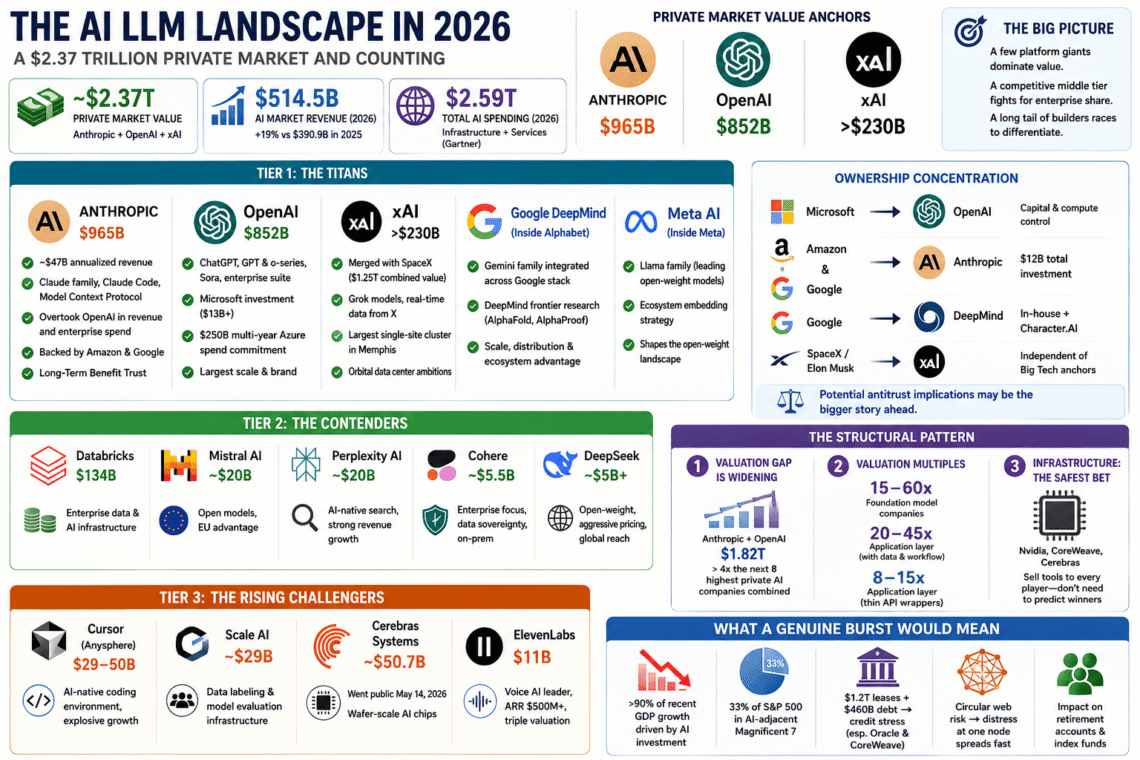
The AI LLM landscape has bifurcated sharply into a small handful of platform companies commanding valuations larger than most national economies, a competitive middle tier fighting for enterprise share, and a long tail of application builders racing to differentiate before the giants absorb their category. Anthropic, OpenAI, and xAI alone now anchor a private market worth roughly 2.37 trillion dollars, with global AI market revenue reaching approximately 514.5 billion dollars in 2026, up 19 percent from 390.9 billion dollars the prior year.
Total worldwide AI spending, including infrastructure and services, is projected by Gartner at 2.59 trillion dollars. Understanding who occupies which tier of this AI LLM landscape, and why, is now essential reading for investors, enterprise buyers, and anyone tracking where genuine value is accumulating in the industry.
Tier One: The Titans
Anthropic sits atop the current AI LLM landscape following a genuinely remarkable repricing. The company filed for its IPO on June 1, 2026, at a 965 billion dollar valuation, built on roughly 47 billion dollars in annualized revenue. Its jump from a 380 billion dollar valuation to 965 billion took roughly three months, driven by Anthropic passing OpenAI in revenue in April 2026, reaching a 30 billion dollar run rate against OpenAI’s 25 billion, after scaling from just 1 billion dollars in annual recurring revenue in only fifteen months.
Anthropic’s Claude business has separately overtaken OpenAI in enterprise business spending share, reaching 34.4 percent according to Ramp payments data. Its flagship products span the Claude model family, Claude Code for software development, and the Model Context Protocol, now the industry’s dominant agent integration standard. Governance sits with a Long-Term Benefit Trust designed to preserve mission alignment despite billions in backing from Amazon and Google.
OpenAI filed its own IPO exactly one week after Anthropic, on June 8, 2026, at an 852 billion dollar valuation. Products span ChatGPT, the GPT and o-series API models, Sora for video generation, and a rapidly expanding enterprise and agentic tooling suite. Microsoft’s 13 billion dollar plus investment anchors the relationship, with Azure serving as OpenAI’s primary compute backbone under a 250 billion dollar multi-year spending commitment discussed at length elsewhere on this blog. OpenAI’s position in the AI LLM landscape remains the largest by absolute scale and brand recognition, though its widening valuation gap with Anthropic through 2026 has become one of the year’s defining storylines.
xAI occupies a genuinely distinctive position in the AI LLM landscape following its February 2026 merger into SpaceX, creating a combined entity valued at 1.25 trillion dollars, the largest corporate merger in history, positioning the combined company for orbital data center ambitions and a blockbuster SpaceX IPO targeting up to 1.5 trillion dollars. Standalone, xAI carries a valuation north of 230 billion dollars, anchored by the Grok model family and what may be the largest single-site compute cluster in the world at its Memphis facility.
Real-time data integration with X gives xAI a genuine differentiator other labs cannot easily replicate, though its enterprise go-to-market motion remains underdeveloped relative to Anthropic and OpenAI, and Grok adoption outside the X ecosystem has been comparatively limited.
Google DeepMind and Meta AI round out the titan tier from within existing public companies rather than as standalone valuations. Google’s Gemini family benefits from full integration across Search, Workspace, and Android, alongside DeepMind’s continuing frontier research output including AlphaFold and AlphaProof, discussed extensively elsewhere on this blog. Meta’s Llama family remains the most consequential open-weight contribution from any Big Tech player in the current AI LLM landscape, a strategic bet on ecosystem embedding over proprietary API revenue that continues to shape competitive dynamics across the entire open-weight segment.
Tier Two: The Contenders
Databricks commands a 134 billion dollar valuation, positioning itself as critical infrastructure for enterprise data and AI pipelines rather than a consumer-facing model provider, a strategic niche that has proven durable precisely because it does not compete directly with the titan tier for frontier model bragging rights.
Mistral AI remains Europe’s clearest AI champion within the global AI LLM landscape, differentiated by open-weight models, a regulatory advantage under the EU AI Act, and continued strategic backing, including a two billion euro investment from ASML that helped push its valuation from six to fourteen billion dollars in under a year, with more recent figures cited near 20 billion dollars. Its principal constraints remain limited US market penetration and comparatively restricted compute access relative to its American rivals.
Perplexity AI occupies a genuinely interesting middle position, an AI-native search competitor backed by Jeff Bezos, Nvidia, and Founders Fund, currently valued near 20 billion dollars after a period of valuation stepping sideways rather than continuing to climb, reflecting intensifying competitive pressure in AI search from both Google and ChatGPT directly. Perplexity stands out specifically for revenue growth velocity even as its valuation growth has moderated.
Cohere has staked its position in the AI LLM landscape on enterprise data sovereignty and on-premise deployment, a differentiator whose durability depends heavily on whether that requirement remains genuine among regulated enterprise buyers or simply becomes a checkbox feature larger providers eventually bundle into their existing platforms at no additional cost.
DeepSeek, examined in detail in earlier coverage on this blog, remains a significant presence in the global AI LLM landscape specifically through open-weight distribution and aggressive pricing, though its Western enterprise penetration continues to be constrained by the data sovereignty and national security concerns documented in our prior coverage of its model distillation controversy.
Tier Three: The Rising Challengers
Beneath the contender tier, a genuinely crowded and fast-moving layer of application builders is racing to establish defensible positions before the titans absorb their categories directly. Cursor, built by Anysphere, has reached a valuation between 29 and 50 billion dollars on the strength of its AI-native coding environment, standing out specifically for revenue growth velocity that rivals or exceeds the titan tier on a percentage basis. Scale AI, valued near 29 billion dollars, anchors the data labeling and model evaluation infrastructure layer that every frontier lab depends on regardless of which model ultimately wins.
Cerebras Systems went public on May 14, 2026, in the year’s biggest tech IPO, and now trades at approximately 50.7 billion dollars in market capitalization following a post-earnings pullback, offering wafer-scale AI chip alternatives to Nvidia’s dominant position. ElevenLabs, focused on voice AI, tripled its valuation to 11 billion dollars following a 500 million dollar Series D, with annualized recurring revenue growing from 330 to 500 million dollars in under six months, one of the sharper growth trajectories anywhere in the current AI LLM landscape.
The Structural Pattern Investors Should Understand
Three patterns define the current AI LLM landscape and are likely to shape its second half of 2026. First, the valuation gap between foundation model companies and everyone else is widening rather than narrowing, with Anthropic and OpenAI together worth 1.82 trillion dollars, more than four times the combined value of the next eight highest-valued private AI companies. Second, foundation model companies trade at 15 to 60 times revenue, while application layer companies built on top of them trade considerably lower, 20 to 45 times revenue with proprietary data and deep workflow integration, but as low as 8 to 15 times if they function essentially as thin API wrappers with limited defensibility.
Third, infrastructure remains, in the words of one analyst, the safest bet in the entire AI LLM landscape. Nvidia, CoreWeave, and Cerebras do not need to predict which application or which model wins. They sell the tools to every side of the competition simultaneously, a structural advantage that has made chip and infrastructure providers the most consistently rewarded segment of the entire sector through 2025 and into 2026.
Ownership Concentration and the Bigger Story
Perhaps the most underappreciated dynamic within the current AI LLM landscape is how thoroughly cloud hyperscalers have won the underlying war for control of the frontier labs themselves. Microsoft effectively controls the OpenAI relationship through capital and compute dependency. Amazon and Google jointly anchor Anthropic through a combined 12 billion dollars in investment. Google maintains DeepMind entirely in-house alongside a commercial relationship with Character.AI.
The only frontier lab genuinely independent of a Big Tech anchor investor is xAI, where Elon Musk’s personal capital and now SpaceX’s balance sheet serve the equivalent function. Whatever position one takes on AI safety regulation, the antitrust implications of this concentration, a handful of trillion-dollar technology companies effectively controlling the entire frontier AI LLM landscape through capital rather than direct ownership, may prove to be the more consequential regulatory story of the coming years.
Conclusion
The AI LLM landscape in August 2026 is a market of extremes, a handful of trillion-dollar platform companies pulling further ahead of everyone else, a competitive middle tier carving out defensible enterprise niches around data sovereignty, coding, and search, and a genuinely crowded long tail of application builders whose survival increasingly depends on whether they can establish proprietary data advantages before the titans expand into their territory directly.
For investors and enterprise decision makers alike, the structural lesson emerging from this landscape is consistent with the infrastructure investment analysis developed across this blog’s recent economics series. Betting on any single model provider carries genuine concentration risk in a market this fast-moving. Betting on the infrastructure layer that serves every competitor simultaneously has, so far, proven to be the more durable position.
-
7 Alarming Warning Signs the AI Bubble Could Be Ready to Burst in 2026
Bringing the Full Picture Together
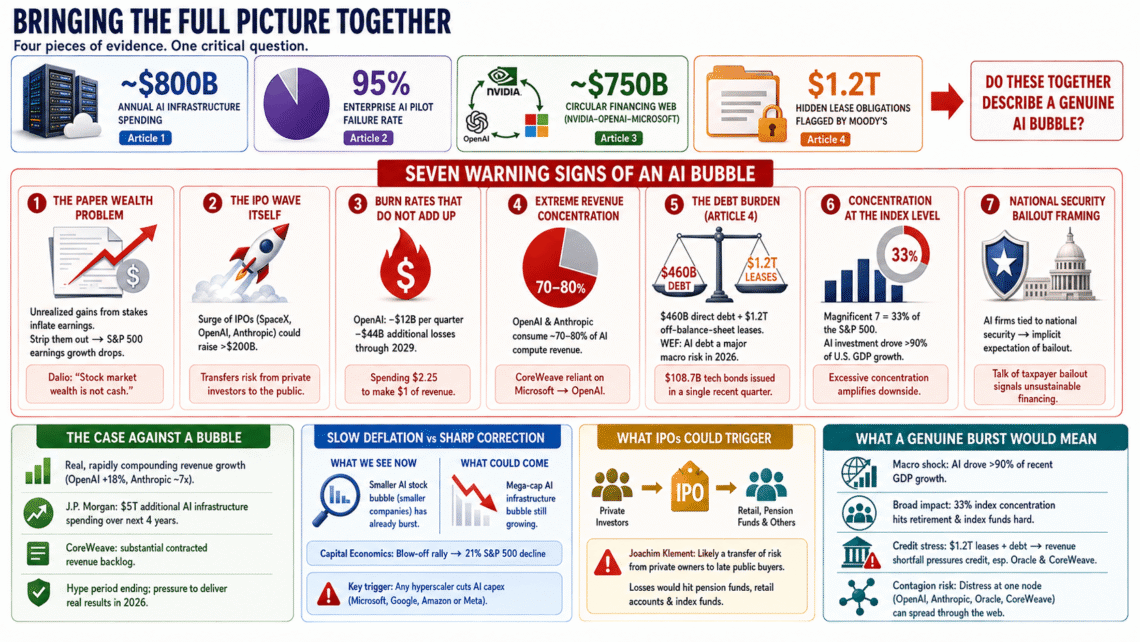
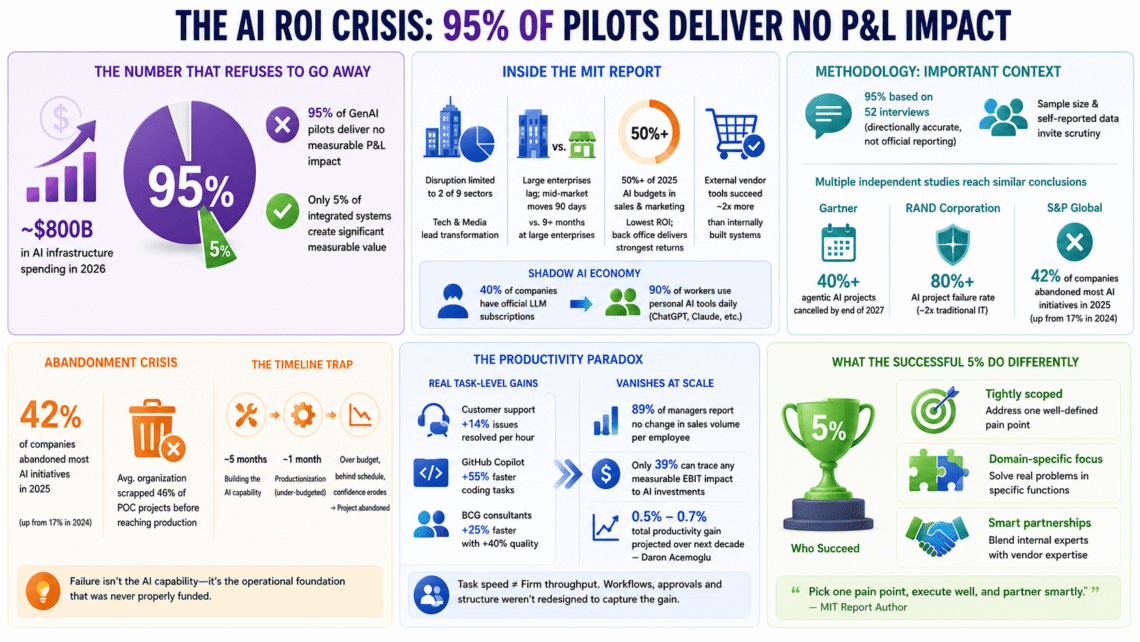
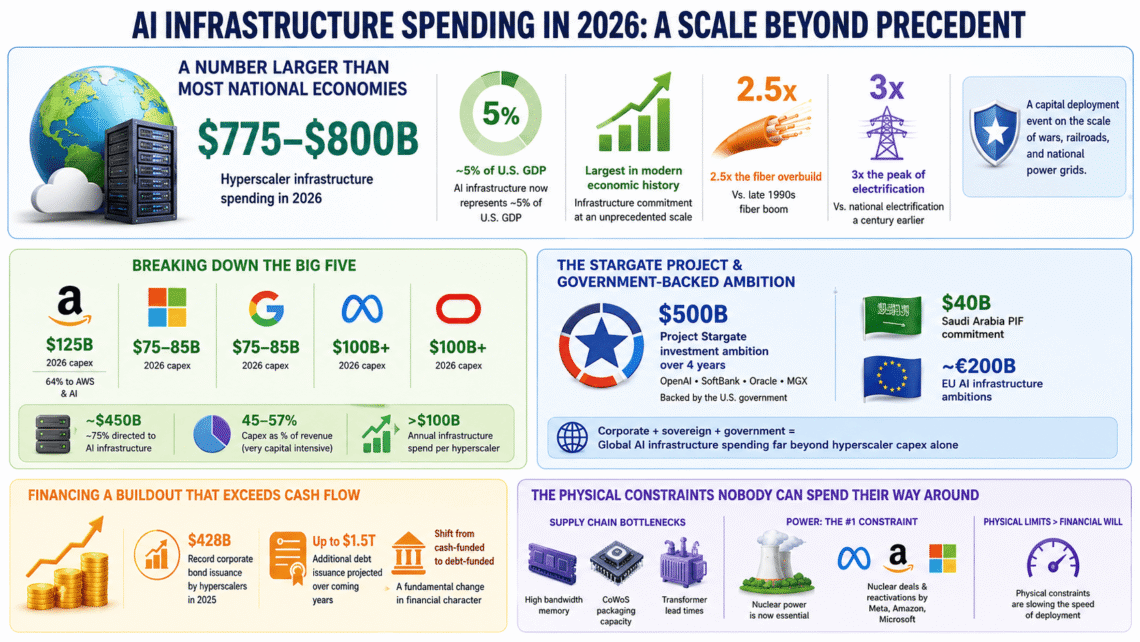
This series has traced nearly 800 billion dollars in annual hyperscaler AI infrastructure spending in Article 1, a 95 percent enterprise pilot failure rate in Article 2, a 750 billion dollar web of circular financing between Nvidia, OpenAI, and Microsoft in Article 3, and 1.2 trillion dollars in hidden lease obligations flagged by Moody’s in Article 4. Each of those articles examined one piece of the puzzle in isolation. This final article asks the question the entire series has been building toward. Taken together, do these four pieces of evidence describe a genuine AI bubble, and if so, what would its bursting actually look like.
The honest answer requires resisting both extremes that dominate public discussion. Dismissing all AI bubble concerns as reflexive skepticism from people who missed the boat ignores genuinely alarming, well-documented financial signals from serious institutions. Treating a bubble collapse as an inevitable, imminent certainty ignores substantial, equally well-documented evidence of real revenue growth and genuine underlying demand. What follows are seven specific, evidence-based warning signs, each drawn from credible financial reporting, followed by an honest look at the counter-arguments and what a genuine unwind would actually mean.
Warning Sign One: The Paper Wealth Problem
Bridgewater Associates founder Ray Dalio has issued what he describes as his most severe market warning yet, stating plainly that current conditions have pushed markets into AI bubble territory comparable to 1929 and 2000. His specific evidence is precise and easy to verify. Recent earnings from Amazon and Alphabet have been significantly inflated by unrealized investment gains from their stakes in unlisted AI companies including Anthropic, as private market valuations soared. Strip out these unrealized paper gains, and the S&P 500’s actual earnings growth rate drops sharply. Dalio’s core warning is simple and worth repeating exactly as he framed it. Stock market wealth is not cash.
Warning Sign Two: The IPO Wave Itself
Dalio identifies a second specific mechanism that has historically preceded bubble collapses. A surge in equity issuance combined with rising interest rates are the two forces that pop bubbles, and the current wave of IPOs from SpaceX, OpenAI, and Anthropic is, in his assessment, a classic warning sign. Anthropic closed a 65 billion dollar Series H round with a post-money valuation of 965 billion dollars, surpassing OpenAI, and is expected to formally launch its IPO process this fall.
Combined, the three pending mega IPOs could raise more than 200 billion dollars. Bank of America has characterized this specific pattern directly, stating that this epic IPO cycle is essentially a large-scale transfer of accumulated risk from early private investors to the public market, precisely the mechanism through which prior AI bubble style collapses have historically transmitted losses to a much broader set of investors.
Warning Sign Three: Burn Rates That Do Not Add Up
The clearest financial red flag underlying AI bubble concerns is the specific, quantifiable relationship between spending and revenue at the industry’s most prominent company. OpenAI is losing 12 billion dollars per quarter and expects 44 billion dollars in additional losses through 2029. Financial analyst Bittner summarized the arithmetic starkly, describing OpenAI as spending 2.25 dollars to make 1 dollar of revenue, and noting pointedly that no dot-com era company survived with that kind of burn rate. The comparison to the 2000 collapse is not incidental commentary. It is the specific historical benchmark analysts keep returning to.
Warning Sign Four: Extreme Revenue Concentration
A particularly concerning AI bubble signal involves how narrowly concentrated actual paying demand for AI infrastructure remains. OpenAI and Anthropic together consume roughly 70 to 80 percent of all AI compute revenue, yet both lose tens of billions of dollars annually. This concentration compounds the circular financing risk documented in Article 3 of this series. CoreWeave illustrates the downstream effect precisely. Its largest client is effectively Microsoft, purchasing capacity specifically to serve OpenAI, meaning CoreWeave’s revenue is highly concentrated in a chain that ultimately traces back to two companies, neither of which has demonstrated a clear path to profitability.
Warning Sign Five: The Debt Burden Documented in Article 4
The 1.2 trillion dollars in off-balance-sheet lease commitments and 460 billion dollars in direct debt detailed in the previous article of this series constitutes, on its own, one of the seven clearest AI bubble warning signs. Economists at the World Economic Forum have specifically flagged AI-related debt pressures as a worrying macroeconomic trend for 2026, and tech companies issued a striking 108.7 billion dollars in corporate bonds during a single recent quarter, a pace that has continued through the first half of 2026 without meaningful slowdown.
Warning Sign Six: Concentration at the Index Level
The AI bubble concern extends well beyond individual companies into the structure of the broader stock market itself. The so called Magnificent Seven technology stocks, Alphabet, Amazon, Apple, Nvidia, Meta, Microsoft, and Tesla, currently make up 33 percent of the entire S&P 500 index. AI-related investment accounted for over 90 percent of United States GDP growth in the first two quarters of the prior year, an extraordinary concentration of economic growth in a single sector. When any single theme drives this large a share of both an equity index and national economic growth simultaneously, the potential downside if that theme falters is proportionally amplified across the entire economy, not contained within the technology sector alone.
Warning Sign Seven: The National Security Bailout Framing
Perhaps the most novel AI bubble warning sign, one without a clean historical precedent from the dot-com era, is the increasing embedding of major AI companies directly into national defense contracts. Analysts have noted this could potentially lead to a future bailout request should financial conditions deteriorate sharply, since companies positioned as critical to national security infrastructure carry an implicit expectation of government backstop that purely commercial dot-com era companies never possessed. Scott Galloway has raised the same concern explicitly, noting that talk of a potential taxpayer bailout itself constitutes evidence that OpenAI lacks a sustainable financing strategy.
The Case Against a Bubble
Responsible analysis requires taking the counter-arguments equally seriously, and they are not trivial. Unlike many dot-com era companies that generated minimal revenue chasing speculative business models, today’s major AI companies show genuine, rapidly compounding revenue growth. The value of OpenAI subscriptions increased 18 percent in a recent year, while Anthropic’s Claude revenue grew nearly sevenfold over the same period.
J.P. Morgan projects 5 trillion dollars in additional AI infrastructure spending over the next four years, a figure that reflects institutional conviction in sustained demand rather than speculative excess alone. CoreWeave, despite its concentration risk, posted a substantial contracted revenue backlog, real signed commitments rather than merely aspirational projections. Chief research officer Sharyn Leaver captured the more measured institutional view precisely, noting that 2026 marks the point where the AI hype period ends as pressure to deliver real, measurable results intensifies, a description of a maturing market correcting its excesses rather than a market collapsing entirely.
Slow Deflation Versus Sharp Correction
Even among analysts convinced some form of AI bubble correction is coming, meaningful disagreement exists about its shape. Capital Economics has already observed that one narrower AI stock bubble, concentrated in smaller, less established companies, has already burst, while a larger, more consequential bubble specifically in mega-cap AI infrastructure stocks continues to grow. The firm’s own modeling anticipates a blow-off rally followed by a 21 percent S&P 500 decline once the larger AI bubble fully unwinds, a sharp correction scenario rather than a gradual one.
Benchmark’s Bill Gurley offered a similarly direct warning in March 2026, stating flatly that AI spending is about to reset. The specific trigger analysts are watching most closely is precise and observable, the moment any major hyperscaler, Microsoft, Google, Amazon, or Meta, publicly announces a cut to AI capital expenditure, an event that has not yet occurred but that multiple analysts identify as the single clearest signal an AI bubble correction has genuinely begun.
What OpenAI and Anthropic’s IPOs Could Actually Trigger
Financial analyst Joachim Klement has offered perhaps the bluntest characterization of what the pending OpenAI and Anthropic IPOs actually represent within the broader AI bubble debate, describing them as probably nothing more than a major transfer of investment risk from current private owners to retail investors, pension funds, and others willing to buy into the hype at a much later and more expensive stage of the cycle.
This framing matters considerably for anyone assessing what a genuine AI bubble collapse would mean practically. Unlike a purely private market correction, which primarily affects venture capital firms and wealthy early investors who can absorb losses, a public market collapse following these IPOs would transmit losses directly to pension funds, retail brokerage accounts, and index funds that millions of ordinary investors hold, a meaningfully different and more broadly damaging outcome than a private valuation reset alone.
What a Genuine Burst Would Mean
If the AI bubble concerns documented across all seven warning signs in this article ultimately prove correct, the consequences would extend considerably beyond the technology sector itself. Given that AI-related investment has driven over 90 percent of recent GDP growth, a sharp AI bubble correction would represent a genuine macroeconomic event, not merely a sector rotation.
Given the 33 percent index concentration in AI-adjacent Magnificent Seven stocks, the impact on retirement accounts and index funds held by ordinary investors would be immediate and significant. Given the 1.2 trillion dollars in debt and lease obligations documented in Article 4, a sharp revenue shortfall relative to expectations could trigger genuine credit stress at specific companies, particularly Oracle and CoreWeave, the two firms Moody’s already identified as facing the sharpest ratings pressure.
And given the deeply circular financing relationships documented in Article 3, distress at any single major node in that web, OpenAI, Anthropic, Oracle, or CoreWeave specifically, carries genuine potential to propagate rapidly through the tightly interconnected companies that depend on one another’s continued participation.
Conclusion
Across this five-part series, the evidence assembled points toward a genuinely mixed but increasingly concerning picture rather than a simple verdict in either direction. Real revenue growth and real infrastructure genuinely coexist alongside speculative excess, unsustainable burn rates, and dangerously concentrated financial exposure. Whether 2026 marks the beginning of the AI bubble’s gradual, manageable deflation, the kind that ultimately leaves behind genuinely valuable infrastructure the way the fiber optic bust eventually did, or a sharper, more disruptive correction triggered by the pending OpenAI and Anthropic IPOs, remains genuinely unresolved as of this writing.
What is no longer credible, based on the evidence traced across all five articles in this series, is the claim that no bubble exists at all. The specific question worth watching most closely, as multiple analysts have identified precisely, is straightforward and observable, whether and when a major hyperscaler is the first to publicly announce it is cutting AI spending. When that happens, this series suggests, the far larger unwind will already be underway.
-
Moody’s Sounds a Critical Alarm: Is Hidden AI Debt risk a Ticking Financial Time Bomb
A Warning From the Institution That Rates Trust Itself
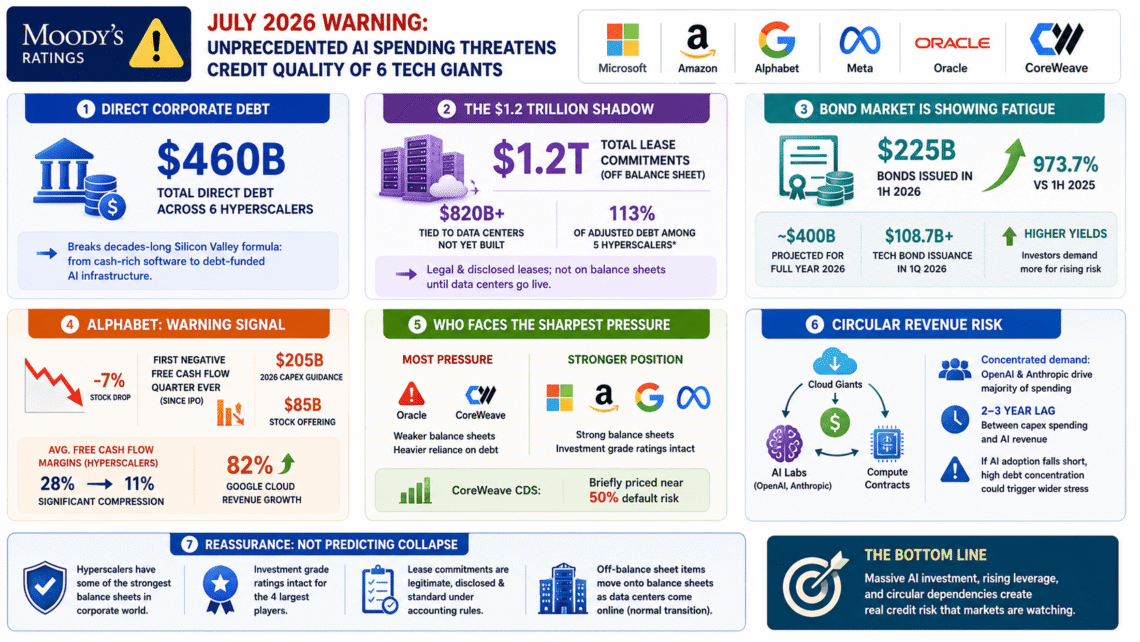
When Moody’s Ratings, one of the three institutions the entire global financial system relies on to judge whether a company can be trusted to repay what it owes, issues a formal warning about a specific industry, markets tend to pay close attention. In July 2026, Moody’s did exactly that, stating plainly that unprecedented AI spending threatens the credit quality of six of the largest technology companies in the world, Microsoft, Amazon, Alphabet, Meta, Oracle, and CoreWeave.
The core of the AI debt risk Moody’s identified is not that these companies are spending enormous sums, a fact already well documented in Article 1 of this series. It is how that spending is being financed, and how much of it remains deliberately structured to stay off the balance sheets investors actually scrutinize.
Understanding the specific mechanics of this AI debt risk, and why Moody’s chose this particular moment to sound the alarm, requires examining three distinct categories of exposure: direct corporate debt, off-balance-sheet lease commitments, and the bond market’s own increasingly nervous response to absorbing all of it at once.
The 460 Billion Dollar Direct Debt Figure
The most straightforward component of AI debt risk is direct corporate debt, borrowed money that already appears plainly on company balance sheets. According to Moody’s own analysis, direct debt across the six hyperscalers tracked in its report has reached approximately 460 billion dollars. This figure alone represents a meaningful shift for companies whose historical financial identity was built specifically on the opposite characteristic.
As Moody’s own report observes, the current moves break a decades-long Silicon Valley formula that created the world’s most valuable companies. Software cost little to replicate, yielding fat profit margins and fortress balance sheets. Generative AI, by contrast, demands a vast physical footprint, warehouses crammed with expensive and energy-hungry servers and chips, and that physical footprint is now being financed increasingly through borrowed capital rather than the internally generated cash flow that once defined these companies’ financial character.
The 1.2 Trillion Dollar Shadow
The far larger and more structurally significant component of AI debt risk sits entirely off the balance sheet, and this is where Moody’s analysis becomes genuinely alarming. Lease commitments across the six hyperscalers Moody’s tracks have ballooned to 1.2 trillion dollars, of which more than 820 billion dollars is tied to data centers that have not even finished construction yet. Moody’s accounting analysts David Gonzales and Alastair Drake calculated that an earlier snapshot of this hidden obligation, 662 billion dollars specifically tied to leases that had not yet begun among just five hyperscalers, was equivalent to 113 percent of those companies’ most recent adjusted debt, larger than everything already sitting openly on their balance sheets combined.
The accounting mechanism behind this AI debt risk is legal and well understood, but its scale is what has changed dramatically. Rather than owning every new AI data center outright, hyperscalers increasingly sign long-term leases with specialized infrastructure developers. Under generally accepted accounting principles, these lease commitments are not required to appear as current liabilities until the underlying data center actually begins operating.
Moody’s is explicit that this does not constitute deception, a Moody’s spokesperson clarified directly that this is not a case of companies avoiding a liability through structuring, simply that the obligation has not yet reached the balance sheet under standard accounting timing rules. Nonetheless, Moody’s treats these lease commitments as debt-equivalent liabilities, obligations that will bind these companies to substantial rent payments for years regardless of how AI revenue actually develops, and a separate investigation by Nikkei Asia Review found that off-balance-sheet obligations across five hyperscalers have surged eightfold in just four years to 1.65 trillion dollars, a figure that now exceeds their combined on-balance-sheet debt entirely.
The Bond Market Is Already Showing Fatigue
Perhaps the clearest real-time signal of genuine AI debt risk comes not from Moody’s report itself but from how the corporate bond market has responded to absorbing this wave of new borrowing. S&P Global calculated that hyperscalers and closely related entities including Nvidia issued 225 billion dollars in bonds during just the first half of 2026, a 973.7 percent increase compared to the same period the prior year, and they remain on pace to issue roughly 400 billion dollars for the full year.
Corporate bond issuance from technology firms specifically exceeded 108.7 billion dollars in a single quarter of 2026, a volume that would have been considered extraordinary for the entire sector across a full year just three years earlier.
The market’s appetite for absorbing this AI debt risk is showing visible strain. S&P Global’s own analysis notes that hyperscalers are now paying a meaningfully higher premium compared with yields on risk-free government bonds than they were previously required to pay, direct evidence that bond investors are demanding greater compensation for what they perceive as rising risk. As S&P put it directly in its own report, market participants are growing leery of quickly rising leverage from issuers previously characterized by strong and reliable cash flow, a notably blunt assessment from an institution not generally given to dramatic language.
Alphabet’s Negative Free Cash Flow Quarter
The clearest individual illustration of how this AI debt risk translates into immediate market consequences arrived when Alphabet reported its first negative free cash flow quarter since its initial public offering, an event that stunned even seasoned analysts given the company’s historical reputation for financial conservatism, despite Google Cloud revenue simultaneously surging 82 percent. Alphabet’s stock dropped 7 percent on the news.
The company subsequently raised its 2026 capital expenditure guidance to 205 billion dollars and announced an 85 billion dollar stock offering, one of the largest equity raises ever undertaken by a technology company, a clear signal that even one of the cash-richest companies in corporate history is now seeking additional financial flexibility specifically to sustain its AI infrastructure buildout.
Average free cash flow margins across the hyperscaler group have compressed from roughly 28 percent down to 11 percent, a genuinely dramatic deterioration in the underlying financial health metric that has historically distinguished these companies from more conventional, capital-intensive industrial businesses.
Who Faces the Sharpest Credit Rating Pressure
Not every company carrying AI debt risk faces equal exposure, and Moody’s analysis draws a meaningful distinction worth understanding precisely. Oracle and CoreWeave face the most immediate ratings pressure among the six companies tracked, reflecting their comparatively weaker underlying balance sheets and heavier relative reliance on debt financing to fund their AI infrastructure commitments.
By contrast, the four largest players, Microsoft, Amazon, Alphabet, and Meta, retain what Moody’s characterizes as fundamentally strong balance sheets even accounting for this new leverage, a distinction that matters considerably for anyone assessing which parts of this AI debt risk landscape represent genuine near-term vulnerability versus which represent a more manageable, if still historically unusual, shift in capital structure among companies with substantial existing financial cushion.
CoreWeave in particular illustrates the sharper end of this risk spectrum concretely. As documented in Article 3 of this series, CoreWeave’s own credit default swaps have briefly implied pricing consistent with something close to a coin flip probability of default, a striking market signal for a company whose infrastructure underpins a meaningful share of current AI compute capacity.
The Circular Revenue Complication
Moody’s analysis explicitly connects this AI debt risk to the circular financing dynamics examined in Article 3 of this series, flagging what it calls a circular AI ecosystem in which tech giants invest directly in AI labs including OpenAI and Anthropic, which then route significant portions of that same capital back into purchasing cloud services from the very companies that funded them.
Moody’s view is that this concentration creates a specific and identifiable systemic vulnerability, most of the AI infrastructure spending documented across this entire series is ultimately serving a remarkably small number of end customers, with OpenAI and Anthropic alone representing an outsized share of total demand, and if AI adoption falls meaningfully short of current market expectations, the concentration of debt among this small number of interconnected companies could trigger broader financial pressure that spreads well beyond any single firm.
Moody’s also flagged a specific structural timing risk embedded directly in this AI debt risk picture, a two to three year lag between when capital is actually spent on data center construction and when corresponding AI-related revenue is realized. That lag means the true test of whether this debt was prudently deployed will not arrive immediately, and current financial statements cannot yet definitively confirm or refute whether the underlying investment thesis is sound.
A Reassurance Worth Taking Seriously
It would be inaccurate to characterize Moody’s report as predicting imminent financial collapse, and the agency’s own careful language deserves to be represented faithfully. Moody’s explicitly states that hyperscalers still maintain some of the most robust balance sheets in the entire corporate world, and their investment grade ratings, while under increased scrutiny, remain intact for the four largest players specifically.
The off-balance-sheet lease commitments driving much of the headline AI debt risk figure are legitimate, disclosed practices under standard accounting rules, not hidden liabilities in any deceptive sense, and much of what currently sits off balance sheets will simply migrate onto them naturally as data centers begin operations over the coming years, a normal and expected accounting transition rather than a hidden financial trap.
Conclusion
The AI debt risk Moody’s has documented in careful, methodical detail is neither a prediction of imminent catastrophe nor a dismissible non-issue. It is a precise, quantified description of a genuine structural shift, 460 billion dollars in direct debt, 1.2 trillion dollars in off-balance-sheet lease commitments, and a bond market already showing visible signs of fatigue after absorbing an unprecedented volume of new issuance in an extraordinarily compressed timeframe.
Whether this AI debt risk resolves smoothly as the anticipated two to three year revenue lag closes, or whether it becomes the mechanism through which the broader AI investment cycle experiences genuine financial stress, is precisely the question Article 5 of this series turns to directly, examining whether the full picture assembled across this series, staggering infrastructure spending, an unresolved ROI crisis, a circular financing web, and now a mounting debt burden, adds up to a genuine AI bubble approaching its limits.
-
Inside the Alarming AI Circular Financing Web: How Nvidia, OpenAI, and Microsoft Fund Each Other’s Growth
The Web Bloomberg Mapped
In January 2026, Bloomberg published a detailed graphics investigation that gave a name and a visual shape to a pattern industry watchers had been describing in increasingly alarmed terms for months. The map traces roughly 46 billion dollars in direct equity stakes and 879 billion dollars in multi-year purchase commitments moving between Microsoft, Oracle, Amazon, Google, Meta, OpenAI, Anthropic, xAI, CoreWeave, Nvidia, and AMD. At the center of this AI circular financing web sits Nvidia, whose market valuation reached 5.4 trillion dollars in mid-2026, a position investor Michael Burry has publicly described as sitting dead center of the entire structure.
The nearly 800 billion dollars in annual hyperscaler infrastructure spending documented in Article 1 of this series does not appear from nowhere; a significant share of it flows directly through the AI circular financing relationships examined here. Understanding whether this AI circular financing arrangement represents rational supply chain coordination in a genuinely constrained market, or the same structural warning sign that has preceded prior financial bubbles, requires tracing the actual mechanics of the deals, examining both sides of a genuinely contested debate among serious analysts, and being honest about what nobody yet knows.
How the Loop Actually Works
The mechanics of AI circular financing are, once traced carefully, straightforward enough to describe in a single sentence, even if the dollar figures involved are difficult to comprehend. Microsoft invested more than 13 billion dollars in OpenAI over several years. OpenAI committed to spending 250 billion dollars on Microsoft’s Azure cloud services. Oracle is constructing 300 billion dollars in Stargate data center infrastructure specifically for OpenAI under long-term contracts. Nvidia invested 30 billion dollars in OpenAI’s most recent 122 billion dollar funding round, while OpenAI simultaneously remains one of Nvidia’s largest chip customers. Nvidia has separately taken equity stakes in CoreWeave and other so-called neocloud providers, companies that are themselves major customers for Nvidia’s chips.
The pattern repeats with variations across nearly every major relationship in the industry. OpenAI’s total named compute commitments now sum to more than a trillion dollars across Azure, Oracle, AWS, CoreWeave, Nvidia, Broadcom, and a six gigawatt AMD deal running through 2035, a deal structured so that OpenAI is poised to become one of AMD’s largest shareholders. Amazon’s 50 billion dollar investment in OpenAI’s March 2026 funding round was structured partly as compute credits, with OpenAI simultaneously committing to spend 100 billion dollars on AWS over eight years.
Google agreed to backstop lease payments at five separate data center locations for Anthropic, effectively helping Anthropic obtain what amounts to a 35 billion dollar loan. Money moves from investor to startup and back to the investor’s own products and services through a loop that is, by construction, self-reinforcing.
The 750 Billion Dollar Escalation
Rather than slowing amid growing scrutiny, this AI circular financing pattern accelerated sharply through mid-2026. Nvidia is now working on a fresh round of infrastructure deals potentially worth more than 750 billion dollars. A partnership unveiled with South Korean conglomerate SK Group in late July 2026 alone represents more than 500 billion dollars in mutual business, tied to building more than two gigawatts of AI data centers on the Korean peninsula, enough electricity to power roughly 1.5 million homes.
More striking still, the Wall Street Journal reported on July 27, 2026, that Nvidia is in talks to provide a 250 billion dollar financing guarantee tied to OpenAI leasing a portion of a planned 500 billion dollar data center project in southern Ohio, led by SoftBank’s energy arm. The same reporting indicates the guarantee would help SoftBank raise debt on more favorable terms than it could obtain otherwise, precisely because OpenAI itself does not currently hold an investment grade credit rating.
Nvidia may also separately help finance roughly 350 billion dollars in chip purchases from OpenAI under a related arrangement. The market reacted immediately and visibly. Nvidia shares fell 4.5 percent on the news, and the price of credit default swaps on Nvidia’s own bonds, effectively a form of default insurance for bondholders, recorded their highest single day increase since active trading in the instrument began.
Jensen Huang’s Direct Rebuttal
Nvidia CEO Jensen Huang has responded to AI circular financing criticism with characteristic directness rather than deflection. Asked specifically about the vendor financing charge as Bloomberg documented the growing 750 billion dollar deal total, Huang stated flatly, the idea that it is circular is ridiculous. His underlying argument, echoed by supporters of the current deal structure across the industry, is that building frontier AI infrastructure is extraordinarily expensive and that the most advanced chips remain genuinely difficult to obtain even now.
In that kind of constrained market, Huang and his allies argue, companies do not simply place purchase orders and wait. They lock in scarce supply by pairing long-term buying commitments with financing, a practice with long precedent in genuinely capital-intensive industries from telecommunications to energy infrastructure.
The Virtuous Circle Counter-Argument
This defense of AI circular financing has a specific and influential institutional champion. Asset manager Janus Henderson has characterized the current wave of AI dealmaking as more accurately described as a virtuous circle, one that helps line up suppliers, builders, and customers to meet what the firm characterizes as genuinely exploding demand for computing power. Under this framing, what critics label circular financing is simply the efficient coordination mechanism a young, capital-intensive, rapidly scaling industry requires to align capacity investment with demand that outstrips what any single company could finance independently through conventional means.
There is a genuine kernel of truth in this defense that deserves acknowledgment. CoreWeave, one of the clearest examples of a company deeply embedded in this AI circular financing web, is at least a public company whose filings provide real numbers rather than speculation. Its first quarter 2026 results showed 2.08 billion dollars in revenue against a 740 million dollar net loss, alongside nearly 100 billion dollars in contracted revenue backlog. That backlog, if it converts to actual delivered revenue over time, represents real economic activity, not merely accounting fiction circulating between related parties.
Why Serious Analysts Remain Alarmed Regardless
Set against these defenses, a growing chorus of serious market analysts continues to treat AI circular financing as a genuine structural risk, and their concern rests on a specific, carefully stated argument rather than blanket skepticism of AI itself. As one detailed industry analysis put it precisely, none of this has to be fake to be dangerous. The revenue can be entirely real, the chips can actually ship, and the data centers can genuinely get built, all while resting on a financing structure in which the same small handful of companies are effectively supporting one another’s demand, obscuring how much of the total activity reflects genuine, independent end-user demand versus intra-industry financial engineering.
Michael Burry, the investor who famously anticipated the 2008 mortgage crisis, has invoked the AI circular financing pattern repeatedly and pointedly in 2026, sharing Bloomberg’s own diagram of the deal web as evidence of a structure he considers genuinely precarious. This concentration of financial risk sits uncomfortably alongside the AI ROI concerns detailed in Article 2 of this series, since much of the revenue circulating through this web has yet to translate into the kind of measurable enterprise value that would justify its scale.
Harvard Kennedy School senior fellow Paulo Carvao has drawn an explicit historical parallel to the late 1990s technology bubble, noting that circular deals during that era were often centered on advertising and cross-selling arrangements between startups, where companies bought each other’s services specifically to inflate the appearance of genuine growth. The concern is not that the parallel is exact in every detail, but that the underlying structural vulnerability, revenue and valuation that depend heavily on continued participation by a small, tightly interconnected group of counterparties, rhymes closely enough with prior bubble dynamics to warrant serious caution.
The Credit Risk Dimension
The AI circular financing debate connects directly to a parallel and increasingly urgent concern that will be examined in full in Article 4 of this series. Moody’s has explicitly warned that the scale of AI related spending threatens the credit quality of Microsoft, Amazon, Alphabet, Meta, Oracle, and CoreWeave specifically. CoreWeave’s own credit default swaps have briefly implied pricing consistent with something close to a coin flip probability of default.
Anthropic’s most recent major compute contract required underwriting through a bank letter of credit rather than being supported directly by its own balance sheet, a structural detail that suggests even sophisticated market participants are not fully confident in the standalone creditworthiness of companies deeply embedded in this AI circular financing web.
What Happened During the Late July Selloff
The genuine market sensitivity to AI circular financing concerns was demonstrated directly during the final week of July 2026. A significant amount of market value was wiped from global chip and AI hardware stocks between July 24 and July 29, 2026, coinciding with the intensified scrutiny of Nvidia’s expanding deal book. Notably, most of that lost value was recovered within the following week, a pattern that itself illustrates the deeply contested nature of this debate.
Investors sold first on the circularity concern, then substantially reversed course, suggesting the market itself remains genuinely undecided about whether AI circular financing represents a serious systemic vulnerability or simply the necessary financial architecture of a capital-intensive industry scaling at unprecedented speed.
Conclusion
The AI circular financing web documented by Bloomberg, and expanding rapidly through 2026 with Nvidia’s 750 billion dollar deal book at its center, is neither obviously fraudulent nor obviously benign. It is a genuinely novel financial structure, real revenue and real infrastructure resting on a foundation of relationships concentrated among a remarkably small number of counterparties, each simultaneously acting as the others’ customer, supplier, and investor.
Jensen Huang calls the circularity framing ridiculous. Michael Burry calls it a warning sign serious enough to invoke repeatedly and publicly. Both cannot be straightforwardly right, and the honest answer, at least for now, is that the structure has not yet been tested by the kind of demand slowdown or credit event that would definitively reveal which characterization is closer to the truth. Article 4 of this series turns directly to that credit risk dimension, examining Moody’s specific warnings and what a genuine stress event within this AI circular financing web would actually look like for the broader economy.
-
The Startling Truth About AI ROI: Why 95 Percent of Enterprise Projects Are Failing
A Number That Refuses to Go Away
Since its publication in mid-2025, one statistic has become the single most repeated, most contested, and most consequential figure in the entire enterprise AI conversation. MIT’s Project NANDA, in a report titled The GenAI Divide: State of AI in Business 2025, found that 95 percent of generative AI pilots deliver no measurable profit and loss impact. Only 5 percent of integrated AI systems create significant, measurable value.
Given the nearly 800 billion dollars in AI infrastructure spending documented in the first article of this series, the AI ROI question this statistic raises is not academic. It is the question on which the entire economic justification for the current investment cycle ultimately rests.
Understanding whether this AI ROI crisis is real, overstated, or something more nuanced requires examining the methodology behind the headline number, the deeper productivity paradox it sits inside, and, most usefully, exactly what separates the small minority of companies that are succeeding from the large majority that are not.
Inside the MIT Report
The GenAI Divide report, based on 52 executive interviews, a survey of roughly 150 business leaders, and analysis of 300 public AI deployments, draws a sharp distinction the authors call the GenAI Divide, a split between widespread adoption and genuine business transformation. Over 80 percent of organizations have piloted tools such as ChatGPT or Copilot, and nearly 40 percent report some form of deployment. Yet these systems overwhelmingly boost individual productivity rather than delivering measurable enterprise level AI ROI.
The report identifies four structural factors behind this divide. Disruption remains limited to just two of nine major sectors, technology and media, that show genuine business transformation from generative AI use. Large enterprises paradoxically lead in pilot volume but lag significantly in successful deployment, while mid-market companies move from pilot to full implementation in roughly 90 days compared to nine months or longer at large enterprises.
AI budgets are allocated in a way that actively works against AI ROI, with over 50 percent of spending in 2025 directed toward sales and marketing pilots, precisely the category the report finds delivers the weakest returns, while the strongest AI ROI consistently comes from back office automation in finance, compliance, and document processing, categories that receive comparatively little budget attention. Finally, tools built by external vendors succeed roughly twice as often as internally built systems, a genuinely important finding for any enterprise weighing a build versus buy decision.
Perhaps the most striking finding is the emergence of what the report calls a shadow AI economy. While only 40 percent of companies maintain official LLM subscriptions, roughly 90 percent of workers surveyed report daily use of personal AI tools such as ChatGPT or Claude for actual job tasks, tools that frequently deliver better performance and faster adoption than the sanctioned systems built specifically to replace them.
The Methodology Question Worth Taking Seriously
Before accepting the 95 percent AI ROI failure figure uncritically, it is worth noting that the report itself has faced genuine methodological scrutiny. The finding of zero measurable return was based on just 52 interviews that the report’s own authors describe as directionally accurate based on individual interviews rather than official company reporting. Marketing AI Institute founder Paul Roetzer has argued publicly that a closer reading of the study’s methodology reveals a considerably more nuanced picture than the viral headline suggests, noting the sample size and self-reported nature of much of the underlying data.
This caveat does not invalidate the broader AI ROI concern, particularly because the MIT figure has since been corroborated, directionally if not precisely, by entirely independent research using different methodologies. Gartner separately predicts that over 40 percent of agentic AI projects will be cancelled by the end of 2027, citing escalating costs and unclear business value.
RAND Corporation’s independent research puts the broader AI project failure rate above 80 percent, roughly double the failure rate of conventional enterprise IT projects, itself a meaningful baseline given how notoriously difficult large-scale enterprise software rollouts already are. When multiple independent research organizations using different methods converge on directionally similar conclusions, the underlying AI ROI concern deserves to be taken seriously even if the precise 95 percent figure carries some uncertainty.
S&P Global and the Abandonment Crisis
A separate and independently sourced data point adds further weight to the AI ROI concern. S&P Global Market Intelligence, surveying over 1,000 IT and business leaders across North America and Europe for its 2025 Voice of the Enterprise report, found that 42 percent of companies abandoned most of their AI initiatives in 2025, a dramatic jump from just 17 percent the prior year. The average organization scrapped 46 percent of its proof of concept projects before they ever reached production.
The mechanism behind this abandonment pattern is instructive for understanding the AI ROI problem more precisely. Organizations that budget six months for an AI project typically allocate roughly five months to building the AI capability itself and only one month to what practitioners call productionization, the unglamorous but essential work of hardening a system for real operational use.
Production infrastructure, if built properly, takes roughly as long as the AI capability itself. By the time this reality becomes apparent, usually around month five, the project is over budget, behind schedule, and executive confidence has eroded. The project gets abandoned, not because the underlying AI capability failed, but because the operational foundation required to sustain it in production was never adequately budgeted for in the first place.
The Productivity Paradox: Real Gains That Vanish at Scale
Perhaps the most conceptually important dimension of the AI ROI debate is what researchers now call the AI productivity paradox, the widening gap between clearly documented task level gains and the near invisible effect of those same gains on company wide and national productivity statistics. The paradox is genuinely puzzling because both halves of it are independently well supported by evidence.
Customer service agents using AI resolve 14 percent more issues per hour. GitHub Copilot users complete coding tasks 55 percent faster. BCG consultants using AI finish work 25 percent quicker with 40 percent higher quality scores. These task level AI ROI gains, ranging from roughly 14 to 55 percent depending on the specific study and task, are real, controlled, and repeatedly replicated.
And yet, at the organizational level, this AI ROI evaporates almost entirely. NBER researchers tracking AI adoption from 61 to 71 percent of surveyed firms between early 2025 and early 2026 found that 89 percent of managers reported no change whatsoever in sales volume per employee over that same period. Only 39 percent of enterprises can trace any measurable EBIT impact to their AI investments at all. Nobel laureate economist Daron Acemoglu has projected a strikingly modest 0.5 to 0.7 percent total productivity gain from AI over the entire next decade, a figure he describes candidly as disappointing relative to the promises the industry has made.
The explanation researchers increasingly converge on is that task level speed is simply not the same thing as firm level throughput. An individual worker completing a task 55 percent faster does not automatically translate into an organization producing 55 percent more output, because the surrounding workflow, approval processes, quality checks, and organizational structure were never redesigned to actually capture that individual speed gain at scale.
What the Successful 5 Percent Actually Do Differently
The most practically useful finding across this entire body of AI ROI research is not the failure statistic itself but the consistent pattern separating the minority that succeed from the majority that do not. McKinsey’s 2025 AI survey found that organizations reporting significant financial returns were twice as likely to have redesigned their end to end workflows before selecting any AI tool, confirming that organizational change, not the underlying technology, is the actual differentiator.
MIT’s own data on the successful minority is similarly specific. Pilots that blended internal AI specialists with external vendor expertise achieved a 67 percent success rate, compared to just 22 percent for projects built entirely in-house. The winning 5 percent consistently shared three traits: tightly scoped initiatives focused on a single, well-defined pain point rather than broad transformation ambitions, domain specific focus rather than generic tooling, and smart partnerships with vendors who understood both the technology and the specific operational context it was being deployed into.
As one MIT report author put it directly, describing successful startups, they pick one pain point, execute well, and partner smartly, a strikingly simple formula against the backdrop of billions of dollars in more diffuse enterprise spending that has failed to replicate it.
Conclusion
The honest verdict on AI ROI in 2026 is neither the total failure the viral 95 percent statistic suggests in isolation, nor the seamless transformation the marketing around generative AI has promised since 2023. It is a genuine and well documented paradox: real, measurable, repeatedly replicated task level productivity gains that are, for the overwhelming majority of enterprises, failing to survive the jump from individual workflow to organizational output.
The 5 percent of companies that are succeeding are not doing so because they have access to better models. They are succeeding because they redesigned the underlying work itself before deploying AI into it, a lesson that costs considerably less to implement than the infrastructure billions documented in Article 1 of this series, and one that most of the market has still not learned.
-
The Staggering $775 Billion AI Infrastructure Spending Race: Where All the Money Is Actually Going
A Number Larger Than Most National Economies
In 2026, the five largest hyperscalers, Amazon, Microsoft, Alphabet, Meta, and Oracle, are on track to spend between 775 and 800 billion dollars on infrastructure, according to CFA analysis published in August 2026. To put that figure in perspective, AI infrastructure spending in the United States now represents roughly 5 percent of national GDP, a level of infrastructure commitment that analysts describe as the largest in modern economic history, 2.5 times the scale of the fiber optic overbuild of the late 1990s and three times the peak of national electrification a century earlier. This is not a niche technology investment cycle. It is a capital deployment event on a scale usually reserved for wars, railroads, and national power grids.
Understanding where this staggering sum of AI infrastructure spending is actually going, and whether the historical parallel to prior infrastructure booms is reassuring or alarming, requires looking closely at the individual commitments, the financing mechanisms behind them, and the physical constraints that are already beginning to bite.
Breaking Down the Big Five
The scale of individual hyperscaler AI infrastructure spending commitments in 2026 is difficult to grasp in isolation. J.P. Morgan estimates aggregate hyperscaler capital expenditure will reach 697 billion dollars this year, while separate analysis from Goldman Sachs projects total hyperscaler capex from 2025 through 2027 will reach 1.15 trillion dollars, more than double the 477 billion dollars spent across the entire 2022 to 2024 period. Roughly 75 percent of this spending, approximately 450 billion dollars, is directed specifically at AI infrastructure, servers, GPUs, data centers, and specialized equipment, rather than traditional cloud computing capacity.
Individual company figures illustrate the intensity of this AI infrastructure spending race. Amazon has guided to approximately 125 billion dollars in 2026 capital expenditure, a 61 percent increase over the prior year, with 64 percent of that spending allocated to AWS and AI initiatives specifically. Alphabet has guided toward 75 to 85 billion dollars. Each of the four largest hyperscalers now individually exceeds 100 billion dollars in annual infrastructure spending, a threshold that would have seemed implausible even eighteen months earlier. Capital intensity, capex as a share of company revenue, has reached 45 to 57 percent at several of these companies, a ratio historically associated with capital intensive industrial and utility companies rather than software businesses.
The Stargate Project and Government-Backed Ambition
Layered on top of individual company AI infrastructure spending is Project Stargate, a joint venture between OpenAI, SoftBank, Oracle, and MGX announced in January 2025 and publicly backed by the Trump administration, with an ambition to invest up to 500 billion dollars in United States data centers and energy infrastructure over four years. J.P. Morgan’s John Servidea, global co-head of Investment Grade Finance, described the moment plainly: AI financing is the biggest secular theme in our professional lifetimes.
The Stargate project illustrates a broader pattern within AI infrastructure spending in 2026: the blurring of lines between corporate capital expenditure, sovereign investment, and government policy. Sovereign programs beyond Stargate itself, including a 40 billion dollar commitment from Saudi Arabia’s Public Investment Fund and roughly 200 billion euros in European Union AI infrastructure ambitions, push the true global figure for AI infrastructure spending considerably higher than hyperscaler capex alone would suggest.
Financing a Buildout That Exceeds Cash Flow
Perhaps the most consequential shift within this AI infrastructure spending cycle is how it is being financed. For most of the past decade, hyperscalers funded capital expenditure primarily from internal operating cash flow, a position of financial strength that distinguished them from more leveraged industries. That era has ended. Hyperscalers issued a record 428 billion dollars in corporate bonds during 2025 alone, with projections suggesting up to 1.5 trillion dollars in additional debt issuance over the coming years as AI infrastructure spending continues to outpace what internal cash generation can support.
This transition from cash funded to debt funded infrastructure spending represents a fundamental change in the financial character of companies that were, until recently, among the most conservatively financed in the entire economy. Analysts at IEEE ComSoc noted the shift directly, observing that hyperscalers are increasingly leaning on debt markets to bridge the gap between rapidly rising AI capex budgets and internal free cash flow, transforming historically cash funded business models into ones utilizing meaningful leverage, even while balance sheets remain nominally strong for now.
The Physical Constraints Nobody Can Spend Their Way Around
A critical dimension of AI infrastructure spending in 2026 that pure dollar figures obscure is the extent to which physical, rather than financial, constraints are now the binding limitation on deployment speed. Critical supply chain bottlenecks, including high bandwidth memory, advanced chip packaging capacity known as CoWoS, and transformer lead times for electrical equipment, threaten to constrain how quickly this enormous volume of AI infrastructure spending can actually translate into operational data center capacity.
Power availability has emerged as perhaps the single most significant constraint. The scale of the AI infrastructure spending buildout has pushed hyperscalers toward power sources that would have seemed exotic for a technology company just a few years ago. Meta’s nuclear power purchase agreement, Amazon’s expanding nuclear power offtake commitments, and Microsoft’s agreement to restart the Three Mile Island nuclear facility all confirm that nuclear power has become an operational requirement for AI infrastructure at this scale, not merely an environmental preference. This same theme, examined in detail in our earlier coverage of AI data centers and their environmental impact, is intensifying rather than resolving as spending accelerates.
The Historical Parallel: Reassuring or Alarming
The comparison between current AI infrastructure spending and prior infrastructure overbuild cycles cuts in two directions simultaneously, and reasonable analysts disagree sharply about which direction should dominate the interpretation. On one hand, every prior infrastructure overbuild cycle identified by historical analysis, the railroad network of the 1880s, the national electrical grid built around 1929, and the global internet backbone constructed during the fiber optic boom of the late 1990s, despite producing bankruptcies, market crashes, and significant excess capacity in the near term, ultimately produced infrastructure that became genuinely foundational to the next era of economic productivity.
Under this framing, current AI infrastructure spending, however excessive it may appear relative to near-term AI revenue, may simply be the necessary and historically consistent overbuilding phase that precedes durable long-term value creation.
On the other hand, the fiber optic comparison specifically carries an uncomfortable warning that industry commentators invoke repeatedly. As one industry analysis put it directly, referencing the stupendous increase in fiber optic spending from 1998 to 2001 until that particular bubble burst, the parallel is not merely rhetorical. Fiber optic capacity built during that boom did eventually prove valuable, but only after a wrenching financial crash wiped out the equity value of the companies that built it, transferred the physical assets to new owners at steep discounts, and left an entire generation of telecom bondholders with significant losses.
Whether the AI infrastructure spending cycle of 2026 follows the same trajectory, useful infrastructure ultimately, but only after a genuinely painful financial reckoning for the companies and investors who financed the initial buildout, is precisely the question this five-part series is built to examine.
What This Means Going Forward
The scale of AI infrastructure spending documented here sets the stage for the four articles that follow in this series. Article 2 will examine whether this extraordinary capital deployment is actually generating measurable returns for the enterprises purchasing AI capability, a question where the evidence, drawn from MIT, Gartner, and RAND research, is considerably more sobering than the raw spending figures might suggest.
Article 3 will trace the increasingly circular financing relationships between Nvidia, OpenAI, Microsoft, and Oracle that are helping fund this buildout, relationships that several analysts argue obscure the true underlying demand signal for AI infrastructure spending itself. Article 4 will examine the credit and debt risk this financing structure is creating, drawing on Moody’s own recent warnings. And Article 5 will bring the full picture together to assess whether the AI infrastructure spending boom documented in this article represents durable economic transformation or a bubble approaching its limits.
Conclusion
What is beyond dispute is the sheer scale of what is being built. Nearly 800 billion dollars in hyperscaler spending in a single year, financed increasingly through debt rather than cash, chasing physical constraints in power and semiconductor supply that money alone cannot immediately solve, and layered with sovereign and government backed commitments that add hundreds of billions more to the global total. Whether this AI infrastructure spending ultimately proves as foundational as the railroads and the electrical grid, or as painful in its near-term unwinding as the fiber optic bust, is a question that will be answered not by this article, but by the years of actual demand, revenue, and repayment that follow it.