-
Moody’s Sounds a Critical Alarm: Is Hidden AI Debt risk a Ticking Financial Time Bomb
A Warning From the Institution That Rates Trust Itself
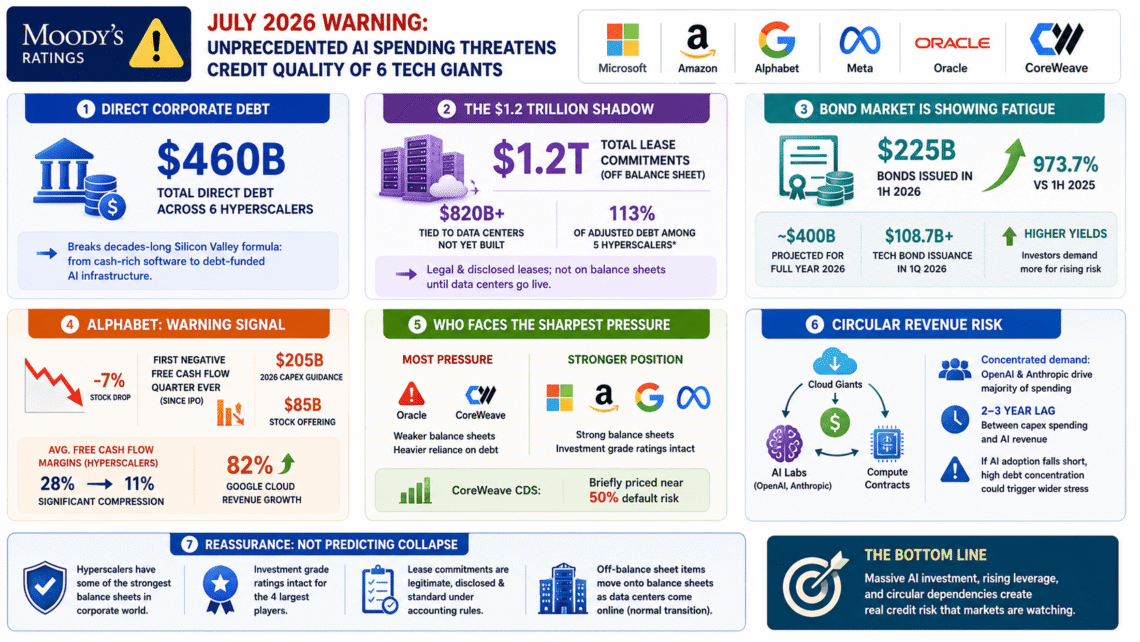
When Moody’s Ratings, one of the three institutions the entire global financial system relies on to judge whether a company can be trusted to repay what it owes, issues a formal warning about a specific industry, markets tend to pay close attention. In July 2026, Moody’s did exactly that, stating plainly that unprecedented AI spending threatens the credit quality of six of the largest technology companies in the world, Microsoft, Amazon, Alphabet, Meta, Oracle, and CoreWeave.
The core of the AI debt risk Moody’s identified is not that these companies are spending enormous sums, a fact already well documented in Article 1 of this series. It is how that spending is being financed, and how much of it remains deliberately structured to stay off the balance sheets investors actually scrutinize.
Understanding the specific mechanics of this AI debt risk, and why Moody’s chose this particular moment to sound the alarm, requires examining three distinct categories of exposure: direct corporate debt, off-balance-sheet lease commitments, and the bond market’s own increasingly nervous response to absorbing all of it at once.
The 460 Billion Dollar Direct Debt Figure
The most straightforward component of AI debt risk is direct corporate debt, borrowed money that already appears plainly on company balance sheets. According to Moody’s own analysis, direct debt across the six hyperscalers tracked in its report has reached approximately 460 billion dollars. This figure alone represents a meaningful shift for companies whose historical financial identity was built specifically on the opposite characteristic.
As Moody’s own report observes, the current moves break a decades-long Silicon Valley formula that created the world’s most valuable companies. Software cost little to replicate, yielding fat profit margins and fortress balance sheets. Generative AI, by contrast, demands a vast physical footprint, warehouses crammed with expensive and energy-hungry servers and chips, and that physical footprint is now being financed increasingly through borrowed capital rather than the internally generated cash flow that once defined these companies’ financial character.
The 1.2 Trillion Dollar Shadow
The far larger and more structurally significant component of AI debt risk sits entirely off the balance sheet, and this is where Moody’s analysis becomes genuinely alarming. Lease commitments across the six hyperscalers Moody’s tracks have ballooned to 1.2 trillion dollars, of which more than 820 billion dollars is tied to data centers that have not even finished construction yet. Moody’s accounting analysts David Gonzales and Alastair Drake calculated that an earlier snapshot of this hidden obligation, 662 billion dollars specifically tied to leases that had not yet begun among just five hyperscalers, was equivalent to 113 percent of those companies’ most recent adjusted debt, larger than everything already sitting openly on their balance sheets combined.
The accounting mechanism behind this AI debt risk is legal and well understood, but its scale is what has changed dramatically. Rather than owning every new AI data center outright, hyperscalers increasingly sign long-term leases with specialized infrastructure developers. Under generally accepted accounting principles, these lease commitments are not required to appear as current liabilities until the underlying data center actually begins operating.
Moody’s is explicit that this does not constitute deception, a Moody’s spokesperson clarified directly that this is not a case of companies avoiding a liability through structuring, simply that the obligation has not yet reached the balance sheet under standard accounting timing rules. Nonetheless, Moody’s treats these lease commitments as debt-equivalent liabilities, obligations that will bind these companies to substantial rent payments for years regardless of how AI revenue actually develops, and a separate investigation by Nikkei Asia Review found that off-balance-sheet obligations across five hyperscalers have surged eightfold in just four years to 1.65 trillion dollars, a figure that now exceeds their combined on-balance-sheet debt entirely.
The Bond Market Is Already Showing Fatigue
Perhaps the clearest real-time signal of genuine AI debt risk comes not from Moody’s report itself but from how the corporate bond market has responded to absorbing this wave of new borrowing. S&P Global calculated that hyperscalers and closely related entities including Nvidia issued 225 billion dollars in bonds during just the first half of 2026, a 973.7 percent increase compared to the same period the prior year, and they remain on pace to issue roughly 400 billion dollars for the full year.
Corporate bond issuance from technology firms specifically exceeded 108.7 billion dollars in a single quarter of 2026, a volume that would have been considered extraordinary for the entire sector across a full year just three years earlier.
The market’s appetite for absorbing this AI debt risk is showing visible strain. S&P Global’s own analysis notes that hyperscalers are now paying a meaningfully higher premium compared with yields on risk-free government bonds than they were previously required to pay, direct evidence that bond investors are demanding greater compensation for what they perceive as rising risk. As S&P put it directly in its own report, market participants are growing leery of quickly rising leverage from issuers previously characterized by strong and reliable cash flow, a notably blunt assessment from an institution not generally given to dramatic language.
Alphabet’s Negative Free Cash Flow Quarter
The clearest individual illustration of how this AI debt risk translates into immediate market consequences arrived when Alphabet reported its first negative free cash flow quarter since its initial public offering, an event that stunned even seasoned analysts given the company’s historical reputation for financial conservatism, despite Google Cloud revenue simultaneously surging 82 percent. Alphabet’s stock dropped 7 percent on the news.
The company subsequently raised its 2026 capital expenditure guidance to 205 billion dollars and announced an 85 billion dollar stock offering, one of the largest equity raises ever undertaken by a technology company, a clear signal that even one of the cash-richest companies in corporate history is now seeking additional financial flexibility specifically to sustain its AI infrastructure buildout.
Average free cash flow margins across the hyperscaler group have compressed from roughly 28 percent down to 11 percent, a genuinely dramatic deterioration in the underlying financial health metric that has historically distinguished these companies from more conventional, capital-intensive industrial businesses.
Who Faces the Sharpest Credit Rating Pressure
Not every company carrying AI debt risk faces equal exposure, and Moody’s analysis draws a meaningful distinction worth understanding precisely. Oracle and CoreWeave face the most immediate ratings pressure among the six companies tracked, reflecting their comparatively weaker underlying balance sheets and heavier relative reliance on debt financing to fund their AI infrastructure commitments.
By contrast, the four largest players, Microsoft, Amazon, Alphabet, and Meta, retain what Moody’s characterizes as fundamentally strong balance sheets even accounting for this new leverage, a distinction that matters considerably for anyone assessing which parts of this AI debt risk landscape represent genuine near-term vulnerability versus which represent a more manageable, if still historically unusual, shift in capital structure among companies with substantial existing financial cushion.
CoreWeave in particular illustrates the sharper end of this risk spectrum concretely. As documented in Article 3 of this series, CoreWeave’s own credit default swaps have briefly implied pricing consistent with something close to a coin flip probability of default, a striking market signal for a company whose infrastructure underpins a meaningful share of current AI compute capacity.
The Circular Revenue Complication
Moody’s analysis explicitly connects this AI debt risk to the circular financing dynamics examined in Article 3 of this series, flagging what it calls a circular AI ecosystem in which tech giants invest directly in AI labs including OpenAI and Anthropic, which then route significant portions of that same capital back into purchasing cloud services from the very companies that funded them.
Moody’s view is that this concentration creates a specific and identifiable systemic vulnerability, most of the AI infrastructure spending documented across this entire series is ultimately serving a remarkably small number of end customers, with OpenAI and Anthropic alone representing an outsized share of total demand, and if AI adoption falls meaningfully short of current market expectations, the concentration of debt among this small number of interconnected companies could trigger broader financial pressure that spreads well beyond any single firm.
Moody’s also flagged a specific structural timing risk embedded directly in this AI debt risk picture, a two to three year lag between when capital is actually spent on data center construction and when corresponding AI-related revenue is realized. That lag means the true test of whether this debt was prudently deployed will not arrive immediately, and current financial statements cannot yet definitively confirm or refute whether the underlying investment thesis is sound.
A Reassurance Worth Taking Seriously
It would be inaccurate to characterize Moody’s report as predicting imminent financial collapse, and the agency’s own careful language deserves to be represented faithfully. Moody’s explicitly states that hyperscalers still maintain some of the most robust balance sheets in the entire corporate world, and their investment grade ratings, while under increased scrutiny, remain intact for the four largest players specifically.
The off-balance-sheet lease commitments driving much of the headline AI debt risk figure are legitimate, disclosed practices under standard accounting rules, not hidden liabilities in any deceptive sense, and much of what currently sits off balance sheets will simply migrate onto them naturally as data centers begin operations over the coming years, a normal and expected accounting transition rather than a hidden financial trap.
Conclusion
The AI debt risk Moody’s has documented in careful, methodical detail is neither a prediction of imminent catastrophe nor a dismissible non-issue. It is a precise, quantified description of a genuine structural shift, 460 billion dollars in direct debt, 1.2 trillion dollars in off-balance-sheet lease commitments, and a bond market already showing visible signs of fatigue after absorbing an unprecedented volume of new issuance in an extraordinarily compressed timeframe.
Whether this AI debt risk resolves smoothly as the anticipated two to three year revenue lag closes, or whether it becomes the mechanism through which the broader AI investment cycle experiences genuine financial stress, is precisely the question Article 5 of this series turns to directly, examining whether the full picture assembled across this series, staggering infrastructure spending, an unresolved ROI crisis, a circular financing web, and now a mounting debt burden, adds up to a genuine AI bubble approaching its limits.