
-
A History of Artificial Intelligence — Part 1: From Ancient Dreams to the Birth of a Field
This is Part 1 of a three-part series tracing the history of artificial intelligence, from its philosophical roots to the creation of OpenAI and ChatGPT. Part 1 covers the early foundations of AI through the AI winters of the 1970s and 80s.
Before the Machines: A Question, Not a Technology
Long before computers existed, humans imagined artificial beings capable of thought — from mechanical automatons in ancient myth to philosophical debates about the nature of mind. But the scientific story of AI begins not with a machine, but with a question. In the 1950s, researchers started exploring whether intelligence could be formalized, tested, and eventually built into machines.
The foundations were laid even earlier than most people realise. In 1943, Warren McCulloch and Walter Pitts published a paper proposing the first mathematical model of a neural network, a concept that would lie mostly dormant for decades before becoming the backbone of modern deep learning. It is a useful reminder that AI’s history is rarely linear; many of its most important ideas were proposed long before the technology existed to realize them.
Alan Turing and the Question “Can Machines Think?”
Alan Turing, often considered the father of modern computing, made many important contributions to artificial intelligence. In 1950, he published his landmark paper “Computing Machinery and Intelligence,” introducing what would later be known as the Turing Test.
Rather than getting tangled in unanswerable philosophical debates about consciousness, Turing proposed something practical: if a machine could convincingly communicate like a human in conversation, its intelligence should be taken seriously. In his proposed experiment, a human evaluator interacts with both a human and a machine without knowing which is which; if the evaluator cannot reliably distinguish between them, the machine is said to have passed the test.
This was a deliberately pragmatic move. It set the tone for decades of AI research: intelligence would be measured by what a system could do, not by philosophical claims about what was happening inside it. That framing of behavior over inner experience would later become the central fault line in one of AI’s most enduring philosophical debates, which we’ll return to shortly.
1956: The Dartmouth Conference and the Birth of a Field
In the summer of 1956, a small group of researchers gathered at Dartmouth College for a workshop proposed by John McCarthy, Marvin Minsky, Nathaniel Rochester, and Claude Shannon. Their proposal stated the conjecture plainly: that every aspect of learning or any other feature of intelligence could in principle be so precisely described that a machine could be made to simulate it.
It was McCarthy’s coinage of “artificial intelligence” that appeared in that proposal, and the phrase stuck partly because the alternatives on offer were worse: “machine intelligence” was vague, and “cybernetics” was already associated with control theory rather than cognition. The workshop was loosely organized and not everyone stayed the full two months, but it established the field’s founding ambition: to simulate, in a machine, every aspect of human intelligence.
Remarkably, one team arrived with a working demonstration already in hand. Allen Newell and Herbert Simon, working with programmer Cliff Shaw, had built the Logic Theorist, a program designed to prove theorems from Whitehead and Russell’s Principia Mathematica. It successfully proved 38 of the first 52 theorems, and one of its proofs was, according to its creators, more elegant than the original. This is widely considered the first true AI program.
The momentum continued quickly. In 1958, John McCarthy developed the Lisp programming language, which became a primary tool for AI research for decades. In 1966, Joseph Weizenbaum created ELIZA, an early natural language program that simulated conversation and famously convinced some users they were talking to a sympathetic listener, despite running on simple pattern-matching rules.
Strong AI, Weak AI, and the Debate That Followed
As programs like ELIZA grew more convincing, a deeper question resurfaced: were these systems actually thinking, or just simulating the appearance of thought? This is the distinction between what philosophers call strong AI and weak AI.
Strong AI is the view that a suitably programmed computer can genuinely understand language and possess mental capabilities similar to a human’s and not merely simulate them. Weak AI, by contrast, holds that computers are useful tools for modeling or simulating mental processes, without making any claim that they actually understand or are truly intelligent.
This distinction became the center of one of the most famous thought experiments in the philosophy of AI: John Searle’s Chinese Room argument, published in 1980.
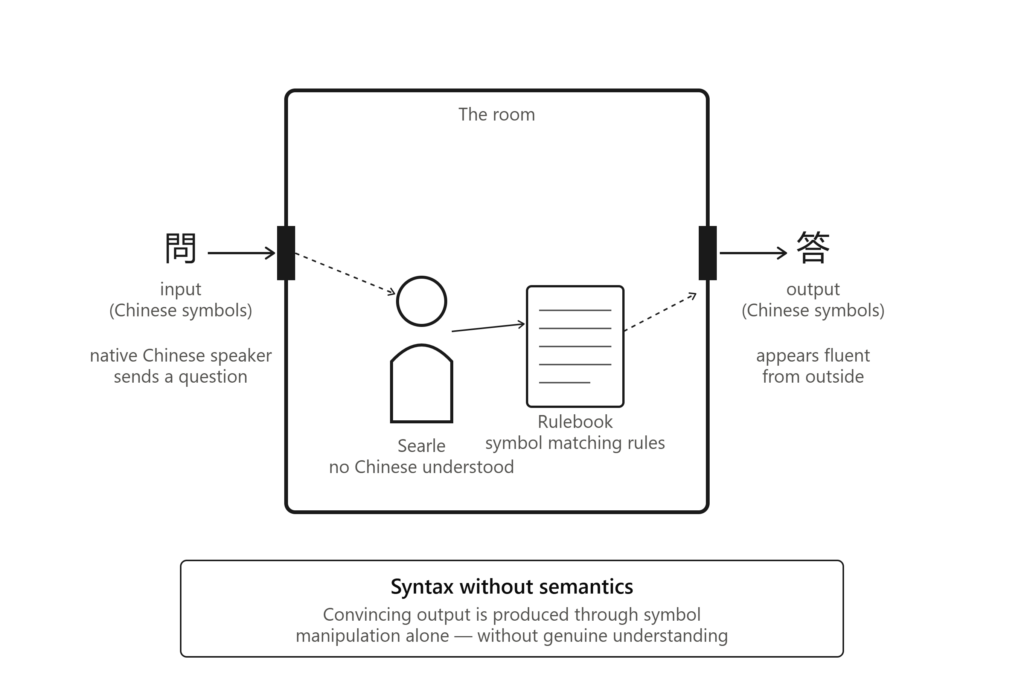
Searle asked readers to imagine a person who does not understand Chinese, sealed inside a room. This person is given Chinese characters through a slot in the door, along with a detailed rulebook (written in a language they do understand) for manipulating those symbols and producing appropriate Chinese characters in response. By following the rules precisely, the person can produce convincing Chinese replies (enough to pass a Turing Test) without ever understanding a single word of Chinese.
Searle’s point was that the person in the room and a computer running a program are not meaningfully different: both follow step-by-step instructions to produce outputs that appear intelligent, without any genuine understanding occurring. The argument was specifically directed at strong AI’s claim that an appropriately programmed computer, given the right inputs and outputs, would have a mind in exactly the same sense humans do. Searle aimed to show that information processing alone, no matter how sophisticated, cannot by itself produce genuine thought or understanding.
The argument was controversial and it remains so. One major line of response, known as the “Systems Reply,” concedes that the person inside the room doesn’t understand Chinese, but argues that some larger system: the room, the rulebook, and the person together might understand, even if no individual component does. A related “Virtual Mind” reply argues the real claim of strong AI isn’t that the computer itself understands, but that the process running on the computer creates a mind that understands, much like a character in a video game. Importantly, the Chinese Room argument was never meant as an attack on AI’s practical capabilities; it does not claim there is a limit to how intelligent a machine’s behavior can appear. Its target was narrower: the philosophical claim that computation alone is sufficient to produce genuine understanding.
Decades later, as language models like ChatGPT produce remarkably fluent conversation, Searle’s question has only grown more relevant, and we’ll return to it directly in Part 3 of this series.
The AI Winters: When Promises Outpaced Reality
The optimism of the 1950s and 60s could not last forever. The field experienced periods of decline known as “AI winters” in the 1970s and late 1980s, driven by unmet expectations and limited computational power. AI winters happened when expectations outpaced reality. Limitations in compute, data, and real-world performance made it difficult to deliver on the bold promises researchers had made, and funding agencies pulled back accordingly.
There was a partial revival before the deepest freeze set in. A resurgence in the 1980s was driven by the development of expert systems — programs that encoded the knowledge of human experts as explicit if-then rules, which found genuine commercial applications in narrow domains like medical diagnosis and chemical analysis. But even expert systems proved brittle and expensive to maintain at scale, and by the late 1980s, a second, harsher AI winter set in.
It would take a very different approach, one centered on learning from data rather than hand-coded rules, to pull the field out of its second winter and toward the breakthroughs that would eventually make modern AI possible. That story, including the rise of machine learning, deep learning, and the neural networks that power today’s chatbots, is where Part 2 picks up.
This is Part 1 of a 3-part series on the history of AI. Part 2 will cover the rise of machine learning and deep learning, leading up to the founding of OpenAI. Part 3 will trace the path from GPT to ChatGPT and discuss what these developments mean for the strong AI vs. weak AI debate today.
-
The Governance Imperative: Why Agentic AI Deployment Is Outpacing Enterprise Readiness
From Pilot Fatigue to Production Reality
Enterprise AI has crossed a threshold. Gartner forecasts that 40% of enterprise applications will embed task-specific AI agents by end of 2026, up from under 5% in 2025. That is not incremental adoption, it is a structural reconfiguration of how enterprises orchestrate work. The transition from isolated generative AI experiments to production-grade, multi-agent architectures is no longer a roadmap item. It is happening now, unevenly, and largely ahead of the governance frameworks designed to contain it.
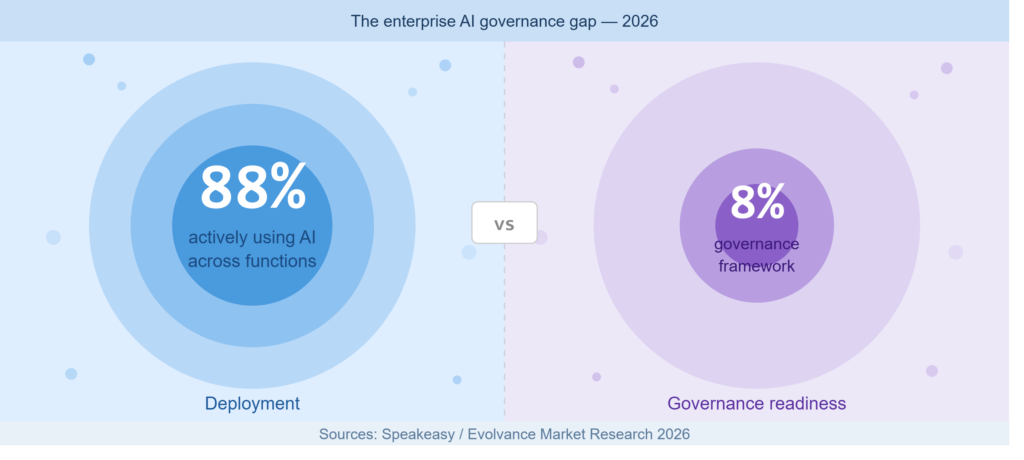
The numbers are unambiguous about the asymmetry. Only 8% of organisations globally have a comprehensive AI governance framework, while 88% are actively using AI across business functions. That eighty-point gap is not a compliance footnote but the operating risk profile of most enterprises deploying agentic systems today.
The Governance Gap Is a Performance Variable, Not a Compliance Checkbox
Enterprise leaders who still frame AI governance as a risk management exercise are misreading the data. Companies using AI governance tools get over 12 times more AI projects into production. Organisations that use evaluation tools move nearly six times more AI systems to production. Governance, in other words, is the primary determinant of deployment velocity, not a constraint on it.
PwC research finds that 74% of all AI-generated economic value is captured by just 20% of organisations, and those AI leaders invest in governance infrastructure at rates significantly higher than the market average. The value concentration this represents is not coincidental. Mature governance programs eliminate the rework cycles, incident responses, and regulatory interventions that bleed velocity from under-governed programs.
The EU AI Act’s full enforcement provisions for high-risk AI systems take effect August 2, 2026, covering credit scoring, employment decisions, and insurance underwriting, with fines reaching €15 million or 3% of global annual turnover for non-compliance. For heavily regulated industries, this regulatory pressure compounds what is already an operational imperative.
Agentic Architecture Introduces an Entirely New Attack Surface
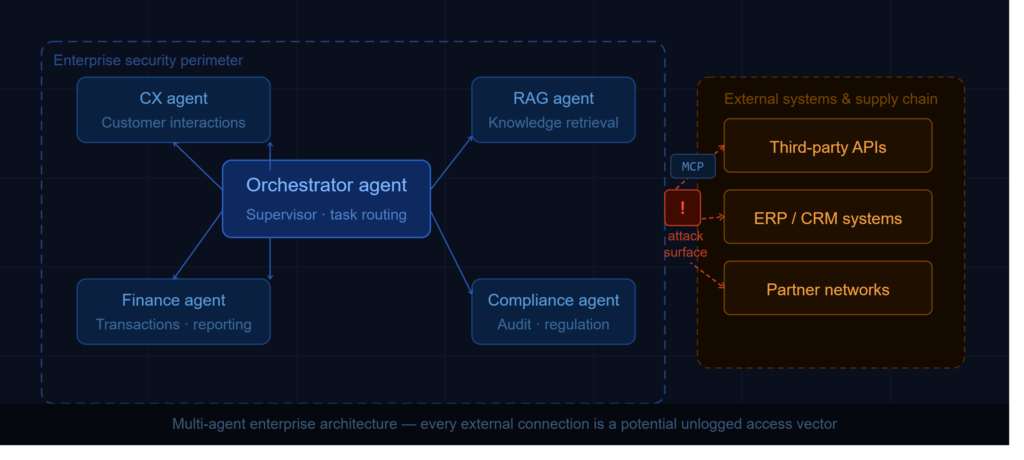
The shift to multi-agent systems does not merely scale existing risk. It introduces qualitatively new categories of it. Agents have identity, privileges, and access to systems and data across the business and out into the extended supply chain, either directly or through interfacing with other agents indirectly. This makes them a new and unexplored security risk, which is an entirely new non-deterministic attack surface.
The NSA released MCP security guidance in May 2026, signaling that federal regulatory requirements are a matter of when, not whether. The Model Context Protocol, which has rapidly matured into a common foundation for agent-to-tool connectivity, enables agents to interact with tools and data sources through standardised interfaces, a vital step toward portability, security, and observability. But standardisation alone does not constitute governance.
Uber’s deployment at scale offers the most instructive production case study available. By early 2026, 84% of Uber’s developers were using agentic coding tools daily, with AI generating between 65% and 72% of all code written inside their IDEs. Uber reached that scale because it built three governance layers before scaling adoption: an LLM gateway handling PII redaction, access control, and audit logging across every model interaction; an MCP gateway governing every agent-to-tool connection across 10,000+ internal services; and an agent identity system extending Zero Trust infrastructure to multi-agent workflows. The sequencing matters: governance infrastructure preceded scale, not the other way around.
Vendor Architecture Is a Strategic Decision, Not a Procurement Decision
Choosing an agentic AI vendor in 2026 is a different kind of decision. The model you select shapes how your agents reason, what they can and cannot do, how your data is handled, and how deeply you become entangled in a vendor’s ecosystem.
The compounding lock-in risk deserves particular attention. If agents run on a vendor’s proprietary orchestration layer, lock-in compounds at every layer of the stack. Enterprises that have not yet defined their agentic AI architecture strategy are already making a default choice. And that default is usually determined by whichever vendor has the best marketing rather than the best governance posture.
Sovereign AI considerations are now reshaping vendor selection in regulated industries. Sovereignty spans infrastructure, security, governance, lifecycle management, hiring policies, supply chains, service contracts, and partnerships, well beyond a one-time infrastructure decision. For European enterprises in particular, open-weight models with EU jurisdictional alignment offer a combination of flexibility and data sovereignty that hyperscaler-tied deployments cannot match.
What Separates Scaling Organisations from Those That Stall
Only 25% of AI initiatives deliver expected ROI, and only 16% reach enterprise-wide scale. Gartner expects over 40% of agentic AI projects to be cancelled by end of 2027 due to with escalating costs, unclear business value, and inadequate risk controls cited as primary drivers.
The distinguishing variable across the data is consistent: enterprises where senior leadership actively shapes AI governance achieve significantly greater business value than those delegating the work to technical teams alone. Governance, in the highest-performing organisations, is not a CISO concern or a legal review but a board-level operating discipline.
For enterprise AI leaders, the strategic question in the second half of 2026 is no longer whether to deploy agentic systems. It is whether the governance, evaluation, and observability infrastructure already in place is commensurate with the autonomy being granted. The organisations that answer that question honestly (and close the gap before scaling further) are precisely the ones that will capture the disproportionate share of value the data consistently points to.
-
When the AI Boom Meets Reality: Understanding the June 2026 Stock Selloff
A Turbulent Week for AI Stocks
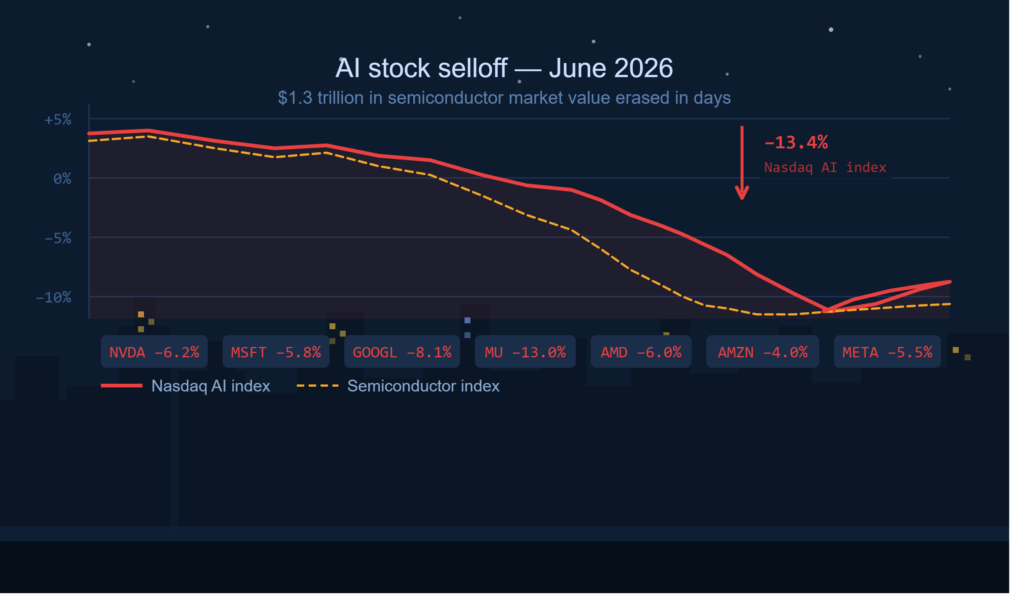
The artificial intelligence sector has been one of the most exciting investment stories of the past several years. But in late June 2026, the mood shifted sharply. On June 23–24, 2026, the tech-heavy Nasdaq dropped 2.21% and the S&P 500 fell 1.44%, as investors sold semiconductor and AI-related shares broadly. The impact did not stay confined to Wall Street. South Korea’s Kospi index tumbled 10%, tripping a circuit breaker (an automatic 20-minute trading halt) with memory chipmakers SK Hynix and Samsung each falling more than 12%.
In total, semiconductor stocks shed more than $1.3 trillion in market value during this correction. For many observers, the question became urgent: is this the beginning of an AI bubble bursting, or simply a market pausing to catch its breath?
What Triggered the Selloff?
There was no single dramatic event that caused the drop. Instead, several slow-building pressures converged at once.
Spending without proof of returns. The most fundamental concern driving the selloff is a straightforward one. Combined 2026 capital expenditures across Microsoft, Alphabet, Amazon, and Meta exceeded $452 billion, while free cash flow at these companies declined dramatically. Investors who were once content to fund AI’s promise are now demanding evidence of profit. Goldman Sachs’s equity research head James Covello summarised the mood bluntly: “At some point, you’ve got to make money.” Enterprise surveys in 2025–2026 found that 95% of corporate AI projects delivered no measurable return.
Talent departures rattled confidence. High-profile AI talent departing from Google DeepMind to competitors, including Nobel Prize-winning researcher John Jumper to Anthropic, and Gemini co-lead Noam Shazeer to OpenAI. And these departures raised questions about competitive advantages, wiping $270 billion from Alphabet’s market cap.
Cautious guidance from chip companies. Broadcom’s Q3 AI chip sales guidance of $16 billion fell short of the $17.2 billion analyst estimate, and the company notably did not raise its full-year AI semiconductor forecast. This triggered a “sell-the-news” reaction, sending Broadcom shares down 14% and creating a ripple effect across the entire chip supply chain.
Valuation fatigue. AI stock valuations had been flying high for several years, built mainly on the technology’s promise rather than the bottom-line profit growth that fuels most companies’ stock price increases. After nine consecutive weeks of gains for the S&P 500, profit-taking was inevitable.
Correction, Not Collapse
It is important to keep this in perspective. Most analysts describe June 2026 as a correction rather than a crash. Tech earnings are still growing, and the Nasdaq remains up 10% for the year despite the selloff.
Micron Technology, the memory and storage chipmaker, surged nearly 16% after reporting stellar earnings, driven by the boom in demand for its semiconductors. That tells a more nuanced story: the underlying demand for AI infrastructure has not disappeared. What has changed is investors’ patience for returns on that investment.
Implications for the AI Industry
This market correction carries several important signals for anyone building in or investing around AI.
Monetisation is now the priority. The era of rewarding AI companies simply for spending boldly is ending. Businesses that can demonstrate clear, measurable returns from their AI investments will attract continued support. Those with vague AI strategies face sustained pressure.
Smaller and open-source models gain relevance. Some analysts argue that AI-related stock prices are falling in tandem with the cost of compute, as more companies question whether frontier models from OpenAI and Anthropic justify the premium when a reliable, lower-cost model may meet their needs perfectly well.
IPO timelines may shift. OpenAI is reportedly considering delaying its IPO because of recent market volatility, which could make it harder for the company to achieve its desired $1 trillion valuation.
Global ripple effects. When hyperscalers pour hundreds of billions into AI data centres, they compete for the same memory chips and components that consumer electronics also need, meaning the AI investment boom is one reason your next PC upgrade costs more than your last one.
What This Means for Learners and Builders
For students and professionals building skills in AI engineering, this correction is not a reason for concern; it is rather a reason to focus. Markets are not rejecting AI; they are demanding that AI deliver. That shift creates a clear opportunity for people who can build practical, results-driven AI solutions rather than theoretical demonstrations.
The companies and professionals who will thrive in the next phase of AI are those who can answer one question clearly: what problem does this solve, and how does it create measurable value? That question has always mattered. Now, the market is insisting on an answer.
-
OpenAI’s $852 Billion Valuation: What It Means for the Future of AI
The Biggest Bet in Tech History
Artificial Intelligence has seen no shortage of headline-grabbing moments over the past few years, but one development from mid-2026 stands apart from the rest. OpenAI closed its largest funding round to date, raising $122 billion at an $852 billion valuation, with major investments from Amazon, NVIDIA, and SoftBank leading the round. To put that number in perspective, $852 billion places OpenAI among the most valuable companies ever created, surpassing the market capitalisation of most nations’ largest corporations and approaching the GDP of entire economies.
This is not just a story about one company raising money. It is a signal about where the technology industry believes the next decade of value creation is headed.
What Is Driving the Valuation?
Numbers this large demand context. OpenAI’s valuation is grounded in real and rapidly growing business metrics. The company reported $2.6 billion in monthly revenue, 900 million ChatGPT weekly active users, and signaled plans for a potential IPO later in the year. Those figures represent extraordinary growth for a company that barely had a commercial product three years ago.
OpenAI also filed a confidential S-1 with the SEC, setting the stage for what would be a landmark public offering. If and when that IPO proceeds, it would be one of the most significant listings in technology history. It will be comparable to the early public offerings of Google, Facebook, and Amazon in their respective eras.
The investment itself reflects a broader industry conviction: that AI is not a feature being bolted onto existing businesses, but an entirely new technological layer that will underpin nearly every sector of the global economy.
Who Is Investing and Why It Matters
The identity of OpenAI’s investors tells its own story. Amazon, NVIDIA, and SoftBank are not passive financial bettors. Each has a strategic reason to be deeply embedded in OpenAI’s future.
Amazon’s $50 billion commitment ties OpenAI to AWS infrastructure, positioning Amazon’s cloud platform as a primary delivery mechanism for AI services at global scale. NVIDIA’s involvement aligns the world’s dominant AI chip maker with the world’s most widely used AI platform. SoftBank brings both capital and distribution reach across Asia and beyond.
For AI engineers and developers, this alignment matters practically. It signals continued investment in the APIs, tools, and infrastructure that power the applications being built today. When the companies funding AI infrastructure are also the companies building the chips and cloud platforms, the ecosystem becomes more integrated, more capable, and, in theory, more accessible.
Potential Impacts: What Changes From Here?
A funding event of this scale has ripple effects that extend well beyond OpenAI’s own products. Here is where those effects are likely to be felt most strongly.
Accelerated competition. When one company commands an $852 billion valuation, rivals respond. Expect Google DeepMind, Anthropic, Meta AI, and emerging players to accelerate their own timelines, hire aggressively, and push model capabilities forward faster than they otherwise would. This competition ultimately benefits developers and end users through better models and lower prices.
Regulatory pressure. Companies valued at this level attract government attention. AI governance conversations that have moved slowly are likely to pick up urgency. The Colorado Consumer Protections for Artificial Intelligence Act, which took effect June 30, 2026, and the proposed federal Great American AI Act are early indicators of a regulatory environment that is beginning to formalise around AI at scale. A publicly traded OpenAI would face scrutiny from securities regulators as well, bringing a new layer of accountability to AI development.
Talent and opportunity. Enormous capital flowing into AI creates enormous demand for people who can build with it. For students and professionals developing AI engineering skills today, the timing could not be better. The gap between organisations that have AI deeply embedded in their operations and those still exploring it is widening; and closing that gap requires skilled builders.
Broader access. Counterintuitively, high valuations often drive down end-user costs. The pressure to grow revenue at a scale that justifies an $852 billion valuation pushes companies to reach more users, expand into new markets, and make their tools more affordable and accessible to individuals, small businesses, and developers worldwide.
The Perspective
OpenAI’s $122 billion funding round is more than a financial milestone. It is a declaration that artificial intelligence has moved from an experimental technology to a foundational economic force. Whether you are a developer building AI applications, a business leader evaluating AI strategy, or a learner just beginning to explore this field, understanding what this moment represents helps you make smarter decisions about where to invest your time and energy.
The question is no longer whether AI will reshape industries. It is whether you will be ready to shape it yourself.
-
Why AI Engineering Is Becoming One of the Most In-Demand Technology Skills
The Rise of AI Engineering
Artificial Intelligence has moved far beyond research laboratories and technology giants. Businesses of every size, from startups to global enterprises, are now actively looking for practical ways to integrate AI into their daily operations. As a result, AI Engineering has emerged as one of the fastest-growing and most in-demand career paths in the technology industry.
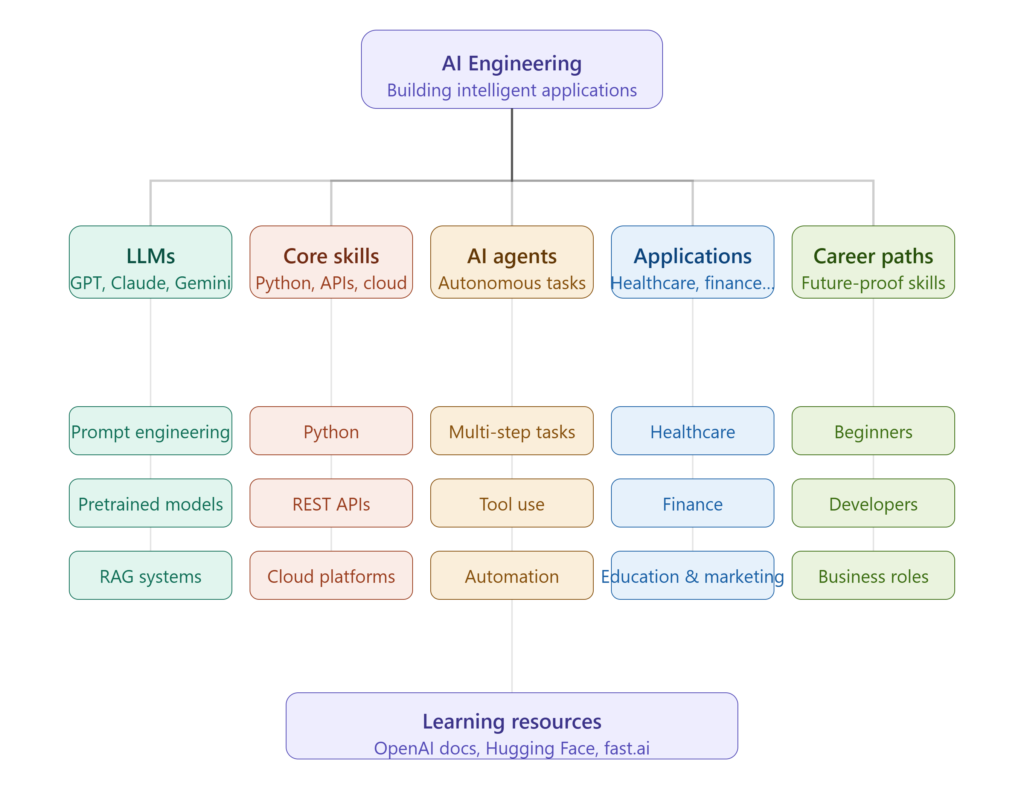
Unlike traditional software development, AI engineering focuses on building applications that can understand language, generate content, analyze data, and automate complex tasks using modern AI models. AI engineers combine software engineering skills with machine learning tools, APIs, cloud services, and prompt engineering to design intelligent applications that solve real business problems at scale.
How Large Language Models Changed Everything
One of the most significant shifts in AI engineering over the past two years has been the widespread adoption of Large Language Models (LLMs) such as ChatGPT, Claude, Gemini, and other generative AI systems. These pretrained models have fundamentally changed how developers build AI-powered applications.
Rather than training a model entirely from scratch, a process that previously required enormous datasets, specialized hardware, and months of work, developers can now integrate powerful LLMs into websites, mobile applications, business workflows, and customer support systems through simple API calls. This dramatically reduces development time, lowers the barrier to entry, and opens exciting new opportunities for innovation across every industry.
What Does an AI Engineer Actually Do?
AI engineering is a broad and evolving discipline. Depending on the organization and project, an AI engineer’s responsibilities may include:
- Designing and building AI-powered applications that leverage LLMs, computer vision, or speech recognition
- Integrating external AI services via REST APIs and cloud platforms such as AWS, Google Cloud, and Microsoft Azure
- Managing and optimizing prompts to improve the accuracy, reliability, and safety of AI outputs
- Building Retrieval-Augmented Generation (RAG) systems that connect AI models to internal databases and knowledge bases
- Testing and evaluating AI outputs to ensure quality, consistency, and alignment with business requirements
- Ensuring solutions remain secure, ethical, and compliant with data privacy regulations
Core technical skills such as Python, REST APIs, SQL databases, and version control remain essential. However, the ability to communicate effectively with AI models — through clear, well-structured prompts and thoughtful system design — has become an equally important and increasingly sought-after skill.
The Growing Role of AI Agents
A particularly exciting trend in AI engineering is the rise of AI agents. Unlike simple chatbots that answer individual questions, AI agents can execute sequences of tasks autonomously. These tasks include retrieving information from the web, analyzing uploaded documents, drafting reports, sending notifications, and interacting with multiple software systems in a coordinated workflow.
Organizations across industries are already exploring agent-based automation to improve productivity, reduce repetitive work, and enable their teams to focus on higher-value activities. For AI engineers, understanding how to design, deploy, and manage multi-step agent workflows is quickly becoming one of the most valuable skills in the field.
Career Opportunities in AI Engineering
For students and professionals looking to build future-proof careers, AI engineering offers a compelling combination of programming, creativity, problem-solving, and continuous learning. The demand for qualified AI engineers is expected to grow significantly across sectors including healthcare, finance, education, manufacturing, marketing, and government.
You do not need to have a traditional machine learning background to enter this field. Many successful AI engineers come from web development, data analysis, or business backgrounds and build their AI skills progressively. They start with APIs and prompt engineering before advancing to more complex topics like fine-tuning, embeddings, and agent frameworks.
Where to Start Learning AI Engineering
If you want to explore AI engineering in greater depth, two of the best starting points are the OpenAI Developer Platform and the Hugging Face Documentation. Both offer practical tutorials, code examples, and up-to-date guidance for developers building modern AI applications.
The most important step is simply to start building. Experiment with APIs, explore open-source models, and work on small projects that solve real problems. Practical experience, more than any certification, is what will set you apart in this fast-moving field.
-
What Is Artificial Intelligence? A Beginner’s Guide
Introduction
Artificial Intelligence (AI) is one of the most transformative and talked-about technologies of our time, and for good reason. In just a few decades, AI has moved from the pages of science fiction novels into our smartphones, hospitals, classrooms, and workplaces. It powers the recommendations that appear when you open Netflix, helps doctors detect diseases earlier than ever before, and enables cars to navigate roads with minimal human input.
What makes AI remarkable is not just what it can do today, but how rapidly it continues to evolve. New breakthroughs in language understanding, image generation, and autonomous reasoning are being announced almost every month. Industries that once seemed immune to automation (such as law, medicine, creative arts) are now being fundamentally reshaped by AI tools.
Yet despite all this buzz, many people still feel uncertain about what AI actually is. Is it just a fancy algorithm? Is it truly “thinking”? Is it something to fear or to embrace? This guide is designed to answer those questions in plain language, without requiring any technical background. Whether you are a student exploring future career paths, a professional looking to stay current, or simply a curious person trying to make sense of the world, understanding the basics of AI has never been more valuable.
What Is Artificial Intelligence?
At its core, Artificial Intelligence refers to the ability of computer systems to perform tasks that would normally require human intelligence. This includes things like understanding spoken or written language, recognizing faces in photographs, translating text between languages, making predictions based on historical data, and even composing music or generating images.
The key idea behind AI is that machines can be trained to solve problems, rather than explicitly programmed step by step. Traditional software follows precise, pre-written instructions: “if X happens, do Y.” AI systems, by contrast, learn from large amounts of data and develop their own internal rules for making decisions. This is why an AI can recognize a cat in a photo it has never seen before: it has learned the general concept of “cat” from millions of examples.
It is worth noting that AI is not a single technology. It is an umbrella term covering a wide range of methods and approaches, including machine learning, deep learning, natural language processing, computer vision, and more. Each of these subfields has its own techniques and applications, but they all share the same fundamental goal: enabling machines to exhibit intelligent behavior.
One fascinating benchmark in AI history is the Turing Test, proposed by British mathematician Alan Turing in 1950. The test asks whether a machine can converse with a human so naturally that the human cannot tell they are talking to a machine. Despite enormous advances, no AI system has unequivocally passed the Turing Test under rigorous, open-ended conditions. This remains a reminder that while AI is extraordinarily powerful in specific domains, human-like general intelligence is still an unsolved frontier.
Examples of AI in Daily Life
One of the most surprising things people discover when learning about AI is just how much of it they already use — often without realizing it. AI is quietly embedded in dozens of tools and platforms most of us interact with every day.
Voice Assistants: When you ask Siri to set a timer, tell Alexa to play music, or ask Google Assistant for the weather, you are using natural language processing (NLP), a branch of AI that enables machines to understand and respond to human speech. These assistants are trained on vast amounts of conversational data to interpret context, intent, and even tone.
Streaming Recommendations: Platforms like Netflix, Spotify, and YouTube use AI recommendation engines that study your viewing or listening history, compare it with patterns from millions of other users, and surface content you are likely to enjoy. The more you use these platforms, the more personalized their suggestions become.
Email Spam Filters: Your email inbox is protected by AI classifiers that analyze the structure, content, and sender behavior of incoming messages to decide whether they are spam. These systems learn continuously as new spam techniques emerge.
Online Translation: Services like Google Translate and DeepL use deep learning models trained on billions of translated sentences. Modern AI translation is remarkably accurate for common languages and has made cross-language communication accessible to people worldwide.
Navigation and Route Planning: Apps like Google Maps and Waze use AI to analyze real-time traffic data, predict congestion, suggest optimal routes, and even anticipate your destination based on your regular patterns.
Chatbots and Customer Support: Many companies now use AI-powered chatbots to handle customer inquiries, process simple requests, and route complex issues to human agents. Advances in large language models (LLMs) have made these systems dramatically more helpful in recent years.
Medical Diagnostics: AI tools can analyze X-rays, MRI scans, and pathology slides to help doctors detect conditions like cancer, diabetic retinopathy, and pneumonia, sometimes with accuracy that rivals experienced specialists.
These are just a handful of examples. AI also plays a significant role in fraud detection, hiring tools, climate modeling, agricultural optimization, and much more.
Types of AI
When researchers and technologists talk about AI, they often distinguish between different levels or types of capability. The two most commonly discussed categories are Narrow AI and General AI.
Narrow AI (also called Weak AI) is the only kind of AI that actually exists today. Narrow AI systems are designed and trained to perform a specific, well-defined task. They can be extraordinarily powerful within that task, often surpassing human performance, but they cannot transfer their abilities to other domains. A chess-playing AI cannot write poetry. A language translation model cannot drive a car. Each system is optimized for one job and one job only.
Examples of Narrow AI include facial recognition software, spam detection algorithms, product recommendation engines, and large language models like the ones used in AI writing assistants.
General AI (also called Artificial General Intelligence, or AGI) is a theoretical concept referring to a machine that could perform any intellectual task that a human can perform – reasoning flexibly across domains, learning from minimal data, and applying knowledge in novel situations. AGI would represent a fundamentally different kind of intelligence than what we have today. As of now, AGI does not exist, and there is significant debate among researchers about how far away it might be, or whether it is achievable at all with current approaches.
Some researchers also discuss a third category, Superintelligent AI, which would surpass human intelligence across all domains. This remains firmly in the realm of speculation and is the subject of both serious academic research and popular philosophical debate.
For practical purposes, everything you encounter in the real world today, no matter how impressive, falls into the Narrow AI category.
Benefits and Challenges
AI offers a remarkable range of benefits that are already improving lives and reshaping industries. At the same time, it introduces complex challenges that society must confront thoughtfully.
Benefits:
Productivity and Automation — AI can handle repetitive, time-consuming tasks at a scale and speed no human workforce could match. This frees people to focus on creative, strategic, and interpersonal work that machines cannot replicate.
Faster and Better Decision-Making — In fields like finance, medicine, and logistics, AI can analyze enormous datasets in seconds and surface insights that would take human analysts days or weeks to find.
Personalized Experiences — From personalized learning platforms that adapt to a student’s pace, to healthcare tools that tailor treatment recommendations to an individual’s genetic profile, AI enables a level of customization that was previously impossible at scale.
Scientific Discovery — AI has accelerated research in drug discovery, materials science, and climate modeling, helping scientists identify promising leads far more efficiently than traditional methods.
Challenges:
Bias and Fairness — AI systems learn from historical data, which often reflects existing societal biases. If not carefully designed and audited, AI tools can perpetuate or even amplify discrimination in hiring, lending, criminal justice, and other high-stakes areas.
Data Privacy — AI systems require large amounts of data to function effectively. This raises serious questions about how personal data is collected, stored, used, and protected — and who ultimately controls it.
Security Risks — AI can be exploited for malicious purposes, including generating convincing disinformation, automating cyberattacks, and creating deepfake content designed to deceive.
Job Displacement — As AI automates more tasks, certain roles will inevitably change or disappear. While new jobs will emerge, the transition may be uneven and will require significant investment in retraining and education.
Transparency and Accountability — Many advanced AI systems operate as “black boxes,” making decisions in ways that are difficult to interpret or explain. This raises important questions about accountability when AI makes consequential errors.
Navigating these trade-offs wisely will be one of the defining challenges of the coming decades.
How to Start Learning AI
The good news is that you do not need a computer science degree to begin understanding and using AI. The field has become far more accessible, and there are excellent resources for learners at every level.
Start with the concepts. Before diving into tools or code, build a solid mental model of what AI is, how it learns, and what its limitations are. Reading accessible books and articles, like this one, is a great first step. Look for introductory courses that explain machine learning concepts in plain language before introducing mathematics.
Explore AI tools hands-on. The fastest way to understand AI is to use it. Experiment with generative AI tools, image generators, translation services, and coding assistants. Pay attention to where they succeed and where they fail, which this builds genuine intuition about how these systems work.
Learn prompt engineering. One of the most practical skills in the AI era is knowing how to communicate effectively with AI systems. Prompt engineering, the art of crafting clear, specific, and well-structured inputs, dramatically improves the quality of AI outputs and is a valuable skill across virtually every profession.
Develop basic technical literacy. You do not need to become a programmer to work with AI, but understanding the basics of how data is structured, what algorithms do, and how models are trained will give you a significant advantage. Introductory Python courses are widely available and provide a strong foundation.
Progress to machine learning fundamentals. Once you are comfortable with the basics, explore introductory machine learning courses. Platforms like Coursera, edX, and fast.ai offer excellent structured learning paths, many of them free.
Stay curious and current. AI is evolving faster than almost any other field. Follow reputable sources, read about new developments, and connect with communities of learners. The willingness to keep learning, not any single skill, is the most important asset you can develop.
Conclusion
Artificial Intelligence is not a distant technology on the horizon. It is already woven into the fabric of daily life, and its influence will only deepen in the years ahead. It is reshaping how we work, learn, create, and communicate, and bringing with it both extraordinary opportunities and serious responsibilities.
Understanding AI does not require you to become an engineer or a data scientist. It requires curiosity, a willingness to engage with new ideas, and the habit of asking good questions about the technology that surrounds you. The people who will thrive in the AI era are not necessarily those who know the most code; they are those who understand what AI can and cannot do, who can apply it thoughtfully in their fields, and who can think critically about its implications.
By taking the time to learn the fundamentals now, you are not just preparing yourself for tomorrow’s job market. You are equipping yourself to participate meaningfully in one of the most consequential conversations of our time.