AI Foundations
Beginner-friendly articles on artificial intelligence, AI tools, prompt engineering, and AI productivity.
-
The Powerful History of Code Review: From Fagan Inspections to the Age of AI Agents
Fifty Years of the Same Basic Question
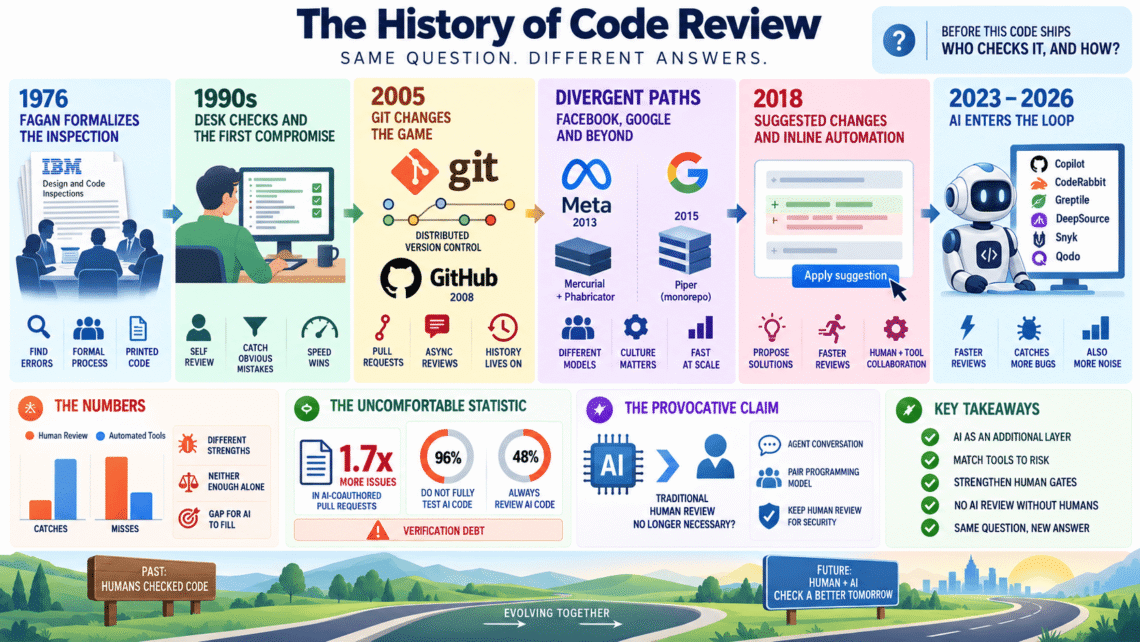
Every era of software engineering has asked the same underlying question. Before this code ships, who checks it, and how? The history of code review is really the history of that single question, answered five different ways across five decades. Each answer reflected the tools, team sizes, and risk tolerance of its moment. Understanding this full arc matters now more than ever, because AI has just introduced the sixth answer, and it looks nothing like the previous five.
-
The Powerful Nvidia LLM Impact and its 5-Year Reign
The Chip Nobody Saw Coming
In May 2020, Nvidia announced a GPU built for data centers, not gaming rigs. Few people outside chip design circles paid much attention. That chip was the A100. Within three years, it became the single piece of hardware most responsible for the modern LLM boom. Understanding Nvidia LLM impact over the past five to ten years means tracing a story that runs through silicon design, software lock-in, and finally, staggering financial engineering. Each stage built directly on the one before it.
-
5 Powerful Ways the Agentic AI Operating System Is Already Replacing Windows as You Know It
The Computing Paradigm That Is Quietly Already Here
For four decades, the fundamental interaction model of personal computing barely changed. You opened an application, you told it exactly what to do through menus and clicks, and it did precisely that and nothing more. In 2026, that model is being dismantled in real time, and not by a speculative research lab but by the world’s largest software company shipping code directly into hundreds of millions of machines.
At Microsoft Build 2026, CEO Satya Nadella stood on stage and declared plainly, we are moving from AI that assists you to AI that acts on your behalf, framing Windows as the first truly agentic operating system, woven into Windows, Azure, and everything in between. The agentic AI operating system is no longer a thought experiment. It is currently rolling out.
Understanding exactly how far this shift has already progressed, what remains genuinely speculative, and what a fully realized agentic AI operating system would mean for how humans relate to their own computers requires separating concrete, shipping technology from the more ambitious, still-unrealized vision Microsoft and its competitors have articulated for the remainder of the decade.
One: The Kernel Itself Is Being Redesigned Around Agents
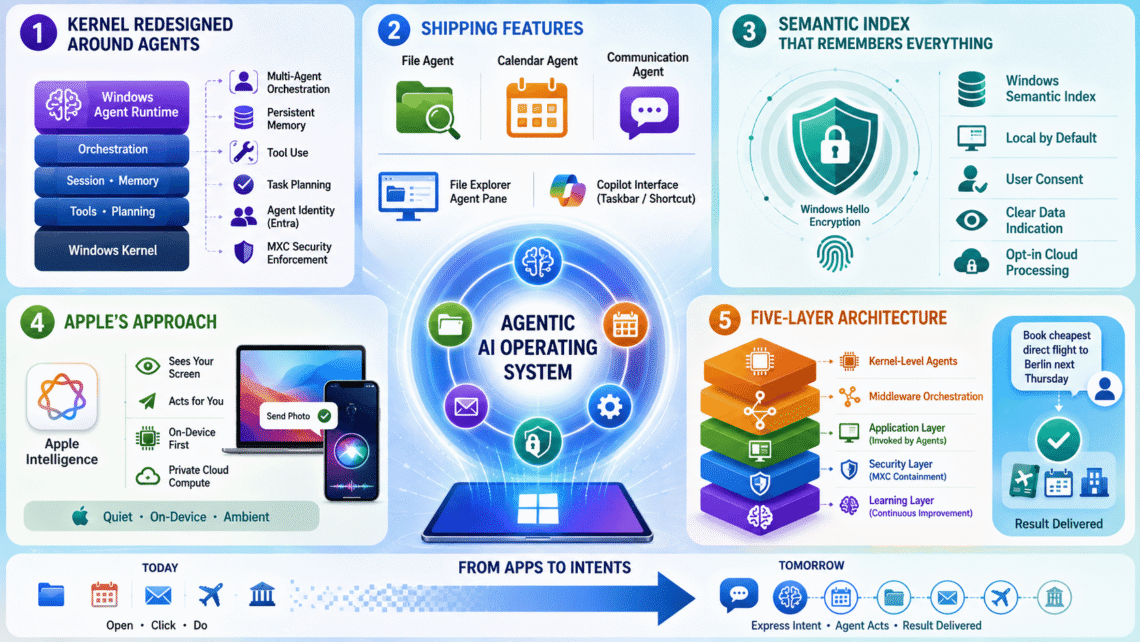
The single most significant technical shift underlying the current agentic AI operating system rollout is architectural rather than cosmetic. Microsoft is not simply adding a chatbot to the taskbar, as it did with earlier Copilot integrations that drew considerable user backlash. The company has embedded a new Windows Agent Runtime directly into the operating system, a system-level orchestration layer providing session management, persistent memory, task planning, tool use, and coordination between multiple simultaneous agents, all built directly into the OS itself rather than bolted on as a separate application. Windows chief Pavan Davuluri described the ambition explicitly, framing Windows as no longer a passive platform but an active participant in work and life.
The security architecture underlying this shift deserves particular attention, since it directly addresses the most obvious objection to an agentic AI operating system, that granting AI system-level access to files, applications, and hardware sounds catastrophically risky. Microsoft’s answer is a policy-driven execution layer called MXC, which allows developers to define precisely what any given agent can access, files, networking, system resources, specific applications, while Windows itself enforces those restrictions at the kernel level rather than trusting the agent’s own behavior.
Every agent operates under its own Entra-backed identity, isolated from the user’s desktop, clipboard, and input devices unless explicitly granted access, with all activity attributed and auditable. This containment model is what makes a genuinely agentic AI operating system plausible for enterprise and security-conscious users rather than remaining a novelty confined to consumer experimentation.
Two: File Organization and System Maintenance Are Already Shipping Features
The specific capabilities envisioned for a mature agentic AI operating system, automatically organizing files, searching content based on natural language rather than exact filenames, and handling routine system maintenance, are not purely speculative. They are shipping in early form right now. Microsoft’s initial release includes purpose-built agents for common tasks, a Calendar Agent, a File Agent, and a Communication Agent, accessible through an updated Copilot interface that can be pinned to the taskbar or summoned by keyboard shortcut. File Explorer itself now includes a dedicated agent pane offering real-time file analysis directly within the file browsing experience.
The longer-term vision Microsoft has articulated publicly for this agentic AI operating system extends considerably further than these initial agents. The stated ambition is a Windows that proactively manages routine computing tasks entirely on its own initiative, organizing photos without being asked, summarizing long email threads automatically, suggesting draft replies before the user has finished reading, and pre-loading applications based on the user’s own historical behavior patterns, anticipating what the user is about to need rather than waiting to be instructed.
This is precisely the file organization, content search, and predictive assistance envisioned as core functions of a genuinely intelligent operating layer, already moving from roadmap to early production release within a single calendar year.
Three: The Semantic Index That Remembers Everything, Carefully
For an agentic AI operating system to genuinely learn from user activity and act intelligently on the user’s behalf, it needs persistent memory of what the user has actually done, a capability that raises the sharpest privacy questions in this entire transition. Microsoft’s answer is the Windows Semantic Index, a personal semantic index encrypted specifically with Windows Hello biometric authentication, designed to enable persistent agent memory and context without simply storing a raw, unencrypted log of everything a user has ever done, a lesson learned directly from the well-documented privacy backlash surrounding the earlier Windows Recall feature.
The privacy framework attached to this memory layer is genuinely load-bearing for whether an agentic AI operating system can achieve mainstream trust rather than remaining confined to enthusiast early adopters. Microsoft has committed publicly to a strict user consent framework, with all data processing defaulting to local, on-device execution unless a user explicitly opts into cloud processing for a specific task, and clear visual indication whenever any agent touches personal data.
Whether this framework proves robust enough to satisfy privacy advocates and regulators once deployed at true consumer scale, well beyond the current early preview population, remains one of the most consequential open questions determining how quickly a genuinely agentic AI operating system reaches mass adoption.
Four: Apple Is Building the Same Vision Through a Different Door
Microsoft is not alone in pursuing this transition, and the contrast with Apple’s approach illustrates two genuinely different philosophies converging on a similar destination. Apple Intelligence, running largely on-device thanks to Apple’s own silicon, pursues a considerably quieter, more understated version of the agentic AI operating system concept, functioning less like a visible chatbot interface and more like an invisible extension of the existing interface itself.
Siri, in its current iteration, can genuinely see what is displayed on a user’s screen and act on it directly, sending a specific photo to a specific contact without the user needing to name the file or navigate to it manually, while most processing happens entirely locally, with cloud computation reserved specifically for the heaviest reasoning tasks through what Apple calls Private Cloud Compute.
This divergence between Microsoft’s visible, chat-forward agent interface and Apple’s quiet, embedded ambient intelligence represents two legitimate architectural bets on what an agentic AI operating system should actually feel like to use day to day, one that foregrounds the agent as a distinct entity the user directly converses with, and one that dissolves the agent so thoroughly into the existing interface that using it barely feels like invoking AI at all.
Which philosophy proves more durable and genuinely preferred by ordinary users, rather than power users and early technology adopters, will likely take several more product generations to determine conclusively.
Five: The Five-Layer Architecture Pointing Toward the OS Disappearing Entirely
Beyond the specific products currently shipping, researchers studying this transition have proposed a more general five-layer architectural framework for understanding where the agentic AI operating system concept is ultimately heading. Kernel-level agents handling low-level resource scheduling and hardware coordination, a middleware layer orchestrating communication between agents and system services, an application layer where traditional software still technically exists but is increasingly invoked by agents rather than directly by users, a security layer enforcing the kind of containment and permission boundaries Microsoft’s MXC system already implements today, and a learning layer that continuously refines the entire stack’s behavior based on accumulated user interaction patterns over time.
The genuinely speculative but technically coherent endpoint this architecture points toward is a computing experience in which the traditional application layer becomes almost entirely invisible to the ordinary user. Rather than opening a calendar application, a payment application, and a travel booking application separately to plan a trip, a user of a mature agentic AI operating system simply expresses an intent directly, book the cheapest direct flight to Berlin next Thursday, and the underlying agentic layer interprets that intent, coordinates every necessary service automatically behind the scenes, and delivers a completed result.
The application layer continues existing beneath this interaction, but the user increasingly interacts with the agent interface itself rather than navigating between individual applications one at a time, a genuine inversion of four decades of established computing convention.
What Remains Genuinely Uncertain
A rigorous, hype-free assessment of the agentic AI operating system concept requires being explicit about what remains unresolved rather than treating this transition as a foregone conclusion. Early real-world testing has already surfaced rough edges, one prominent technology journalist reported his own Scout agent, Microsoft’s always-on Copilot agent, sending an email composed as a single unformatted run-on sentence, a small but telling reminder that autonomous execution without adequate human review still carries genuine, practical failure modes well short of any catastrophic scenario.
Security researchers have specifically emphasized that continuously running local agents require carefully intentional isolation, since developers and users alike need genuine, verifiable control over exactly what any given agent can access, and confidence that those specific controls will actually hold under real-world conditions rather than merely on paper.
Standardization across the industry represents a further genuine obstacle. For an agentic AI operating system on one device to coordinate meaningfully with an agent running on a user’s phone or within a separate smart home ecosystem built by an entirely different company, the industry needs shared, interoperable protocols, an challenge directly analogous to the Model Context Protocol standardization discussed extensively elsewhere on this blog, extended now to the considerably higher-stakes context of operating system level agent coordination across competing vendors with genuinely divergent commercial incentives.
Conclusion
The agentic AI operating system is not a distant, purely speculative vision confined to research papers and product roadmaps. It is a concrete architectural shift already embedded directly into the Windows kernel, shipping in early form to real users, and being pursued through a parallel but philosophically distinct path by Apple simultaneously. File organization, proactive system maintenance, and natural language content search, the specific capabilities this article set out to examine, are already moving from aspiration to early production reality within a single calendar year, considerably faster than most observers would have predicted even eighteen months ago.
What remains genuinely open is not whether an agentic AI operating system arrives, but rather how quickly it matures past its current, occasionally rough early implementation, how convincingly the privacy and containment framework holds up once deployed at true mass scale, and how thoroughly the traditional application layer that has defined computing since the earliest graphical interfaces ultimately recedes behind an intelligence layer that, for the first time in computing history, is designed to act on a user’s behalf rather than simply waiting patiently to be told exactly what to do next.
-
The Critical Future of LLM Technology: A Hype-Free Forecast for the Next Five Years (Part 2)
This is Part 2 of a two-part series taking a rigorous, hype-free look at large language model progress. Part 1 examined what actually drove LLM development history over the past decade, scaling laws, algorithmic efficiency, and the unresolved reasoning debate. Part 2 turns to the specific pipeline of techniques currently in development and offers a grounded forecast for the future of LLM technology through roughly 2030.
Forecasting Without the Marketing Department
Part 1 of this series established the two forces that genuinely drove LLM capability forward over the past decade, compute scaling and algorithmic efficiency, alongside a third, newer axis, inference-time reasoning, that emerged only in the past two years. Any credible forecast of the future of LLM technology must build directly on that evidence base rather than product roadmap slides, and must take seriously a specific, quantifiable constraint that has received too little public attention relative to its actual significance, the finite supply of human-generated text itself.
The Data Wall Is Real, and It Is Closer Than Most Coverage Admits
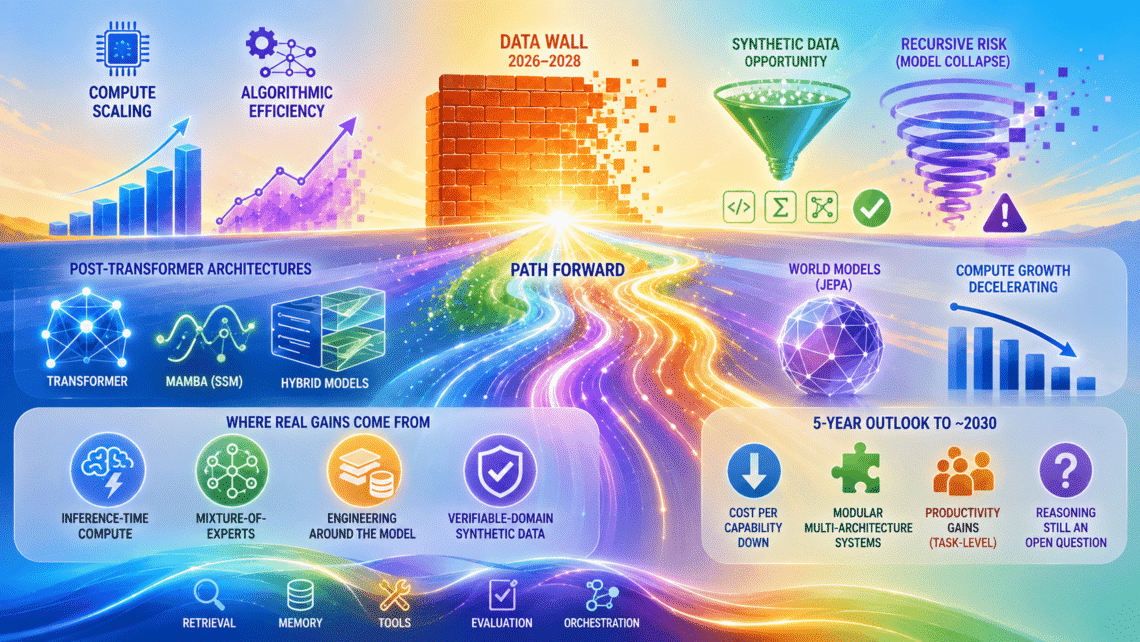
The single most consequential, best-evidenced constraint shaping the future of LLM technology over the next several years is what researchers call the data wall. Epoch AI’s careful analysis estimates the effective stock of high-quality, usable human-generated public text at roughly 300 trillion tokens, adjusted for quality and deduplication. That figure sounds enormous until it is set against actual consumption. GPT-4 was trained on somewhere between 6 and 13 trillion tokens.
A frontier model trained in 2026 using the compute available at facilities such as the Abilene Stargate site, running at roughly 240 tokens per parameter, a ratio pushed considerably higher than the original Chinchilla-optimal 20 tokens per parameter as labs squeeze more value from every available token, would want approximately 400 trillion tokens, a figure that already exceeds the entire unfiltered Common Crawl dataset.
The consensus estimate across multiple independent research groups places genuine exhaustion of easily accessible, high-quality public text somewhere between 2026 and 2028, with Epoch AI’s own analysis suggesting the timeline could compress toward the earlier end of that range if labs continue overtraining smaller models on repeated data passes, a practice already well underway. This is not a distant, speculative constraint. It is arguably the single most binding limitation on the pure scaling paradigm that dominated the first half of LLM development history, and any serious forecast of the future of LLM technology must treat it as a near-term engineering reality rather than a theoretical curiosity.
Synthetic Data: A Real Tool With a Real Failure Mode
The industry’s primary response to the data wall has been synthetic data, using models to generate additional training material rather than relying solely on scraped human text. Adoption has moved considerably faster than even optimistic 2022 forecasts anticipated. Microsoft’s Phi-4 model was trained on 400 billion synthetic tokens spanning fifty distinct dataset types and scored 91.8 percent on AMC math benchmarks, outperforming considerably larger models trained primarily on human text. Nvidia’s 320 million dollar acquisition of Gretel AI signals how seriously infrastructure providers now treat synthetic data generation as core, durable business infrastructure rather than a temporary stopgap.
But synthetic data carries a genuine, well-documented failure mode that any honest forecast of the future of LLM technology must address directly rather than glossing over. Recursive training, using one generation of model output to train the next generation of the same model family without careful filtering, causes measurable model collapse, a progressive narrowing of output diversity and a degradation in the model’s grip on the genuine statistical structure of real-world language and knowledge.
The critical distinction researchers now draw is between replacing human data wholesale, which reliably degrades model quality over successive generations, and accumulating synthetic data as a targeted supplement, filtered and verified specifically for tasks with checkable, verifiable answers such as mathematics, code, and structured reasoning, where synthetic data has shown genuine and repeated success. The future of LLM technology almost certainly depends on this distinction being respected rigorously by every major lab, since the alternative, an AI industry inadvertently training its most important systems on a slowly collapsing diet of recycled AI output, represents a genuinely serious and underappreciated risk.
The Post-Transformer Architecture Race
A second major front shaping the future of LLM technology involves the underlying architecture itself. The Transformer’s core self-attention mechanism, examined extensively elsewhere on this blog, carries a fundamental computational cost, its complexity scales quadratically with sequence length, making extremely long contexts, legal contracts, genomic sequences, entire codebases, computationally expensive in a way that becomes genuinely impractical at scale.
State Space Models, particularly the Mamba architecture and its recent Mamba-3 iteration published in March 2026, address this directly by replacing attention with a mechanism inspired by classical control theory, achieving linear rather than quadratic complexity with respect to sequence length while maintaining an explicit, continuously updated hidden state that functions as a form of persistent memory. Critically, the future of LLM technology is not shaping up as a clean architectural replacement, Mamba entirely displacing Transformers, but rather as convergence toward hybrid designs.
Nvidia’s Nemotron 3 family, released in April 2026, explicitly alternates between standard attention layers and Mamba-2 state space layers within the same model, a design chosen specifically because long-context efficiency has become increasingly critical as more LLMs get embedded into agentic systems that require maintaining and reasoning over increasingly long working contexts. Industry practitioners tracking this shift have been notably measured in their assessment, treating each new architectural release as a practical question, does this change agent loop cost, prompt caching efficiency, or cost per session, rather than as a revolutionary leap, a sober framing worth adopting for any credible forecast.
World Models and the LeCun Bet
A more architecturally radical thread shaping the future of LLM technology comes directly from the reasoning critique examined in Part 1. Yann LeCun’s Joint Embedding Predictive Architecture, JEPA, represents a genuinely different bet, one where the model learns to predict abstract representations of its input rather than predicting raw pixels or tokens one at a time, an approach LeCun argues is dramatically more efficient and more capable of producing something closer to genuine world understanding than token-level autoregressive prediction can achieve. Image and video variants, I-JEPA and V-JEPA, have already shown promising results, and a language-focused variant, LLM-JEPA, began circulating in research circles in September 2025.
Whether JEPA-style world models genuinely displace autoregressive transformers within the forecast window of this article, or remain a productive but secondary research direction, is precisely the kind of question where honest forecasting requires acknowledging genuine uncertainty rather than false confidence.
What seems considerably more likely, based on the pattern already visible in hybrid Transformer-Mamba designs, is that the future of LLM technology converges toward modular, multi-architecture systems, distinct specialized components, efficient long-context backbones, world-model style planning modules, memory-augmented systems capable of accumulating knowledge across interactions, combined deliberately within a single deployed system, rather than any single architecture winning outright and displacing all competitors.
Compute Growth Is Slowing From Its Recent Peak
A frequently overlooked but genuinely important input to any credible forecast of the future of LLM technology is that raw compute growth itself, while still substantial, is decelerating from its most extreme recent trajectory. Detailed compute accounting shows frontier training system capacity increasing roughly 160-fold across four years, or approximately 3.55 times annually, a blistering pace, but one that current chip price-performance trends, improving at roughly 1.39 times annually after inflation adjustment according to Epoch AI, cannot sustain indefinitely without continued, extraordinary capital investment of the kind examined in this blog’s recent five-part series on AI industry economics.
When the data wall constraint, the synthetic data ceiling, and a compute growth trajectory that must eventually moderate are considered together, serious forecasters increasingly anticipate a genuine slowdown in pure pretraining scale gains sometime after 2028, a specific, dated prediction considerably more grounded than vague talk of an approaching technological plateau.
Where the Real Gains Will Actually Come From
If pure pretraining scale is approaching genuine physical and data constraints, where does the future of LLM technology’s next wave of capability improvement actually come from. The evidence assembled across both parts of this series points toward four specific, already-visible directions rather than speculative breakthroughs.
Inference-time compute, examined in Part 1, will almost certainly continue growing as a share of total capability gains, even as its own scaling exhibits the latent saturation trend documented in the 2026 reinforcement learning literature, meaning gains will likely become more expensive to extract even as they continue.
Mixture-of-Experts architectures, which activate only a fraction of total parameters for any given input, will continue to improve the ratio of genuine capability to compute cost, a trend already visible in models like Nemotron 3, which pairs MoE sparsity with hybrid Mamba-Transformer layers specifically to maximize this efficiency.
Engineering built around the model, retrieval systems, persistent memory, tool use, structured evaluation, and orchestration across specialized sub-models, is where practitioners closest to production deployment increasingly locate the genuine, durable competitive advantage, precisely because effortless capability gains purely from scaling a single monolithic model are ending, a conclusion directly consistent with the AI ROI findings from our five-part economics series, where the companies capturing real value were those redesigning workflows around AI rather than simply deploying a bigger model.
And targeted, verifiable-domain synthetic data, mathematics, code, formal logic, structured reasoning, will continue delivering genuine capability gains precisely because these domains allow automated verification of correctness, sidestepping the model collapse risk that makes wholesale synthetic replacement of general text so dangerous.
A Grounded Five-Year Outlook
Bringing the full evidence base from both parts of this series together, a genuinely hype-free forecast for the future of LLM technology through roughly 2030 looks considerably more modest, and considerably more interesting, than either extreme position commonly advanced in public discussion. Costs per unit of capability will very likely continue falling, driven by the well-documented three to four times annual algorithmic efficiency gains established in Part 1, MoE sparsity, and hybrid architecture efficiency, even as headline frontier training runs continue costing more in absolute terms due to sheer scale.
Complexity will increasingly shift from monolithic scale toward modular, multi-architecture systems combining efficient long-context backbones, specialized reasoning modules, and persistent memory, rather than a single architecture simply growing larger indefinitely. Productivity gains will very likely continue showing the pattern documented in Part 1’s rigorous economic research, real and measurable at the task level, but persistently capped by how effectively humans and organizations integrate these tools into actual workflows, a human and organizational bottleneck rather than a purely technical one.
And the deeper question of whether these systems achieve anything resembling genuine human-style reasoning, as opposed to increasingly sophisticated and useful pattern matching, will very likely remain genuinely unresolved throughout this entire forecast window, continuing to divide serious, credible researchers rather than being definitively settled by any single benchmark or model release.
Conclusion
The future of LLM technology, examined honestly and against the specific, quantified evidence assembled across this two-part series, is neither the smooth, inevitable glide path toward artificial general intelligence that some industry marketing suggests, nor the dead end that the most dismissive skeptics predict. It is something more specific, more constrained, and ultimately more useful to understand precisely, a technology approaching genuine, well-documented physical and data limits on its original scaling paradigm, responding with real, measurable, but imperfect engineering solutions, synthetic data, architectural hybridization, inference-time reasoning, that each carry their own specific tradeoffs and failure modes.
Whether that combination proves sufficient to sustain the pace of capability improvement the public has grown accustomed to watching since 2020, or whether the field genuinely decelerates as several credible forecasts now anticipate sometime after 2028, is a question this series cannot resolve definitively today. What it can offer, and what the marketing narrative surrounding this technology so rarely does, is a precise, evidence-grounded account of exactly which forces will determine that answer, and why.
This concludes our two-part series on LLM development history and the future of LLM technology. Explore Part 1 for the full account of the past decade.
-
The Critical Truth About LLM Development History: A Decade of Progress Without the Hype (Part 1)
This is Part 1 of a two-part series taking a rigorous, hype-free look at large language model progress. Part 1 examines what actually happened technically over the past decade, separating genuine algorithmic breakthroughs from marketing narrative. Part 2 will examine the specific techniques currently in the pipeline and offer a grounded forecast for the next five years.
Separating the Signal From a Decade of Noise
Ten years of large language model development have produced a genuinely confusing public narrative, one part remarkable engineering achievement, one part carefully managed marketing, and one part unresolved scientific dispute among the researchers who actually build these systems. This two-part series sets out to examine LLM development history the way a rigorous engineering post-mortem would, using measured, published, peer-reviewed evidence rather than product launch keynotes, and being explicit about where genuine scientific disagreement still exists among serious researchers.
The honest starting point is that two distinct forces drove all measurable progress across this LLM development history, and conflating them, as popular coverage routinely does, obscures rather than clarifies what actually happened and what is likely to happen next.
Force One: Raw Compute Scaling
The dominant narrative of early LLM development history was straightforward and, for several years, empirically accurate. OpenAI’s 2020 scaling laws, authored by Jared Kaplan and colleagues, established that model performance improved predictably as a power law function of parameters, dataset size, and training compute.
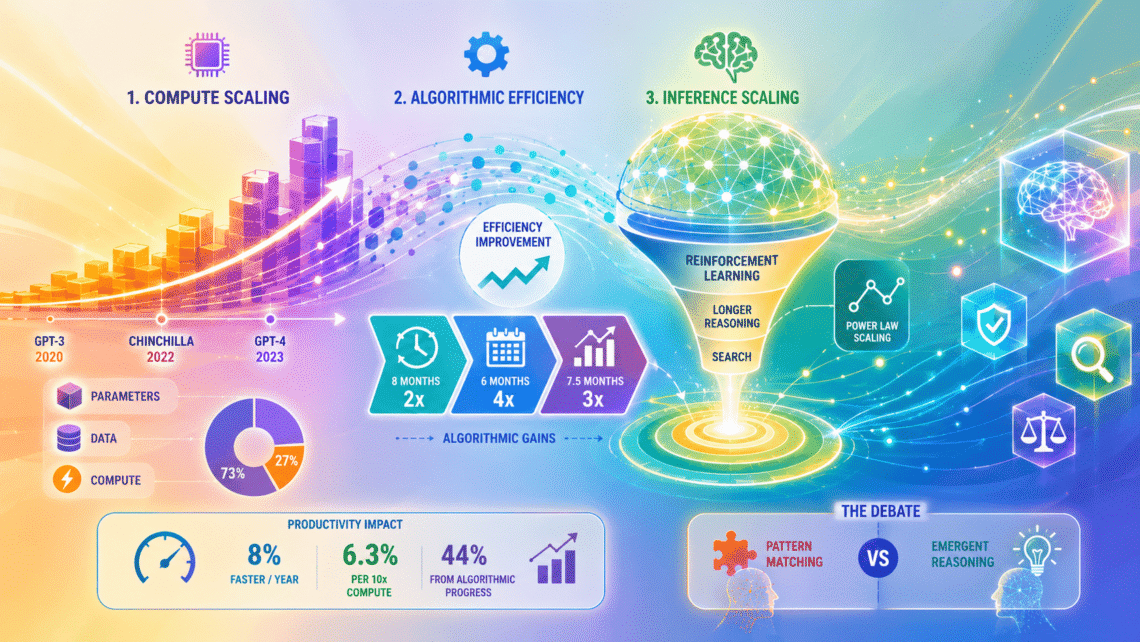
The practical conclusion drawn from this research was specific and consequential: given a fixed compute budget, the optimal strategy allocated roughly 73 percent toward parameters and only 27 percent toward data, meaning build the largest model you can afford and do not worry excessively about data volume. GPT-3, a 175 billion parameter model trained on just 300 billion tokens, a ratio of roughly 1.7 tokens per parameter, was a direct product of this thinking and became a genuine sensation.
This phase of LLM development history proved short-lived once subjected to more rigorous testing. DeepMind’s 2022 Chinchilla paper, examined extensively elsewhere on this blog, demonstrated that Kaplan’s original scaling laws had significantly underweighted the value of training data relative to parameters. The compute-optimal ratio, Chinchilla established, was closer to 20 tokens per parameter, not 1.7, meaning GPT-3 scale models trained under the earlier Kaplan regime were substantially undertrained relative to their parameter count.
This single correction, more than any subsequent architectural innovation, explains much of the capability jump between the GPT-3 and GPT-4 generation of models, a fact that receives considerably less public attention than it deserves given its outsized practical impact on LLM development history.
Force Two: Algorithmic Efficiency, the Quieter and More Important Story
The genuinely underappreciated thread running through LLM development history is algorithmic efficiency, improvements that let a model achieve a given performance level using dramatically less compute than an earlier approach required, entirely independent of simply buying more hardware. Multiple independent research efforts, using different methodologies, have converged on a strikingly consistent estimate. Epoch AI’s analysis found that training compute required to reach a fixed performance threshold has halved approximately every eight months.
Anthropic CEO Dario Amodei separately estimated the figure at roughly four times per year. A 2025 paper titled Price of Progress, isolating algorithmic gains specifically from open models to control for competitive effects, independently estimated algorithmic efficiency progress at approximately three times per year. Three independent methodologies converging on halving times of eight months, six months, and seven and a half months respectively is a genuinely rare degree of empirical agreement in a field this contested, and it represents one of the more solid, well-evidenced conclusions available about LLM development history to date.
A more rigorous 2025 academic framework distinguishes between compute-dependent and compute-independent algorithmic advancements specifically to avoid conflating these two forces, since compute-dependent improvements only become significant at scales far beyond their original conception, while compute-independent improvements raise efficiency uniformly across every scale. This distinction matters directly for forecasting, since it clarifies that some techniques currently discussed as breakthroughs will only meaningfully matter once frontier labs deploy compute budgets an order of magnitude beyond what is currently available, while others are already delivering their full benefit today.
The Third Axis Nobody Anticipated: Inference Scaling
Perhaps the single most consequential shift in LLM development history over the past two years has been the emergence of an entirely new axis of scaling that the original Kaplan and Chinchilla frameworks never accounted for. From 2020 through 2024, frontier progress was governed almost entirely by training scale, larger datasets, larger models, larger training compute budgets. Over 2024 and 2025, the field added a fundamentally different second axis, inference scale, also called test-time compute, spending considerably more computation at the moment of generation itself, through longer deliberation and search-like reasoning strategies, to raise problem-solving performance, sometimes more cost-effectively than simply training a larger base model in the first place.
This bifurcation genuinely reframes what counts as progress within LLM development history, and it explains a pattern that confused many observers through 2025, models with similar or even smaller parameter counts than their predecessors nonetheless posting dramatically better performance on hard reasoning benchmarks, purely because they had learned, through reinforcement learning on verifiable outcomes, to generate longer, more structured internal reasoning traces before committing to a final answer.
The 2026 academic literature on reinforcement learning post-training scaling has since found that this inference-time scaling follows its own distinct power law relationship between test loss, compute, and data, structurally similar to pretraining scaling laws but with a critical difference, reinforcement learning post-training exhibits a latent saturation trend, meaning that while larger models do achieve higher learning efficiency during this phase, the returns diminish measurably faster as scale increases than they do during pretraining itself. This finding matters enormously for Part 2 of this series, since it suggests inference scaling cannot simply be scaled indefinitely as a substitute for continued pretraining progress.
What This Actually Meant for Productivity, Measured Rigorously
Separating LLM development history from marketing requires looking at controlled, preregistered economic research rather than anecdote, and the most rigorous study available offers a genuinely useful, if considerably more modest than commonly claimed, picture. A December 2025 preregistered experiment involving over 500 consultants, data analysts, and managers, each completing real professional tasks using one of thirteen different LLMs, found a robust calendar-time scaling effect, each year of frontier model progress was associated with an 8 percent reduction in task completion time.
Isolating the effect of pure compute scale specifically, a tenfold increase in model training compute was associated with only a 6.3 percent reduction in task completion time, with roughly 44 percent of total observed improvement attributable specifically to algorithmic progress rather than raw scale.
The study’s most analytically important finding, however, concerns a divergence that deserves far more public attention than it currently receives. While the quality of autonomous model output scaled essentially linearly with training compute, the quality of human-assisted output remained largely stagnant across successive model generations. This implies that human users, through the specific way they prompt, interpret, and apply model outputs, effectively cap the realized capability gains of frontier models at a fixed ceiling, a genuinely sobering finding for anyone assuming that simply deploying a more capable model automatically translates into proportionally greater organizational productivity, a theme directly consistent with the AI ROI evidence examined in our recent five-part series on AI industry economics.
The Genuine Scientific Dispute: Pattern Matching or Reasoning
No honest account of LLM development history can avoid the genuine, unresolved dispute currently dividing serious AI researchers, a dispute that has nothing to do with marketing hype and everything to do with what these systems are actually doing internally. Yann LeCun, Meta’s former chief AI scientist, has argued consistently and pointedly throughout 2025 and 2026 that autoregressive transformer models, however impressive their outputs, remain fundamentally pattern matching engines rather than genuine world models.
Yann’s critique is specific: current LLMs can describe gravity eloquently because they have ingested millions of textual descriptions of gravity, but they cannot predict that an unsupported object will fall because they possess no internal concept of falling beyond statistical token associations, no grounded representation of cause and effect that would allow genuine planning or reasoning about consequences.
Cognitive scientist Gary Marcus has raised a closely related but distinct critique, tracing his skepticism back to his own 1992 publications and his 2001 book The Algebraic Mind, which anticipated the hallucination and unreliable reasoning problems LLMs continue to exhibit decades before LLMs existed. Neuroscientist Karl Friston has framed the underlying objection even more starkly, describing LLMs as, in his words, just a mapping between content and content, with nothing genuinely in the middle representing understanding.
It is worth noting explicitly that this dispute is not settled, and reasonable, technically serious researchers occupy positions across the entire spectrum, from LeCun and Marcus’s skepticism to the position, held by many working directly on frontier reasoning models, that inference-time scaling and reinforcement learning on verifiable outcomes are already producing genuinely emergent reasoning capability that simple pattern matching could not explain.
What is measurably true, regardless of which theoretical camp proves correct, is the hallucination statistic itself. Even as of April 2026, hallucinations in court filings by prominent, sophisticated law firms using frontier AI tools continued to occur, direct evidence that the hallucination problem central to this entire LLM development history debate remains genuinely unresolved rather than a solved problem simply awaiting wider deployment.
Conclusion
The genuine, evidence-grounded account of LLM development history over the past decade is considerably more interesting, and considerably more measured, than either the breathless marketing narrative or the dismissive skeptic narrative alone would suggest. Real, repeatedly measured algorithmic efficiency gains of roughly three to four times per year compounded with genuine compute scaling to produce the capability curve the public has observed.
A genuinely new axis of progress, inference-time scaling, emerged in the past two years and has already begun exhibiting its own distinct saturation dynamics. And a serious, unresolved scientific dispute concerning LLM development history about whether the underlying architecture can ever produce genuine reasoning, rather than increasingly sophisticated pattern matching, continues to divide credible researchers rather than being settled decisively in either direction.
Part 2 of this series turns from this historical account toward the specific technical pipeline, the architectural alternatives to the transformer, the emerging training techniques, and the realistic, hype-free forecast for what these forces are actually likely to produce, in terms of cost, capability, and genuine reasoning ability, over the next five years.
Part 2: The Next Five Years, coming next in the Current Events series.
-
The Critical Future of AI Mathematics: Literature Mining, Crisis Debates, and What Comes Next (Part 2)
This is Part 2 of a series examining how AI is transforming mathematical research. Part 1 covered automated theorem proving and formal proof assistants. Part 2 examines literature mining, the peer review crisis, existential debates within the mathematical community, and the future of AI mathematics as a discipline.
From Proving Theorems to Reading Everything Ever Written
Part 1 traced how AI systems learned to construct genuinely new mathematical proofs. But an equally consequential and less discussed capability underlies much of that progress: the ability to read, search, and synthesize the entire published mathematical literature at a scale no human researcher could ever match. This capability, often described as literature mining, has become central to understanding the future of AI mathematics, and it has already produced one of the field’s more embarrassing public controversies.
In October 2025, OpenAI claimed that GPT 5 had solved ten previously open Erdős problems. The claim was publicly refuted within hours. The model had not actually solved the problems from first principles. It had performed what researchers now call a super literature search, locating previously published but obscure papers that had already resolved the problems, papers that had simply escaped the attention of the mathematicians maintaining the Erdős problem database.
A similar pattern recurred when DeepMind deployed an agent called Aletheia at the end of 2025, which attempted 700 unsolved problems from the Erdős database and correctly resolved thirteen, but only four represented genuinely new mathematical work. The other nine were, once again, successful literature searches rather than novel proofs.
This distinction matters enormously for understanding the future of AI mathematics honestly. Locating a forgotten proof buried in decades of published papers is a genuinely valuable service to the mathematical community, since human researchers cannot possibly track every result published across thousands of journals. But it is a fundamentally different capability from generating new mathematics, and conflating the two, as several early press releases did, has become a significant source of friction between AI labs and the mathematicians whose trust they need.
The Peer Review System Under Genuine Strain
The most immediate and practically consequential challenge shaping the future of AI mathematics is not a technical limitation at all. It is institutional. AI systems can now generate a large number of proofs that appear correct on inspection, often within hours, while carefully verifying a single dense mathematical argument by hand can take a human expert weeks or longer. The number of mathematicians qualified to review highly specialized proofs in any given subfield is extremely limited, and this mismatch is creating what several researchers now openly describe as a peer review crisis specific to AI generated mathematics.
The concern is not hypothetical. Multiple instances have already occurred in 2026 in which AI systems or their developers announced significant mathematical results through press releases or preprints before the claims had received adequate scrutiny, only for errors or overstatements to surface afterward under closer examination. If a substantial volume of AI generated mathematical reasoning enters circulation as preprints or public announcements faster than the community can verify it, the practical effect is not merely wasted reviewer time.
It risks burying genuinely valuable human and AI assisted discoveries under a volume of unverified claims that erodes trust in the published mathematical record itself, a concern mathematician Jeremy Avigad has documented carefully in his own 2026 survey of the field, noting that automated reasoning tools including SAT solvers have already resolved open problems in combinatorics, algebra, and discrete geometry, alongside machine learning techniques that have identified new combinatorial objects and counterexamples to standing conjectures, all while formal verification systems like Lean’s Mathlib library are increasingly used to verify results even before or entirely outside the traditional peer review process.
A Genuine Crisis Essay and the Question of Authorship
The tension within the mathematical community reached a notably sharp point in early August 2026, when a widely circulated essay titled “The Crisis of AI-Generated Mathematics” argued for what its author called total opposition to the use of artificial intelligence in mathematics.
The essay’s specific example is illustrative of the deeper concern driving the future of AI mathematics debate: a mathematician working in matroid theory, before publishing a completed solo paper, offered the project as a test case for an AI system’s ability to prove theorems and autonomously write up results, raising a question the field has not yet resolved, namely what authorship and intellectual authority even mean once AI can generate publishable mathematical content without a human necessarily understanding every step.
The essay proposes genuinely radical institutional responses, including replacing traditional individual authorship with a model of co-ownership, in which any mathematician who can demonstrate authoritative understanding of a result, the kind of deep comprehension expected of a human author today, would be recognized as a legitimate steward of that work regardless of who or what originally generated it.
Whether or not this specific proposal gains traction, its existence signals something important about where the future of AI mathematics debate has moved: from a purely technical question about capability toward a genuinely institutional question about what journals, credentialing bodies, and the mathematical community itself will need to become in response.
The Existential Framing Emerging From Within the Field
Perhaps the most striking development shaping discussion of the future of AI mathematics is the emergence, from within the mathematical community itself rather than from outside AI safety circles, of essays explicitly framing rapid mathematical AI progress as a signal of broader existential risk. One widely discussed 2026 essay observes that career defining theorems are now being proven on a weekly basis by AI systems given only minimal guidance, and notes that internal frontier models at major AI labs are reportedly producing mathematical breakthroughs in batches, with the rate of serious AI proven theorems appearing to grow exponentially through the year.
The essay’s central argument is not really about mathematics as a profession at all. It uses the visible, measurable acceleration in mathematical capability as a legible proxy for a much larger and harder to observe acceleration in general AI reasoning ability, arguing that mathematicians are uniquely well positioned to notice this signal early precisely because mathematical correctness is so much easier to verify than progress in messier real world domains.
This framing has proven genuinely divisive. Some in the mathematical community view it as an overreaction that conflates competition style problem solving with the far broader, messier work most research mathematicians actually do. Others, including voices circulating informally on social platforms suggesting that a given year’s Fields Medal might be the last one awarded primarily for human insight, treat it as a serious and urgent signal.
Terence Tao’s own more measured position, discussed in Part 1, sits deliberately between these poles, acknowledging the genuine disruption while insisting that the deeper question mathematicians must answer is what mathematical research is actually meant to accomplish, a question that predates AI entirely and that AI has simply made newly urgent rather than newly created.
What the Career Landscape Actually Looks Like
For students and early career mathematicians, the future of AI mathematics carries direct practical stakes beyond the philosophical debate. Current labour market analysis suggests the discipline is bifurcating rather than simply shrinking. Roles centred on routine computation and mechanical proof verification are being genuinely automated, while demand is rising sharply for hybrid roles, AI research scientists who blend theoretical mathematical training with practical machine learning experimentation, computational mathematicians who apply numerical and AI methods to open scientific problems, and quantitative analysts who integrate AI driven techniques into financial and risk modelling.
Compensation data suggests these hybrid roles, which explicitly combine deep mathematical fluency with programming and AI systems knowledge, currently command a meaningful premium over more narrowly traditional theoretical positions, a trend that career analysts expect to strengthen rather than reverse as the decade continues.
The clear implication for mathematics education, a question raised explicitly in university seminars examining the future of AI mathematics through 2025 and 2026, is that foundational mathematical fluency, understanding what a proof actually establishes and why, rather than merely executing computational procedures, is becoming more valuable precisely because AI has made the procedural layer nearly free.
Whether mathematics curricula adapt quickly enough to reflect that shift, moving away from testing procedures AI now performs flawlessly and toward cultivating the judgement needed to specify problems correctly and evaluate AI generated arguments critically, remains genuinely unresolved and varies enormously between institutions.
Toward a Genuinely Balanced Outlook
Bringing the full picture from both parts of this series together, the future of AI mathematics is neither the triumphant, fully automated transformation suggested by the most breathless press releases, nor the wholesale crisis threatening the discipline’s survival that the most alarmed essays describe. The verified achievements are genuinely remarkable: medal level Olympiad performance, formally verified proofs of major theorems, and at least a handful of authentically novel contributions to open research problems accepted by leading mathematicians.
The genuine problems are equally real: a peer review infrastructure straining under a volume of claims it cannot verify fast enough, unresolved questions about authorship and intellectual credit, and a small but vocal contingent within the field itself treating the pace of progress as a warning sign for something considerably larger than mathematics.
What seems most likely, based on the trajectory traced across both parts of this series, is a discipline that reorganizes around a division of labour broadly consistent with what Terence Tao has already described, humans specifying problems and exercising judgement over what mathematics is worth pursuing and why, formal systems and AI handling an increasing share of the mechanical construction and verification of proofs, and an institutional structure, journals, credentialing bodies, and peer review itself, that will need genuine reinvention rather than incremental adjustment to remain trustworthy.
Whether that reinvention happens deliberately, through the kind of proposals now circulating in essays and conference discussions, or reactively, in response to a genuine crisis of confidence in the published mathematical record, is likely to be decided over the next several years, not decades, given the pace this series has documented throughout 2025 and 2026.
Conclusion
The future of AI mathematics is being written in real time, and unusually for a technological transformation, it is being written with genuine, careful participation from the very experts most qualified to evaluate it, rather than imposed on a discipline caught unaware. That is, on balance, a reason for cautious optimism rather than alarm.
Mathematics has weathered a genuine crisis of foundations once before, a century ago, and emerged with a more rigorous, more explicit, and ultimately more resilient understanding of its own methods. Whether the current moment produces a comparable resolution, or whether the strains identified across both parts of this series prove harder to reconcile than the logical paradoxes of the early twentieth century, is a question only the coming years of actual practice, not further speculation, will be able to answer.
-
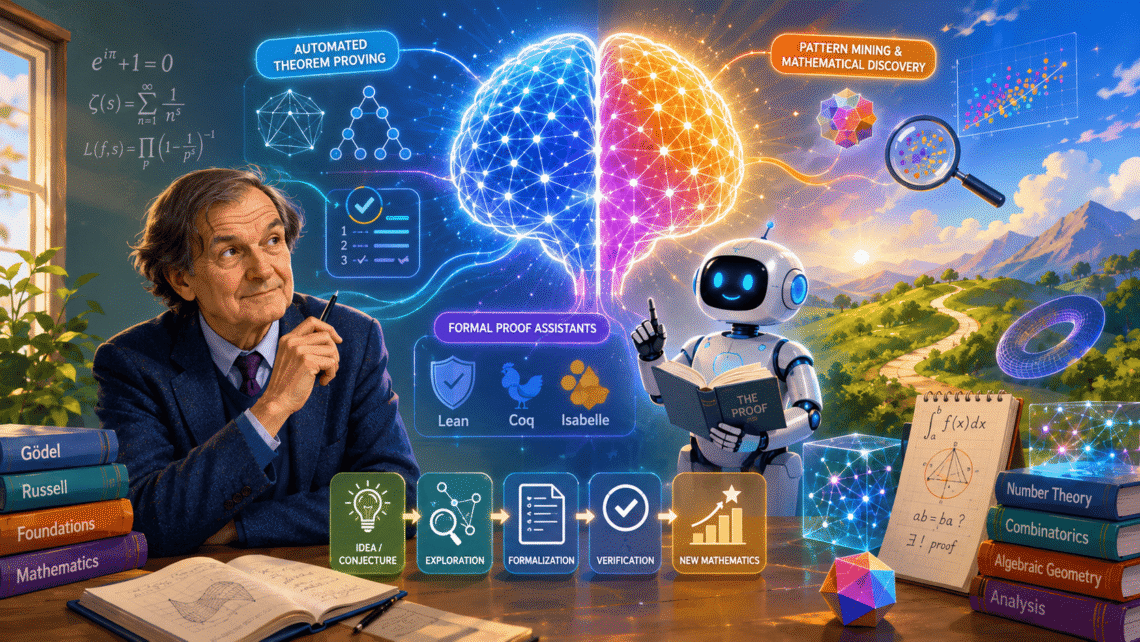
The Powerful Rise of AI in Mathematics: Automated Reasoning, Proof Assistants, and What Comes Next (Part 1)
This is Part 1 of a series examining how AI is transforming mathematical research. Part 1 covers the core contributions in automated theorem proving, proof assistants, and pattern mining, along with the limitations and open debates currently dividing the mathematical community.
A Discipline That Prided Itself on Being Unautomatable
For most of computing history, mathematics was assumed to be the last stronghold that AI would conquer, if it ever could at all. Mathematical proof requires airtight, step by step logical rigor of a kind that resists the probabilistic pattern matching underlying most machine learning systems. Yet in the space of roughly two years, AI in mathematics has moved from a curiosity discussed at specialist workshops to a subject serious enough to warrant a dedicated public lecture at the 2026 International Congress of Mathematicians, delivered by Terence Tao, widely regarded as the most accomplished living mathematician.
Tao’s framing was direct: mathematics, he argued, is entering a second crisis in its foundations, comparable in scale to the crisis triggered by Russell’s paradox and Gödel’s incompleteness theorems a century earlier, except this time the disruption comes from artificial intelligence rather than internal logical contradiction.
Understanding what AI in mathematics has actually achieved, where it genuinely struggles, and what mathematicians themselves are saying about it requires examining three distinct but interconnected fronts, automated theorem proving, formal proof assistants, and pattern mining across the mathematical literature, each of which has developed at a strikingly different pace.
Automated Reasoning: From Olympiad Silver to Erdős Problems
The most publicly visible achievement of AI in mathematics has come from competition mathematics, precisely because Olympiad problems provide a clean, verifiable benchmark. In 2024, Google DeepMind’s AlphaProof, an AlphaZero inspired reinforcement learning system, combined with AlphaGeometry 2, solved four of six problems at the International Mathematical Olympiad, achieving a score equivalent to a silver medal, the first time any AI system had reached medal level performance at the competition.
AlphaProof trains by learning to find formal proofs through reinforcement learning on millions of auto-formalized problems, and for the hardest cases uses what DeepMind calls test time reinforcement learning, generating and learning from millions of related problem variants at the moment of inference itself, rather than relying purely on pretrained knowledge.
Progress since then has accelerated further. By the 2025 IMO, an advanced Gemini Deep Think framework achieved gold medal level performance, and OpenAI reported a comparable gold medal result from one of its own models. These results moved AI in mathematics from an interesting research direction to a genuine competitive presence in a domain long considered the exclusive preserve of the most gifted young mathematicians in the world.
The frontier has moved beyond Olympiad problems entirely into genuinely unsolved research mathematics. In January 2026, reports emerged that GPT 5.2 Pro, paired with the formalization system Aristotle, generated proofs for two specific Erdős Problems, open questions in number theory that had remained unresolved for years, and crucially, these proofs secured acceptance from Terence Tao himself after careful review. Separately, DeepMind’s AlphaEvolve system collaborated directly with Tao to find new approaches to previously unsolved mathematical problems, demonstrating that AI in mathematics is no longer confined to reproducing known results faster but is beginning to genuinely contribute novel mathematical insight.
Proof Assistants: The Infrastructure That Makes Trust Possible
Running parallel to automated theorem proving is a distinct and arguably more foundational thread of AI in mathematics: formal proof assistants, software systems such as Lean, Coq, and Isabelle that allow mathematical proofs to be written in a machine checkable formal language, verified line by line with the same rigor a computer applies to checking whether a program compiles. Tudor Achim, CEO of Math Inc, captured the significance of this approach starkly: when a formal system outputs a proof, nobody has to look at it, because you know it is correct by construction, addressing what he calls the verification problem, the bottleneck created when AI generates mathematical content faster than humans can check it.
The pace of progress specifically within Lean 4 based formalization has been extraordinary through 2025 and into 2026. HunyuanProver, a model fine tuned specifically for interactive theorem proving, achieved state of the art results on the standard MiniF2F benchmark and successfully proved several genuine IMO level statements. Using a system called Gauss, Math Inc completed a challenge originally set by Terence Tao and mathematician Alex Kontorovich to fully formalize the strong Prime Number Theorem in Lean, a genuinely significant undertaking given the theorem’s depth and historical importance.
Most recently, a system called AxiomProver, working with mathematician Ken Ono, reportedly solved all twelve problems from the 2025 Putnam Competition, widely regarded as the most difficult undergraduate mathematics competition in the United States, and went further, resolving four previously open conjectures that had stumped human mathematicians, including uncovering a connection to nineteenth century Jacobi symbols that had been entirely missed by the human researchers working on the problem.
Tao himself has tracked this progress with characteristic precision, introducing the concept of the de Bruijn factor, a measure of how much additional effort formalizing a proof in Lean requires compared to writing it informally. He estimated this factor at roughly twenty in 2023 and 2024, and noted by late 2025 and into 2026 that rapid advances in autoformalization, AI systems that translate informal mathematical writing directly into formal Lean code, had essentially emptied the queue of unclaimed formalization tasks on at least one major mathematical library project, a striking practical demonstration of how quickly this specific application of AI in mathematics has matured.
Pattern Mining and Mathematical Discovery Beyond Proof
A third and less publicly discussed application of AI in mathematics involves pattern mining and conjecture generation, using machine learning not to prove statements but to discover which statements might be true in the first place, a task that has historically depended on mathematical intuition built over decades of experience. DeepMind’s FunSearch system, which combines large language models with evolutionary program search, discovered new solutions to the cap set problem, a longstanding open question in combinatorics, and produced more effective bin packing algorithms than previously known, genuinely novel mathematical objects rather than reproductions of existing results.
A related system called PatternBoost used pattern recognition across large mathematical datasets to disprove a conjecture that had stood unresolved for thirty years, demonstrating that AI in mathematics can contribute not only proofs of true statements but also counterexamples that overturn long held mathematical beliefs. This lineage traces back to earlier systems such as Graffiti, which pioneered automated conjecture generation decades before the current wave of deep learning made such systems dramatically more capable. Comprehensive surveys of this emerging field now describe mathematical exploration and discovery at scale as a distinct research area in its own right, separate from both automated theorem proving and formal verification, focused specifically on using AI to identify which mathematical questions are worth asking.
Where AI in Mathematics Genuinely Struggles
Despite this rapid progress, mathematicians closest to the technology are notably careful about its current limitations, and Tao’s own analysis is instructive precisely because it avoids both dismissiveness and hype. He draws a sharp and important distinction between Lean as a formal proof assistant versus an automatic theorem prover, noting that Lean formalizes a proof a human has already found, and that on its own it is not all that useful in discovering genuinely new proofs.
The emerging best practice he describes divides labour deliberately: humans author or carefully review the statement of a theorem, since verification only certifies that a formal proof matches a formal statement, not that the formal statement actually captures the mathematician’s real intent, while automation increasingly handles the mechanical work of constructing the proof itself once the statement is correctly specified.
This human review bottleneck remains genuinely unresolved. As Tao and his co-author Tanya Klowden note in their 2026 preprint on mathematical methods in the age of AI, there are serious concerns that entire areas of academic mathematical discourse could be drowned out by a flood of low quality AI generated content, echoing a concern raised independently by mathematician Vladimir Voevodsky years earlier, that a technically dense argument by a trusted author, difficult to check and superficially similar to arguments already known to be correct, is hardly ever checked in careful detail, a human trust shortcut that becomes considerably more dangerous once AI can generate such arguments at essentially unlimited scale.
There is also a genuine philosophical unease circulating within the mathematical community that goes beyond technical limitation. Discussions at academic seminars, including a Fall 2025 mathematics and AI course at the University of Washington, have raised pointed questions that Tao’s own lecture explicitly grapples with: does mathematics lose value when computers become better at it than humans, is there an enfeeblement risk in incorporating AI into mathematical training and education, and should foundational skills such as long division or manual integration still be taught if AI in mathematics can perform them instantly and flawlessly.
Tao’s own answer, delivered at the ICM lecture, was that mathematicians need to articulate far more clearly what goals mathematical research is actually meant to serve, arguing that theorem proving and problem solving alone were never the complete picture of why mathematicians do mathematics in the first place, and that this question has become newly urgent precisely because AI has begun to threaten the sufficiency of the old, implicit answer.
Conclusion
AI in mathematics has progressed, in the space of roughly two years, from solving Olympiad geometry problems to contributing genuine proofs accepted by Terence Tao for previously open questions in number theory, while formal proof assistants have simultaneously matured into infrastructure capable of verifying mathematical claims with a rigor no individual human reviewer can match at scale. Pattern mining systems have begun generating and disproving conjectures independently, adding a third distinct capability to the toolkit.
Yet the mathematicians working closest to these systems remain measured rather than triumphant, emphasizing that formal verification certifies correctness against a stated formal claim, not that the claim itself captures genuine mathematical intent, and that the deeper question of what mathematical research is actually for has become considerably more pressing than the narrower question of what AI can currently compute.
-
Is AI Making Us Smarter After All? Part 2: The Balanced Verdict on Human Thinking
This is Part 2 of a two-part series examining whether outsourcing creative and cognitive work to AI is degrading human thinking. Part 1 reviewed the substantial evidence for cognitive offloading and skill decay. Part 2 examines the counter-evidence, the conditions under which AI making us smarter is genuinely possible, and what a fair verdict actually requires.
The Evidence Deserves a Second Look
Part 1 of this series presented a genuinely troubling body of evidence: EEG studies showing weaker neural connectivity, clinicians losing diagnostic skill after AI support was introduced, and a documented illusion of competence among AI users. None of that evidence was overstated, and none of it should be dismissed. But responsible engagement with any body of research requires looking at the full picture, including the studies, researchers, and institutions actively exploring whether AI making us smarter is not just possible but already happening under the right conditions.
The truth that emerges from a complete review of the literature is neither the alarmist story nor a naive optimism. It is something more specific and more useful: the outcome depends heavily on how AI is used, not merely on whether it is used at all.
The Same MIT Study, Read More Carefully
It is worth returning to the widely cited MIT Media Lab EEG study from Part 1, because subsequent, more careful engagement with its actual design reveals an important nuance often lost in headline coverage. The study compared three conditions: writing entirely from memory, writing with a search engine, and writing with an LLM that performed the bulk of the composition itself. The condition that showed weakened neural engagement was specifically the one in which the AI did most of the intellectual work for the participant, essentially replacing their thinking rather than supporting it.
This distinction matters enormously for the AI making us smarter question, because it points toward a specific, testable hypothesis: the harm observed in cognitive offloading research may depend less on AI use per se and more on whether the human remains an active, effortful participant in the cognitive task or becomes a passive recipient of a finished output. A 2026 paper in Computers in Human Behavior captured this distinction precisely in its title: AI makes you smarter but none the wiser, describing a genuine disconnect between measurable performance gains and accurate self-assessment of understanding, a finding that complicates rather than confirms a simple decline narrative.
The Cover Letter Study: A Case for Genuine Learning
One of the more carefully designed recent studies bearing on AI making us smarter comes from behavioural scientists at Wharton, led by Benjamin Lira Luttges. Researchers taught participants to edit poorly written cover letters using either AI-generated feedback or feedback from human professionals. After this training phase, participants were then asked to edit a new, poorly written cover letter entirely without any assistance, human or AI.
The results were genuinely encouraging for anyone hoping AI making us smarter is achievable rather than wishful thinking. Letters produced by the AI-trained group were just as likely to secure a job interview, according to blind human evaluators, as letters from the group trained by human professionals. Crucially, the AI in this study did not simply hand participants a rewritten letter to copy. It walked them through structured feedback, and the learning transferred to genuinely independent performance afterward. This is precisely the kind of evidence that distinguishes AI used as a teacher from AI used as a replacement for thinking, and the distinction turns out to be the single most important variable across the entire body of research.
The Augmentation and Atrophy Framework
A comprehensive 2025 review published in the American Journal of Education and Information Technology introduced a useful conceptual framework worth adopting directly: the Problem-Solving Trade-Off Hypothesis, which proposes that AI’s cognitive impact splits cleanly into augmentation effects and atrophy effects, often for the very same tool, depending entirely on how it is deployed. When used as a research partner, actively engaged with and questioned, AI can genuinely augment critical inquiry. When accepted uncritically as a finished answer, the same tool promotes intellectual passivity.
This framework helps explain an otherwise confusing pattern in the research literature, where some studies find AI making us smarter while others find the opposite, often examining superficially similar AI tools. A comprehensive 2026 review of the cognitive literature reached a similarly nuanced conclusion: moderate AI usage shows minimal cognitive impact, while excessive reliance correlates with decreased critical thinking abilities. The relationship is not linear, and it is not simply about the amount of AI use but the structure and intentionality of that use.
What USC’s New Research Is Actually Testing
The most rigorous ongoing effort to move beyond speculation on the AI making us smarter question is a study launched in July 2026 by USC Viterbi, funded by the National Science Foundation, examining doctors, journalists, and software engineers to determine whether structured AI use can strengthen creativity and critical thinking rather than erode it. The study’s design is explicitly informed by earlier findings, including Stadler et al.’s 2024 research showing that AI use eases mental load but often at the expense of depth of understanding, precisely the tension this two-part series has traced throughout.
What makes the USC research significant is its second phase, which moves beyond simply measuring whether harm occurs and instead attempts to redesign how humans and AI interact specifically to optimise for better creativity and critical thinking outcomes. This reflects a genuine and important shift in the research community’s framing, from asking whether AI making us smarter or dumber is happening as a fixed, inevitable outcome, toward asking how interaction design itself determines which outcome occurs.
The Original Sin of Bad Comparisons
A significant portion of the alarm in this debate traces back to comparing AI-assisted outcomes against an idealised, effortful baseline that most people were never actually achieving in the first place. Before generative AI, the realistic alternative to using ChatGPT for a first draft was often not deep, effortful, independent composition. It was frequently a rushed, low-effort draft produced under time pressure, or simply not producing the work at all. The relevant comparison for AI making us smarter is not AI use versus an idealised deep thinker with unlimited time. It is AI use versus the actual behaviour people were engaging in before AI existed, which was frequently far from ideal itself.
This reframing does not excuse genuine skill atrophy in domains, such as medical diagnosis, where the underlying skill is safety-critical and must be actively maintained regardless of convenience. But for a great deal of everyday writing, brainstorming, and problem solving, the honest comparison group was never a maximally engaged human mind. It was often a tired, distracted, or simply absent one, and against that realistic baseline, AI assistance frequently represents a genuine net gain in both output quality and, when used interactively rather than passively, in the thinking that produces it.
Fostering Collaboration Rather Than Replacement
A 2025 paper in the Journal of Student Research at Indiana University East reviewed the competing evidence directly and reached a conclusion that deserves to anchor any balanced verdict on this topic: AI fosters collaboration and efficiency, and in some cases may enhance critical thinking skills, while overuse without deliberate structure can deplete those same skills. The word collaboration is doing important work in that sentence. It suggests the healthiest relationship with AI tools treats them as a genuine thinking partner, one whose output is questioned, challenged, and integrated actively, rather than either a replacement for thought or a threat to be avoided entirely.
The CHI 2025 Tools for Thought workshop, convening 56 researchers across cognitive science, human-computer interaction, and education, framed the challenge in exactly these terms: the goal is not merely to protect human cognition from AI’s potential negative impacts, but to actively design AI tools and interaction patterns that augment thinking, in the same way that older external tools, including writing itself, have historically extended and strengthened human cognitive capacity rather than simply replacing it.
A Genuinely Balanced Verdict
Bringing both parts of this series together, the fairest conclusion is neither AI making us dumber nor AI making us smarter as a fixed, universal outcome. It is that AI is a cognitive amplifier whose effect depends almost entirely on the structure of the interaction. Passive, unstructured use, accepting AI output wholesale without engagement, reliably correlates with skill atrophy and a documented illusion of competence. Active, structured use, treating AI as a partner to question, challenge, and learn from rather than simply defer to, shows genuine evidence of strengthening rather than weakening independent capability afterward.
For the specific creative activities that motivated this series, writing and image generation, the practical implication is clear. Using an LLM to produce a finished piece of writing with minimal engagement likely does erode the specific compositional and reasoning skills that writing itself has always cultivated as a side effect of the struggle to express an idea clearly. Using an LLM as an interactive collaborator, one whose suggestions are evaluated, revised, and pushed back against, appears considerably more likely to leave those same skills intact or even strengthened, closer to how a skilled writer benefits from an editor’s feedback than a diminishment of their own capability.
Conclusion: The Choice Is Still Ours
The question of whether AI is making humanity dumber or AI is making us smarter turns out not to be a question about the technology at all. It is a question about human choices, individual and institutional, about how deeply we engage with tools that are, for the first time in history, capable of doing so much of our thinking for us if we allow them to. The calculator did not make humanity worse at abstract mathematical reasoning, because the deeper reasoning skills calculators freed us from tedious computation to pursue turned out to matter more than the arithmetic itself.
Whether generative AI follows a similar trajectory, freeing humans for a more valuable kind of thinking, or instead erodes capacities more central to what makes thinking meaningful in the first place, remains genuinely undetermined, and will likely be decided differently across different domains, different age groups, and different patterns of use.
What the evidence assembled across both parts of this series makes clear is that the outcome is not predetermined by the technology itself. It is being determined, right now, by millions of individual decisions about how deeply to engage with the tools already in nearly everyone’s hands. That is, in the end, a more demanding and more hopeful conclusion than either a simple story of decline or a simple story of progress would offer. The evidence suggests humanity retains meaningful agency in this outcome. Whether AI making us smarter becomes the dominant story or the exception may depend less on further research and more on whether that agency is actually exercised.
This concludes our two-part series on AI and human cognition. Explore Part 1 for the full evidence on cognitive offloading
-
Is AI Making Us Dumber? Part 1: The Alarming Evidence Behind Cognitive Offloading
This is Part 1 of a two-part series examining whether outsourcing creative and cognitive work to AI is degrading human thinking. Part 1 reviews the scientific evidence on cognitive offloading and skill decay. Part 2 will examine the counter-evidence, the nuance researchers have found, and what a genuinely balanced position looks like.
A Question That Refuses to Go Away
Every generation of new technology has provoked the same anxious question. Socrates worried that writing would destroy memory. Calculators sparked fears that children would forget arithmetic. Search engines were accused of hollowing out our capacity to retain knowledge.
The question of whether AI making us dumber is a genuine phenomenon or merely the latest iteration of an old cultural panic deserves to be taken seriously rather than dismissed reflexively, precisely because this time there is a growing body of controlled scientific evidence to examine rather than speculation alone.
The honest starting point is that something measurable is happening. Whether it amounts to humanity becoming dumber, in any meaningful sense of that phrase, is a harder and more contested question, one this two-part series will examine from both directions. Part 1 takes the evidence for genuine cognitive harm seriously and presents it in full.
The Concept That Explains the Mechanism
The scientific literature converges on a specific mechanism to explain how and why AI making us dumber might actually occur: cognitive offloading, the act of delegating mental tasks to an external system, reducing one’s own cognitive engagement with the problem. This is not a new concept. Humans have used calculators to support arithmetic, GPS systems to support navigation, and the internet to support memory for decades. What distinguishes AI is the breadth and depth of tasks it can now absorb, extending well beyond simple retrieval into reasoning, synthesis, and even creative composition itself.
The International AI Safety Report 2026, a major government-commissioned review of AI risks, addressed this directly, noting that cognitive offloading can free up cognitive resources and improve efficiency, but that research also indicates potential long-term effects on the development and maintenance of cognitive skills.
That report cited one particularly striking finding: three months after clinicians began using AI support for detecting tumours, their ability to detect them without AI assistance had dropped by 6 percent. This is not a hypothetical worry. It is a documented erosion of a trained medical skill, in a domain where the stakes of that erosion are genuinely serious.
What the MIT Study Actually Found
The most widely cited piece of evidence in the AI making us dumber debate comes from MIT’s Media Lab, in a 2025 study titled “Your Brain on ChatGPT: Accumulation of Cognitive Debt when Using an AI Assistant for Essay Writing Task.” Researchers used electroencephalography, EEG, to measure brain activity in participants writing essays under three conditions: using an LLM, using a search engine, and using no external tools at all.
The results were striking. Participants who wrote essays using an LLM showed weaker neural connectivity during the task compared to those using a search engine or working unassisted. Over repeated sessions, brain activity in the LLM-assisted group declined further, a pattern the researchers described using the phrase cognitive debt, a metaphor suggesting that reliance on AI accumulates a kind of deficit in genuine engagement that compounds over time rather than remaining a one-time convenience.
While this specific study has not yet completed peer review, its findings have been influential precisely because they align with a broader pattern found across multiple independent research groups.
The 666-Participant Study and the Critical Thinking Correlation
Perhaps the most methodologically robust evidence for AI making us dumber comes from Michael Gerlich, a professor at the Swiss Business School in Zurich, who published a 2025 study in the journal Societies examining AI tool use and critical thinking across 666 participants. Gerlich found a significant negative correlation between frequent AI usage and critical thinking abilities, with cognitive offloading identified as the specific mediating mechanism. Individuals who relied heavily on AI tools for problem solving demonstrated measurably reduced independent reasoning capacity compared to lighter users. That raises the question: is AI making us dumber?
The age dimension of Gerlich’s findings deserves particular attention. Younger participants demonstrated stronger dependence on AI tools and scored lower on critical thinking assessments than older participants, a pattern replicated across several subsequent studies. This raises a specific and pressing concern about AI making us dumber that differs from earlier technology panics: if the effect is concentrated most heavily in developing minds still building foundational cognitive skills, the long-term societal consequences could be considerably more significant than a simple across-the-board decline distributed evenly across all age groups. AI making us dumber?
The Illusion of Competence
One of the more unsettling findings in the recent literature is what researchers at the University of Technology Sydney termed the illusion of competence in a March 2026 report. Participants who used AI in an unstructured way, letting it reason and synthesise on their behalf, rated their own understanding of the material as high, because the AI’s output was fluent and confident. They believed they had genuinely grasped the underlying material. When subsequently asked to reproduce the reasoning without AI assistance, they could not.
This gap between perceived competence and actual competence is arguably the most concerning specific mechanism within the broader AI making us dumber debate, because it is significantly harder to detect and correct than a simple wrong answer would be. A student who gets a maths problem wrong knows they need to study further.
A student who has an AI solve the problem, reads a fluent explanation, and feels they understand it, has no internal signal telling them their actual competence has not changed at all. The Federal University of Rio de Janeiro’s preregistered randomised controlled trial in 2025 quantified this gap directly, finding an 11 percentage point retention deficit 45 days later between AI-assisted learners and those who worked through material independently. AI making us dumber?
National Security Takes the Question Seriously
The AI making us dumber debate has moved beyond academic psychology into genuine institutional concern at the highest levels of government. The Council on Strategic Risks, an organisation that formally advises the United States government on national security matters, launched a dedicated 2026 debate series specifically examining whether AI is degrading critical thinking within the national security workforce itself.
The concern is direct and consequential: the Pentagon and State Department have rapidly deployed AI tools across their workforce in the name of efficiency, but if cognitive offloading genuinely degrades critical thinking capacity, and national security work fundamentally depends on clear, independent human judgement under pressure, efficiency gains in the short term could be quietly purchasing a less capable, less resilient institution over the longer term. AI making us dumber?
This is a genuinely significant marker for how seriously the underlying concern is being taken outside of academic circles. Governments do not typically convene formal debate series about cultural anxieties they consider unfounded. The fact that this question has reached the level of national security policy discussion suggests the evidence base, while still developing, has crossed a threshold that institutional decision makers consider worth taking seriously.
The Creative Dimension: Writing and Image Generation Specifically
The question posed at the start of this series concerned specifically creative activities, writing and image generation, rather than cognitive tasks broadly. The evidence here is somewhat more limited than for skills like arithmetic or medical diagnosis, but the mechanism identified across the wider literature applies with particular force to creative work. Writing, in particular, is not merely a output-production task.
The act of composing a sentence, revising it, and wrestling with how to express a specific idea precisely is itself a form of thinking, not merely a transcription of thoughts that already existed fully formed. When that generative struggle is outsourced entirely to an LLM, what is lost is not simply the final text but potentially the cognitive process of clarifying one’s own thinking that writing has always served, for writers, as a byproduct of the act itself.
The Google Effect research, which predates the LLM era and examined how search engines changed memory patterns, found that people who expect to have future access to information are less likely to remember the information itself, but more likely to remember where to find it. Whether an equivalent shift is occurring with creative composition, where people increasingly remember how to prompt an AI to produce writing or images rather than how to produce the work themselves, is an open and urgent research question that the field has only begun to address directly.
Conclusion
The evidence assembled in this first part of the series is genuinely substantial. Peer-reviewed studies in respected journals, a major government safety report, EEG data from MIT, and a formal national security debate series all point in a consistent direction: outsourcing cognitive and creative work to AI carries a measurable cost to the specific skills being offloaded, mediated by a documented mechanism, cognitive offloading, that researchers can observe and quantify. The illusion of competence finding is particularly troubling, because it suggests the erosion may be largely invisible to the people experiencing it until the underlying skill is tested directly.
None of this, on its own, definitively proves that AI is making humanity dumber in some broad, irreversible sense. It proves something narrower and still significant: that specific skills, when specifically offloaded to AI, tend to atrophy, and that younger users appear more vulnerable to this effect than older ones.
Whether this constitutes a genuine crisis, a manageable trade-off, or something considerably more nuanced than either extreme is where Part 2 of this series turns next, examining the counter-evidence, the conditions under which AI use appears to strengthen rather than weaken thinking, and what a genuinely balanced verdict on this question actually requires.
Part 2: The Counter-Evidence and a Balanced Verdict, coming next.
-
7 Powerful Ways AI Circular Economy Solutions Are Transforming Waste Into Wealth
An Industry Running Without a Ledger
The circular economy has a data problem hiding behind what looks like a materials problem. Despite growing investment and awareness, the global circularity rate has fallen from 9.1% to 6.9% in just five years. That is a startling number. Billions of dollars in sustainability commitments, and the world is becoming less circular, not more.
Global supply chains can provide near-perfect visibility from raw material to point of sale. But when the product reaches the consumer’s hands, the data disappears. This leads to one of the largest information voids in the global economy: consumer disposal. The AI circular economy movement exists precisely to close this void, and it is doing so at a pace that deserves close attention from businesses, policymakers, and sustainability leaders alike.
1. Real-Time Waste Identification and Sorting
The most mature application of AI circular economy technology is computer vision at the point of disposal. Computer vision models capable of identifying items, recognising materials and brands, and delivering real-time behavioural feedback now run entirely on-device, requiring no cloud infrastructure, and consuming the energy equivalent of a single laptop. What once demanded a research lab now fits inside a waste station.
Early deployments of these systems across over 20 countries have demonstrated sorting accuracy above 90%, with consumer engagement increases of more than tenfold at the bin. Companies including GreyParrot exemplify this. GreyParrot uses AI-powered computer vision and deep learning to analyse waste streams in real time, characterising thousands of objects per minute.
2. Robotic Sorting at Materials Recovery Facilities
Downstream from the point of disposal, AI circular economy applications extend into the physical sorting infrastructure itself. AI-controlled robotic arms are now being used in Materials Recovery Facilities all over the United States and other parts of the world, sorting plastic, paper, metal, and glass at a pace that would have been unthinkable a decade ago.
AI-powered robots use deep learning technology for visual recognition to classify plastic waste, with reported precision of 92.1% and recall rates that make automated sorting genuinely competitive with manual labour at industrial scale. One documented system, ZenBrain, analyses sensor and camera data to create an accurate real-time analysis of the waste stream, and based on this analysis, heavy-duty robots make autonomous decisions on which objects to pick, separating waste fractions quickly and accurately.
This AI circular economy infrastructure provides the backbone that makes circularity economically feasible at scale, not just theoretically desirable. When facilities can sort mixed recyclables into high-purity, high-value commodity streams quickly and cost-effectively, recovered materials become genuinely competitive inputs for manufacturers.
3. Predictive Analytics for Contamination and Quality Control
AI enables continuous tracking and monitoring of landfill conditions and detects hazardous substances in real time. Beyond simple identification, machine learning models trained on historical contamination data can predict which incoming waste streams are likely to contain non-recyclable or hazardous contaminants before they enter the processing line, allowing facilities to adjust sorting protocols proactively rather than reactively.
The integration of predictive models is transforming how waste is processed and materials are reused, addressing significant technical, economic, and systemic barriers that have historically limited resource recovery rates.
4. Designing Out Waste at the Product Level
The AI circular economy opportunity extends upstream, into product design itself, well before an item ever reaches a bin. Research from the Ellen MacArthur Foundation, produced in collaboration with Google with analytical support from McKinsey, finds that AI can offer substantial improvements in three main areas: product design, operations, and infrastructure optimisation.
The scale of this opportunity is significant. The potential value unlocked by AI in helping design out waste in a circular economy for food is up to USD 127 billion a year by 2030. For consumer electronics, the equivalent figure is up to USD 90 billion. AI models can simulate the disassembly and material recovery potential of a product design before manufacturing begins, allowing engineers to redesign components for easier separation, repair, and recycling at the design stage rather than trying to solve the problem after millions of units have already been produced.
5. Closing the Attention Gap Through Behavioural Data
One of the most conceptually interesting applications of AI circular economy technology addresses disposal as a behavioural, not just technical, challenge. An attention layer is the data infrastructure that captures human behaviour at the moment of decision. Google built one for search queries, Spotify built one for listening, payments networks built them for spending. But disposal has never had one.
Research in behavioural science confirms that real-time cues at the bin shape sorting behaviour far more effectively than signage or education campaigns alone. By deploying AI at the point of disposal that gives immediate feedback (confirming correct sorting, flagging contamination, or gamifying recycling behaviour), organisations are discovering that AI circular economy tools change consumer behaviour, not just process waste more efficiently after the fact.
6. Supply Chain Optimisation and Traceability
AI could be applied at a system level, as demonstrated by initiatives such as Global Fishing Watch, which uses satellite data and machine learning to track fishing vessel behaviour globally and support sustainable resource management. The same principle extends to industrial supply chains: AI models tracking material flows from raw input through manufacturing, distribution, use, and eventual recovery can identify where materials are being lost from the loop and where redesigned logistics could close those gaps.
The AI-driven circular economy waste management framework integrates multiple components: advanced recycling operations, environmental impact assessment, AI route optimisation, AI sorting systems, recycling process enhancement, and circular material integration, to enhance material recovery and minimise waste.
7. Regulatory Compliance and Reporting Automation
Regulatory demand is creating an urgent need for exactly the kind of data an attention layer would produce. Extended producer responsibility legislation now spans more than 70 jurisdictions worldwide, with the EU’s Packaging and Packaging Waste Regulation taking effect in August 2026.
AI circular economy systems that automatically capture item-level disposal and material recovery data are becoming essential compliance infrastructure, not optional sustainability add-ons. Every one of these regulatory frameworks depends on measuring waste, but the measurement infrastructure barely exists. You cannot regulate what you cannot see. Automated AI reporting closes precisely this gap, converting compliance from a costly manual audit exercise into a continuous, low-friction data stream.
The Financial Case: From Subsidies to Unit Economics
The business case for AI circular economy investment is becoming sharper as the technology matures. Europe faces an €82 billion annual investment gap in its circular economy transition. Private capital requires measurable, repeatable unit economics; financial models cannot be built on estimates of what might be in a waste stream. Circularity’s financing problem is, at root, a data problem.
An attention layer would change the equation for every stakeholder. Brands would gain a transactable consumer touchpoint at disposal, not just at purchase, with real data on how packaging performs in the field. Venues and property operators could turn waste from a pure cost centre into a data-rich, revenue-generating operation. Waste processors could receive cleaner, verified feedstock. Regulators could get compliance intelligence in real time instead of self-reported estimates.
This reframing matters. AI circular economy investment is no longer a purely environmental cost centre. It is increasingly a data infrastructure investment with measurable, financeable returns, which is precisely the shift that unlocks private capital at scale.
Conclusion
The circular economy has spent decades trying to solve a materials problem. The evidence increasingly suggests it is an information problem. AI circular economy applications, from real-time waste identification and robotic sorting to product design simulation and regulatory automation, are the tools finally capable of closing that information gap at the scale the crisis demands.
Waste is one of the largest behavioural datasets humanity produces, and one of the least measured. But the technology to change this exists, and the regulatory demand exists. The question that remains is whether businesses, investors, and policymakers will move quickly enough to deploy AI circular economy solutions at the pace the falling global circularity rate now demands.