The Explosive OpenAI Math Solutions Controversy: 377 Results, Many Questions
A Dump Nobody Could Read in a Week
On October 6, OpenAI published AI-generated solutions to more than 370 hard math problems. The batch landed on GitHub all at once. It covers problems that mathematicians have chased for years. Within hours, the OpenAI math solutions were at the center of a fierce debate.
This article explains what was released, why mathematicians are split, and what the dispute says about the future of research. The OpenAI math solutions raise a question bigger than any single proof. How do we trust results that arrive faster than people can check them?
What OpenAI Actually Released
Reports differ on the exact numbers. Most outlets say more than 370 problems. Others say 377 results. One tracker counts 722 manuscripts grouped into 372 result families. The differences come from how results were counted. The counting itself has become part of the dispute.
All of the OpenAI math solutions came from an unreleased internal model. That detail matters. Nobody outside the company can run the model or repeat the work.
Some of the problems are famous. One report says the batch includes challenges linked to three Millennium Prize Problems. Some solutions are full and some are partial. Reporters warn that not every one may be correct. OpenAI president Greg Brockman framed the release as a step “towards acceleration of scientific discovery and improving quality of life for everyone.”
Why Mathematicians Disagree About the OpenAI Math Solutions
Some see a turning point. Terence Tao said the mass release marks the end of what he calls “Math 1.0.” In that older world, finding solutions to open problems drove the field. This was true even when the answers were hard to understand at first. Many mathematicians now agree that math will not look the same again.
Others see a failure of process. One widely quoted criticism called the release “not a demonstration of scholarship, but a demonstration of power.” The point is simple. Scholarship means others can read, check, and build on the work. A pile of hundreds of manuscripts does not do that by itself.
The Verification Gap
Checking a proof is slow. One hard proof can take an expert weeks. Hundreds arriving at once is a new scale of problem for the OpenAI math solutions and for the field.
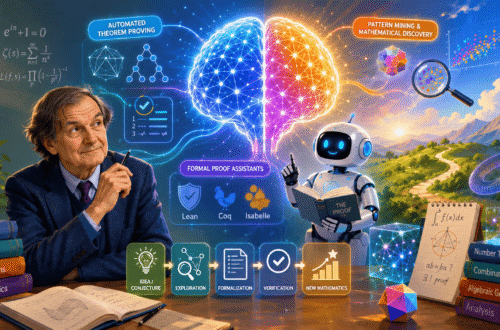
The strongest tool is formal proof. The proof is written in a language like Lean, and a computer checks every step. Before the release, OpenAI consulted an advisory group of mathematicians called AGMAI. Its guidelines say proofs that people cannot follow should be formalized.
TechCrunch reported that 42 percent of the proofs OpenAI released had not been formalized. It concluded that OpenAI fell short of the standards the group set. AGMAI also suggested that OpenAI help fund human mathematicians. Someone must turn machine output into real understanding. Without that, the OpenAI math solutions may sit unused.
The Plagiarism and Credit Question
Melanie Matchett Wood of Harvard sits on the advisory group. She said AI systems can produce plenty of mathematical output that does not meet academic standards. “It often includes plagiarism,” she said.
This echoes an older embarrassment. In October 2025, an OpenAI executive claimed GPT-5 had solved 10 open Erdős problems. Mathematician Thomas Bloom called that a dramatic misrepresentation. The model had found existing solutions in the literature. OpenAI researcher Sebastien Bubeck later agreed that only solutions in the literature were found. Demis Hassabis called the episode embarrassing.
So a basic question hangs over the new OpenAI math solutions. Which results are truly new, and which restate earlier human work?
Did Mathematicians Help the Model Without Knowing?
Tristan Buckmaster was at the center of the earlier Navier-Stokes dispute covered on this blog. He raised another worry with the New York Times. It is unclear whether mathematicians using OpenAI’s tools inadvertently pointed the company’s internal system toward answers. If so, some OpenAI math solutions could carry hidden human fingerprints.
Experts also object to the setup itself. They say frontier labs should not test the hardest problems on closed models that the wider community cannot use. The Institute for Advanced Study has not endorsed the practice. OpenAI has not said it will stop. It has said it will work with the institute to give “mathematicians a voice in how we move forward.”
Are the Proofs Too Hard to Follow?
Some mathematicians complain that AI proofs are hard to read. That makes it hard to build on them. Mathematician Litt called this concern “overstated.” He noted that human mathematical writing is often hard to follow too.
The debate has real weight. If a proof is correct but opaque, is it knowledge yet? Mathematicians have always valued understanding as well as truth. The OpenAI math solutions test that value directly.
What to Watch After the OpenAI Math Solutions
Several things will decide how this ends.
- Independent checks. Whether outside teams verify results in Lean or by hand.
- Funding for humans. Whether OpenAI backs mathematicians, as AGMAI suggested.
- Other labs. Reporting so far suggests neither DeepMind nor Anthropic has tried a release at this scale.
- Survival rate. Which of the OpenAI math solutions hold up under scrutiny.
Conclusion
The OpenAI math solutions controversy is not mainly about whether AI can do math. It plainly can do a lot. The fight is about trust, credit, and process. A result matters only if the community can check it, understand it, and credit it fairly.
Whatever the final tally, the OpenAI math solutions have forced mathematicians to write new rules in real time. The standards they set now will shape how every future AI result is judged.


You May Also Like

5 Powerful Ways the Agentic AI Operating System Is Already Replacing Windows as You Know It

The Powerful Rise of AI Gaming Platforms: Google’s Playground and the Coming of AI Players