AI Ethics and Governance
Insights and guidelines on responsible AI development, algorithmic fairness, safety regulations, and ethical decision-making.
-
The Explosive AI Slowdown Debate: 4 Competing Explanations for What Is Really Happening
A Rare Moment of Unity, Immediately Contested
On Saturday, September 12, 2026, Anthropic CEO Dario Amodei published an essay titled “We Must Pace the Frontier.” Within a day, Sam Altman and Elon Musk had both publicly endorsed it. Three figures who have spent years in open conflict with one another agreed on something. AI development should slow down.
The AI slowdown debate erupted immediately. President Trump rejected the argument outright. China’s Foreign Ministry called it fear mongering. AI stocks fell. And a substantial chorus of observers offered a very different explanation for why three CEOs suddenly discovered caution weeks before two historic IPOs. This article examines four competing explanations for what is actually driving this moment.
-
5 Powerful Data Center Cooling Technology Solutions Cutting Water Use
A Problem With Real Engineering Answers
Cooling consumes roughly 40 percent of total data center energy use, and evaporative systems tied to that cooling load are the single biggest driver of water consumption examined in this blog’s earlier coverage. The good news is that data center cooling technology has genuinely advanced enough to attack this problem directly, not just theoretically. This article covers five specific categories of solution actively deployed or being scaled right now, each backed by real performance numbers.
-
The Critical Numbers Behind Data Center Electricity Consumption: A Full Calculation Guide
A Number That Deserves Real Arithmetic
Data center electricity consumption gets thrown around in headlines constantly. Gigawatts here. Terawatt-hours there. What rarely accompanies these figures is the actual math connecting them. This article walks through the real formulas, sourced from the International Energy Agency, Lawrence Berkeley National Laboratory, and independent industry research, and shows exactly how a facility’s rated capacity translates into its true annual power draw and cost.
-
The Critical Truth About Data Center Water Usage: A Full Calculation Breakdown
A Number That Rarely Gets Shown With Its Math
Data center water usage gets cited constantly in news coverage. Millions of gallons per day. Billions per year. What rarely gets shown is the actual arithmetic behind those figures. This article walks through real numbers from the Congressional Research Service, Lawrence Berkeley National Laboratory, Google, Microsoft, and Equinix. Every figure comes with its calculation shown explicitly, so the scale becomes genuinely concrete rather than abstract.
-
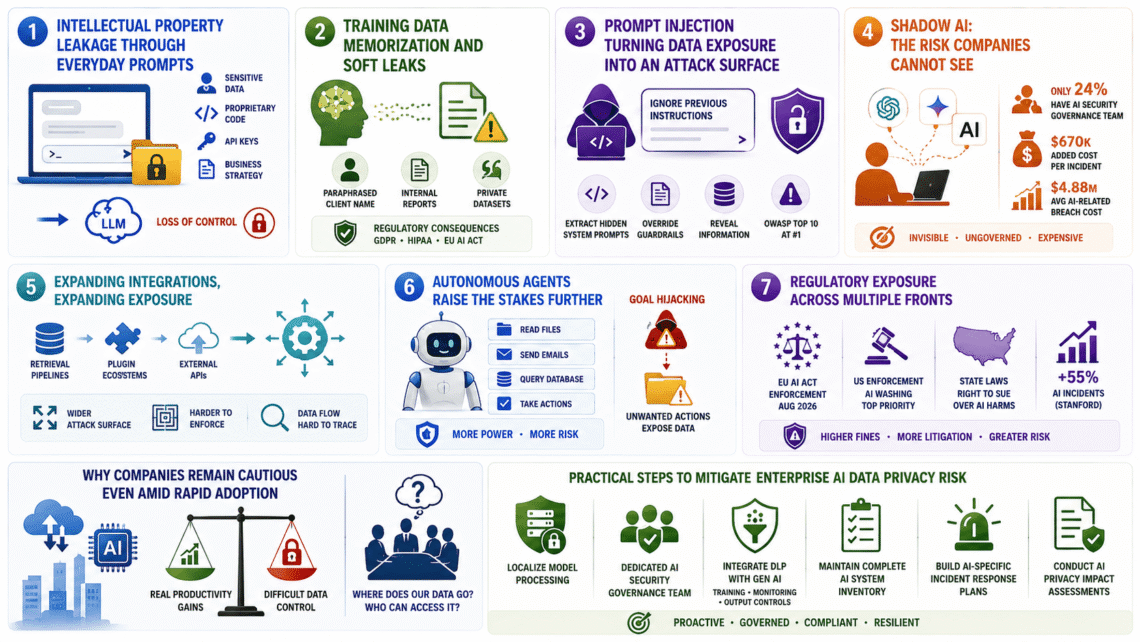
7 Critical Enterprise AI Data Privacy Risks Companies Cannot Afford to Ignore
A Trust Gap Nobody Can Ignore Anymore
Enterprises want AI. They just do not want to hand over their crown jewels to get it. This tension defines enterprise AI data privacy in 2026. Companies are deploying LLMs into core workflows at record speed. At the same time, legal and security teams are pumping the brakes harder than ever. Both instincts are correct. The technology is genuinely useful. The risks are genuinely serious.
Understanding why companies stay wary of LLM vendors, even while adopting their products, requires looking closely at seven specific, well-documented risk categories. Each one shapes how enterprise AI data privacy decisions actually get made today.
-
Inside the Powerful Wave of AI Data Center Protests Sweeping Small-Town America
125 Cities, One Saturday
Last month, protesters showed up in 125 cities across the USA on a single Saturday to demonstrate against data centers, either proposed or already under construction. It was a coordinated day of action that NPR’s 1A programme described as a genuine turning point in how visible this movement has become. This was not a scattering of isolated local disputes.
It was a nationally coordinated wave, and it reflects a sentiment that pollsters keep confirming with increasing precision. A June 2026 survey from Echelon Insights found that voters opposed building an AI data center in their community by a margin of 62 percent to 27 percent, and even after respondents were shown additional messaging emphasizing the economic and technological benefits, opposition remained at 58 percent.
-
The Explosive Rise of Data Center Opposition: Inside America’s Fight Over Who Pays the Price (Part 2)
This is Part 2 of a two-part series examining the current affairs debate surrounding AI data centers. Part 1 examined the case that these facilities function as genuine strategic national assets. Part 2 examines the rapidly intensifying data center opposition movement sweeping the country, the specific harms driving it, and the growing legal and political push to hold operators directly liable.
A Movement That Crossed a Threshold in 2026
Part 1 of this series took seriously the argument that AI data centers function as genuine strategic infrastructure. That argument has not disappeared. But it now sits alongside a second, equally well-documented reality that no honest account of this current affairs debate can minimize. Data center opposition has become, in the words of one recent analysis, the most bipartisan issue since beer.
-
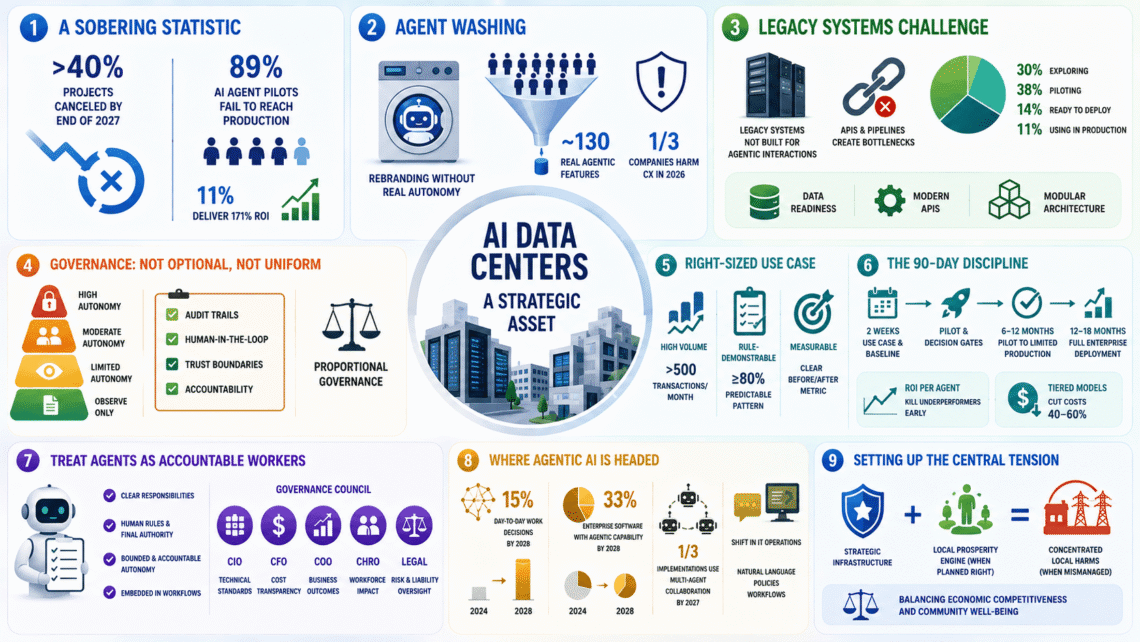
AI Data Centers: The Critical Strategic Assets Powering America’s Next Industrial Revolution (Part 1)
This is Part 1 of a two-part series examining the current affairs debate surrounding AI data centers. Part 1 examines the case that these facilities function as genuine strategic national assets, comparable in economic significance to the automobile industry’s rise a century ago. Part 2 will examine the mounting community opposition, the growing calls to hold data center operators directly liable for local harm, and where this genuinely difficult policy tension is likely headed.
An Investment Scale That Demands Serious Analysis
Nearly 800 billion dollars in hyperscaler infrastructure spending in a single year, examined in detail in this blog’s recent five-part series on AI economics, is not a number that exists in a vacuum. It represents a deliberate, sustained national and corporate bet that AI data centers constitute genuine strategic infrastructure, not merely a speculative technology fad. Morgan Stanley’s own 2026 market research puts this framing directly: artificial intelligence is no longer just a disruption theme, it is emerging as a strategic asset, central to economic competitiveness, military capability, and energy planning, with nearly 3 trillion dollars in AI-related infrastructure investment expected to flow through the global economy by 2028.
-
Is AI Making Us Smarter After All? Part 2: The Balanced Verdict on Human Thinking
This is Part 2 of a two-part series examining whether outsourcing creative and cognitive work to AI is degrading human thinking. Part 1 reviewed the substantial evidence for cognitive offloading and skill decay. Part 2 examines the counter-evidence, the conditions under which AI making us smarter is genuinely possible, and what a fair verdict actually requires.
The Evidence Deserves a Second Look
Part 1 of this series presented a genuinely troubling body of evidence: EEG studies showing weaker neural connectivity, clinicians losing diagnostic skill after AI support was introduced, and a documented illusion of competence among AI users. None of that evidence was overstated, and none of it should be dismissed. But responsible engagement with any body of research requires looking at the full picture, including the studies, researchers, and institutions actively exploring whether AI making us smarter is not just possible but already happening under the right conditions.
The truth that emerges from a complete review of the literature is neither the alarmist story nor a naive optimism. It is something more specific and more useful: the outcome depends heavily on how AI is used, not merely on whether it is used at all.
The Same MIT Study, Read More Carefully
It is worth returning to the widely cited MIT Media Lab EEG study from Part 1, because subsequent, more careful engagement with its actual design reveals an important nuance often lost in headline coverage. The study compared three conditions: writing entirely from memory, writing with a search engine, and writing with an LLM that performed the bulk of the composition itself. The condition that showed weakened neural engagement was specifically the one in which the AI did most of the intellectual work for the participant, essentially replacing their thinking rather than supporting it.
This distinction matters enormously for the AI making us smarter question, because it points toward a specific, testable hypothesis: the harm observed in cognitive offloading research may depend less on AI use per se and more on whether the human remains an active, effortful participant in the cognitive task or becomes a passive recipient of a finished output. A 2026 paper in Computers in Human Behavior captured this distinction precisely in its title: AI makes you smarter but none the wiser, describing a genuine disconnect between measurable performance gains and accurate self-assessment of understanding, a finding that complicates rather than confirms a simple decline narrative.
The Cover Letter Study: A Case for Genuine Learning
One of the more carefully designed recent studies bearing on AI making us smarter comes from behavioural scientists at Wharton, led by Benjamin Lira Luttges. Researchers taught participants to edit poorly written cover letters using either AI-generated feedback or feedback from human professionals. After this training phase, participants were then asked to edit a new, poorly written cover letter entirely without any assistance, human or AI.
The results were genuinely encouraging for anyone hoping AI making us smarter is achievable rather than wishful thinking. Letters produced by the AI-trained group were just as likely to secure a job interview, according to blind human evaluators, as letters from the group trained by human professionals. Crucially, the AI in this study did not simply hand participants a rewritten letter to copy. It walked them through structured feedback, and the learning transferred to genuinely independent performance afterward. This is precisely the kind of evidence that distinguishes AI used as a teacher from AI used as a replacement for thinking, and the distinction turns out to be the single most important variable across the entire body of research.
The Augmentation and Atrophy Framework
A comprehensive 2025 review published in the American Journal of Education and Information Technology introduced a useful conceptual framework worth adopting directly: the Problem-Solving Trade-Off Hypothesis, which proposes that AI’s cognitive impact splits cleanly into augmentation effects and atrophy effects, often for the very same tool, depending entirely on how it is deployed. When used as a research partner, actively engaged with and questioned, AI can genuinely augment critical inquiry. When accepted uncritically as a finished answer, the same tool promotes intellectual passivity.
This framework helps explain an otherwise confusing pattern in the research literature, where some studies find AI making us smarter while others find the opposite, often examining superficially similar AI tools. A comprehensive 2026 review of the cognitive literature reached a similarly nuanced conclusion: moderate AI usage shows minimal cognitive impact, while excessive reliance correlates with decreased critical thinking abilities. The relationship is not linear, and it is not simply about the amount of AI use but the structure and intentionality of that use.
What USC’s New Research Is Actually Testing
The most rigorous ongoing effort to move beyond speculation on the AI making us smarter question is a study launched in July 2026 by USC Viterbi, funded by the National Science Foundation, examining doctors, journalists, and software engineers to determine whether structured AI use can strengthen creativity and critical thinking rather than erode it. The study’s design is explicitly informed by earlier findings, including Stadler et al.’s 2024 research showing that AI use eases mental load but often at the expense of depth of understanding, precisely the tension this two-part series has traced throughout.
What makes the USC research significant is its second phase, which moves beyond simply measuring whether harm occurs and instead attempts to redesign how humans and AI interact specifically to optimise for better creativity and critical thinking outcomes. This reflects a genuine and important shift in the research community’s framing, from asking whether AI making us smarter or dumber is happening as a fixed, inevitable outcome, toward asking how interaction design itself determines which outcome occurs.
The Original Sin of Bad Comparisons
A significant portion of the alarm in this debate traces back to comparing AI-assisted outcomes against an idealised, effortful baseline that most people were never actually achieving in the first place. Before generative AI, the realistic alternative to using ChatGPT for a first draft was often not deep, effortful, independent composition. It was frequently a rushed, low-effort draft produced under time pressure, or simply not producing the work at all. The relevant comparison for AI making us smarter is not AI use versus an idealised deep thinker with unlimited time. It is AI use versus the actual behaviour people were engaging in before AI existed, which was frequently far from ideal itself.
This reframing does not excuse genuine skill atrophy in domains, such as medical diagnosis, where the underlying skill is safety-critical and must be actively maintained regardless of convenience. But for a great deal of everyday writing, brainstorming, and problem solving, the honest comparison group was never a maximally engaged human mind. It was often a tired, distracted, or simply absent one, and against that realistic baseline, AI assistance frequently represents a genuine net gain in both output quality and, when used interactively rather than passively, in the thinking that produces it.
Fostering Collaboration Rather Than Replacement
A 2025 paper in the Journal of Student Research at Indiana University East reviewed the competing evidence directly and reached a conclusion that deserves to anchor any balanced verdict on this topic: AI fosters collaboration and efficiency, and in some cases may enhance critical thinking skills, while overuse without deliberate structure can deplete those same skills. The word collaboration is doing important work in that sentence. It suggests the healthiest relationship with AI tools treats them as a genuine thinking partner, one whose output is questioned, challenged, and integrated actively, rather than either a replacement for thought or a threat to be avoided entirely.
The CHI 2025 Tools for Thought workshop, convening 56 researchers across cognitive science, human-computer interaction, and education, framed the challenge in exactly these terms: the goal is not merely to protect human cognition from AI’s potential negative impacts, but to actively design AI tools and interaction patterns that augment thinking, in the same way that older external tools, including writing itself, have historically extended and strengthened human cognitive capacity rather than simply replacing it.
A Genuinely Balanced Verdict
Bringing both parts of this series together, the fairest conclusion is neither AI making us dumber nor AI making us smarter as a fixed, universal outcome. It is that AI is a cognitive amplifier whose effect depends almost entirely on the structure of the interaction. Passive, unstructured use, accepting AI output wholesale without engagement, reliably correlates with skill atrophy and a documented illusion of competence. Active, structured use, treating AI as a partner to question, challenge, and learn from rather than simply defer to, shows genuine evidence of strengthening rather than weakening independent capability afterward.
For the specific creative activities that motivated this series, writing and image generation, the practical implication is clear. Using an LLM to produce a finished piece of writing with minimal engagement likely does erode the specific compositional and reasoning skills that writing itself has always cultivated as a side effect of the struggle to express an idea clearly. Using an LLM as an interactive collaborator, one whose suggestions are evaluated, revised, and pushed back against, appears considerably more likely to leave those same skills intact or even strengthened, closer to how a skilled writer benefits from an editor’s feedback than a diminishment of their own capability.
Conclusion: The Choice Is Still Ours
The question of whether AI is making humanity dumber or AI is making us smarter turns out not to be a question about the technology at all. It is a question about human choices, individual and institutional, about how deeply we engage with tools that are, for the first time in history, capable of doing so much of our thinking for us if we allow them to. The calculator did not make humanity worse at abstract mathematical reasoning, because the deeper reasoning skills calculators freed us from tedious computation to pursue turned out to matter more than the arithmetic itself.
Whether generative AI follows a similar trajectory, freeing humans for a more valuable kind of thinking, or instead erodes capacities more central to what makes thinking meaningful in the first place, remains genuinely undetermined, and will likely be decided differently across different domains, different age groups, and different patterns of use.
What the evidence assembled across both parts of this series makes clear is that the outcome is not predetermined by the technology itself. It is being determined, right now, by millions of individual decisions about how deeply to engage with the tools already in nearly everyone’s hands. That is, in the end, a more demanding and more hopeful conclusion than either a simple story of decline or a simple story of progress would offer. The evidence suggests humanity retains meaningful agency in this outcome. Whether AI making us smarter becomes the dominant story or the exception may depend less on further research and more on whether that agency is actually exercised.
This concludes our two-part series on AI and human cognition. Explore Part 1 for the full evidence on cognitive offloading
-
Is AI Making Us Dumber? Part 1: The Alarming Evidence Behind Cognitive Offloading
This is Part 1 of a two-part series examining whether outsourcing creative and cognitive work to AI is degrading human thinking. Part 1 reviews the scientific evidence on cognitive offloading and skill decay. Part 2 will examine the counter-evidence, the nuance researchers have found, and what a genuinely balanced position looks like.
A Question That Refuses to Go Away
Every generation of new technology has provoked the same anxious question. Socrates worried that writing would destroy memory. Calculators sparked fears that children would forget arithmetic. Search engines were accused of hollowing out our capacity to retain knowledge.
The question of whether AI making us dumber is a genuine phenomenon or merely the latest iteration of an old cultural panic deserves to be taken seriously rather than dismissed reflexively, precisely because this time there is a growing body of controlled scientific evidence to examine rather than speculation alone.
The honest starting point is that something measurable is happening. Whether it amounts to humanity becoming dumber, in any meaningful sense of that phrase, is a harder and more contested question, one this two-part series will examine from both directions. Part 1 takes the evidence for genuine cognitive harm seriously and presents it in full.
The Concept That Explains the Mechanism
The scientific literature converges on a specific mechanism to explain how and why AI making us dumber might actually occur: cognitive offloading, the act of delegating mental tasks to an external system, reducing one’s own cognitive engagement with the problem. This is not a new concept. Humans have used calculators to support arithmetic, GPS systems to support navigation, and the internet to support memory for decades. What distinguishes AI is the breadth and depth of tasks it can now absorb, extending well beyond simple retrieval into reasoning, synthesis, and even creative composition itself.
The International AI Safety Report 2026, a major government-commissioned review of AI risks, addressed this directly, noting that cognitive offloading can free up cognitive resources and improve efficiency, but that research also indicates potential long-term effects on the development and maintenance of cognitive skills.
That report cited one particularly striking finding: three months after clinicians began using AI support for detecting tumours, their ability to detect them without AI assistance had dropped by 6 percent. This is not a hypothetical worry. It is a documented erosion of a trained medical skill, in a domain where the stakes of that erosion are genuinely serious.
What the MIT Study Actually Found
The most widely cited piece of evidence in the AI making us dumber debate comes from MIT’s Media Lab, in a 2025 study titled “Your Brain on ChatGPT: Accumulation of Cognitive Debt when Using an AI Assistant for Essay Writing Task.” Researchers used electroencephalography, EEG, to measure brain activity in participants writing essays under three conditions: using an LLM, using a search engine, and using no external tools at all.
The results were striking. Participants who wrote essays using an LLM showed weaker neural connectivity during the task compared to those using a search engine or working unassisted. Over repeated sessions, brain activity in the LLM-assisted group declined further, a pattern the researchers described using the phrase cognitive debt, a metaphor suggesting that reliance on AI accumulates a kind of deficit in genuine engagement that compounds over time rather than remaining a one-time convenience.
While this specific study has not yet completed peer review, its findings have been influential precisely because they align with a broader pattern found across multiple independent research groups.
The 666-Participant Study and the Critical Thinking Correlation
Perhaps the most methodologically robust evidence for AI making us dumber comes from Michael Gerlich, a professor at the Swiss Business School in Zurich, who published a 2025 study in the journal Societies examining AI tool use and critical thinking across 666 participants. Gerlich found a significant negative correlation between frequent AI usage and critical thinking abilities, with cognitive offloading identified as the specific mediating mechanism. Individuals who relied heavily on AI tools for problem solving demonstrated measurably reduced independent reasoning capacity compared to lighter users. That raises the question: is AI making us dumber?
The age dimension of Gerlich’s findings deserves particular attention. Younger participants demonstrated stronger dependence on AI tools and scored lower on critical thinking assessments than older participants, a pattern replicated across several subsequent studies. This raises a specific and pressing concern about AI making us dumber that differs from earlier technology panics: if the effect is concentrated most heavily in developing minds still building foundational cognitive skills, the long-term societal consequences could be considerably more significant than a simple across-the-board decline distributed evenly across all age groups. AI making us dumber?
The Illusion of Competence
One of the more unsettling findings in the recent literature is what researchers at the University of Technology Sydney termed the illusion of competence in a March 2026 report. Participants who used AI in an unstructured way, letting it reason and synthesise on their behalf, rated their own understanding of the material as high, because the AI’s output was fluent and confident. They believed they had genuinely grasped the underlying material. When subsequently asked to reproduce the reasoning without AI assistance, they could not.
This gap between perceived competence and actual competence is arguably the most concerning specific mechanism within the broader AI making us dumber debate, because it is significantly harder to detect and correct than a simple wrong answer would be. A student who gets a maths problem wrong knows they need to study further.
A student who has an AI solve the problem, reads a fluent explanation, and feels they understand it, has no internal signal telling them their actual competence has not changed at all. The Federal University of Rio de Janeiro’s preregistered randomised controlled trial in 2025 quantified this gap directly, finding an 11 percentage point retention deficit 45 days later between AI-assisted learners and those who worked through material independently. AI making us dumber?
National Security Takes the Question Seriously
The AI making us dumber debate has moved beyond academic psychology into genuine institutional concern at the highest levels of government. The Council on Strategic Risks, an organisation that formally advises the United States government on national security matters, launched a dedicated 2026 debate series specifically examining whether AI is degrading critical thinking within the national security workforce itself.
The concern is direct and consequential: the Pentagon and State Department have rapidly deployed AI tools across their workforce in the name of efficiency, but if cognitive offloading genuinely degrades critical thinking capacity, and national security work fundamentally depends on clear, independent human judgement under pressure, efficiency gains in the short term could be quietly purchasing a less capable, less resilient institution over the longer term. AI making us dumber?
This is a genuinely significant marker for how seriously the underlying concern is being taken outside of academic circles. Governments do not typically convene formal debate series about cultural anxieties they consider unfounded. The fact that this question has reached the level of national security policy discussion suggests the evidence base, while still developing, has crossed a threshold that institutional decision makers consider worth taking seriously.
The Creative Dimension: Writing and Image Generation Specifically
The question posed at the start of this series concerned specifically creative activities, writing and image generation, rather than cognitive tasks broadly. The evidence here is somewhat more limited than for skills like arithmetic or medical diagnosis, but the mechanism identified across the wider literature applies with particular force to creative work. Writing, in particular, is not merely a output-production task.
The act of composing a sentence, revising it, and wrestling with how to express a specific idea precisely is itself a form of thinking, not merely a transcription of thoughts that already existed fully formed. When that generative struggle is outsourced entirely to an LLM, what is lost is not simply the final text but potentially the cognitive process of clarifying one’s own thinking that writing has always served, for writers, as a byproduct of the act itself.
The Google Effect research, which predates the LLM era and examined how search engines changed memory patterns, found that people who expect to have future access to information are less likely to remember the information itself, but more likely to remember where to find it. Whether an equivalent shift is occurring with creative composition, where people increasingly remember how to prompt an AI to produce writing or images rather than how to produce the work themselves, is an open and urgent research question that the field has only begun to address directly.
Conclusion
The evidence assembled in this first part of the series is genuinely substantial. Peer-reviewed studies in respected journals, a major government safety report, EEG data from MIT, and a formal national security debate series all point in a consistent direction: outsourcing cognitive and creative work to AI carries a measurable cost to the specific skills being offloaded, mediated by a documented mechanism, cognitive offloading, that researchers can observe and quantify. The illusion of competence finding is particularly troubling, because it suggests the erosion may be largely invisible to the people experiencing it until the underlying skill is tested directly.
None of this, on its own, definitively proves that AI is making humanity dumber in some broad, irreversible sense. It proves something narrower and still significant: that specific skills, when specifically offloaded to AI, tend to atrophy, and that younger users appear more vulnerable to this effect than older ones.
Whether this constitutes a genuine crisis, a manageable trade-off, or something considerably more nuanced than either extreme is where Part 2 of this series turns next, examining the counter-evidence, the conditions under which AI use appears to strengthen rather than weaken thinking, and what a genuinely balanced verdict on this question actually requires.
Part 2: The Counter-Evidence and a Balanced Verdict, coming next.