The Powerful Rise of AI Gaming Platforms: Google’s Playground and the Coming of AI Players
A Game Built From a Sentence
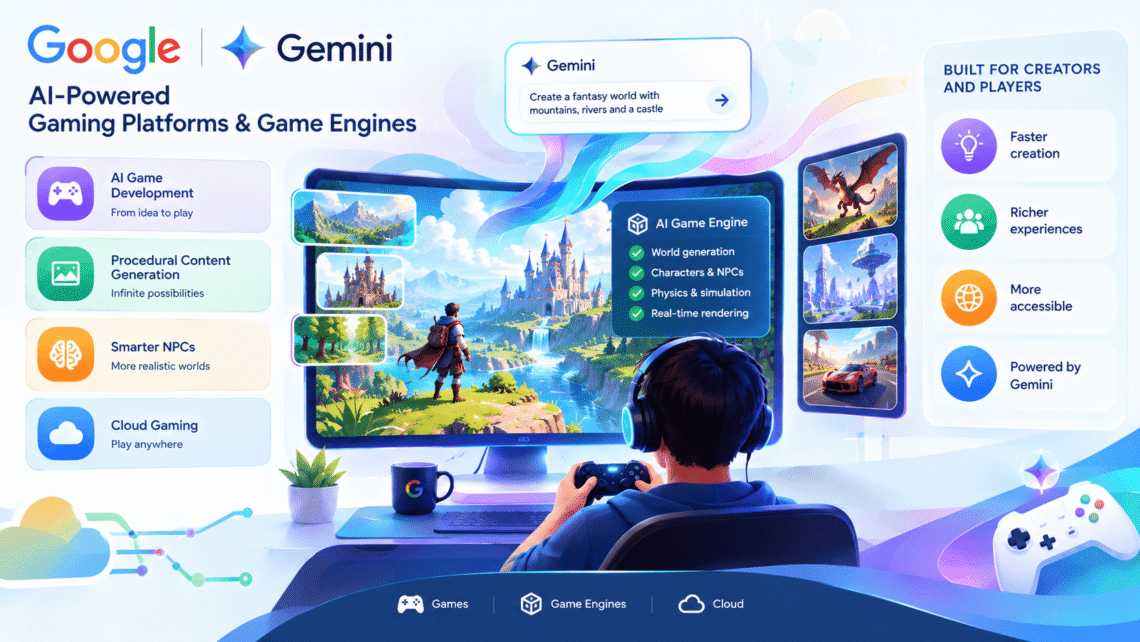
On Wednesday, Google Labs launched Playground, a new experiment in AI gaming platforms. The idea is simple. You describe a game in plain words, and the platform builds it. No coding is needed.
This article looks at what Playground does and how it fits into the wider rise of AI gaming platforms. It then asks a bigger question. What happens when game characters stop following scripts and start acting like real players?
What Playground Actually Does
TechCrunch reported the details on October 7. Creators can pick a genre, such as trivia or racing. They can also start from scratch. They choose 2D or 3D, and single-player or multiplayer. Then they describe the mechanics, the gameplay, and the visual style.
Users can also upload images. The AI turns them into game assets that match the game’s art style. Finished games run on phones and computers. A game can stay private, be shared by link, or be published to a public gallery called Explore. Published games can have leaderboards, and creators can keep editing after release.
Access is limited for now. Playground is open to adults in the US. Playing is free. Making games uses a weekly token budget, and Google One AI subscribers get higher limits. Google also plans to add Unity Spark integration. That could bring “professional-level” mechanics and more 3D features.
A Crowded Field of AI Gaming Platforms
Google is not alone. Roblox announced its own Build feature in July. It lets users make games with natural language prompts. Microsoft’s Muse model can generate game visuals and controller actions. Unity now offers an AI assistant inside its editor. Taken together, AI gaming platforms have become a race, not a single product.
Google also has some history here. It shut down its cloud gaming service Stadia in 2022. It later added YouTube Playables, a hub of instant web games. Playground sits inside Google Labs. That label marks it as an experiment.
Why Easy Game Making Matters
The main promise of AI gaming platforms is access. Many people have game ideas. Few have the coding, art, or design skills to build them. A tool that turns a sentence into a playable prototype removes that wall.
There is a catch. Easy creation can mean a flood of weak games. This blog has covered the same problem in text and video under the name AI slop. Curation and quality filters will matter.
The token limit also shows a hidden truth. Generating games takes real compute, and compute costs money. AI gaming platforms will have to balance free access against those costs, a tension this blog has traced in its coverage of AI economics.
From Scripted NPCs to AI Players
Now to the second question. Today’s non-player characters, or NPCs, mostly follow scripts. They repeat the same lines. They run fixed routines. Players spot the pattern within minutes.
An AI player is different. It reads the game state, makes a plan, and acts under the same rules as a human. Nvidia has pushed this idea with its ACE autonomous game characters. Nvidia describes them as characters that “perceive, plan, and act like human players.” They run on a small language model and use a memory system to recall past events.
This is already shipping in limited form. In PUBG, an AI teammate called Ally is being tested. It can follow orders, share loot, drive vehicles, and fight other players. The life simulation inZOI uses ACE for about 300 autonomous characters with personalities. Naraka: Bladepoint has added AI teammates too. Ubisoft ran its own experiment, called Teammates. Tool makers such as Inworld and Convai sell similar character brains to studios.
Beyond building games, AI gaming platforms and engines are now changing who, or what, plays them.
The Hard Limits Today
Real time is hard. A cloud model can take seconds to reply. In a fast game, that is an eternity. Running a smaller model on the player’s own graphics card fixes the delay. But it limits how smart the character can be. It also shifts the cost to the player’s hardware.
One 2026 industry analysis noted that many players will simply switch the feature off. Its blunt verdict was that AI NPCs are still a luxury feature, not a default. These limits apply to every one of the AI gaming platforms planning to host smart characters.
Quality control is another worry. A character with no guardrails can break the story. Most studios are moving toward a hybrid. Writers build the world and set its limits. The AI fills in behavior inside those limits.
Where AI Gaming Platforms Could Go Next
Games have long served as testing grounds for AI research. That history makes the leap to AI players feel natural. Several paths look plausible.
- Teammates that learn you. They adapt to your skill, remember past matches, and speak the language of the game.
- Opponents that never feel scripted. Difficulty could adjust smoothly instead of in fixed steps.
- Full lobbies at any hour. An AI player could fill an empty seat in a multiplayer match.
- Worlds made on the fly. DeepMind’s Genie research points toward interactive worlds generated in real time.
- Creator-made characters. On AI gaming platforms like Playground, a creator might one day describe a character’s personality and drop it into a game.
Questions Nobody Has Answered
Should a player be told whether a teammate is human or AI? Honesty matters most in competitive play. How will developers tell AI players apart from cheating bots?
Companion characters that remember you could create real emotional bonds. Who is responsible if that goes badly? And what happens to voice actors, writers, and designers when characters can be generated? Each question will shape how AI gaming platforms are regulated and trusted.
Conclusion
Google’s Playground is a small launch with a large idea. AI gaming platforms are turning game making into something anyone can try. At the same time, tools like Nvidia ACE are turning game characters into something closer to players.
The limits are real today. Speed, cost, and quality all hold things back. But the direction is clear. As AI gaming platforms mature, the line between a scripted character and a true opponent or teammate will blur. The open question is whether players, studios, and regulators will be ready when it does.


You May Also Like
The Powerful History of Code Review: From Fagan Inspections to the Age of AI Agents
The Critical Truth About LLM Development History: A Decade of Progress Without the Hype (Part 1)