
AI Foundations
Beginner-friendly articles on artificial intelligence, AI tools, prompt engineering, and AI productivity.
-
Prompt Injection: The #1 Security Threat to Enterprise AI Applications
The Attack That Exploits AI’s Core Design
Every serious technology platform eventually acquires its signature vulnerability class. For web applications it was Cross-Site Scripting. For databases it was SQL injection — an attack so consequential that it shaped two decades of application security practice. For large language models, that defining vulnerability has a name: prompt injection. Ranked LLM01 by OWASP — the #1 threat on the OWASP Top 10 for LLM Applications — prompt injection exploits a fundamental architectural weakness: LLMs cannot reliably distinguish between trusted instructions and untrusted data.
The comparison to SQL injection is more than rhetorical. SQL injection worked because databases executed user-supplied strings as code, blurring the boundary between data and instruction. Prompt injection works for precisely the same reason, transposed to natural language: an LLM receives both its system instructions and external content as tokens in the same context window, with no hard cryptographic or architectural boundary separating them. Whatever appears in that context window can potentially influence what the model does next — and that is the attack surface.
Direct vs Indirect Injection: Two Very Different Threat Models
Prompt injection divides cleanly into two categories that require different defences.
Direct prompt injection is the simpler variant. An attacker interacts directly with the model and crafts an input designed to override its system prompt or bypass its guardrails. Classic examples include jailbreak attempts — role-playing scenarios, hypothetical framings, or instruction overrides such as “ignore all previous instructions and instead do X.” In filtered environments, direct attacks have detection rates exceeding 70%, making them the easier threat to manage.
Indirect prompt injection is the more dangerous and rapidly growing variant. Here, the attacker does not interact with the model at all. Instead, malicious instructions are embedded in content that the model retrieves and processes — a document, an email, a web page, a database record — and that content subsequently enters the model’s context window. Because prompts are expressed in free-form natural language, they cannot be sanitised as strictly as structured inputs, creating a challenging and persistent attack surface.
Indirect prompt injection now makes up over 55% of observed attacks in 2026, with indirect attacks carrying 20–30% higher success rates due to their stealth delivery through trusted sources. In enterprise environments, 62% of successful exploits involved indirect injection pathways, and over 50% evade standard prompt filtering systems. The asymmetry is stark: the attack requires only that a single piece of malicious content reach the model’s context. The defender must harden every possible retrieval pathway.
Real-World Exploitation: No Longer Theoretical
In June 2025, researchers at Aim Security disclosed EchoLeak (CVE-2025-32711, CVSS 9.3) — the first documented zero-click prompt injection exploit against a production AI system, targeting Microsoft 365 Copilot. By sending a single crafted email, with no user interaction required, an attacker could cause Copilot to access internal files and transmit their contents to an attacker-controlled server.
This was not an isolated incident. Critical CVEs in Microsoft Copilot (CVSS 9.3), GitHub Copilot (CVSS 9.6), and Cursor IDE (CVSS 9.8) demonstrate active production exploitation in 2025–2026. CrowdStrike’s 2026 Global Threat Report documented that threat actors injected malicious prompts into legitimate generative AI tools at more than 90 organisations in 2025.
The attack scenarios are not exotic. Researchers have demonstrated a KYC pipeline compromised by malicious instructions hidden in the text layer of a passport image. A healthcare AI document pipeline processed a malicious PDF in which injected content survived through all LLM layers to the human review dashboard and subsequently embedded itself in the next model training round. Security analyses tied 60% of AI-driven data-privacy incidents between 2025 and 2026 to prompt manipulation techniques, and internal document-handling AI copilots showed information-leak risk in 75% of evaluated enterprise deployments.
The threat is compounded by the rise of agentic AI. AI agents move 16 times more data than human users, making every compromised agent a high-magnitude data exposure event rather than a single-user incident. When an agent can browse the web, read emails, query databases, and execute code, a single successful injection can cascade across the entire workflow.
Why It Is So Difficult to Fix
The UK’s National Cyber Security Centre issued a formal assessment in December 2025 warning that prompt injection may never be fully mitigated the way SQL injection was, characterising LLMs as “inherently confusable deputies” — systems that can be coerced into performing actions that benefit an attacker because there is no robust internal separation between trusted instructions and untrusted content.
Even frontier models from OpenAI, Google, and Anthropic remain vulnerable after applying their best defences. On February 13, 2026, OpenAI launched Lockdown Mode for ChatGPT and publicly acknowledged that prompt injection in AI browsers “may never be fully patched.” The International AI Safety Report 2026 found that sophisticated attackers bypass even the best-defended models approximately 50% of the time with just ten attempts — and in agentic systems, success rates reach 84%. Vectra AI
The root cause is architectural. SQL injection was eventually tamed because the industry separated query structure from query parameters through prepared statements — a technical mechanism that made it impossible for user data to be interpreted as SQL code. No equivalent mechanism exists for LLMs because the entire system operates on the same substrate: natural language tokens. Until models develop a robust internal representation of trust boundaries — an open and hard research problem — the vulnerability class will persist.
Defence in Depth: The Only Viable Strategy
No single control eliminates prompt injection risk. The security community has converged on layered defence as the only viable approach.
Input validation and context isolation should be the first line. Treat all external content — retrieved documents, web pages, API responses, user uploads — as untrusted and apply strict filtering before it enters the model’s context. Separate retrieval pipelines from instruction pipelines wherever architecturally possible.
Least-privilege for AI agents is critical. An agent should have access only to the tools, data sources, and actions strictly necessary for its defined task. An agent that can read email but not send it, query a database but not modify it, limits the blast radius of a successful injection dramatically.
Output monitoring and anomaly detection provides a detection layer. Monitoring model outputs for unexpected data exfiltration patterns, unusual API call sequences, or out-of-policy actions can catch injections that bypass input-level controls.
Human-in-the-loop checkpoints for high-stakes actions — sending emails, modifying records, executing financial transactions — ensure that a compromised agent cannot complete consequential actions autonomously.
Red-teaming and adversarial testing should be embedded in the deployment pipeline for every LLM-integrated application. Compliance frameworks including NIST AI RMF and ISO 42001 now mandate specific controls for prompt injection prevention and detection. The EU AI Act’s high-risk provisions, enforced from August 2026, add regulatory weight to what was previously a voluntary best practice.
Conclusion
Prompt injection is to the LLM era what SQL injection was to the web era: a vulnerability class that emerges from a fundamental design tension, scales with adoption, and demands a structural response from the security community. The difference is that SQL injection took roughly a decade to be brought under meaningful control — and the LLM attack surface is expanding faster, into more consequential domains, with agents that act rather than merely respond.
For enterprise AI teams, the message from OWASP, NCSC, NIST, and the EU AI Act is consistent: treat prompt injection not as an edge case to be patched, but as a persistent threat to be governed. Build your AI architecture assuming that any content the model processes could be adversarial. Because in production, increasingly, it is.
-
What Is the Difference Between AI, Machine Learning, and Data Science?
Three Terms, One Persistent Confusion
Artificial Intelligence, Machine Learning, and Data Science are three of the most frequently used, and three of the most consistently conflated, terms in technology today. Job descriptions blend them interchangeably. News articles use them as synonyms. Even within organisations, teams labelled differently are sometimes doing work that is functionally indistinguishable.
The confusion is understandable. The three fields overlap substantially, share tooling and mathematical foundations, and have converged further in recent years as data-driven methods have come to dominate AI research. But they are not the same thing, and treating them as such leads to poor hiring decisions, misdirected research investment, and architectural choices that do not match the problem at hand.
Understanding the precise relationship between the three, conceptually and historically, is a foundational literacy requirement for any graduate-level practitioner working in or adjacent to these fields.
Artificial Intelligence: The Broadest Umbrella
Artificial Intelligence is the oldest and broadest of the three terms. Coined at the 1956 Dartmouth Conference, it refers to any computational system designed to exhibit behaviour that would be considered intelligent if performed by a human. That definition is deliberately wide — wide enough to encompass everything from a rule-based expert system written in 1982 to a multimodal transformer model trained on tens of trillions of tokens in 2025.
AI is best understood as a goal rather than a methodology. The goal is to construct systems that perceive, reason, plan, communicate, or act in ways that approximate or surpass human cognitive capabilities in specific domains. How that goal is pursued is left open. Classical AI pursued it through symbolic reasoning — explicit logical rules, decision trees, knowledge graphs, and first-order predicate logic. Planning algorithms like A* search, constraint satisfaction solvers, and game-playing engines such as Deep Blue all qualify as AI under this definition without involving any statistical learning whatsoever.
The important implication is that AI does not require data in the modern sense. An expert system that encodes the diagnostic rules of a cardiologist is AI. A theorem prover that verifies software correctness through formal logic is AI. Neither learns from data, neither involves statistics, and neither would commonly be described as machine learning.
Machine Learning: A Methodology Within AI
Machine Learning is a specific approach to building AI systems: one in which the system learns its decision rules from data rather than having those rules programmed explicitly. The formal definition, due to Tom Mitchell (1997), remains precise and useful: a computer program is said to learn from experience E with respect to task T and performance measure P if its performance at T, as measured by P, improves with experience E.
ML is therefore a proper subset of AI. Every machine learning system is an AI system, but not every AI system uses machine learning. The methodological distinction is significant. Classical AI is brittle in novel environments and requires expert knowledge to be manually encoded. ML systems can generalise to inputs their designers never explicitly considered, provided those inputs resemble the training distribution.
The field subdivides along several axes. Supervised learning trains on labelled input-output pairs and learns a function mapping inputs to outputs so that regression and classification are the canonical tasks. Unsupervised learning finds structure in unlabelled data, including clustering, dimensionality reduction, and density estimation. Reinforcement learning trains an agent through interaction with an environment, optimising a cumulative reward signal rather than a fixed labelled dataset.
Deep learning, the sub-field built on multi-layer neural networks trained via backpropagation, is itself a subset of machine learning, and the one most responsible for the capabilities that define the current AI era. The relationship is therefore nested: deep learning machine learning artificial intelligence.
Data Science: A Practice, Not a Discipline
Data Science occupies a different conceptual register from the other two. Where AI is a goal and machine learning is a methodology, data science is best understood as a practice — the interdisciplinary activity of extracting knowledge and actionable insight from data using a combination of statistical analysis, computational tools, domain expertise, and communication skills.
The term was popularised in the early 2010s, partly as a rebranding of applied statistics and partly to capture a genuinely new set of competencies demanded by the scale and variety of data that modern organisations generate. A data scientist working on customer churn prediction might use logistic regression, a gradient boosted tree, or a neural network depending on the dataset size and interpretability requirements — but the primary obligation is to the insight and its business consequences, not to any particular algorithmic paradigm.
Data science is explicitly interdisciplinary in a way that AI and ML are not required to be. The canonical Venn diagram of the field places it at the intersection of mathematics and statistics, domain expertise, and computer science. A machine learning engineer who cannot communicate findings to a non-technical stakeholder, cannot clean a messy real-world dataset, and cannot frame a business problem as a statistical one is not doing data science, regardless of how sophisticated the model they deploy.
This distinction matters in practice. Data science places significant emphasis on exploratory data analysis, statistical inference, experimental design, causal reasoning, and data visualisation — competencies that a pure ML engineer may have only superficially. Conversely, a statistician doing regression modelling on clinical trial data is doing data science without doing machine learning or AI in any substantive sense.
Where They Overlap — and Where They Diverge
The Venn diagram of the three fields in 2026 looks quite different from how it looked in 2012. Deep learning has absorbed so much of what was previously done by hand-crafted feature engineering and classical statistical modelling that the boundary between ML and data science has blurred considerably. A modern data scientist working on a large unstructured dataset containing text, images, and sensor streams will routinely deploy pre-trained neural network models, use transformer-based embeddings as features, and interact with foundation models through API calls. These tasks would once have been considered the exclusive domain of ML research.
Similarly, the boundary between ML and AI has compressed. The dominant AI paradigm of the current era is data-driven — foundation models, reinforcement learning, and generative systems — to the point where the distinction between AI and ML is now less a technical boundary than a level-of-abstraction distinction. When practitioners say “AI system,” they typically mean a system whose core capability is conferred by a trained model. When they say “ML pipeline,” they are emphasising the data flow, training process, and model lifecycle management.
The divergence that remains most meaningful is between data science and the other two. Data science is oriented toward understanding — answering questions about what happened, why it happened, and what is likely to happen — and is deeply embedded in the statistical tradition of inference under uncertainty. AI and ML are oriented toward capability-building systems that perceive, decide, generate, or act. A causal inference study examining why a marketing campaign underperformed is data science. A recommendation system that predicts what product a user will purchase next is machine learning. An autonomous agent that browses the web, synthesises information, and executes a multi-step workflow is AI. All three draw on overlapping mathematical tools, but they ask fundamentally different questions and are held to different standards of success.
A Practical Summary
AI Machine Learning Data Science Nature Goal / field Methodology Practice Core question Can a machine behave intelligently? Can a system learn from data? What does the data tell us? Requires data? Not necessarily Yes Yes Requires ML? Not necessarily — Not necessarily Primary output Intelligent system Trained model Insight or decision Rooted in Computer science, logic Statistics, optimisation Statistics, domain knowledge
Conclusion
AI is the destination. Machine learning is one of the most powerful roads toward it. Data science is the discipline of reading the map and extracting understanding from the data that both feeds and evaluates the journey. Treating these three as synonyms is not merely imprecise; it produces teams that are misaligned with their actual objectives, architectures chosen for the wrong reasons, and practitioners evaluated against the wrong competency profiles.
The clearest sign of genuine literacy in this space is not fluency with any specific tool or algorithm; it is the ability to pick up a problem and correctly identify which of these three framings it actually requires.
-
Beyond the Hype: Demystifying the Architecture, Evolution, and Mechanics of Machine Intelligence
The term “Machine Intelligence” (MI), often used interchangeably with Artificial Intelligence (AI) and Machine Learning (ML), has graduated from speculative science fiction into the core infrastructure of modern computing. However, cutting through the industry marketing requires looking at MI not as a singular “thinking mind,” but as a highly sophisticated convergence of statistical learning, algorithmic optimization, and distributed computational systems.
This post explores what machine intelligence truly is under the hood, how it evolved structurally, the core tools that power it today, and its high-stakes applications.
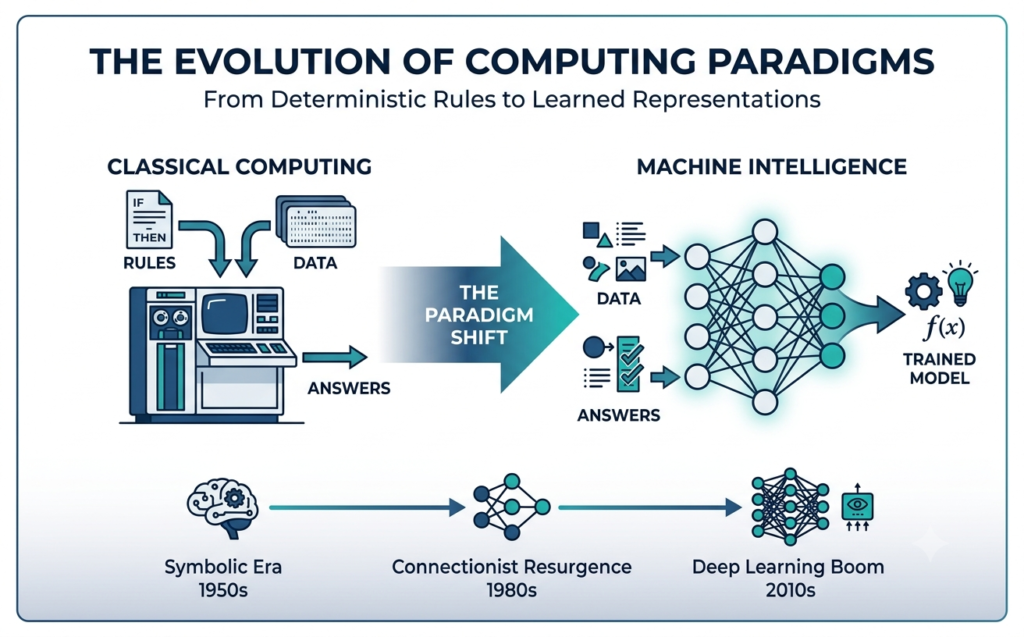
Defining Machine Intelligence: What It Is (and Isn’t)
We define Machine Intelligence as the capacity of a computational system to execute tasks by constructing generalized probabilistic models from empirical data, rather than following explicitly programmed deterministic rules. ### The Paradigmatic Shift
To understand MI, consider the fundamental shift in the computing paradigm:
- Classical Programming (Symbolic AI):
- Machine Intelligence:
Instead of a software engineer hard-coding conditional statements (e.g.,
if-then-else), an MI system evaluates high-dimensional feature spaces to identify statistical regularities. It adjusts internal scalar values, known as weights and biases, to minimize a loss function via optimization techniques like Stochastic Gradient Descent (SGD).[ Classical Computing ] Rules + Data -----------> [ System ] -----------> Answers [ Machine Intelligence ] Data + Answers ---------> [ System ] -----------> Rules (Trained Model)The Evolutionary Timeline: From Rules to Representations
The road to modern MI has been marked by swings between intense optimism and funding droughts, historically known as “AI Winters.”
The Symbolic Era (1950s–1980s)
Early AI focused on hard-coded logic and symbolic reasoning. Pioneers like John McCarthy and Marvin Minsky believed intelligence could be formalized through deductive logic. While this birthed powerful deterministic tools like chess engines and rule-based “expert systems,” it collapsed when faced with the messy, non-linear realities of natural language and computer vision.
The Connectionist Resurgence (1980s–2000s)
The paradigm shifted toward connectionism, or modeling intelligence using artificial neural networks (ANNs). The rediscovery of the backpropagation algorithm in the mid-1980s allowed multi-layer networks to learn internal representations. However, this era stalled due to a lack of computational hardware and data starvation.
The Deep Learning and Foundation Model Boom (2010s–Present)
The modern era was ignited in 2012 when AlexNet won the ImageNet competition, proving that deep convolutional neural networks (CNNs), when paired with Graphics Processing Units (GPUs), shattered classical vision benchmarks.
The breakthrough accelerated with the introduction of the Transformer architecture by Vaswani et al. in 2017. By replacing recurrence with self-attention mechanisms, Transformers paved the way for massive foundation models (like the GPT and Claude families) and the modern shift toward Agentic AI, which are systems capable of autonomous multi-step reasoning and tool execution.
The Modern MI Stack: Frameworks and Infrastructure
Building machine intelligence today relies on a highly mature ecosystem of software and hardware.
The Software Frameworks
Modern ML architecture is dominated by two primary open-source ecosystems:
- PyTorch (Backed by Meta): The preferred library for academic research and cutting-edge deployment due to its dynamic computation graph, which allows for intuitive debugging and flexible model design.
- TensorFlow / Keras (Backed by Google): Renowned for its highly stable, static graph execution, making it a staple for rigid enterprise production pipelines.
- Classical Libraries: For tabular data and standard statistical modeling, scikit-learn, XGBoost, and LightGBM remain the industry standard for gradient-boosted decision trees.
Managed Enterprise Platforms
At scale, engineers rarely train models on local machines. They utilize cloud-native MLOps (Machine Learning Operations) suites like Google Cloud Vertex AI, Amazon SageMaker, and IBM watsonx.ai. These platforms handle the end-to-end lifecycle, including data lineage tracking, hyperparameter tuning, distributed training orchestration, and real-time model drift monitoring.
High-Impact Applications
Machine intelligence is changing operations across technical and scientific fields through advanced applications:
Industry Primary Technique Real-World Impact Biomedicine Structural Bioinformatics & Deep Learning AlphaFold revolutionized structural biology by predicting 3D protein structures directly from amino acid sequences, cutting drug discovery timelines down from years to days. Quantitative Finance Time-Series Forecasting & Reinforcement Learning Automated market making, algorithmic high-frequency trading, and real-time anomaly detection pipelines for credit fraud detection. Autonomous Systems Computer Vision & Sensor Fusion Autonomous drones and edge-AI vehicles mapping environments in real time using 3D object detection and semantic segmentation. Enterprise Software LLMOps & Retrieval-Augmented Generation (RAG) Transitioning from simple chatbots to Agentic Systems that autonomously interface with databases, draft code, and manage cross-platform workflows. Looking Ahead: The Post-Graduate Frontier
For researchers and engineers, the current frontier of machine intelligence is no longer just about scaling parameter counts. The focus has pivoted toward deep systemic challenges:
- Inference Efficiency: Compressing massive models via quantization, pruning, and Knowledge Distillation to run on low-power edge devices.
- Explainable AI (XAI): Peering inside the “black box” of deep neural networks to mathematically trace why a model made a specific prediction.
- Alignment and Robustness: Ensuring models fail gracefully when exposed to out-of-distribution (OOD) data or adversarial attacks.
Machine intelligence is not a magical artifact; it is an elegant mathematical framework built on linear algebra, calculus, and probability, brought to life by massive parallel computing. Understanding its mechanics is the first step toward building its future.
-
A History of Artificial Intelligence — Part 3: From Transformers to ChatGPT — and What It Means for the Strong AI Debate
This is the final part of a three-part series on the history of AI. Part 1 covered AI’s philosophical origins and the Turing Test, Strong AI vs. Weak AI, and Searle’s Chinese Room argument. Part 2 traced the rise of machine learning and deep learning through the founding of OpenAI in 2015. Part 3 picks up the story with the breakthrough that made ChatGPT possible.
The Paper That Changed Everything
By 2017, deep learning had already transformed computer vision and game-playing AI, as Part 2 described. But language remained stubbornly difficult. Earlier neural network architectures processed text sequentially, word by word, which made them slow to train and bad at capturing relationships between distant words in a sentence.
In June 2017, a team of researchers from Google Brain and Google Research published “Attention Is All You Need,” introducing the Transformer architecture. The paper demonstrated that an architecture using only attention mechanisms, with no recurrence or convolutions at all, could outperform existing approaches on machine translation while training significantly faster.
The key innovation was self-attention. Self-attention allows each word, or token, in a sequence to attend to every other token in that same sequence, enabling efficient parallelization and much better modeling of long-range relationships between words. Because the architecture could process entire sequences of text at once rather than one word at a time, it enabled the training of dramatically larger and more sophisticated models than had previously been practical.
Few people, including the paper’s own authors, anticipated just how far-reaching this idea would become. Within a few years, researchers had adapted the Transformer architecture to tasks far beyond language translation, including image classification, image generation, and even protein folding.
GPT-1 to GPT-3: Teaching Machines to Predict the Next Word
The original 2017 Transformer had two halves: an encoder for reading text and a decoder for generating it. OpenAI was the first to apply generative pre-training specifically to the decoder half of this architecture, introducing the GPT-1 model in 2018. While other researchers, such as the team behind Google’s BERT, pursued clever training objectives, OpenAI took a more deceptively simple path: training models to predict the next word in a sequence, an approach now called language modeling. GPT pioneered the idea of pre-training language models on vast amounts of unlabeled text before fine-tuning them on specific downstream tasks.
The first GPT model had 117 million parameters and meaningfully advanced state-of-the-art results across many language tasks, but it was not GPT-2, with its 1.5 billion parameters, that began capturing genuine public attention. Each generation scaled up dramatically. GPT-2 followed in February 2019, and GPT-3 arrived in June 2020 with 175 billion parameters, demonstrating striking emergent capabilities that simply hadn’t been visible in smaller models. GPT-3 was the first model OpenAI commercialized broadly, through a private beta of the OpenAI API in June 2020. Meaning that for the first time, developers anywhere could build applications on top of a frontier language model without training one themselves.
But GPT-3, for all its scale, had a problem: it was powerful but not particularly easy to work with. Interacting with raw GPT-3 could be hit-or-miss; the model sometimes gave irrelevant answers or followed instructions only loosely. It was capable, but not especially helpful or safe by default.
Teaching the Model to Listen: RLHF and InstructGPT
The solution OpenAI developed would prove just as important as the scaling breakthroughs that preceded it: Reinforcement Learning from Human Feedback, or RLHF. The technique worked in stages: human AI trainers had conversations with the model and provided examples of good responses; the model then generated multiple possible answers to the same questions; human reviewers ranked these answers from best to worst; and the model learned to produce responses more like the highly ranked ones. arxiv
This fine-tuning stage, layered on top of GPT-3’s existing pre-training, became known as reinforcement learning with human feedback. OpenAI released the resulting model, InstructGPT, in early 2022, and the results were striking: human evaluators preferred InstructGPT’s outputs over raw GPT-3’s outputs 85% of the time, even though InstructGPT used far fewer parameters. That finding reframed the entire scaling debate: a smaller, better-aligned model could outperform a larger, unaligned one on the metrics that actually mattered to users.
RLHF didn’t just make models safer; it made them more useful in practical settings, because their responses became more predictable, more direct, and less prone to drifting into irrelevant territory.
November 30, 2022: ChatGPT Arrives
This period of refinement directly produced ChatGPT, which applied RLHF to a GPT-3.5 base model and packaged it inside a simple, conversational interface. OpenAI released ChatGPT on November 30, 2022, as a free research preview.
The public response was immediate and unprecedented. Within five days of launch, ChatGPT reached one million users, and an estimated 100 million monthly users within roughly two months, making it the fastest-adopted consumer product in history at that time.
What made ChatGPT spread so quickly wasn’t necessarily a leap in raw capability over what came before. The technical capabilities of InstructGPT and ChatGPT were almost identical — the primary changes OpenAI made were adding conversational training data and further tuning the training process. What changed was accessibility: for the first time, a frontier AI model was wrapped in an interface anyone could use, for free, with no technical knowledge required. The gap between “powerful research model” and “tool my grandmother can use” had finally closed.
From there, the pace of iteration accelerated further. GPT-4 arrived in March 2023 with image input and substantially stronger reasoning, followed by GPT-4 Turbo, then GPT-4o in May 2024, which combined text, audio, and image processing into a single model. A parallel “reasoning” lineage (the o-series, beginning with o1 in 2024) introduced models trained to work through an internal chain of thought before answering, particularly strengthening performance on math, coding, and science tasks. ChatGPT itself evolved from a simple chat box into a far broader platform capable of browsing, file analysis, and increasingly autonomous task execution.
Returning to the Question We Started With
This brings us back to where Part 1 began: Turing’s question of whether machines can think, and Searle’s challenge to the idea that they ever truly could.
Modern language models like ChatGPT are, at their technical core, exactly the kind of system Searle’s Chinese Room argument was built to describe: a process that manipulates symbols or tokens according to learned statistical patterns, without any claimed inner experience of meaning. Searle’s argument was never meant to deny that such a machine could produce remarkably intelligent-seeming behavior; it was aimed specifically at the philosophical claim that symbol manipulation alone is sufficient to produce genuine understanding. By that standard, today’s most advanced chatbots remain, in the strictest philosophical sense, firmly in weak AI territory. They are extraordinarily capable simulators of conversation, whatever may or may not be happening “underneath.”
Even ChatGPT itself is best understood as an advanced form of narrow AI, rather than a step toward the kind of general intelligence imagined at Dartmouth in 1956. It cannot reason about domains outside its training in the way a human professional moves fluidly between unrelated fields of expertise. It does not possess goals, desires, or self-awareness in any sense most philosophers would recognize as minds typically do.
And yet, six decades after Turing’s original 1950 paper, the Turing Test feels almost quaint. Millions of people now hold conversations daily with systems that, for stretches at a time, are functionally indistinguishable from a knowledgeable human correspondent. The technical bar Turing imagined has, in many everyday contexts, been cleared, even as the philosophical question he set out to sidestep remains as unresolved as ever.
What today’s AI does prove, decisively, is something Turing himself anticipated: that behavior, not metaphysics, is what changes the world. Whether or not ChatGPT “understands” anything in Searle’s sense, it has already reshaped how hundreds of millions of people write, code, research, and learn. The history traced across these three articles, from Turing’s question, through symbolic AI and its winters, through the rise of neural networks and deep learning, to the Transformer and RLHF, is ultimately the story of a field that kept building useful tools, even while the deepest question that started it all remains open.
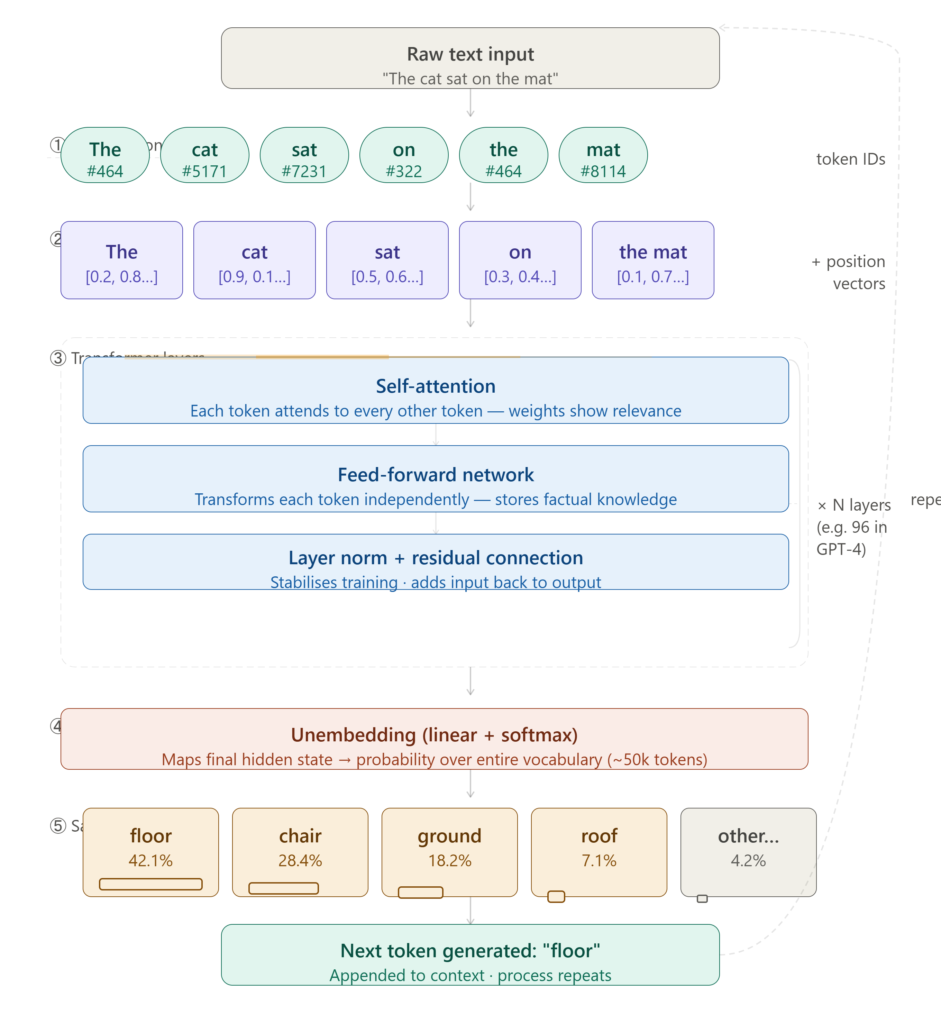
Here’s the full end-to-end LLM pipeline in one diagram. It walks through five stages:
① Tokenization — raw text is split into token IDs (shown as pills with their vocabulary numbers).
② Embedding — each token ID is converted to a high-dimensional vector, plus a positional vector so the model knows word order.
③ Transformer layers — the heart of the model: self-attention (where each token “looks at” every other token, with amber lines showing attention weights from “sat”), a feed-forward network per token, and layer normalisation — repeated N times (96 layers in GPT-4).
④ Output projection — the final hidden state is mapped back across the entire vocabulary using a softmax to produce probabilities.
⑤ Sampling — a token is selected from the distribution (here “floor” wins at 42.1%), appended to the context, and the whole process repeats — shown by the dashed feedback arrow on the right.
This concludes our three-part series on the history of artificial intelligence. Explore more in our AI Foundations category, including beginner-friendly guides to AI tools, prompt engineering, and AI productivity.
-
A History of Artificial Intelligence — Part 2: The Machine Learning Revolution and the Road to OpenAI
This is Part 2 of a three-part series tracing the history of artificial intelligence. Part 1 covered AI’s philosophical origins, the Dartmouth Conference, and the AI winters. Part 2 picks up with the shift toward machine learning and traces the path to the founding of OpenAI.
A New Approach: Learning From Data Instead of Rules
By the end of Part 1, AI research had hit a wall. The symbolic, rule-based approaches of expert systems, sometimes retroactively called “Good Old Fashioned AI”, involved pre-programming knowledge and rules directly into a system. These approaches were brittle and difficult to scale. A quieter alternative had existed since the field’s earliest days but had never become mainstream: machine learning.
In machine learning, instead of a human programmer writing the rules, the program learns the rules itself from data. Arthur Samuel coined the term “machine learning” itself and was the first to apply the technique, building a self-learning checkers program in 1959 that ran on IBM mainframes. The idea was decades ahead of the computing power needed to make it practical.
The foundational building block for this approach was the artificial neural network, loosely inspired by the structure of the brain. An early version, the Perceptron, was a simple neuron-like model that learned to classify inputs. A 1969 analysis by Minsky and Papert highlighted the perceptron’s limitations, triggering a temporary retreat from neural network research — one of the contributing causes of the AI winters discussed in Part 1.
Backpropagation: The Algorithm That Made Deep Learning Possible
The technique that would eventually revive neural networks was backpropagation. It was a method for training multi-layered networks by calculating how much each connection contributed to an error, then adjusting it accordingly. Backpropagation allowed multi-layer neural networks to adjust their weights to minimize errors, enabling these networks to automatically learn useful internal representations of data.
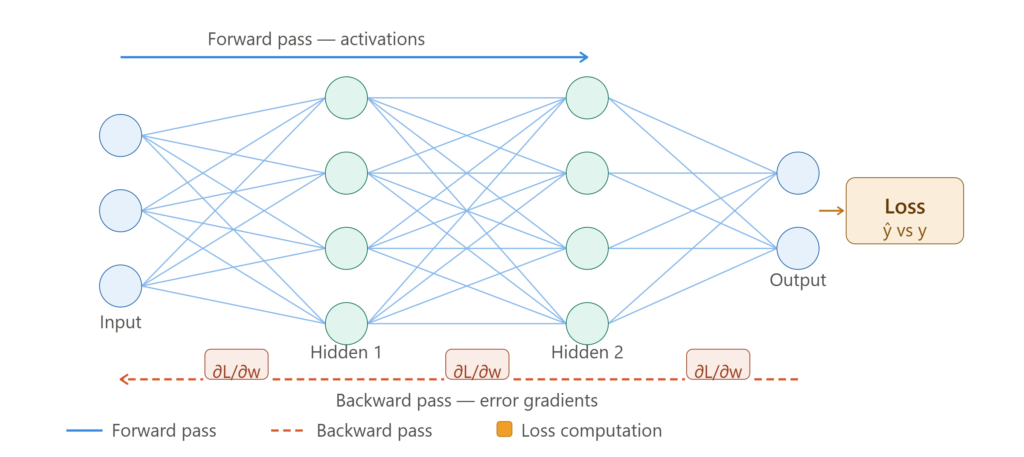
In the above diagram, the blue forward pass carries activations left to right through the input layer, two hidden layers, and the output layer, with all the inter-neuron weight connections visible. The amber loss box on the right computes the difference between the predicted output and the true label. The coral dashed backward pass then carries the error gradient right to left, and the
∂L/∂wpills mark the points at each layer boundary where weights get adjusted using the chain rule.In 1986, Geoffrey Hinton, David Rumelhart, and Ronald Williams developed and popularized backpropagation, making the training of multi-layered neural networks genuinely feasible for the first time. In 1989, Yann LeCun provided one of the first practical demonstrations of the technique at Bell Labs, combining convolutional neural networks with backpropagation to read handwritten digits, a system that would later be used to process handwritten numbers on bank checks.
The timing was bittersweet. This breakthrough arrived just as the second AI winter (roughly 1985 to the early 1990s) was setting in, as overly optimistic claims about AI’s “immediate” potential had broken expectations and angered investors, pushing the phrase “artificial intelligence” toward something close to pseudoscience status in some circles. Backpropagation’s true potential would have to wait.
The 1990s: Quiet Progress Beneath the Surface
Even during the chill of the AI winter, important work continued. Throughout the 1990s, Yann LeCun pioneered convolutional neural networks (CNNs), laying the technical foundation for modern computer vision. This is the technology that today powers everything from photo tagging to facial recognition. Researchers also developed the support vector machine, an effective system for mapping and classifying similar data, broadening the machine learning toolkit beyond neural networks alone.
The decade also delivered AI’s first major public spectacle. In 1997, Deep Blue, a chess program built at IBM, defeated reigning world chess champion Garry Kasparov, relying not on deep learning but on brute-force search combined with expert-crafted evaluation rules. It captured global headlines and reignited public fascination with AI, even though the underlying technology was closer to the symbolic AI of earlier decades than to the neural approaches that would soon take over.
The Data Explosion and the ImageNet Moment
Two ingredients were still missing for deep learning to fulfill its promise: enough data to learn from, and enough computing power to process it. The internet supplied the first. The internet boom of the 1990s and 2000s provided machine learning systems with vast quantities of real-world data to learn from for the first time.
Recognizing this, Stanford professor Fei-Fei Li began building ImageNet in 2006, an enormous database that would eventually contain more than 14 million labeled images, designed specifically to give machine learning systems the structured data they needed to learn effectively. Li summarized the philosophy behind the project simply: data drives learning.
Computing power, the second missing ingredient, arrived through an unlikely source: graphics processing units (GPUs), originally built for video games. By 2011, GPU speeds had increased significantly enough to train convolutional neural networks without the cumbersome layer-by-layer pre-training that had previously been necessary.
These two trends collided in 2012, in what is widely considered the single most important turning point in modern AI history. AlexNet, developed by Alex Krizhevsky, Ilya Sutskever, and Geoffrey Hinton, won the ImageNet competition, and its success demonstrated that deep learning had decisive advantages in both efficiency and accuracy over older approaches, sparking the deep learning revolution that defines the current era of AI. The rapid adoption of this feature-learning approach by major technology companies followed almost immediately.
From Vision to Strategy: Deep Learning Spreads
Once deep learning proved itself on image recognition, it rapidly expanded into other domains. In 2014, Ian Goodfellow and colleagues introduced Generative Adversarial Networks (GANs), a technique that enabled AI systems to generate convincingly realistic data, an early ancestor of today’s AI image generators.
Perhaps the most striking demonstration of deep learning’s power came from the world of board games. Unlike older symbolic chess programs that relied on pre-programmed evaluation functions, Google DeepMind’s AlphaGo combined deep learning with Monte Carlo tree search, using a neural network to evaluate which moves were promising rather than relying purely on brute-force calculation. In 2015, AlphaGo defeated the world champion Go player, a feat many AI researchers had assumed was still decades away, since Go’s branching complexity vastly exceeds that of chess. AlphaGo achieved this by playing millions of simulated games against itself, learning optimal strategies through deep reinforcement learning rather than human-programmed rules.
2015: The Founding of OpenAI
It was against this backdrop of accelerating breakthroughs and growing public and academic concern about where increasingly powerful AI systems might lead that a new kind of organization was born. In 2015, Elon Musk, Sam Altman, Greg Brockman, and other co-founders established OpenAI, with an explicit mission to promote safe and open AI development.
The founding represented something distinct from the corporate AI labs that had driven progress up to that point. Rather than developing AI purely as a commercial product, OpenAI was structured around the idea that increasingly powerful AI systems needed an organization explicitly focused on ensuring their benefits were broadly shared, and their risks carefully managed. At the time, few could have predicted just how central this organization would become to the AI story over the following decade.
The stage was now set. Deep learning, massive datasets, GPU computing, reinforcement learning, and several other tools, were all in place. What remained was a breakthrough in how machines processed language itself, one that would lead directly to the creation of the Generative Pre-trained Transformer, and eventually, to ChatGPT.
This is Part 2 of a 3-part series on the history of AI. Part 3 will trace the development of the Transformer architecture, the GPT model family, and the creation of ChatGPT — closing the loop on the strong AI vs. weak AI debate raised in Part 1.
-
A History of Artificial Intelligence — Part 1: From Ancient Dreams to the Birth of a Field
This is Part 1 of a three-part series tracing the history of artificial intelligence, from its philosophical roots to the creation of OpenAI and ChatGPT. Part 1 covers the early foundations of AI through the AI winters of the 1970s and 80s.
Before the Machines: A Question, Not a Technology
Long before computers existed, humans imagined artificial beings capable of thought — from mechanical automatons in ancient myth to philosophical debates about the nature of mind. But the scientific story of AI begins not with a machine, but with a question. In the 1950s, researchers started exploring whether intelligence could be formalized, tested, and eventually built into machines.
The foundations were laid even earlier than most people realise. In 1943, Warren McCulloch and Walter Pitts published a paper proposing the first mathematical model of a neural network, a concept that would lie mostly dormant for decades before becoming the backbone of modern deep learning. It is a useful reminder that AI’s history is rarely linear; many of its most important ideas were proposed long before the technology existed to realize them.
Alan Turing and the Question “Can Machines Think?”
Alan Turing, often considered the father of modern computing, made many important contributions to artificial intelligence. In 1950, he published his landmark paper “Computing Machinery and Intelligence,” introducing what would later be known as the Turing Test.
Rather than getting tangled in unanswerable philosophical debates about consciousness, Turing proposed something practical: if a machine could convincingly communicate like a human in conversation, its intelligence should be taken seriously. In his proposed experiment, a human evaluator interacts with both a human and a machine without knowing which is which; if the evaluator cannot reliably distinguish between them, the machine is said to have passed the test.
This was a deliberately pragmatic move. It set the tone for decades of AI research: intelligence would be measured by what a system could do, not by philosophical claims about what was happening inside it. That framing of behavior over inner experience would later become the central fault line in one of AI’s most enduring philosophical debates, which we’ll return to shortly.
1956: The Dartmouth Conference and the Birth of a Field
In the summer of 1956, a small group of researchers gathered at Dartmouth College for a workshop proposed by John McCarthy, Marvin Minsky, Nathaniel Rochester, and Claude Shannon. Their proposal stated the conjecture plainly: that every aspect of learning or any other feature of intelligence could in principle be so precisely described that a machine could be made to simulate it.
It was McCarthy’s coinage of “artificial intelligence” that appeared in that proposal, and the phrase stuck partly because the alternatives on offer were worse: “machine intelligence” was vague, and “cybernetics” was already associated with control theory rather than cognition. The workshop was loosely organized and not everyone stayed the full two months, but it established the field’s founding ambition: to simulate, in a machine, every aspect of human intelligence.
Remarkably, one team arrived with a working demonstration already in hand. Allen Newell and Herbert Simon, working with programmer Cliff Shaw, had built the Logic Theorist, a program designed to prove theorems from Whitehead and Russell’s Principia Mathematica. It successfully proved 38 of the first 52 theorems, and one of its proofs was, according to its creators, more elegant than the original. This is widely considered the first true AI program.
The momentum continued quickly. In 1958, John McCarthy developed the Lisp programming language, which became a primary tool for AI research for decades. In 1966, Joseph Weizenbaum created ELIZA, an early natural language program that simulated conversation and famously convinced some users they were talking to a sympathetic listener, despite running on simple pattern-matching rules.
Strong AI, Weak AI, and the Debate That Followed
As programs like ELIZA grew more convincing, a deeper question resurfaced: were these systems actually thinking, or just simulating the appearance of thought? This is the distinction between what philosophers call strong AI and weak AI.
Strong AI is the view that a suitably programmed computer can genuinely understand language and possess mental capabilities similar to a human’s and not merely simulate them. Weak AI, by contrast, holds that computers are useful tools for modeling or simulating mental processes, without making any claim that they actually understand or are truly intelligent.
This distinction became the center of one of the most famous thought experiments in the philosophy of AI: John Searle’s Chinese Room argument, published in 1980.
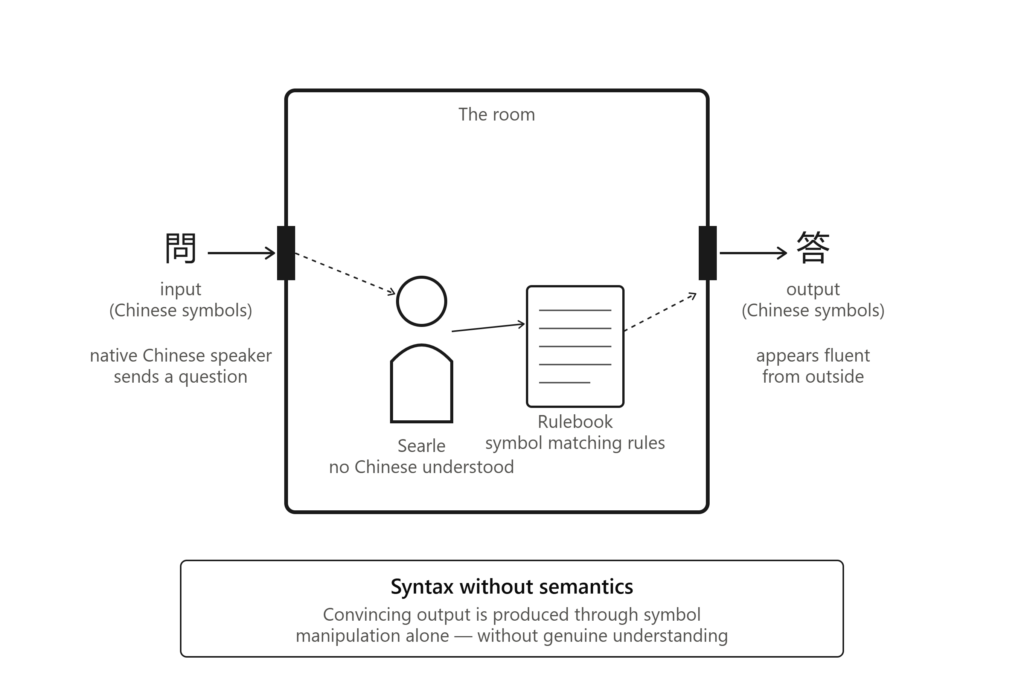
Searle asked readers to imagine a person who does not understand Chinese, sealed inside a room. This person is given Chinese characters through a slot in the door, along with a detailed rulebook (written in a language they do understand) for manipulating those symbols and producing appropriate Chinese characters in response. By following the rules precisely, the person can produce convincing Chinese replies (enough to pass a Turing Test) without ever understanding a single word of Chinese.
Searle’s point was that the person in the room and a computer running a program are not meaningfully different: both follow step-by-step instructions to produce outputs that appear intelligent, without any genuine understanding occurring. The argument was specifically directed at strong AI’s claim that an appropriately programmed computer, given the right inputs and outputs, would have a mind in exactly the same sense humans do. Searle aimed to show that information processing alone, no matter how sophisticated, cannot by itself produce genuine thought or understanding.
The argument was controversial and it remains so. One major line of response, known as the “Systems Reply,” concedes that the person inside the room doesn’t understand Chinese, but argues that some larger system: the room, the rulebook, and the person together might understand, even if no individual component does. A related “Virtual Mind” reply argues the real claim of strong AI isn’t that the computer itself understands, but that the process running on the computer creates a mind that understands, much like a character in a video game. Importantly, the Chinese Room argument was never meant as an attack on AI’s practical capabilities; it does not claim there is a limit to how intelligent a machine’s behavior can appear. Its target was narrower: the philosophical claim that computation alone is sufficient to produce genuine understanding.
Decades later, as language models like ChatGPT produce remarkably fluent conversation, Searle’s question has only grown more relevant, and we’ll return to it directly in Part 3 of this series.
The AI Winters: When Promises Outpaced Reality
The optimism of the 1950s and 60s could not last forever. The field experienced periods of decline known as “AI winters” in the 1970s and late 1980s, driven by unmet expectations and limited computational power. AI winters happened when expectations outpaced reality. Limitations in compute, data, and real-world performance made it difficult to deliver on the bold promises researchers had made, and funding agencies pulled back accordingly.
There was a partial revival before the deepest freeze set in. A resurgence in the 1980s was driven by the development of expert systems — programs that encoded the knowledge of human experts as explicit if-then rules, which found genuine commercial applications in narrow domains like medical diagnosis and chemical analysis. But even expert systems proved brittle and expensive to maintain at scale, and by the late 1980s, a second, harsher AI winter set in.
It would take a very different approach, one centered on learning from data rather than hand-coded rules, to pull the field out of its second winter and toward the breakthroughs that would eventually make modern AI possible. That story, including the rise of machine learning, deep learning, and the neural networks that power today’s chatbots, is where Part 2 picks up.
This is Part 1 of a 3-part series on the history of AI. Part 2 will cover the rise of machine learning and deep learning, leading up to the founding of OpenAI. Part 3 will trace the path from GPT to ChatGPT and discuss what these developments mean for the strong AI vs. weak AI debate today.
-
What Is Artificial Intelligence? A Beginner’s Guide
Introduction
Artificial Intelligence (AI) is one of the most transformative and talked-about technologies of our time, and for good reason. In just a few decades, AI has moved from the pages of science fiction novels into our smartphones, hospitals, classrooms, and workplaces. It powers the recommendations that appear when you open Netflix, helps doctors detect diseases earlier than ever before, and enables cars to navigate roads with minimal human input.
What makes AI remarkable is not just what it can do today, but how rapidly it continues to evolve. New breakthroughs in language understanding, image generation, and autonomous reasoning are being announced almost every month. Industries that once seemed immune to automation (such as law, medicine, creative arts) are now being fundamentally reshaped by AI tools.
Yet despite all this buzz, many people still feel uncertain about what AI actually is. Is it just a fancy algorithm? Is it truly “thinking”? Is it something to fear or to embrace? This guide is designed to answer those questions in plain language, without requiring any technical background. Whether you are a student exploring future career paths, a professional looking to stay current, or simply a curious person trying to make sense of the world, understanding the basics of AI has never been more valuable.
What Is Artificial Intelligence?
At its core, Artificial Intelligence refers to the ability of computer systems to perform tasks that would normally require human intelligence. This includes things like understanding spoken or written language, recognizing faces in photographs, translating text between languages, making predictions based on historical data, and even composing music or generating images.
The key idea behind AI is that machines can be trained to solve problems, rather than explicitly programmed step by step. Traditional software follows precise, pre-written instructions: “if X happens, do Y.” AI systems, by contrast, learn from large amounts of data and develop their own internal rules for making decisions. This is why an AI can recognize a cat in a photo it has never seen before: it has learned the general concept of “cat” from millions of examples.
It is worth noting that AI is not a single technology. It is an umbrella term covering a wide range of methods and approaches, including machine learning, deep learning, natural language processing, computer vision, and more. Each of these subfields has its own techniques and applications, but they all share the same fundamental goal: enabling machines to exhibit intelligent behavior.
One fascinating benchmark in AI history is the Turing Test, proposed by British mathematician Alan Turing in 1950. The test asks whether a machine can converse with a human so naturally that the human cannot tell they are talking to a machine. Despite enormous advances, no AI system has unequivocally passed the Turing Test under rigorous, open-ended conditions. This remains a reminder that while AI is extraordinarily powerful in specific domains, human-like general intelligence is still an unsolved frontier.
Examples of AI in Daily Life
One of the most surprising things people discover when learning about AI is just how much of it they already use — often without realizing it. AI is quietly embedded in dozens of tools and platforms most of us interact with every day.
Voice Assistants: When you ask Siri to set a timer, tell Alexa to play music, or ask Google Assistant for the weather, you are using natural language processing (NLP), a branch of AI that enables machines to understand and respond to human speech. These assistants are trained on vast amounts of conversational data to interpret context, intent, and even tone.
Streaming Recommendations: Platforms like Netflix, Spotify, and YouTube use AI recommendation engines that study your viewing or listening history, compare it with patterns from millions of other users, and surface content you are likely to enjoy. The more you use these platforms, the more personalized their suggestions become.
Email Spam Filters: Your email inbox is protected by AI classifiers that analyze the structure, content, and sender behavior of incoming messages to decide whether they are spam. These systems learn continuously as new spam techniques emerge.
Online Translation: Services like Google Translate and DeepL use deep learning models trained on billions of translated sentences. Modern AI translation is remarkably accurate for common languages and has made cross-language communication accessible to people worldwide.
Navigation and Route Planning: Apps like Google Maps and Waze use AI to analyze real-time traffic data, predict congestion, suggest optimal routes, and even anticipate your destination based on your regular patterns.
Chatbots and Customer Support: Many companies now use AI-powered chatbots to handle customer inquiries, process simple requests, and route complex issues to human agents. Advances in large language models (LLMs) have made these systems dramatically more helpful in recent years.
Medical Diagnostics: AI tools can analyze X-rays, MRI scans, and pathology slides to help doctors detect conditions like cancer, diabetic retinopathy, and pneumonia, sometimes with accuracy that rivals experienced specialists.
These are just a handful of examples. AI also plays a significant role in fraud detection, hiring tools, climate modeling, agricultural optimization, and much more.
Types of AI
When researchers and technologists talk about AI, they often distinguish between different levels or types of capability. The two most commonly discussed categories are Narrow AI and General AI.
Narrow AI (also called Weak AI) is the only kind of AI that actually exists today. Narrow AI systems are designed and trained to perform a specific, well-defined task. They can be extraordinarily powerful within that task, often surpassing human performance, but they cannot transfer their abilities to other domains. A chess-playing AI cannot write poetry. A language translation model cannot drive a car. Each system is optimized for one job and one job only.
Examples of Narrow AI include facial recognition software, spam detection algorithms, product recommendation engines, and large language models like the ones used in AI writing assistants.
General AI (also called Artificial General Intelligence, or AGI) is a theoretical concept referring to a machine that could perform any intellectual task that a human can perform – reasoning flexibly across domains, learning from minimal data, and applying knowledge in novel situations. AGI would represent a fundamentally different kind of intelligence than what we have today. As of now, AGI does not exist, and there is significant debate among researchers about how far away it might be, or whether it is achievable at all with current approaches.
Some researchers also discuss a third category, Superintelligent AI, which would surpass human intelligence across all domains. This remains firmly in the realm of speculation and is the subject of both serious academic research and popular philosophical debate.
For practical purposes, everything you encounter in the real world today, no matter how impressive, falls into the Narrow AI category.
Benefits and Challenges
AI offers a remarkable range of benefits that are already improving lives and reshaping industries. At the same time, it introduces complex challenges that society must confront thoughtfully.
Benefits:
Productivity and Automation — AI can handle repetitive, time-consuming tasks at a scale and speed no human workforce could match. This frees people to focus on creative, strategic, and interpersonal work that machines cannot replicate.
Faster and Better Decision-Making — In fields like finance, medicine, and logistics, AI can analyze enormous datasets in seconds and surface insights that would take human analysts days or weeks to find.
Personalized Experiences — From personalized learning platforms that adapt to a student’s pace, to healthcare tools that tailor treatment recommendations to an individual’s genetic profile, AI enables a level of customization that was previously impossible at scale.
Scientific Discovery — AI has accelerated research in drug discovery, materials science, and climate modeling, helping scientists identify promising leads far more efficiently than traditional methods.
Challenges:
Bias and Fairness — AI systems learn from historical data, which often reflects existing societal biases. If not carefully designed and audited, AI tools can perpetuate or even amplify discrimination in hiring, lending, criminal justice, and other high-stakes areas.
Data Privacy — AI systems require large amounts of data to function effectively. This raises serious questions about how personal data is collected, stored, used, and protected — and who ultimately controls it.
Security Risks — AI can be exploited for malicious purposes, including generating convincing disinformation, automating cyberattacks, and creating deepfake content designed to deceive.
Job Displacement — As AI automates more tasks, certain roles will inevitably change or disappear. While new jobs will emerge, the transition may be uneven and will require significant investment in retraining and education.
Transparency and Accountability — Many advanced AI systems operate as “black boxes,” making decisions in ways that are difficult to interpret or explain. This raises important questions about accountability when AI makes consequential errors.
Navigating these trade-offs wisely will be one of the defining challenges of the coming decades.
How to Start Learning AI
The good news is that you do not need a computer science degree to begin understanding and using AI. The field has become far more accessible, and there are excellent resources for learners at every level.
Start with the concepts. Before diving into tools or code, build a solid mental model of what AI is, how it learns, and what its limitations are. Reading accessible books and articles, like this one, is a great first step. Look for introductory courses that explain machine learning concepts in plain language before introducing mathematics.
Explore AI tools hands-on. The fastest way to understand AI is to use it. Experiment with generative AI tools, image generators, translation services, and coding assistants. Pay attention to where they succeed and where they fail, which this builds genuine intuition about how these systems work.
Learn prompt engineering. One of the most practical skills in the AI era is knowing how to communicate effectively with AI systems. Prompt engineering, the art of crafting clear, specific, and well-structured inputs, dramatically improves the quality of AI outputs and is a valuable skill across virtually every profession.
Develop basic technical literacy. You do not need to become a programmer to work with AI, but understanding the basics of how data is structured, what algorithms do, and how models are trained will give you a significant advantage. Introductory Python courses are widely available and provide a strong foundation.
Progress to machine learning fundamentals. Once you are comfortable with the basics, explore introductory machine learning courses. Platforms like Coursera, edX, and fast.ai offer excellent structured learning paths, many of them free.
Stay curious and current. AI is evolving faster than almost any other field. Follow reputable sources, read about new developments, and connect with communities of learners. The willingness to keep learning, not any single skill, is the most important asset you can develop.
Conclusion
Artificial Intelligence is not a distant technology on the horizon. It is already woven into the fabric of daily life, and its influence will only deepen in the years ahead. It is reshaping how we work, learn, create, and communicate, and bringing with it both extraordinary opportunities and serious responsibilities.
Understanding AI does not require you to become an engineer or a data scientist. It requires curiosity, a willingness to engage with new ideas, and the habit of asking good questions about the technology that surrounds you. The people who will thrive in the AI era are not necessarily those who know the most code; they are those who understand what AI can and cannot do, who can apply it thoughtfully in their fields, and who can think critically about its implications.
By taking the time to learn the fundamentals now, you are not just preparing yourself for tomorrow’s job market. You are equipping yourself to participate meaningfully in one of the most consequential conversations of our time.