A History of Artificial Intelligence — Part 3: From Transformers to ChatGPT — and What It Means for the Strong AI Debate
This is the final part of a three-part series on the history of AI. Part 1 covered AI’s philosophical origins and the Turing Test, Strong AI vs. Weak AI, and Searle’s Chinese Room argument. Part 2 traced the rise of machine learning and deep learning through the founding of OpenAI in 2015. Part 3 picks up the story with the breakthrough that made ChatGPT possible.
The Paper That Changed Everything
By 2017, deep learning had already transformed computer vision and game-playing AI, as Part 2 described. But language remained stubbornly difficult. Earlier neural network architectures processed text sequentially, word by word, which made them slow to train and bad at capturing relationships between distant words in a sentence.
In June 2017, a team of researchers from Google Brain and Google Research published “Attention Is All You Need,” introducing the Transformer architecture. The paper demonstrated that an architecture using only attention mechanisms, with no recurrence or convolutions at all, could outperform existing approaches on machine translation while training significantly faster.
The key innovation was self-attention. Self-attention allows each word, or token, in a sequence to attend to every other token in that same sequence, enabling efficient parallelization and much better modeling of long-range relationships between words. Because the architecture could process entire sequences of text at once rather than one word at a time, it enabled the training of dramatically larger and more sophisticated models than had previously been practical.
Few people, including the paper’s own authors, anticipated just how far-reaching this idea would become. Within a few years, researchers had adapted the Transformer architecture to tasks far beyond language translation, including image classification, image generation, and even protein folding.
GPT-1 to GPT-3: Teaching Machines to Predict the Next Word
The original 2017 Transformer had two halves: an encoder for reading text and a decoder for generating it. OpenAI was the first to apply generative pre-training specifically to the decoder half of this architecture, introducing the GPT-1 model in 2018. While other researchers, such as the team behind Google’s BERT, pursued clever training objectives, OpenAI took a more deceptively simple path: training models to predict the next word in a sequence, an approach now called language modeling. GPT pioneered the idea of pre-training language models on vast amounts of unlabeled text before fine-tuning them on specific downstream tasks.
The first GPT model had 117 million parameters and meaningfully advanced state-of-the-art results across many language tasks, but it was not GPT-2, with its 1.5 billion parameters, that began capturing genuine public attention. Each generation scaled up dramatically. GPT-2 followed in February 2019, and GPT-3 arrived in June 2020 with 175 billion parameters, demonstrating striking emergent capabilities that simply hadn’t been visible in smaller models. GPT-3 was the first model OpenAI commercialized broadly, through a private beta of the OpenAI API in June 2020. Meaning that for the first time, developers anywhere could build applications on top of a frontier language model without training one themselves.
But GPT-3, for all its scale, had a problem: it was powerful but not particularly easy to work with. Interacting with raw GPT-3 could be hit-or-miss; the model sometimes gave irrelevant answers or followed instructions only loosely. It was capable, but not especially helpful or safe by default.
Teaching the Model to Listen: RLHF and InstructGPT
The solution OpenAI developed would prove just as important as the scaling breakthroughs that preceded it: Reinforcement Learning from Human Feedback, or RLHF. The technique worked in stages: human AI trainers had conversations with the model and provided examples of good responses; the model then generated multiple possible answers to the same questions; human reviewers ranked these answers from best to worst; and the model learned to produce responses more like the highly ranked ones. arxiv
This fine-tuning stage, layered on top of GPT-3’s existing pre-training, became known as reinforcement learning with human feedback. OpenAI released the resulting model, InstructGPT, in early 2022, and the results were striking: human evaluators preferred InstructGPT’s outputs over raw GPT-3’s outputs 85% of the time, even though InstructGPT used far fewer parameters. That finding reframed the entire scaling debate: a smaller, better-aligned model could outperform a larger, unaligned one on the metrics that actually mattered to users.
RLHF didn’t just make models safer; it made them more useful in practical settings, because their responses became more predictable, more direct, and less prone to drifting into irrelevant territory.
November 30, 2022: ChatGPT Arrives
This period of refinement directly produced ChatGPT, which applied RLHF to a GPT-3.5 base model and packaged it inside a simple, conversational interface. OpenAI released ChatGPT on November 30, 2022, as a free research preview.
The public response was immediate and unprecedented. Within five days of launch, ChatGPT reached one million users, and an estimated 100 million monthly users within roughly two months, making it the fastest-adopted consumer product in history at that time.
What made ChatGPT spread so quickly wasn’t necessarily a leap in raw capability over what came before. The technical capabilities of InstructGPT and ChatGPT were almost identical — the primary changes OpenAI made were adding conversational training data and further tuning the training process. What changed was accessibility: for the first time, a frontier AI model was wrapped in an interface anyone could use, for free, with no technical knowledge required. The gap between “powerful research model” and “tool my grandmother can use” had finally closed.
From there, the pace of iteration accelerated further. GPT-4 arrived in March 2023 with image input and substantially stronger reasoning, followed by GPT-4 Turbo, then GPT-4o in May 2024, which combined text, audio, and image processing into a single model. A parallel “reasoning” lineage (the o-series, beginning with o1 in 2024) introduced models trained to work through an internal chain of thought before answering, particularly strengthening performance on math, coding, and science tasks. ChatGPT itself evolved from a simple chat box into a far broader platform capable of browsing, file analysis, and increasingly autonomous task execution.
Returning to the Question We Started With
This brings us back to where Part 1 began: Turing’s question of whether machines can think, and Searle’s challenge to the idea that they ever truly could.
Modern language models like ChatGPT are, at their technical core, exactly the kind of system Searle’s Chinese Room argument was built to describe: a process that manipulates symbols or tokens according to learned statistical patterns, without any claimed inner experience of meaning. Searle’s argument was never meant to deny that such a machine could produce remarkably intelligent-seeming behavior; it was aimed specifically at the philosophical claim that symbol manipulation alone is sufficient to produce genuine understanding. By that standard, today’s most advanced chatbots remain, in the strictest philosophical sense, firmly in weak AI territory. They are extraordinarily capable simulators of conversation, whatever may or may not be happening “underneath.”
Even ChatGPT itself is best understood as an advanced form of narrow AI, rather than a step toward the kind of general intelligence imagined at Dartmouth in 1956. It cannot reason about domains outside its training in the way a human professional moves fluidly between unrelated fields of expertise. It does not possess goals, desires, or self-awareness in any sense most philosophers would recognize as minds typically do.
And yet, six decades after Turing’s original 1950 paper, the Turing Test feels almost quaint. Millions of people now hold conversations daily with systems that, for stretches at a time, are functionally indistinguishable from a knowledgeable human correspondent. The technical bar Turing imagined has, in many everyday contexts, been cleared, even as the philosophical question he set out to sidestep remains as unresolved as ever.
What today’s AI does prove, decisively, is something Turing himself anticipated: that behavior, not metaphysics, is what changes the world. Whether or not ChatGPT “understands” anything in Searle’s sense, it has already reshaped how hundreds of millions of people write, code, research, and learn. The history traced across these three articles, from Turing’s question, through symbolic AI and its winters, through the rise of neural networks and deep learning, to the Transformer and RLHF, is ultimately the story of a field that kept building useful tools, even while the deepest question that started it all remains open.
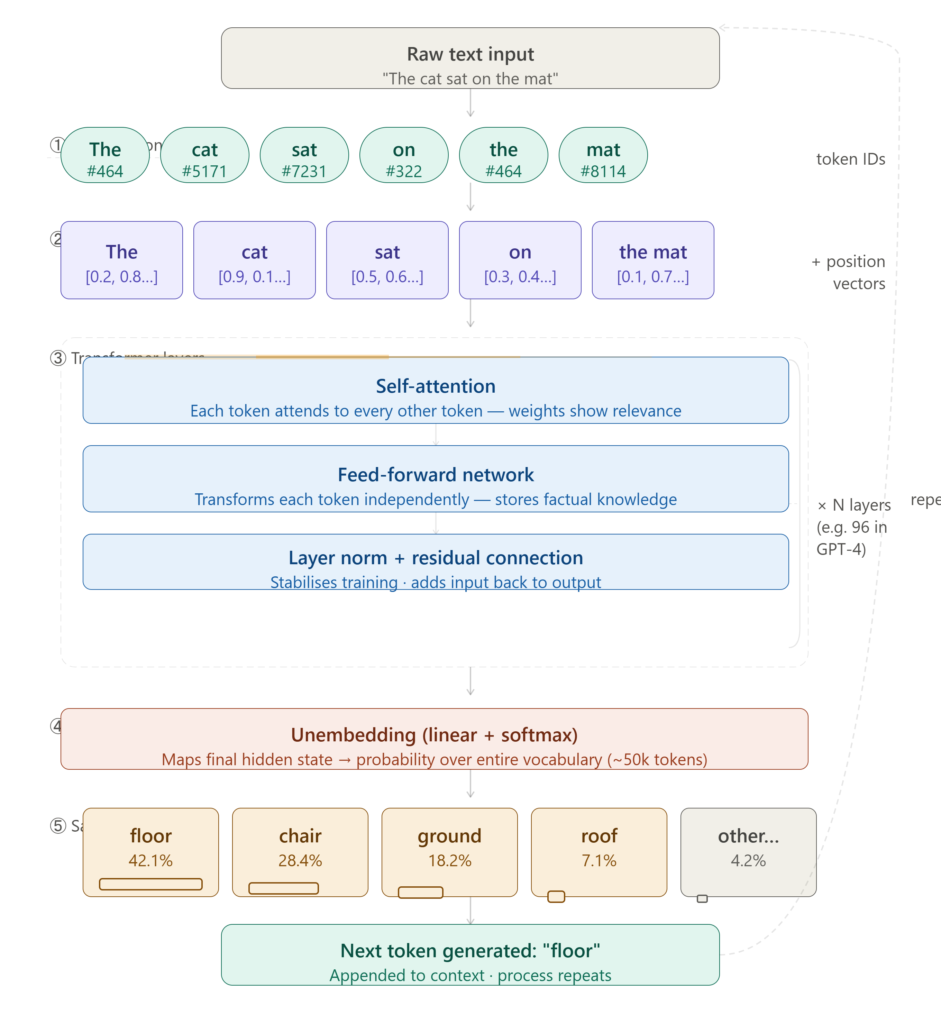
Here’s the full end-to-end LLM pipeline in one diagram. It walks through five stages:
① Tokenization — raw text is split into token IDs (shown as pills with their vocabulary numbers).
② Embedding — each token ID is converted to a high-dimensional vector, plus a positional vector so the model knows word order.
③ Transformer layers — the heart of the model: self-attention (where each token “looks at” every other token, with amber lines showing attention weights from “sat”), a feed-forward network per token, and layer normalisation — repeated N times (96 layers in GPT-4).
④ Output projection — the final hidden state is mapped back across the entire vocabulary using a softmax to produce probabilities.
⑤ Sampling — a token is selected from the distribution (here “floor” wins at 42.1%), appended to the context, and the whole process repeats — shown by the dashed feedback arrow on the right.
This concludes our three-part series on the history of artificial intelligence. Explore more in our AI Foundations category, including beginner-friendly guides to AI tools, prompt engineering, and AI productivity.
You May Also Like
5 Powerful Ways the Agentic AI Operating System Is Already Replacing Windows as You Know It
The Powerful Nvidia LLM Impact and its 5-Year Reign