The Critical Future of AI Mathematics: Literature Mining, Crisis Debates, and What Comes Next (Part 2)
This is Part 2 of a series examining how AI is transforming mathematical research. Part 1 covered automated theorem proving and formal proof assistants. Part 2 examines literature mining, the peer review crisis, existential debates within the mathematical community, and the future of AI mathematics as a discipline.
From Proving Theorems to Reading Everything Ever Written
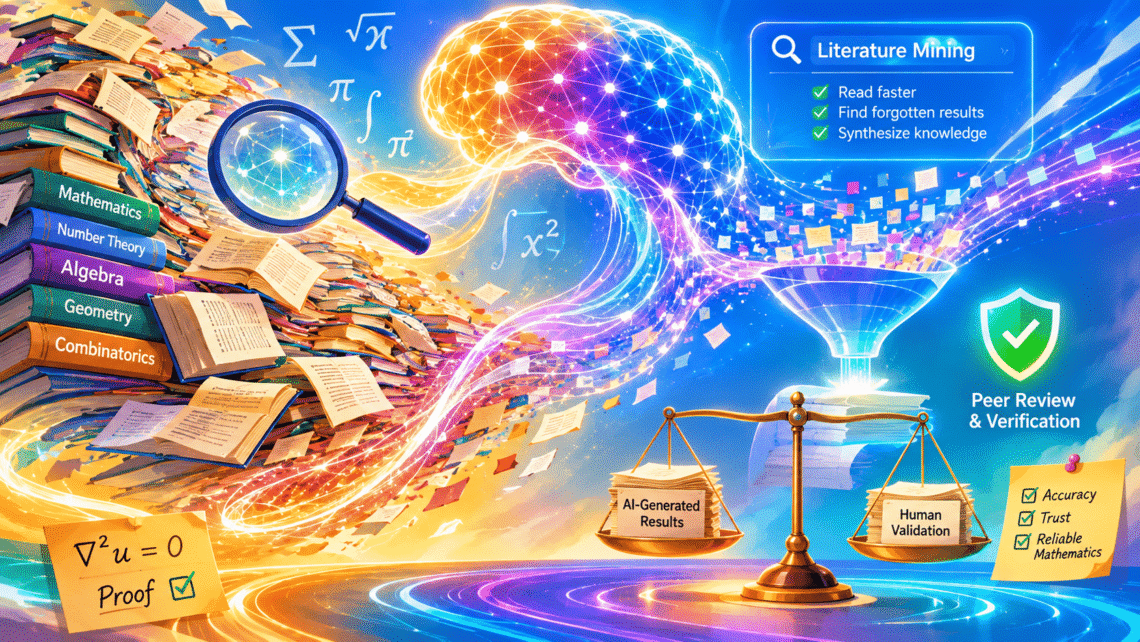
Part 1 traced how AI systems learned to construct genuinely new mathematical proofs. But an equally consequential and less discussed capability underlies much of that progress: the ability to read, search, and synthesize the entire published mathematical literature at a scale no human researcher could ever match. This capability, often described as literature mining, has become central to understanding the future of AI mathematics, and it has already produced one of the field’s more embarrassing public controversies.
In October 2025, OpenAI claimed that GPT 5 had solved ten previously open Erdős problems. The claim was publicly refuted within hours. The model had not actually solved the problems from first principles. It had performed what researchers now call a super literature search, locating previously published but obscure papers that had already resolved the problems, papers that had simply escaped the attention of the mathematicians maintaining the Erdős problem database.
A similar pattern recurred when DeepMind deployed an agent called Aletheia at the end of 2025, which attempted 700 unsolved problems from the Erdős database and correctly resolved thirteen, but only four represented genuinely new mathematical work. The other nine were, once again, successful literature searches rather than novel proofs.
This distinction matters enormously for understanding the future of AI mathematics honestly. Locating a forgotten proof buried in decades of published papers is a genuinely valuable service to the mathematical community, since human researchers cannot possibly track every result published across thousands of journals. But it is a fundamentally different capability from generating new mathematics, and conflating the two, as several early press releases did, has become a significant source of friction between AI labs and the mathematicians whose trust they need.
The Peer Review System Under Genuine Strain
The most immediate and practically consequential challenge shaping the future of AI mathematics is not a technical limitation at all. It is institutional. AI systems can now generate a large number of proofs that appear correct on inspection, often within hours, while carefully verifying a single dense mathematical argument by hand can take a human expert weeks or longer. The number of mathematicians qualified to review highly specialized proofs in any given subfield is extremely limited, and this mismatch is creating what several researchers now openly describe as a peer review crisis specific to AI generated mathematics.
The concern is not hypothetical. Multiple instances have already occurred in 2026 in which AI systems or their developers announced significant mathematical results through press releases or preprints before the claims had received adequate scrutiny, only for errors or overstatements to surface afterward under closer examination. If a substantial volume of AI generated mathematical reasoning enters circulation as preprints or public announcements faster than the community can verify it, the practical effect is not merely wasted reviewer time.
It risks burying genuinely valuable human and AI assisted discoveries under a volume of unverified claims that erodes trust in the published mathematical record itself, a concern mathematician Jeremy Avigad has documented carefully in his own 2026 survey of the field, noting that automated reasoning tools including SAT solvers have already resolved open problems in combinatorics, algebra, and discrete geometry, alongside machine learning techniques that have identified new combinatorial objects and counterexamples to standing conjectures, all while formal verification systems like Lean’s Mathlib library are increasingly used to verify results even before or entirely outside the traditional peer review process.
A Genuine Crisis Essay and the Question of Authorship
The tension within the mathematical community reached a notably sharp point in early August 2026, when a widely circulated essay titled “The Crisis of AI-Generated Mathematics” argued for what its author called total opposition to the use of artificial intelligence in mathematics.
The essay’s specific example is illustrative of the deeper concern driving the future of AI mathematics debate: a mathematician working in matroid theory, before publishing a completed solo paper, offered the project as a test case for an AI system’s ability to prove theorems and autonomously write up results, raising a question the field has not yet resolved, namely what authorship and intellectual authority even mean once AI can generate publishable mathematical content without a human necessarily understanding every step.
The essay proposes genuinely radical institutional responses, including replacing traditional individual authorship with a model of co-ownership, in which any mathematician who can demonstrate authoritative understanding of a result, the kind of deep comprehension expected of a human author today, would be recognized as a legitimate steward of that work regardless of who or what originally generated it.
Whether or not this specific proposal gains traction, its existence signals something important about where the future of AI mathematics debate has moved: from a purely technical question about capability toward a genuinely institutional question about what journals, credentialing bodies, and the mathematical community itself will need to become in response.
The Existential Framing Emerging From Within the Field
Perhaps the most striking development shaping discussion of the future of AI mathematics is the emergence, from within the mathematical community itself rather than from outside AI safety circles, of essays explicitly framing rapid mathematical AI progress as a signal of broader existential risk. One widely discussed 2026 essay observes that career defining theorems are now being proven on a weekly basis by AI systems given only minimal guidance, and notes that internal frontier models at major AI labs are reportedly producing mathematical breakthroughs in batches, with the rate of serious AI proven theorems appearing to grow exponentially through the year.
The essay’s central argument is not really about mathematics as a profession at all. It uses the visible, measurable acceleration in mathematical capability as a legible proxy for a much larger and harder to observe acceleration in general AI reasoning ability, arguing that mathematicians are uniquely well positioned to notice this signal early precisely because mathematical correctness is so much easier to verify than progress in messier real world domains.
This framing has proven genuinely divisive. Some in the mathematical community view it as an overreaction that conflates competition style problem solving with the far broader, messier work most research mathematicians actually do. Others, including voices circulating informally on social platforms suggesting that a given year’s Fields Medal might be the last one awarded primarily for human insight, treat it as a serious and urgent signal.
Terence Tao’s own more measured position, discussed in Part 1, sits deliberately between these poles, acknowledging the genuine disruption while insisting that the deeper question mathematicians must answer is what mathematical research is actually meant to accomplish, a question that predates AI entirely and that AI has simply made newly urgent rather than newly created.
What the Career Landscape Actually Looks Like
For students and early career mathematicians, the future of AI mathematics carries direct practical stakes beyond the philosophical debate. Current labour market analysis suggests the discipline is bifurcating rather than simply shrinking. Roles centred on routine computation and mechanical proof verification are being genuinely automated, while demand is rising sharply for hybrid roles, AI research scientists who blend theoretical mathematical training with practical machine learning experimentation, computational mathematicians who apply numerical and AI methods to open scientific problems, and quantitative analysts who integrate AI driven techniques into financial and risk modelling.
Compensation data suggests these hybrid roles, which explicitly combine deep mathematical fluency with programming and AI systems knowledge, currently command a meaningful premium over more narrowly traditional theoretical positions, a trend that career analysts expect to strengthen rather than reverse as the decade continues.
The clear implication for mathematics education, a question raised explicitly in university seminars examining the future of AI mathematics through 2025 and 2026, is that foundational mathematical fluency, understanding what a proof actually establishes and why, rather than merely executing computational procedures, is becoming more valuable precisely because AI has made the procedural layer nearly free.
Whether mathematics curricula adapt quickly enough to reflect that shift, moving away from testing procedures AI now performs flawlessly and toward cultivating the judgement needed to specify problems correctly and evaluate AI generated arguments critically, remains genuinely unresolved and varies enormously between institutions.
Toward a Genuinely Balanced Outlook
Bringing the full picture from both parts of this series together, the future of AI mathematics is neither the triumphant, fully automated transformation suggested by the most breathless press releases, nor the wholesale crisis threatening the discipline’s survival that the most alarmed essays describe. The verified achievements are genuinely remarkable: medal level Olympiad performance, formally verified proofs of major theorems, and at least a handful of authentically novel contributions to open research problems accepted by leading mathematicians.
The genuine problems are equally real: a peer review infrastructure straining under a volume of claims it cannot verify fast enough, unresolved questions about authorship and intellectual credit, and a small but vocal contingent within the field itself treating the pace of progress as a warning sign for something considerably larger than mathematics.
What seems most likely, based on the trajectory traced across both parts of this series, is a discipline that reorganizes around a division of labour broadly consistent with what Terence Tao has already described, humans specifying problems and exercising judgement over what mathematics is worth pursuing and why, formal systems and AI handling an increasing share of the mechanical construction and verification of proofs, and an institutional structure, journals, credentialing bodies, and peer review itself, that will need genuine reinvention rather than incremental adjustment to remain trustworthy.
Whether that reinvention happens deliberately, through the kind of proposals now circulating in essays and conference discussions, or reactively, in response to a genuine crisis of confidence in the published mathematical record, is likely to be decided over the next several years, not decades, given the pace this series has documented throughout 2025 and 2026.
Conclusion
The future of AI mathematics is being written in real time, and unusually for a technological transformation, it is being written with genuine, careful participation from the very experts most qualified to evaluate it, rather than imposed on a discipline caught unaware. That is, on balance, a reason for cautious optimism rather than alarm.
Mathematics has weathered a genuine crisis of foundations once before, a century ago, and emerged with a more rigorous, more explicit, and ultimately more resilient understanding of its own methods. Whether the current moment produces a comparable resolution, or whether the strains identified across both parts of this series prove harder to reconcile than the logical paradoxes of the early twentieth century, is a question only the coming years of actual practice, not further speculation, will be able to answer.


You May Also Like
The Critical Truth About LLM Development History: A Decade of Progress Without the Hype (Part 1)
7 Powerful Ways AI Circular Economy Solutions Are Transforming Waste Into Wealth