The AI IPO Race: 5 Critical Numbers Investors Cannot Ignore
Two Giants, One Very Different Timeline
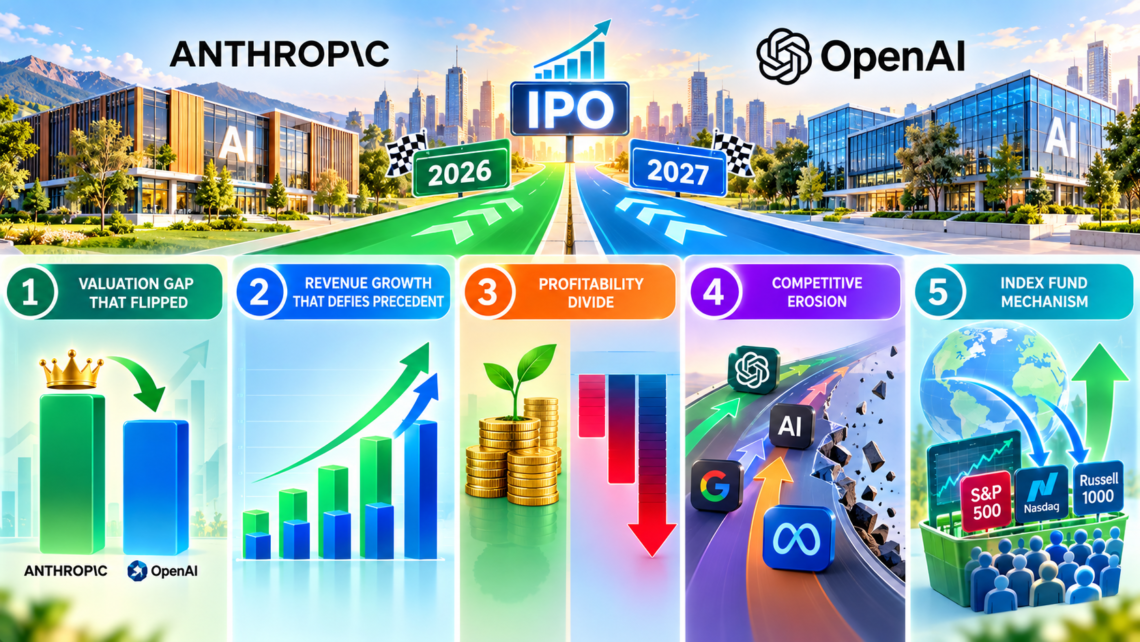
The AI IPO race has produced more speculation than clarity so far in 2026. Anthropic confidentially filed its S-1 on June 1. OpenAI followed exactly one week later, on June 8. Both companies formally sit in the IPO queue. But the similarity ends there. Anthropic appears to be sprinting toward a 2026 listing. OpenAI has drifted toward mid-2027, with CFO Sarah Friar telling employees the company “will be a public company in 2027, if not sooner.” Understanding the AI IPO race requires separating genuine business fundamentals from the marketing hype surrounding both names, and this report walks through five numbers that matter most before any investor places a dollar.
1. The Valuation Gap That Flipped
For most of 2025, OpenAI held the larger private valuation. That changed in 2026. Anthropic’s valuation reached roughly 965 billion dollars following a 65 billion dollar Series H round in May 2026, surpassing OpenAI’s 852 billion dollar valuation from its own March 2026 funding round. This flip matters enormously for anyone following the AI IPO race narrative, since it directly contradicts the assumption that OpenAI’s earlier market entry and larger consumer brand automatically translate into superior investor value.
Some reports have floated an even higher base case, suggesting Anthropic could list above 1 trillion dollars this fall, while OpenAI’s own management has reportedly rejected valuation prints below 1 trillion dollars for its eventual debut. Secondary market trading platforms like Forge Global have shown OpenAI shares changing hands closer to 880 to 890 billion dollars, a modest premium over its last formal funding round but still trailing Anthropic on a pure valuation basis.
2. Revenue Growth That Genuinely Defies Precedent
Strip away the marketing hype for a moment, and the underlying revenue numbers in this AI IPO race are genuinely remarkable by any historical standard. Anthropic’s annualized revenue reportedly crossed 44 billion dollars by May 2026, representing roughly 30 times growth in just 16 months. Anthropic also surpassed OpenAI in quarterly revenue for the first time in the second quarter of 2026, posting 11.5 billion dollars against OpenAI’s 6.7 billion dollars for that same period.
OpenAI’s own growth trajectory remains impressive in absolute terms. Revenue grew from roughly 2 billion dollars annualized in 2023 to over 20 billion dollars by the end of 2025, driven substantially by ChatGPT crossing 900 million weekly active users. But the comparative growth rate, and the more recent quarterly crossover, has shifted the competitive narrative that defines much of the media coverage around this AI IPO race.
3. The Profitability Divide
Here is where the two companies diverge most sharply, and where investors evaluating this AI IPO race need to look past headline valuation entirely. Anthropic is reportedly on track to post its first-ever operating profit, approximately 559 million dollars, in the second quarter of 2026, according to a person with knowledge of its financials cited by CNBC.
OpenAI’s financial picture looks considerably different. The Information reported OpenAI lost approximately 1.22 dollars for every dollar of revenue in the first quarter of 2026. FutureSearch estimates OpenAI’s 2026 GAAP losses at 25 to 26 billion dollars, with a cumulative cash burn estimate reaching 665 billion dollars if inference costs do not fall meaningfully faster than current projections. Reuters reported OpenAI spent 34 billion dollars in 2025 alone, including 19 billion dollars on research and development and nearly 6 billion dollars on sales and marketing.
This profitability gap is arguably the single most important fact separating genuine business fundamentals from AI IPO race hype. A company approaching sustainable profitability commands a fundamentally different risk profile than one whose path to profitability depends entirely on GPU compute becoming meaningfully cheaper over the next several years.
4. Competitive Erosion on Both Sides
Neither company enters this AI IPO race with an unchallenged moat, and prospective investors should weigh this carefully against the marketing narratives both companies present publicly. Sacra’s April 2026 analysis found OpenAI’s developer market share declined from approximately 60 percent to 51 percent year over year, with Anthropic’s Claude Code taking meaningful share specifically in AI coding tools. Google’s Gemini and Meta’s open-source Llama models provide free alternatives that compress what OpenAI can realistically charge enterprise customers.
Anthropic faces its own version of this pressure. GPT-5.5 and Gemini 3.0 Ultra are challenging Claude directly on coding benchmarks, an area Anthropic has built much of its enterprise reputation around. Anthropic also carries meaningful infrastructure dependency risk, since Amazon and Google function simultaneously as its cloud suppliers and its direct AI competitors, a structural tension that does not resolve simply because both companies hold equity stakes in Anthropic itself.
5. The Index Fund Mechanism Nobody Explains Clearly
Perhaps the least understood dynamic shaping this AI IPO race involves what happens automatically once either company actually lists. When SpaceX listed in June 2026 at a valuation approaching 1.77 trillion dollars, it entered the CRSP US Total Market Index within five trading days, a mechanism that forms the backbone of major index funds held inside millions of retirement accounts. The Russell 1000 and Nasdaq-100 followed within weeks.
This matters because retail investors holding index funds never placed an individual order or evaluated the valuation multiple themselves. The passive fund infrastructure bought the stock on their behalf automatically. In SpaceX’s case, shares subsequently shed between 20 and 30 percent from their post-listing peak, transferring that paper loss directly into the collective balance sheets of ordinary retirement savers who never made an active decision to own the stock at all.
Given that Anthropic is reportedly targeting a listing that could clear at or above 2 trillion dollars, and that even a modest 5 to 8 percent public float at that valuation would represent roughly 100 billion dollars in tradable shares, this same mechanism is already being prepared for the broader AI IPO race regardless of individual investor sentiment.
Separating Genuine Thesis From Entry Price
The marketing language surrounding both companies deserves direct scrutiny before this report closes. Sam Altman has publicly downplayed the entire framing of a race, telling CNBC that “an IPO is just a fundraising event” and calling competitive listing timing comparisons “meaningless,” emphasizing instead that AI competition is about technology and business quality. This is a reasonable position rhetorically, but it sits in tension with reporting that OpenAI’s own management has rejected valuation prints below 1 trillion dollars, a stance that itself reflects considerable sensitivity to exactly the comparative narrative Altman claims not to care about.
One widely circulated investor analysis framed the core question precisely, and it deserves repeating here without softening. Is AI the future? It almost certainly is. The harder question is at what price even a correct thesis stops being a good investment. A useful historical parallel exists in Saudi Aramco, a company controlling over 10 percent of global oil, unambiguously the right company in the right sector, that has still failed to reward public market investors meaningfully six years after its own listing. Extraordinary narrative and extraordinary entry price are not the same thing, and confusing them is precisely where AI IPO race enthusiasm risks becoming a genuine investor liability rather than a legitimate opportunity.
What This Means for Prospective Investors
Anthropic currently presents the stronger fundamental case within this AI IPO race, backed by faster growth, an approaching profitability milestone, and a valuation multiple, roughly 20 times run-rate revenue at its last private round, that remains demanding but not entirely disconnected from its underlying numbers. OpenAI presents the larger brand and installed user base, but a considerably less certain path to profitability and a valuation increasingly dependent on continued hypergrowth persisting for years.
Neither company should be evaluated purely on the strength of press coverage or founder commentary. The specific figures in this report, valuation multiples, quarterly revenue crossovers, GAAP loss estimates, and market share erosion on both sides, represent the concrete evidence investors should weigh directly against whatever price either company ultimately sets at listing.
Conclusion
The AI IPO race will likely produce two of the largest technology listings in history, regardless of which company reaches the public market first. But size and timing tell investors remarkably little about actual value. Anthropic’s faster growth and approaching profitability, set against OpenAI’s larger scale and considerably heavier losses, means this AI IPO race deserves the same rigorous scrutiny any extraordinary valuation demands, not the reflexive enthusiasm that has characterized much of the coverage surrounding both companies so far in 2026.


You May Also Like
The Powerful AI LLM Landscape 2026: Mapping the Titans, Contenders, and Rising Challengers
Is OpenAI Pricing Power Collapsing Fast? The Alarming Truth Behind the 80 Percent Cut