5 Powerful Data Center Cooling Technology Solutions Cutting Water Use
A Problem With Real Engineering Answers
Cooling consumes roughly 40 percent of total data center energy use, and evaporative systems tied to that cooling load are the single biggest driver of water consumption examined in this blog’s earlier coverage. The good news is that data center cooling technology has genuinely advanced enough to attack this problem directly, not just theoretically. This article covers five specific categories of solution actively deployed or being scaled right now, each backed by real performance numbers.
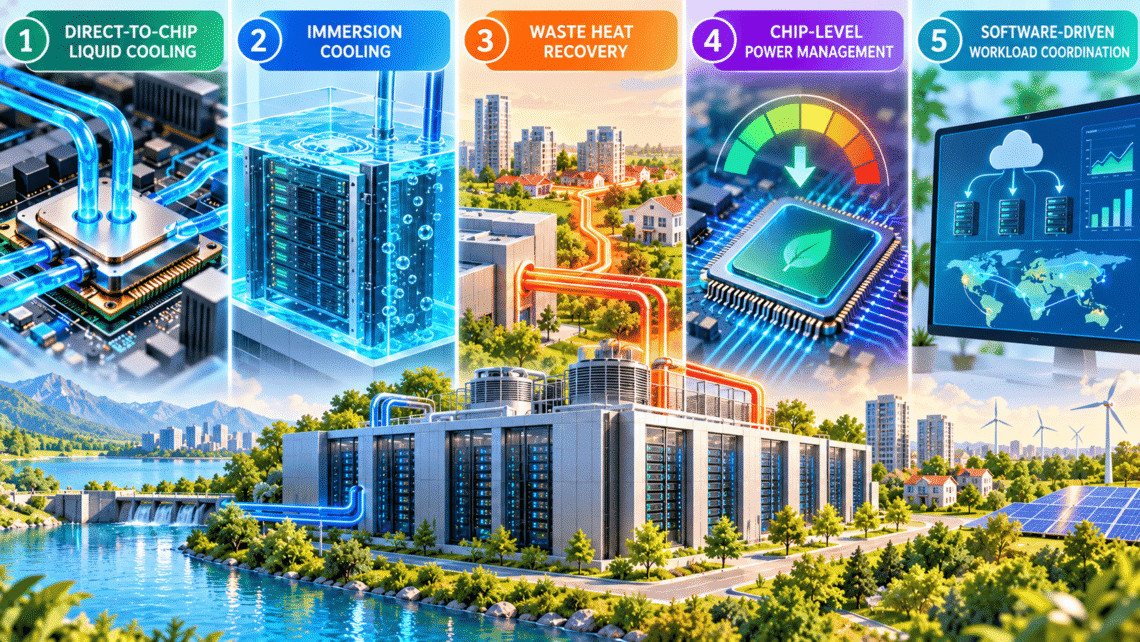
1. Direct-to-Chip Liquid Cooling
The most mature next-generation approach routes chilled fluid directly to server components through cold plates mounted on CPUs and GPUs. This bypasses the need to cool an entire room of air just to reach a handful of hot components.
The physics explain why this works so well. Water has up to 3,000 times the heat absorption capacity of air. Data center cooling technology built around liquid rather than air removes heat far more efficiently at the source, without requiring energy-heavy refrigeration of the surrounding room.
Most new hyperscale builds announced in 2025 and 2026 now specify direct liquid cooling as a base requirement, not an optional upgrade. Liquid cooling systems achieve Power Usage Effectiveness ratios as low as 1.05 to 1.15, compared to 1.4 to 1.8 for conventional air-cooled facilities. That gap translates directly into lower electricity draw for cooling alone.
2. Immersion Cooling
A step beyond direct-to-chip cooling, immersion cooling submerges entire servers in a non-conductive dielectric fluid. The liquid absorbs heat directly from every component simultaneously, eliminating server fans entirely.
According to Microsoft’s own reported results from its two-phase immersion cooling pilots, this approach reduces cooling energy consumption by up to 95 percent compared to conventional air-cooled systems. Separate industry benchmarking confirms immersion cooling cuts cooling costs by 40 percent while using 90 percent less water than traditional approaches.
Two distinct variants exist within this category. Single-phase immersion keeps the dielectric fluid in liquid form throughout the cycle, circulating it through a heat exchanger. Dual-phase immersion lets the fluid change state to gas as it absorbs heat, then condenses back to liquid once it rises above the server pool. Dr. Levy, a researcher tracking this space, called immersion liquid cooling “the most promising technology based on thermal performance” among all current options, though he cautioned it is not automatically the right fit for every facility.
The market reflects this genuine momentum. Data center liquid cooling revenue is projected to cross 3 billion dollars in 2026, growing at a compound annual rate above 19 percent.
3. Waste Heat Recovery and District Heating
Every watt of electricity a data center consumes eventually becomes heat. Traditional facilities simply reject that heat into the atmosphere, treating it as pure waste. A growing set of regulators and operators now treat it as a resource instead.
Germany’s Energy Efficiency Act sets a concrete, escalating mandate. Starting July 2026, new data centers must prove they are utilizing at least 10 percent of their generated waste heat, rising to 15 percent in 2027 and 20 percent in 2028. This is not a voluntary sustainability gesture. It is binding data center cooling technology policy with real compliance deadlines attached.
Scandinavia has moved furthest on this front already. Finland, Sweden, Denmark, and Norway routinely integrate data center waste heat directly into district heating networks. Stockholm’s district energy operator actively connects excess heat producers into its citywide network. A concrete example makes this tangible. An Amazon Web Services data center in Tallaght, Ireland, provides recycled heat free of charge to a scheme designed to heat 55,000 square meters of public buildings, commercial space, and 133 apartments.
This matters for water usage specifically because it changes the underlying economics. A facility recovering and monetizing its waste heat has a stronger financial case for investing in the liquid cooling infrastructure needed to capture that heat efficiently in the first place, rather than relying on cheaper but more water-intensive evaporative towers.
4. Chip-Level Dynamic Power and Precision Management
Cooling technology alone cannot solve the water problem if the underlying chip keeps generating more heat every generation. This is where software-driven, chip-level power management becomes genuinely essential to data center cooling technology as a whole system.
Nvidia’s newest Rubin architecture introduces NVFP4, a technique the company describes as dynamically adjusting computational precision on the fly. Rather than running every calculation at maximum detail, NVFP4 lowers precision automatically when high detail is not needed, speeding up processing and reducing power draw, then increases precision again when accuracy genuinely requires it. According to Nvidia, this single technique allows training a 10 trillion parameter model using roughly one quarter of the hardware previously required, directly reducing the total heat generated per unit of useful computation.
This chip-level approach is paired with increasingly sophisticated power analysis during the design phase itself. Cadence Design Systems built a Dynamic Power Analysis tool specifically to model chip designs exceeding 40 billion gates, assessing power consumption across billions of processing cycles before a chip is even manufactured. This lets engineers identify power and heat peaks in advance and rebalance the design, rather than discovering thermal problems only after deployment. Given that a single Rubin Ultra configuration is expected to reach 3.6 kilowatts of power draw, this kind of upfront modeling has become a genuine necessity, not an optimization afterthought.
5. Software-Driven Workload and Cooling Coordination
The final category of data center cooling technology operates at the software layer entirely, coordinating how workloads themselves get scheduled and distributed to minimize thermal load in the first place. This includes dynamically shifting computationally intensive tasks to cooler periods or cooler geographic locations, and actively managing which servers handle peak demand based on real-time thermal headroom rather than static assignment.
This approach treats cooling not as a fixed infrastructure cost applied uniformly across a facility, but as a variable that software can actively optimize against, much the same way cloud providers already optimize workload placement for cost and latency. Combined with the hardware-level advances above, this creates a genuinely layered defense against unnecessary heat generation, catching inefficiency at the scheduling level before it ever reaches a cooling system at all.
Why This Combination Matters More Than Any Single Fix
No individual technology on this list solves the water problem alone. Direct-to-chip cooling reduces water use substantially but still relies on some evaporative backup in many climates. Immersion cooling delivers the deepest cuts but requires genuine capital investment and facility redesign. Waste heat recovery only pays off when paired with efficient liquid capture systems in the first place. And chip-level precision management reduces the underlying heat load that any cooling system then has to handle.
The real story emerging from 2025 and 2026 deployment data is that leading operators are combining these approaches rather than picking one. A modern hyperscale facility increasingly pairs direct liquid cooling at the rack level, immersion cooling for the highest-density AI clusters specifically, waste heat capture routed to a district heating partner where geography allows, and chip-level dynamic precision scaling baked directly into the silicon itself.
Conclusion
Data center cooling technology has moved decisively past the assumption that evaporative water use is simply an unavoidable cost of computing at scale. Liquid cooling in its direct-to-chip and immersion forms, waste heat recovery backed by real regulatory mandates in Germany and widespread adoption across Scandinavia, and chip-level innovations like NVFP4 dynamic precision scaling together represent a genuine, multi-layered response to the water usage figures this blog examined in earlier coverage.
The technology to dramatically cut water consumption already exists and is already shipping. The remaining question, as with so much of the AI infrastructure buildout, is simply how quickly the rest of the industry follows the leaders already deploying it.


You May Also Like
Inside the Alarming AI Circular Financing Web: How Nvidia, OpenAI, and Microsoft Fund Each Other’s Growth
The Essential Guide to Using Agentic AI Effectively While Avoiding Costly Failure (Part 2)