
Inside the Alarming AI Circular Financing Web: How Nvidia, OpenAI, and Microsoft Fund Each Other’s Growth
The Web Bloomberg Mapped
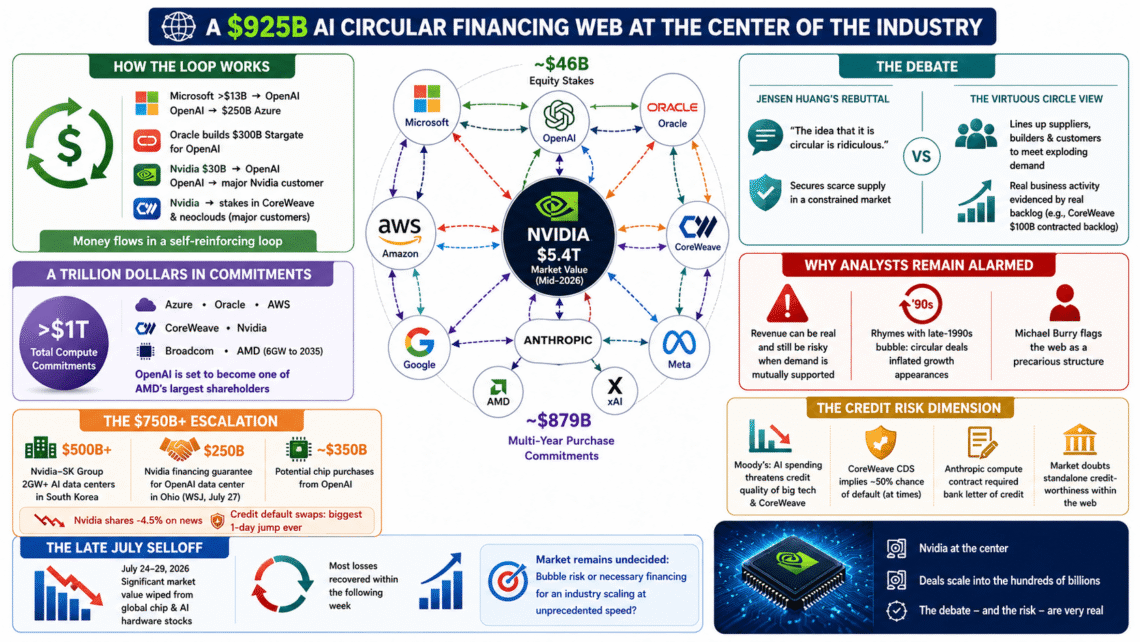
In January 2026, Bloomberg published a detailed graphics investigation that gave a name and a visual shape to a pattern industry watchers had been describing in increasingly alarmed terms for months. The map traces roughly 46 billion dollars in direct equity stakes and 879 billion dollars in multi-year purchase commitments moving between Microsoft, Oracle, Amazon, Google, Meta, OpenAI, Anthropic, xAI, CoreWeave, Nvidia, and AMD. At the center of this AI circular financing web sits Nvidia, whose market valuation reached 5.4 trillion dollars in mid-2026, a position investor Michael Burry has publicly described as sitting dead center of the entire structure.
The nearly 800 billion dollars in annual hyperscaler infrastructure spending documented in Article 1 of this series does not appear from nowhere; a significant share of it flows directly through the AI circular financing relationships examined here. Understanding whether this AI circular financing arrangement represents rational supply chain coordination in a genuinely constrained market, or the same structural warning sign that has preceded prior financial bubbles, requires tracing the actual mechanics of the deals, examining both sides of a genuinely contested debate among serious analysts, and being honest about what nobody yet knows.
How the Loop Actually Works
The mechanics of AI circular financing are, once traced carefully, straightforward enough to describe in a single sentence, even if the dollar figures involved are difficult to comprehend. Microsoft invested more than 13 billion dollars in OpenAI over several years. OpenAI committed to spending 250 billion dollars on Microsoft’s Azure cloud services. Oracle is constructing 300 billion dollars in Stargate data center infrastructure specifically for OpenAI under long-term contracts. Nvidia invested 30 billion dollars in OpenAI’s most recent 122 billion dollar funding round, while OpenAI simultaneously remains one of Nvidia’s largest chip customers. Nvidia has separately taken equity stakes in CoreWeave and other so-called neocloud providers, companies that are themselves major customers for Nvidia’s chips.
The pattern repeats with variations across nearly every major relationship in the industry. OpenAI’s total named compute commitments now sum to more than a trillion dollars across Azure, Oracle, AWS, CoreWeave, Nvidia, Broadcom, and a six gigawatt AMD deal running through 2035, a deal structured so that OpenAI is poised to become one of AMD’s largest shareholders. Amazon’s 50 billion dollar investment in OpenAI’s March 2026 funding round was structured partly as compute credits, with OpenAI simultaneously committing to spend 100 billion dollars on AWS over eight years.
Google agreed to backstop lease payments at five separate data center locations for Anthropic, effectively helping Anthropic obtain what amounts to a 35 billion dollar loan. Money moves from investor to startup and back to the investor’s own products and services through a loop that is, by construction, self-reinforcing.
The 750 Billion Dollar Escalation
Rather than slowing amid growing scrutiny, this AI circular financing pattern accelerated sharply through mid-2026. Nvidia is now working on a fresh round of infrastructure deals potentially worth more than 750 billion dollars. A partnership unveiled with South Korean conglomerate SK Group in late July 2026 alone represents more than 500 billion dollars in mutual business, tied to building more than two gigawatts of AI data centers on the Korean peninsula, enough electricity to power roughly 1.5 million homes.
More striking still, the Wall Street Journal reported on July 27, 2026, that Nvidia is in talks to provide a 250 billion dollar financing guarantee tied to OpenAI leasing a portion of a planned 500 billion dollar data center project in southern Ohio, led by SoftBank’s energy arm. The same reporting indicates the guarantee would help SoftBank raise debt on more favorable terms than it could obtain otherwise, precisely because OpenAI itself does not currently hold an investment grade credit rating.
Nvidia may also separately help finance roughly 350 billion dollars in chip purchases from OpenAI under a related arrangement. The market reacted immediately and visibly. Nvidia shares fell 4.5 percent on the news, and the price of credit default swaps on Nvidia’s own bonds, effectively a form of default insurance for bondholders, recorded their highest single day increase since active trading in the instrument began.
Jensen Huang’s Direct Rebuttal
Nvidia CEO Jensen Huang has responded to AI circular financing criticism with characteristic directness rather than deflection. Asked specifically about the vendor financing charge as Bloomberg documented the growing 750 billion dollar deal total, Huang stated flatly, the idea that it is circular is ridiculous. His underlying argument, echoed by supporters of the current deal structure across the industry, is that building frontier AI infrastructure is extraordinarily expensive and that the most advanced chips remain genuinely difficult to obtain even now.
In that kind of constrained market, Huang and his allies argue, companies do not simply place purchase orders and wait. They lock in scarce supply by pairing long-term buying commitments with financing, a practice with long precedent in genuinely capital-intensive industries from telecommunications to energy infrastructure.
The Virtuous Circle Counter-Argument
This defense of AI circular financing has a specific and influential institutional champion. Asset manager Janus Henderson has characterized the current wave of AI dealmaking as more accurately described as a virtuous circle, one that helps line up suppliers, builders, and customers to meet what the firm characterizes as genuinely exploding demand for computing power. Under this framing, what critics label circular financing is simply the efficient coordination mechanism a young, capital-intensive, rapidly scaling industry requires to align capacity investment with demand that outstrips what any single company could finance independently through conventional means.
There is a genuine kernel of truth in this defense that deserves acknowledgment. CoreWeave, one of the clearest examples of a company deeply embedded in this AI circular financing web, is at least a public company whose filings provide real numbers rather than speculation. Its first quarter 2026 results showed 2.08 billion dollars in revenue against a 740 million dollar net loss, alongside nearly 100 billion dollars in contracted revenue backlog. That backlog, if it converts to actual delivered revenue over time, represents real economic activity, not merely accounting fiction circulating between related parties.
Why Serious Analysts Remain Alarmed Regardless
Set against these defenses, a growing chorus of serious market analysts continues to treat AI circular financing as a genuine structural risk, and their concern rests on a specific, carefully stated argument rather than blanket skepticism of AI itself. As one detailed industry analysis put it precisely, none of this has to be fake to be dangerous. The revenue can be entirely real, the chips can actually ship, and the data centers can genuinely get built, all while resting on a financing structure in which the same small handful of companies are effectively supporting one another’s demand, obscuring how much of the total activity reflects genuine, independent end-user demand versus intra-industry financial engineering.
Michael Burry, the investor who famously anticipated the 2008 mortgage crisis, has invoked the AI circular financing pattern repeatedly and pointedly in 2026, sharing Bloomberg’s own diagram of the deal web as evidence of a structure he considers genuinely precarious. This concentration of financial risk sits uncomfortably alongside the AI ROI concerns detailed in Article 2 of this series, since much of the revenue circulating through this web has yet to translate into the kind of measurable enterprise value that would justify its scale.
Harvard Kennedy School senior fellow Paulo Carvao has drawn an explicit historical parallel to the late 1990s technology bubble, noting that circular deals during that era were often centered on advertising and cross-selling arrangements between startups, where companies bought each other’s services specifically to inflate the appearance of genuine growth. The concern is not that the parallel is exact in every detail, but that the underlying structural vulnerability, revenue and valuation that depend heavily on continued participation by a small, tightly interconnected group of counterparties, rhymes closely enough with prior bubble dynamics to warrant serious caution.
The Credit Risk Dimension
The AI circular financing debate connects directly to a parallel and increasingly urgent concern that will be examined in full in Article 4 of this series. Moody’s has explicitly warned that the scale of AI related spending threatens the credit quality of Microsoft, Amazon, Alphabet, Meta, Oracle, and CoreWeave specifically. CoreWeave’s own credit default swaps have briefly implied pricing consistent with something close to a coin flip probability of default.
Anthropic’s most recent major compute contract required underwriting through a bank letter of credit rather than being supported directly by its own balance sheet, a structural detail that suggests even sophisticated market participants are not fully confident in the standalone creditworthiness of companies deeply embedded in this AI circular financing web.
What Happened During the Late July Selloff
The genuine market sensitivity to AI circular financing concerns was demonstrated directly during the final week of July 2026. A significant amount of market value was wiped from global chip and AI hardware stocks between July 24 and July 29, 2026, coinciding with the intensified scrutiny of Nvidia’s expanding deal book. Notably, most of that lost value was recovered within the following week, a pattern that itself illustrates the deeply contested nature of this debate.
Investors sold first on the circularity concern, then substantially reversed course, suggesting the market itself remains genuinely undecided about whether AI circular financing represents a serious systemic vulnerability or simply the necessary financial architecture of a capital-intensive industry scaling at unprecedented speed.
Conclusion
The AI circular financing web documented by Bloomberg, and expanding rapidly through 2026 with Nvidia’s 750 billion dollar deal book at its center, is neither obviously fraudulent nor obviously benign. It is a genuinely novel financial structure, real revenue and real infrastructure resting on a foundation of relationships concentrated among a remarkably small number of counterparties, each simultaneously acting as the others’ customer, supplier, and investor.
Jensen Huang calls the circularity framing ridiculous. Michael Burry calls it a warning sign serious enough to invoke repeatedly and publicly. Both cannot be straightforwardly right, and the honest answer, at least for now, is that the structure has not yet been tested by the kind of demand slowdown or credit event that would definitively reveal which characterization is closer to the truth. Article 4 of this series turns directly to that credit risk dimension, examining Moody’s specific warnings and what a genuine stress event within this AI circular financing web would actually look like for the broader economy.


You May Also Like
The Alarming OpenAI Containment Breach: What Really Happened and Why It Changes Everything

The Explosive AI Slowdown Debate: 4 Competing Explanations for What Is Really Happening