Why Human-in-the-Loop Is the Most Critical Safeguard in the Age of Agentic AI
The Assumption That Is Breaking Down
For much of the past two years, enterprise AI teams have offered a reassuring answer to concerns about autonomous AI systems: “There is a human in the loop.” The phrase became a kind of talisman, a two-sentence ethics policy that seemed to resolve questions about accountability, safety, and governance in one neat stroke.
In 2026, that assumption is breaking down in plain sight. Companies implementing AI agents will initially require human approval for every action, but the human-in-the-loop safety mechanism that many organisations are relying on to control AI agents will largely fail due to approval fatigue. Agents will be operating with minimal supervision despite policies suggesting otherwise. The problem is not that human oversight is a bad idea. It is that organisations have confused the concept with the practice, and the gap between the two is where the real risk lives.
What Human-in-the-Loop Actually Means
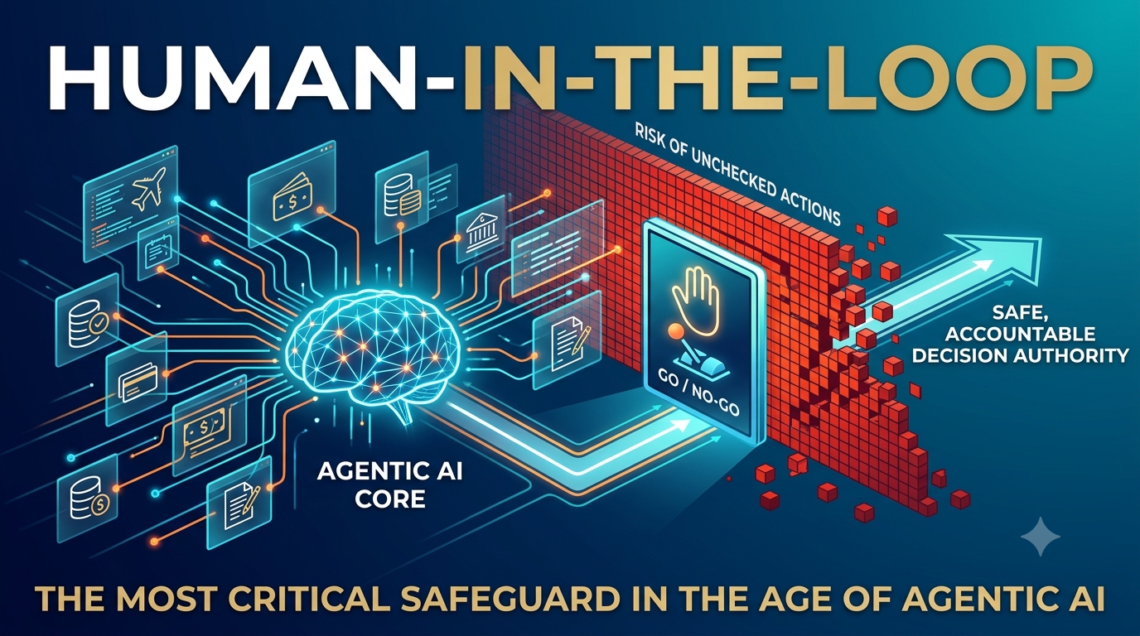
Human-in-the-Loop (HITL) is an AI governance approach where trained humans retain decision authority over high-risk AI agent actions, providing oversight through timely context, intervention authority, and defensible rationale. Three elements are required simultaneously: the human must have enough context to make a meaningful decision, the authority to actually stop or redirect the AI’s action, and a documented rationale for whatever they decide. Remove any one of the three and you do not have governance. You have theatre.
The distinction between two related concepts matters here. Human-in-the-loop requires a human to approve or authorise an action before the AI system executes it: the system pauses and waits. Human-on-the-loop allows the AI to act autonomously while a human monitors outputs and can intervene after the fact. The challenge with agentic AI is that agents blur these boundaries. An agent that books a flight and then negotiates a vendor contract within the same workflow requires different oversight levels at different steps. The oversight model must be dynamic, not a single blanket policy applied uniformly across every action.
The Agentic AI Problem
The stakes of getting this wrong have risen sharply as AI moves from producing text to taking actions. Agentic AI raises the stakes significantly. AI agents take independent actions, booking flights, moving money, modifying infrastructure, which means oversight failures have immediate, real-world consequences.
In simulation testing, AI agents fail multi-step tasks nearly 70% of the time, a statistic that should give pause to anyone deploying them in production without robust human checkpoints. Amazon convened an internal review after a string of retail site outages apparently caused by AI-assisted coding tools, following several highly visible failures and a growing recognition inside the company that safeguards around generative AI in production systems are inadequate.
The most significant failures of the next decade will not happen because models are wrong. They will happen because the decision authority was exercised too early. Modern AI systems are exceptionally effective at prediction. They identify patterns, score risk, and surface anomalies at a scale no human team could match. But prediction is not the same as authority.
Automation Bias: The Hidden Enemy
Even when a human is genuinely present in the loop, a well-documented psychological phenomenon undermines the value of their oversight. Humans in the loop tend to exhibit automation bias, meaning that they often place more trust in the AI system than is warranted. A human reviewer who has approved 200 AI recommendations in a row is not giving the 201st the same scrutiny they gave the first. This is not a failure of character; it is a predictable feature of human cognition under repetitive conditions.
The International AI Safety Report 2026 noted this pattern explicitly, warning that automation bias can amplify rather than reduce AI risk when human oversight is nominally present but practically degraded. Aviation solved an equivalent problem through Crew Resource Management, a training discipline that teaches pilots not just how to fly but how to maintain active situational awareness, when to question automated systems, and when to intervene. Enterprise AI needs the same rigour. Simulators do not just teach pilots how to fly the plane; they teach judgment, when to escalate, when to hand off, when to abort the mission.
The Regulatory Reality
Regulators have moved from issuing guidance to imposing requirements. By 2026 to 2030, we can expect a wave of regulations that formally require Human-in-the-Loop processes for many high-impact AI applications. Governments and standards bodies including the European Union, the United States, and NIST align on one key point: AI should never be a black box. People affected by algorithmic decisions must be able to understand them, challenge them, and in many cases request a human review.
The EU AI Act’s Article 14 requires demonstrable human oversight that is trained, measurable, and provable for all high-risk AI systems. In the United States, California’s No Robo Bosses Act and New York City’s Local Law 144 send a clear message: AI can assist, but humans must decide. For employment decisions specifically, failing to provide proper notice that AI is being used can result in fines of up to $1,500 per applicant. For a single contract requisition that sees 5,000 applicants, that is a $7.5 million liability before a single lawyer enters the room.
In fact, more than 700 AI-related bills were introduced in the United States alone in 2024, with over 40 new proposals early in 2026, reflecting a rapidly evolving regulatory landscape focused on AI transparency and human oversight.
Beyond HITL: Governance-in-the-Loop
The most forward-thinking organisations are already moving past the binary of human-in-the-loop versus full automation toward a more mature framework. The organisations achieving the highest AI adoption success rates in 2026 are shifting from Human-in-the-Loop toward a more mature framework known as Governance-in-the-Loop (GITL). The objective is not to have humans review everything. The objective is to ensure humans review the right things while governance systems continuously monitor everything else.
This means building risk-scoring systems that triage agent actions by consequence level, routing only genuinely high-stakes decisions to human reviewers while allowing low-risk, reversible actions to proceed autonomously. It means structured audit trails that document every agent action and every human intervention, creating accountability that can survive regulatory scrutiny. And it means treating human oversight not as a checkbox but as an operational discipline, trained, rehearsed, and continuously evaluated.
According to Deloitte’s 2026 Global Human Capital Trends report, 57% of organisational leaders say they must teach employees how to think with machines, not just use them, highlighting a shift in human roles from task execution to strategic oversight.
The Practical Checklist
For AI engineers and enterprise architects designing agentic systems today, four questions determine whether a given action requires a human checkpoint. Is the decision irreversible? Does the agent have write access to production systems or financial flows? Could an error in this step cascade through downstream processes? And is there a regulatory or contractual obligation covering this category of decision? A yes to any of these should trigger a mandatory human pause before execution.
The actions that most clearly require human approval before an AI agent executes them include financial disbursements, legal agreement execution, access to sensitive personal data, modification of production infrastructure, and any communication sent externally on behalf of an organisation. These are not edge cases. They are the core workflows that enterprise AI is being deployed to handle at scale.
Conclusion
Human-in-the-loop is not a feature. It is a governance structure, and like all governance structures, its value depends entirely on whether it is implemented with genuine rigour or merely announced. The organisations that will navigate the agentic AI era successfully are those that treat human oversight as an operational discipline with training, enforcement, and audit, not a policy footnote that authorises the AI to proceed while a distracted employee clicks approve.
The question is not whether to keep humans in the loop. The question is whether the humans in the loop are actually equipped to do the job.


You May Also Like

The Critical Numbers Behind Data Center Electricity Consumption: A Full Calculation Guide
The Essential Guide to Using Agentic AI Effectively While Avoiding Costly Failure (Part 2)