The Essential Guide to Using Agentic AI Effectively While Avoiding Costly Failure (Part 2)
This is Part 2 of a two-part series examining agentic AI in depth. Part 1 traced the term’s origin and rapid emergence into the defining technology story of 2025 and 2026. Part 2 examines how agentic AI can actually be used effectively, the specific patterns separating successful deployments from the substantial share already documented as failing, and where the technology is heading next.
A Sobering Statistic That Demands Attention
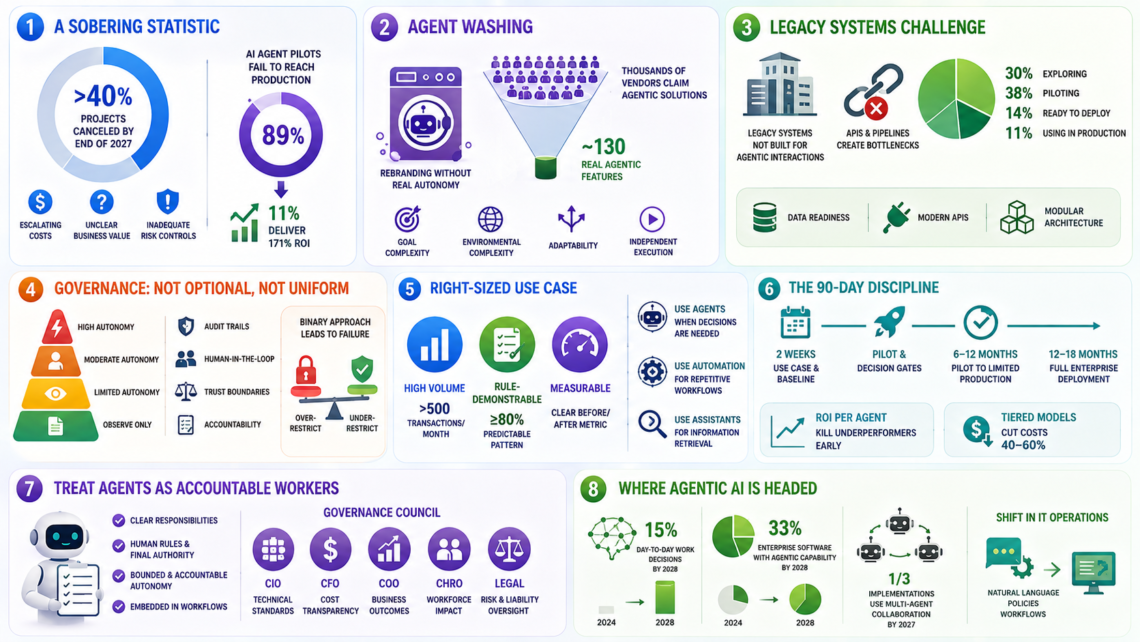
Part 1 of this series traced agentic AI from a psychology term through Andrew Ng’s 2024 reframing to Google’s formal declaration of an agentic era. That trajectory could easily suggest a technology on an uninterrupted upward path. The reality on the ground is considerably more complicated, and any honest guide to using agentic AI effectively must begin with the failure data rather than skip past it. Gartner, based on a poll of more than 3,400 organizations actively investing in the technology, predicts that over 40 percent of agentic AI projects will be canceled by the end of 2027, due specifically to escalating costs, unclear business value, or inadequate risk controls.
Separate analysis places the figure even higher at the earliest stage of the funnel, with 89 percent of AI agent pilots failing to reach production at all, though the 11 percent that do survive reportedly deliver a striking 171 percent return on investment.
This gap between overall failure rate and the outsized returns of genuine success is the central fact anyone deploying agentic AI needs to understand. The technology is not modestly disappointing on average. It is sharply bimodal, producing either substantial value or outright cancellation, with comparatively little middle ground, which makes understanding exactly what separates the two outcomes considerably more valuable than generic enthusiasm or generic skepticism alone.
Agent Washing: The First Trap to Avoid
Before an organization can use agentic AI effectively, it needs to be able to recognize when it is not actually being offered agentic AI at all. Gartner has identified and named a widespread industry pattern it calls agent washing, vendors rebranding existing chatbots and conventional automation tools as agentic AI without delivering genuine autonomous capability. Of the many thousands of vendors currently claiming agentic solutions, Gartner estimates that only around 130 offer real agentic features as defined by the agenticness spectrum discussed in Part 1.
Marketing budgets spent on the rest are not purchasing agents. They are purchasing dressed-up automation carrying an agentic price tag, and the consequences extend beyond wasted spend, Gartner separately predicts that in 2026, one third of companies will actively harm their own customer experience by deploying such prematurely rebranded AI, eroding brand trust through a personalization agent that misreads a customer, a content agent that violates compliance, or a journey agent that floods a churning customer with poorly timed offers.
The practical defense against agent washing is straightforward but requires genuine technical scrutiny rather than taking vendor marketing at face value, evaluating any proposed agentic AI system against the four dimensions of agenticness established in Part 1, goal complexity, environmental complexity, adaptability, and independent execution, rather than accepting the label itself as sufficient evidence of genuine capability.
Why Legacy Systems Are the Quiet Killer of Agentic AI Projects
A specific and frequently underestimated cause of agentic AI failure is architectural rather than strategic. Deloitte’s 2026 research found that legacy enterprise systems simply were not designed for agentic interactions, most agents still depend on conventional APIs and traditional data pipelines to reach enterprise systems, creating bottlenecks that directly limit any agent’s genuine autonomous capability regardless of how sophisticated its underlying model is. Deloitte’s own field data illustrates precisely how large the gap between enthusiasm and readiness currently is, while 30 percent of surveyed organizations report actively exploring agentic AI and 38 percent are piloting solutions, only 14 percent have solutions genuinely ready to deploy and a mere 11 percent are actively using agentic systems in production.
The practical implication for using agentic AI effectively is that data and integration readiness must be assessed and addressed before any agent deployment begins, not discovered midway through a pilot. Organizations that treat agentic AI implementation as simply another software deployment layered on top of existing infrastructure frequently fail, while those that recognize its distinct requirements, real-time data pipelines, modern APIs capable of two-way action rather than only data retrieval, and modular architecture designed specifically to support autonomous decision-making, achieve considerably stronger outcomes.
Governance Is Not Optional, and It Is Not Uniform
Perhaps the single most consequential and most frequently misunderstood factor in agentic AI success is governance, and specifically, the mistaken assumption that a single governance approach can apply uniformly across every agent an organization deploys. Gartner’s research on this point is direct, applying uniform governance across AI agents regardless of their autonomy level and scope will itself lead to enterprise agent failure. Failures occur most often when an organization fails to distinguish between an agent’s actual ability to act and the genuine scope of access it has been granted, a distinction that sounds obvious in principle but is routinely collapsed in practice.
Gartner recommends a proportional governance model instead, classifying every deployed agent across distinct autonomy levels, with each level carrying its own corresponding trust boundary and governance requirement. At the most constrained level, observe agents are limited strictly to read-only access to clearly defined data sources, with their outputs visible only to the specific user who requested them, appropriate for use cases such as document summarization where the risk of unsupervised action is genuinely low.
As autonomy increases toward agents capable of taking direct, consequential action, the corresponding governance requirement must scale correspondingly, audit trails, human-in-the-loop checkpoints for high-stakes decisions, and explicit accountability for every action taken. Gartner’s own senior analysts state this failure mode plainly, enterprises are treating AI agent governance as binary, either locked down or fully trusted, and that binary framing is itself the root cause of failure, producing either over-restriction that slows delivery and quietly drives unauthorized shadow development, or under-restriction that exposes the organization to genuine operational risk.
The Right-Sized Use Case: Where Agentic AI Actually Delivers Value
The organizations achieving genuine success with agentic AI share a consistent, specific pattern in how they select their initial use cases, and this pattern deserves close attention from anyone planning a deployment. A practical three-part filter has emerged from enterprise implementation research, viable candidates for agentic AI should involve genuinely high transaction volume, generally above roughly 500 relevant transactions per month, should be rule-demonstrable, meaning at least 80 percent of cases follow a clearly defined, predictable pattern rather than requiring genuinely novel judgment each time, and should be measurable, with a clear, unambiguous before-and-after metric available to evaluate whether the deployment actually delivered value.
This filter helps explain a distinction Gartner draws explicitly and that deserves to anchor any practical agentic AI strategy, using AI agents specifically when genuine decisions are needed, using conventional automation for routine, fully predictable workflows that do not require adaptive judgment, and using simpler AI assistants for straightforward information retrieval tasks that never required autonomous action in the first place.
Misapplying agentic AI, deploying it for tasks better suited to conventional automation or simple retrieval, is itself identified by Gartner as a primary driver of high failure rates, since it burdens a genuinely powerful but genuinely complex technology with tasks that never needed that complexity, inflating cost and risk without any corresponding gain in capability.
The 90-Day Discipline That Separates Success From Cancellation
Enterprise implementation research has converged on a specific, time-bound structure for moving agentic AI from pilot to production that offers a practical template worth adopting directly. The recommended approach begins with two weeks dedicated specifically to use case selection and establishing a rigorous baseline measurement, before any agent development begins at all, ensuring the organization has a genuine before state against which to measure whether the deployment actually worked.
This is followed by a structured pilot phase with explicit go or no-go decision gates built directly into the timeline, rather than allowing a struggling pilot to drift indefinitely while consuming budget and organizational patience. The realistic overall timeline, based on current field data, runs six to twelve months from initial pilot to limited production deployment, and twelve to eighteen months to full enterprise-scale deployment, and organizations attempting to compress this timeline artificially are disproportionately represented among Gartner’s 40 percent cancellation statistic.
A further specific discipline worth adopting directly is tracking ROI per individual agent rather than only at the program level, enabling an organization to identify and shut down underperforming agentic AI deployments early, before they consume significant budget, rather than discovering the failure only after a large, sunk investment.
Tiered model strategies, deploying lower-cost models for routine, lower-stakes tasks while reserving premium frontier models specifically for genuinely high-stakes decisions, have been shown to cut infrastructure costs by 40 to 60 percent without meaningfully compromising outcome quality, a pattern directly consistent with the AI ROI research covered in this blog’s recent five-part economics series, where the organizations capturing genuine value were consistently those exercising this kind of operational discipline rather than simply deploying the most capable available model indiscriminately.
Treating Agents as Accountable Workers, Not Software Deployments
The clearest single distinction separating organizations succeeding with agentic AI from those adding to Gartner’s failure statistics is conceptual rather than purely technical. Leading organizations are succeeding specifically because they are reimagining their operations and managing agents as workers, with clear responsibilities and accountable performance, rather than treating agentic AI deployment as simply another conventional software rollout layered onto existing processes. Every genuinely successful agentic AI deployment is embedded within a workflow where humans explicitly set the governing rules and retain final authority over consequential decisions, an approach that treats the agent’s autonomy as bounded and accountable by design, rather than open-ended and unsupervised by default.
This framing has direct practical implications for how organizations should structure oversight. The most effective governance councils, according to Gartner’s own research, are co-led jointly by the CIO, CFO, COO, CHRO, and general counsel, each contributing a distinct and necessary form of accountability, technical standards, cost transparency, business outcome verification, workforce change management, and risk and liability oversight respectively. This genuinely cross-functional structure prevents the siloed, fragmented deployment pattern that Gartner identifies as a specific driver of both operational failure and, separately, real reputational and regulatory exposure.
Where Agentic AI Is Heading Next
Looking beyond the immediate implementation challenges this article has examined, several concrete developments already visible in the current data point toward where agentic AI is genuinely headed over the next several years, rather than where marketing narratives alone suggest it might. Gartner forecasts that 15 percent of day-to-day work decisions will be accomplished autonomously through agentic AI by 2028, rising from effectively zero in 2024, alongside 33 percent of enterprise software applications incorporating genuine agentic capability by the same year.
Multi-agent collaboration, distinct specialized agents working together within a single application or workflow rather than a single generalist agent attempting to handle every task, is expected to become considerably more prevalent, with roughly one third of agentic AI implementations combining agents with distinct, complementary skills by 2027 to manage genuinely complex tasks that exceed any single agent’s effective scope.
The interaction model underlying enterprise IT operations specifically is expected to shift meaningfully as well, moving away from traditional command-line interfaces and rigid scripts, toward natural language prompt engineering, explicit policy definition, and workflow orchestration, as infrastructure and operations teams increasingly turn to agentic AI they can direct conversationally rather than through traditional scripted automation, a genuine change in operating model rather than merely a change in tooling.
Conclusion
Bringing both parts of this series together, agentic AI’s rapid emergence from a niche academic term into the defining technology narrative of 2025 and 2026 was never in serious doubt once the underlying infrastructure milestones traced in Part 1, the Model Context Protocol chief among them, made genuine autonomous action technically achievable at scale. What remains genuinely contested, and what this second article has attempted to answer directly with evidence rather than enthusiasm, is which specific organizational practices separate the substantial minority capturing real, measurable value from the equally substantial majority currently on track to join Gartner’s 40 percent cancellation statistic by 2027.
The pattern that emerges consistently across every credible source examined in this article is not primarily technical at all. It is disciplined use case selection matched carefully to genuine agentic capability rather than agent washing, proportional governance calibrated precisely to each agent’s actual autonomy and access rather than applied uniformly, legacy infrastructure genuinely prepared before deployment rather than discovered as an obstacle midway through a pilot, and a cross-functional accountability structure that treats deployed agents as genuine accountable workers rather than simply another software feature.
Organizations that internalize these specific, evidence-based lessons are positioned to capture the substantial value agentic AI has already demonstrated it can deliver. Those that do not are, according to the field’s own most rigorous forecasting, considerably more likely to fund an expensive and entirely avoidable learning experience instead.


You May Also Like
3 Alarming Environmental Costs of AI: Data Centers, Drought, and Community Backlash
AI Data Centers: The Critical Strategic Assets Powering America’s Next Industrial Revolution (Part 1)