
The Staggering $775 Billion AI Infrastructure Spending Race: Where All the Money Is Actually Going
A Number Larger Than Most National Economies
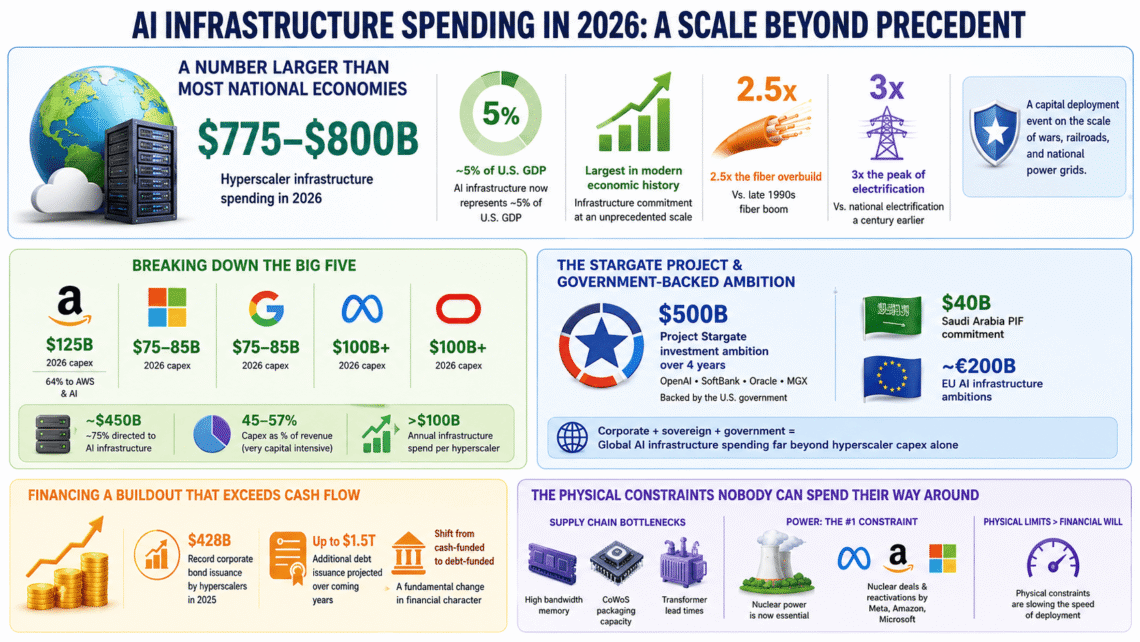
In 2026, the five largest hyperscalers, Amazon, Microsoft, Alphabet, Meta, and Oracle, are on track to spend between 775 and 800 billion dollars on infrastructure, according to CFA analysis published in August 2026. To put that figure in perspective, AI infrastructure spending in the United States now represents roughly 5 percent of national GDP, a level of infrastructure commitment that analysts describe as the largest in modern economic history, 2.5 times the scale of the fiber optic overbuild of the late 1990s and three times the peak of national electrification a century earlier. This is not a niche technology investment cycle. It is a capital deployment event on a scale usually reserved for wars, railroads, and national power grids.
Understanding where this staggering sum of AI infrastructure spending is actually going, and whether the historical parallel to prior infrastructure booms is reassuring or alarming, requires looking closely at the individual commitments, the financing mechanisms behind them, and the physical constraints that are already beginning to bite.
Breaking Down the Big Five
The scale of individual hyperscaler AI infrastructure spending commitments in 2026 is difficult to grasp in isolation. J.P. Morgan estimates aggregate hyperscaler capital expenditure will reach 697 billion dollars this year, while separate analysis from Goldman Sachs projects total hyperscaler capex from 2025 through 2027 will reach 1.15 trillion dollars, more than double the 477 billion dollars spent across the entire 2022 to 2024 period. Roughly 75 percent of this spending, approximately 450 billion dollars, is directed specifically at AI infrastructure, servers, GPUs, data centers, and specialized equipment, rather than traditional cloud computing capacity.
Individual company figures illustrate the intensity of this AI infrastructure spending race. Amazon has guided to approximately 125 billion dollars in 2026 capital expenditure, a 61 percent increase over the prior year, with 64 percent of that spending allocated to AWS and AI initiatives specifically. Alphabet has guided toward 75 to 85 billion dollars. Each of the four largest hyperscalers now individually exceeds 100 billion dollars in annual infrastructure spending, a threshold that would have seemed implausible even eighteen months earlier. Capital intensity, capex as a share of company revenue, has reached 45 to 57 percent at several of these companies, a ratio historically associated with capital intensive industrial and utility companies rather than software businesses.
The Stargate Project and Government-Backed Ambition
Layered on top of individual company AI infrastructure spending is Project Stargate, a joint venture between OpenAI, SoftBank, Oracle, and MGX announced in January 2025 and publicly backed by the Trump administration, with an ambition to invest up to 500 billion dollars in United States data centers and energy infrastructure over four years. J.P. Morgan’s John Servidea, global co-head of Investment Grade Finance, described the moment plainly: AI financing is the biggest secular theme in our professional lifetimes.
The Stargate project illustrates a broader pattern within AI infrastructure spending in 2026: the blurring of lines between corporate capital expenditure, sovereign investment, and government policy. Sovereign programs beyond Stargate itself, including a 40 billion dollar commitment from Saudi Arabia’s Public Investment Fund and roughly 200 billion euros in European Union AI infrastructure ambitions, push the true global figure for AI infrastructure spending considerably higher than hyperscaler capex alone would suggest.
Financing a Buildout That Exceeds Cash Flow
Perhaps the most consequential shift within this AI infrastructure spending cycle is how it is being financed. For most of the past decade, hyperscalers funded capital expenditure primarily from internal operating cash flow, a position of financial strength that distinguished them from more leveraged industries. That era has ended. Hyperscalers issued a record 428 billion dollars in corporate bonds during 2025 alone, with projections suggesting up to 1.5 trillion dollars in additional debt issuance over the coming years as AI infrastructure spending continues to outpace what internal cash generation can support.
This transition from cash funded to debt funded infrastructure spending represents a fundamental change in the financial character of companies that were, until recently, among the most conservatively financed in the entire economy. Analysts at IEEE ComSoc noted the shift directly, observing that hyperscalers are increasingly leaning on debt markets to bridge the gap between rapidly rising AI capex budgets and internal free cash flow, transforming historically cash funded business models into ones utilizing meaningful leverage, even while balance sheets remain nominally strong for now.
The Physical Constraints Nobody Can Spend Their Way Around
A critical dimension of AI infrastructure spending in 2026 that pure dollar figures obscure is the extent to which physical, rather than financial, constraints are now the binding limitation on deployment speed. Critical supply chain bottlenecks, including high bandwidth memory, advanced chip packaging capacity known as CoWoS, and transformer lead times for electrical equipment, threaten to constrain how quickly this enormous volume of AI infrastructure spending can actually translate into operational data center capacity.
Power availability has emerged as perhaps the single most significant constraint. The scale of the AI infrastructure spending buildout has pushed hyperscalers toward power sources that would have seemed exotic for a technology company just a few years ago. Meta’s nuclear power purchase agreement, Amazon’s expanding nuclear power offtake commitments, and Microsoft’s agreement to restart the Three Mile Island nuclear facility all confirm that nuclear power has become an operational requirement for AI infrastructure at this scale, not merely an environmental preference. This same theme, examined in detail in our earlier coverage of AI data centers and their environmental impact, is intensifying rather than resolving as spending accelerates.
The Historical Parallel: Reassuring or Alarming
The comparison between current AI infrastructure spending and prior infrastructure overbuild cycles cuts in two directions simultaneously, and reasonable analysts disagree sharply about which direction should dominate the interpretation. On one hand, every prior infrastructure overbuild cycle identified by historical analysis, the railroad network of the 1880s, the national electrical grid built around 1929, and the global internet backbone constructed during the fiber optic boom of the late 1990s, despite producing bankruptcies, market crashes, and significant excess capacity in the near term, ultimately produced infrastructure that became genuinely foundational to the next era of economic productivity.
Under this framing, current AI infrastructure spending, however excessive it may appear relative to near-term AI revenue, may simply be the necessary and historically consistent overbuilding phase that precedes durable long-term value creation.
On the other hand, the fiber optic comparison specifically carries an uncomfortable warning that industry commentators invoke repeatedly. As one industry analysis put it directly, referencing the stupendous increase in fiber optic spending from 1998 to 2001 until that particular bubble burst, the parallel is not merely rhetorical. Fiber optic capacity built during that boom did eventually prove valuable, but only after a wrenching financial crash wiped out the equity value of the companies that built it, transferred the physical assets to new owners at steep discounts, and left an entire generation of telecom bondholders with significant losses.
Whether the AI infrastructure spending cycle of 2026 follows the same trajectory, useful infrastructure ultimately, but only after a genuinely painful financial reckoning for the companies and investors who financed the initial buildout, is precisely the question this five-part series is built to examine.
What This Means Going Forward
The scale of AI infrastructure spending documented here sets the stage for the four articles that follow in this series. Article 2 will examine whether this extraordinary capital deployment is actually generating measurable returns for the enterprises purchasing AI capability, a question where the evidence, drawn from MIT, Gartner, and RAND research, is considerably more sobering than the raw spending figures might suggest.
Article 3 will trace the increasingly circular financing relationships between Nvidia, OpenAI, Microsoft, and Oracle that are helping fund this buildout, relationships that several analysts argue obscure the true underlying demand signal for AI infrastructure spending itself. Article 4 will examine the credit and debt risk this financing structure is creating, drawing on Moody’s own recent warnings. And Article 5 will bring the full picture together to assess whether the AI infrastructure spending boom documented in this article represents durable economic transformation or a bubble approaching its limits.
Conclusion
What is beyond dispute is the sheer scale of what is being built. Nearly 800 billion dollars in hyperscaler spending in a single year, financed increasingly through debt rather than cash, chasing physical constraints in power and semiconductor supply that money alone cannot immediately solve, and layered with sovereign and government backed commitments that add hundreds of billions more to the global total. Whether this AI infrastructure spending ultimately proves as foundational as the railroads and the electrical grid, or as painful in its near-term unwinding as the fiber optic bust, is a question that will be answered not by this article, but by the years of actual demand, revenue, and repayment that follow it.


You May Also Like
Google’s Powerful Gemma 4 Model: 5 Critical Reasons It Is Reshaping the Open-Source AI Landscape

The Explosive AI Slowdown Debate: 4 Competing Explanations for What Is Really Happening