-
The Startling Truth About AI ROI: Why 95 Percent of Enterprise Projects Are Failing
A Number That Refuses to Go Away
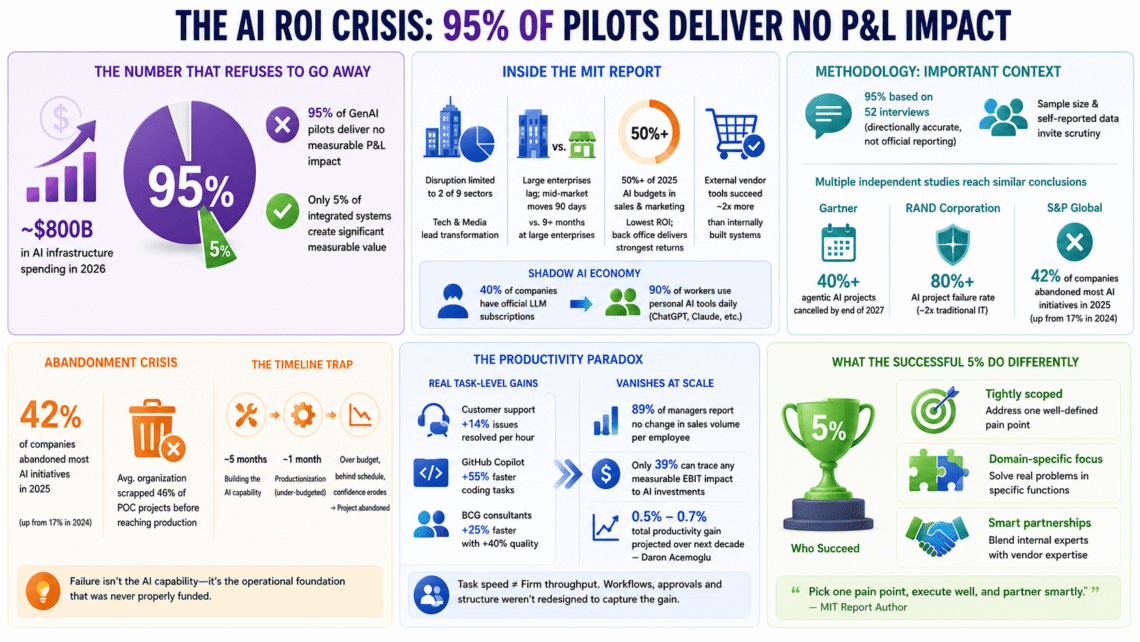
Since its publication in mid-2025, one statistic has become the single most repeated, most contested, and most consequential figure in the entire enterprise AI conversation. MIT’s Project NANDA, in a report titled The GenAI Divide: State of AI in Business 2025, found that 95 percent of generative AI pilots deliver no measurable profit and loss impact. Only 5 percent of integrated AI systems create significant, measurable value.
Given the nearly 800 billion dollars in AI infrastructure spending documented in the first article of this series, the AI ROI question this statistic raises is not academic. It is the question on which the entire economic justification for the current investment cycle ultimately rests.
Understanding whether this AI ROI crisis is real, overstated, or something more nuanced requires examining the methodology behind the headline number, the deeper productivity paradox it sits inside, and, most usefully, exactly what separates the small minority of companies that are succeeding from the large majority that are not.
Inside the MIT Report
The GenAI Divide report, based on 52 executive interviews, a survey of roughly 150 business leaders, and analysis of 300 public AI deployments, draws a sharp distinction the authors call the GenAI Divide, a split between widespread adoption and genuine business transformation. Over 80 percent of organizations have piloted tools such as ChatGPT or Copilot, and nearly 40 percent report some form of deployment. Yet these systems overwhelmingly boost individual productivity rather than delivering measurable enterprise level AI ROI.
The report identifies four structural factors behind this divide. Disruption remains limited to just two of nine major sectors, technology and media, that show genuine business transformation from generative AI use. Large enterprises paradoxically lead in pilot volume but lag significantly in successful deployment, while mid-market companies move from pilot to full implementation in roughly 90 days compared to nine months or longer at large enterprises.
AI budgets are allocated in a way that actively works against AI ROI, with over 50 percent of spending in 2025 directed toward sales and marketing pilots, precisely the category the report finds delivers the weakest returns, while the strongest AI ROI consistently comes from back office automation in finance, compliance, and document processing, categories that receive comparatively little budget attention. Finally, tools built by external vendors succeed roughly twice as often as internally built systems, a genuinely important finding for any enterprise weighing a build versus buy decision.
Perhaps the most striking finding is the emergence of what the report calls a shadow AI economy. While only 40 percent of companies maintain official LLM subscriptions, roughly 90 percent of workers surveyed report daily use of personal AI tools such as ChatGPT or Claude for actual job tasks, tools that frequently deliver better performance and faster adoption than the sanctioned systems built specifically to replace them.
The Methodology Question Worth Taking Seriously
Before accepting the 95 percent AI ROI failure figure uncritically, it is worth noting that the report itself has faced genuine methodological scrutiny. The finding of zero measurable return was based on just 52 interviews that the report’s own authors describe as directionally accurate based on individual interviews rather than official company reporting. Marketing AI Institute founder Paul Roetzer has argued publicly that a closer reading of the study’s methodology reveals a considerably more nuanced picture than the viral headline suggests, noting the sample size and self-reported nature of much of the underlying data.
This caveat does not invalidate the broader AI ROI concern, particularly because the MIT figure has since been corroborated, directionally if not precisely, by entirely independent research using different methodologies. Gartner separately predicts that over 40 percent of agentic AI projects will be cancelled by the end of 2027, citing escalating costs and unclear business value.
RAND Corporation’s independent research puts the broader AI project failure rate above 80 percent, roughly double the failure rate of conventional enterprise IT projects, itself a meaningful baseline given how notoriously difficult large-scale enterprise software rollouts already are. When multiple independent research organizations using different methods converge on directionally similar conclusions, the underlying AI ROI concern deserves to be taken seriously even if the precise 95 percent figure carries some uncertainty.
S&P Global and the Abandonment Crisis
A separate and independently sourced data point adds further weight to the AI ROI concern. S&P Global Market Intelligence, surveying over 1,000 IT and business leaders across North America and Europe for its 2025 Voice of the Enterprise report, found that 42 percent of companies abandoned most of their AI initiatives in 2025, a dramatic jump from just 17 percent the prior year. The average organization scrapped 46 percent of its proof of concept projects before they ever reached production.
The mechanism behind this abandonment pattern is instructive for understanding the AI ROI problem more precisely. Organizations that budget six months for an AI project typically allocate roughly five months to building the AI capability itself and only one month to what practitioners call productionization, the unglamorous but essential work of hardening a system for real operational use.
Production infrastructure, if built properly, takes roughly as long as the AI capability itself. By the time this reality becomes apparent, usually around month five, the project is over budget, behind schedule, and executive confidence has eroded. The project gets abandoned, not because the underlying AI capability failed, but because the operational foundation required to sustain it in production was never adequately budgeted for in the first place.
The Productivity Paradox: Real Gains That Vanish at Scale
Perhaps the most conceptually important dimension of the AI ROI debate is what researchers now call the AI productivity paradox, the widening gap between clearly documented task level gains and the near invisible effect of those same gains on company wide and national productivity statistics. The paradox is genuinely puzzling because both halves of it are independently well supported by evidence.
Customer service agents using AI resolve 14 percent more issues per hour. GitHub Copilot users complete coding tasks 55 percent faster. BCG consultants using AI finish work 25 percent quicker with 40 percent higher quality scores. These task level AI ROI gains, ranging from roughly 14 to 55 percent depending on the specific study and task, are real, controlled, and repeatedly replicated.
And yet, at the organizational level, this AI ROI evaporates almost entirely. NBER researchers tracking AI adoption from 61 to 71 percent of surveyed firms between early 2025 and early 2026 found that 89 percent of managers reported no change whatsoever in sales volume per employee over that same period. Only 39 percent of enterprises can trace any measurable EBIT impact to their AI investments at all. Nobel laureate economist Daron Acemoglu has projected a strikingly modest 0.5 to 0.7 percent total productivity gain from AI over the entire next decade, a figure he describes candidly as disappointing relative to the promises the industry has made.
The explanation researchers increasingly converge on is that task level speed is simply not the same thing as firm level throughput. An individual worker completing a task 55 percent faster does not automatically translate into an organization producing 55 percent more output, because the surrounding workflow, approval processes, quality checks, and organizational structure were never redesigned to actually capture that individual speed gain at scale.
What the Successful 5 Percent Actually Do Differently
The most practically useful finding across this entire body of AI ROI research is not the failure statistic itself but the consistent pattern separating the minority that succeed from the majority that do not. McKinsey’s 2025 AI survey found that organizations reporting significant financial returns were twice as likely to have redesigned their end to end workflows before selecting any AI tool, confirming that organizational change, not the underlying technology, is the actual differentiator.
MIT’s own data on the successful minority is similarly specific. Pilots that blended internal AI specialists with external vendor expertise achieved a 67 percent success rate, compared to just 22 percent for projects built entirely in-house. The winning 5 percent consistently shared three traits: tightly scoped initiatives focused on a single, well-defined pain point rather than broad transformation ambitions, domain specific focus rather than generic tooling, and smart partnerships with vendors who understood both the technology and the specific operational context it was being deployed into.
As one MIT report author put it directly, describing successful startups, they pick one pain point, execute well, and partner smartly, a strikingly simple formula against the backdrop of billions of dollars in more diffuse enterprise spending that has failed to replicate it.
Conclusion
The honest verdict on AI ROI in 2026 is neither the total failure the viral 95 percent statistic suggests in isolation, nor the seamless transformation the marketing around generative AI has promised since 2023. It is a genuine and well documented paradox: real, measurable, repeatedly replicated task level productivity gains that are, for the overwhelming majority of enterprises, failing to survive the jump from individual workflow to organizational output.
The 5 percent of companies that are succeeding are not doing so because they have access to better models. They are succeeding because they redesigned the underlying work itself before deploying AI into it, a lesson that costs considerably less to implement than the infrastructure billions documented in Article 1 of this series, and one that most of the market has still not learned.