-
The Powerful Rise of Agentic AI: Tracing Its Origins and Explosive Emergence (Part 1)
This is Part 1 of a two-part series examining agentic AI in depth. Part 1 traces the term’s origin, defines it precisely, and follows its rapid emergence from academic obscurity to the defining technology story of 2025 and 2026. Part 2 will examine how agentic AI can be used effectively, the frameworks separating genuine success from costly failure, and where the technology is heading next.
A Word Borrowed From Psychology, Repurposed by Engineers
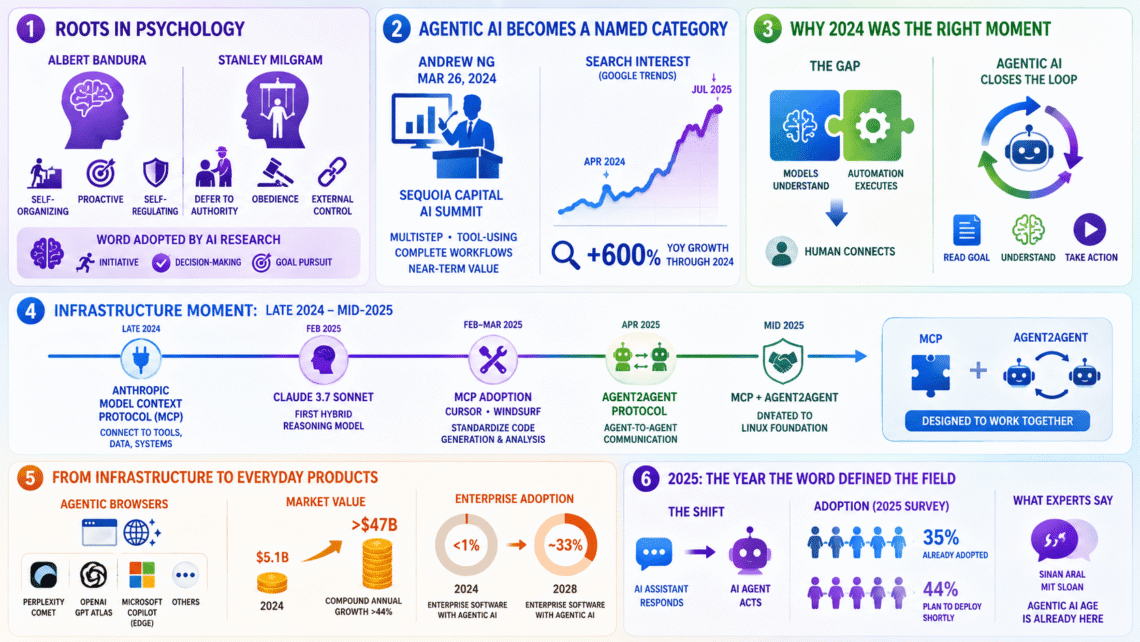
Before agentic AI became one of the fastest-growing terms in enterprise technology, agentic already had a settled meaning in an entirely different field. Psychologist Albert Bandura used the word to describe individuals who are self-organizing, proactive, and self-regulating, people who shape their own circumstances rather than merely reacting to them.
Stanley Milgram, in his famous obedience experiments, used the same root word differently still, describing an agentic state in which individuals defer their own judgment to an external authority. Both meanings, self-directed initiative and the capacity to act rather than simply respond, would eventually converge, decades later, into how the AI research community adopted the term.
The AI field itself began using agentic in the 2010s, applying it to software systems exhibiting qualities analogous to human agency, initiative, decision-making, and independent goal pursuit. But this early usage remained confined almost entirely to academic papers and specialist research circles. Merriam-Webster’s current definition, able to accomplish results with autonomy, used especially in reference to artificial intelligence, reflects how thoroughly the term has since migrated from psychology into everyday technology vocabulary, a migration that happened remarkably fast once it began in earnest.
The Moment Agentic AI Became a Named Category
While the underlying research concepts trace back decades, the specific framing of agentic AI as a distinct, named category with strategic significance has a more precise point of origin. Andrew Ng, the Stanford professor and AI pioneer, is widely credited with coining and popularizing the term in its modern usage at the Sequoia Capital AI Summit on March 26, 2024, arguing specifically that multistep, tool-using systems capable of executing complete workflows might deliver more near-term economic value than simply continuing to scale ever-larger foundation models.
This was a genuinely consequential reframing. It shifted the industry conversation away from a narrow focus on model size and benchmark scores, and toward a different question entirely, what these systems could actually accomplish when given the ability to act, not merely respond.
Google Trends data confirms just how sharply this reframing caught on. Interest in agentic AI as a search term remained minimal for years, then spiked sharply beginning in April 2024, immediately following Ng’s talk, and continued climbing to reach its peak popularity in July 2025. A separate industry analysis found search volume for the term increasing by more than 600 percent year on year through 2024, a growth curve that mirrors, and in some respects exceeds, the public fascination that greeted ChatGPT’s own release in late 2022.
Why 2024 Was the Right Moment, Not an Arbitrary One
The timing of agentic AI’s emergence as a distinct category was not coincidental. It reflected a genuine technical gap that had become obvious to practitioners across the industry roughly simultaneously. By 2024, many organizations had reached the same realization from independent directions. Large language models could understand human intent far better than any prior technology, and separate automation tools could reliably execute repeatable, predefined steps, but these two capabilities lived in entirely separate parts of the workflow, disconnected from one another. Work moved forward only when a human being manually connected the interpretation step to the execution step, reading a model’s output and then personally performing whatever action it recommended.
This specific gap, models that understood but could not act, and automation that could act but could not understand, is precisely what agentic AI was built to close. Rather than stopping at interpretation, as a standard chatbot does, agentic systems were designed to read a goal, understand its surrounding context, and then carry out the necessary actions directly within a live system, closing the loop that had previously always required manual human intervention.
The Infrastructure Moment: Late 2024 Through Mid-2025
Understanding why agentic AI moved from a promising concept to genuine production reality requires tracing a specific sequence of infrastructure milestones that unfolded across roughly eighteen months. In late 2024, Anthropic introduced the Model Context Protocol, an open standard allowing large language models to connect to external tools, databases, and live systems in a consistent, predictable way, examined extensively elsewhere on this blog. This single development is widely regarded as the key inflection point that made agentic AI practically deployable at scale, since it gave models, for the first time, a reliable and standardized way to reach beyond generating text and actually act upon the world.
The momentum continued to build rapidly through the first half of 2025. In February 2025, Anthropic released Claude 3.7 Sonnet, described as the first hybrid reasoning model on the market, and the Model Context Protocol specification itself gained widespread adoption across development tools including Cursor and WindSurf, which integrated it directly to standardize code generation and repository analysis.
In April 2025, Google introduced a complementary protocol, Agent2Agent, addressing a distinct problem from MCP, not how a single agent connects to external tools, but how multiple separate agents communicate and coordinate with one another. Crucially, the two protocols were designed from the outset to work together rather than compete, and by later in the year both had been donated to the Linux Foundation, cementing them as genuinely open, vendor-neutral industry standards rather than proprietary experiments controlled by any single company.
From Infrastructure to Everyday Products
These underlying protocol developments translated into visible consumer and enterprise products with striking speed. By mid-2025, agentic browsers began appearing across the industry, tools including Perplexity’s Comet, OpenAI’s GPT Atlas, Microsoft’s Copilot integration within Edge, and several others, each reframing the humble web browser from a passive window for displaying information into an active participant capable of completing entire tasks independently, such as booking a vacation directly, rather than merely helping a user search for flight options and leaving the actual booking to them.
The market figures accompanying this product wave were substantial by any measure. The market value of agentic AI reached approximately 5.1 billion dollars in 2024, and industry analysis from Capgemini projects that figure will exceed 47 billion dollars, growing at a compound annual rate above 44 percent. Perhaps more tellingly, in 2024 less than 1 percent of enterprise software included any agentic AI capability at all. By 2028, analysts expect close to a third of all enterprise software to incorporate it, a genuinely dramatic penetration curve for any enterprise technology category to achieve within a single decade.
2025: The Year the Word Defined the Field
By the close of 2025, agentic had become, in the words of one widely circulated year-end industry retrospective, the one word that captures the life of artificial intelligence in 2025, a term that transcended mere buzzword status to become the defining characteristic of how organizations and individuals actually experienced AI throughout the year. Where 2023 and 2024 had been dominated almost entirely by generative AI’s ability to create text, images, and code upon request, 2025 marked a genuine transition, from AI functioning as a responsive assistant waiting to be asked, toward AI functioning as an autonomous actor capable of completing complex, multi-step tasks with minimal continuous human direction.
MIT Sloan management professor Sinan Aral captured the state of the field succinctly in early 2026, stating plainly that the agentic AI age is already here, noting that agents are already deployed at scale across the economy performing all kinds of tasks. A spring 2025 survey conducted jointly by MIT Sloan Management Review and Boston Consulting Group found that 35 percent of surveyed organizations had already adopted AI agents in some form, with a further 44 percent expressing concrete plans to deploy the technology in short order, figures that place agentic AI among the fastest enterprise technology adoption curves ever measured.
Google Formalizes the Shift at I/O 2026
The clearest institutional confirmation that agentic AI had moved from emerging trend to defined industry era arrived at Google I/O 2026, where Sundar Pichai and the Google DeepMind team did not simply announce new models in the manner of prior years, but explicitly reframed what AI itself is meant to do going forward.
The shift they articulated was specific and deliberate, moving away from smarter chatbots and improved search results, toward AI that takes genuine initiative, executes multi-step tasks independently, and works on a user’s behalf without requiring continuous hand-holding throughout the process. The distinction Google drew was precise and worth repeating exactly, a chatbot answers, an agent does, a formulation that captures the entire conceptual shift this article has traced in a single, memorable sentence.
Where the Definition Stands Today
Current academic and industry consensus increasingly frames agentic AI not as a fixed, binary classification but as a continuous spectrum, a concept researchers now call agenticness, defined as the degree to which a system can adaptably achieve complex goals in dynamic environments with limited direct supervision. This spectrum encompasses four measurable dimensions, the complexity of goals a system can pursue reliably, the complexity of the environments it can operate within, its capacity to adapt to genuinely novel or unexpected circumstances, and its ability to execute independently with minimal ongoing human intervention.
OpenAI’s own internal framing treats agentic as a gradual continuum rather than a strict yes-or-no category, meaning that as any given system’s capabilities along these four dimensions cross a sufficiently high combined threshold, it naturally transitions from being simply an AI tool into being recognized, functionally, as agentic AI.
This nuanced framing matters considerably for how organizations and individuals should think about the technology going into Part 2 of this series, since it clarifies that adopting agentic AI effectively is not a matter of flipping a single switch from non-agentic to fully autonomous, but rather a matter of deliberately choosing how far along this spectrum any given task or workflow genuinely needs to sit.
Conclusion
Agentic AI’s journey from a niche psychological term, through decades of quiet academic development in robotics and multi-agent systems research, to Andrew Ng’s specific 2024 reframing, and finally to Google’s explicit declaration of an agentic era at I/O 2026, represents one of the fastest conceptual migrations in recent technology history. What makes this trajectory genuinely significant, rather than merely another cycle of industry buzzword inflation, is that it was accompanied at every stage by concrete, verifiable infrastructure milestones, the Model Context Protocol, Agent2Agent, and the resulting standardized ecosystem, each addressing a specific, previously unsolved technical gap between AI systems that could understand and automation that could act.
Part 2 of this series turns from this historical account toward the genuinely practical question this trajectory raises for any individual or organization today, how agentic AI can actually be used effectively, which specific patterns separate the deployments generating real, measurable value from the substantial share already documented as failing to deliver on their promise, and where this technology is realistically headed over the next several years.
Part 2: Using Agentic AI Effectively, coming next in the Current Events series.