-
Can AI Become a Powerful AI Hardware Component You Simply Plug In?
A Strange Question That Is Suddenly Not So Strange
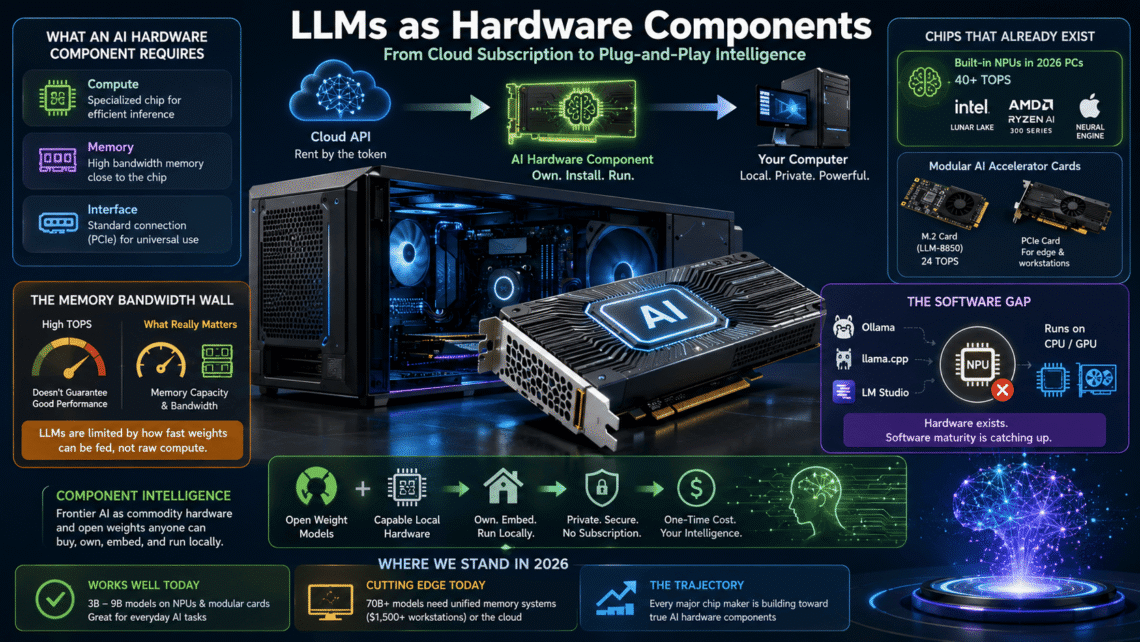
For decades, upgrading a computer meant a physical transaction. You bought a stick of RAM, slotted it into a motherboard, and your machine had more memory. You bought a graphics card, installed it, and your machine could render games or train neural networks. Intelligence itself never worked this way. It lived in the cloud, behind an API, rented by the token, controlled entirely by whichever company trained the model. In 2026, a genuinely interesting question has moved from science fiction into serious industry discussion: can we turn today’s large language models into an AI hardware component, something you install the way you install a GPU card, rather than something you subscribe to?
The answer, examined carefully, is more nuanced than a simple yes or no. Parts of this vision are already real and shipping today. Other parts remain years away, constrained not by ambition but by physics, memory bandwidth, and software maturity that has not caught up with the hardware.
What an AI Hardware Component Actually Requires
To understand whether an LLM can become a true AI hardware component, it helps to break the idea into its constituent parts. A GPU card works as a component because it is self contained, it has its own memory, its own processing units, and a standard interface, PCIe, that any compatible motherboard understands. For an LLM to work the same way, three things need to exist simultaneously: a physical chip capable of running the model’s mathematics efficiently, enough fast memory located close to that chip to hold the model’s weights, and a standardised interface that lets any computer recognise and use the card without custom software written specifically for it.
Every one of these three requirements is currently only partially satisfied, and understanding exactly where the gaps are is the key to understanding how close we actually are to a true plug in AI hardware component.
The Chips That Already Exist
The good news is that specialised AI hardware component chips are not hypothetical. Neural Processing Units, or NPUs, are now standard in most premium laptops sold in 2026. Intel’s Lunar Lake platform, AMD’s Ryzen AI 300 series, and Apple’s Neural Engine each deliver 40 or more TOPS, trillions of operations per second, of dedicated AI processing power. Microsoft’s Copilot Plus PC certification requires exactly this threshold, and these chips genuinely do accelerate certain AI workloads locally, particularly small models and specific Windows AI features, with remarkably low power draw.
Beyond laptops, dedicated AI accelerator cards already exist in modular, pluggable form factors. M.2 cards such as the LLM-8850, built around a compact system on chip delivering 24 TOPS, slot directly into the M.2 connectors found in most modern PCs and single board computers, offering exactly the plug and play experience the question envisions, at least for smaller models. PCIe based AI accelerator cards, designed for edge servers and workstations, extend this same modular philosophy to larger workloads.
So in a genuine, practical sense, the AI hardware component already exists as a product category. The catch is what these components can actually run.
The Memory Bandwidth Wall
This is where the vision runs into real physics rather than marketing copy. A large language model is not primarily limited by raw computational speed. It is limited by memory bandwidth, the rate at which the model’s weights, often tens of gigabytes of them, can be moved from storage into the processing unit fast enough to keep up with generation. As one detailed 2026 hardware analysis put it plainly, buyers who see a laptop advertised with 40 or 50 TOPS assume this means the machine can run a large language model like Llama or Mistral locally. In practice, TOPS numbers tell you almost nothing about whether an AI hardware component can run a genuinely capable model at usable speed.
The distinction matters enormously. Thin, low power NPU chips, similar in architecture to those found in smartphone camera processors, are excellent at small, sustained tasks, but they simply do not have the memory capacity or bandwidth to hold and serve a 70 billion parameter model. As one 2026 hardware database bluntly summarises the situation, you should read the memory column, not the TOPS column, when evaluating whether any given AI hardware component can genuinely run a local LLM.
This is precisely why the current generation of serious local AI hardware component systems, such as AMD’s Ryzen AI Max Plus 395 platform or Nvidia’s new RTX Spark superchip, take a fundamentally different architectural approach than a simple plug in card. Rather than a small accelerator with its own limited memory, these are unified memory systems, where the CPU, GPU, and NPU all share access to a large pool, up to 128 gigabytes, of high speed memory on a single package. This lets a properly configured system run a 70 billion parameter model entirely without offloading work to slower system memory, something no simple plug in card with its own small onboard memory can currently achieve.
Component Intelligence: A New Way of Thinking About It
Technology analyst Shelly Palmer recently articulated a compelling framing for where this trend is actually heading, describing what he calls component intelligence: frontier class AI productised as commodity hardware and open weights that any company or individual can buy, own, embed, and run locally, with no dependence on a centralised model provider. This framing captures something important that a narrow focus on physical card form factors misses.
The real transformation into an AI hardware component is not only about a chip you slot into a motherboard. It is about intelligence itself becoming ownable, embeddable, and independent of a subscription relationship with a distant cloud provider, in the same way electricity became a commodity utility rather than something only large factories could generate for themselves.
Open weight models, discussed extensively elsewhere on this blog, are the software half of this equation. A capable open weight model, once downloaded, is functionally a piece of intelligence you now own outright. Pair that model with genuinely capable local hardware, and the AI hardware component vision starts to look less like science fiction and considerably more like the current trajectory of the entire industry.
The Software Gap Nobody Talks About
Even where the hardware genuinely exists, a surprising bottleneck remains largely invisible to casual buyers. As of mid-2026, the mainstream local LLM runtimes that most enthusiasts actually use, Ollama, llama.cpp, and LM Studio, do not route inference workloads to the dedicated NPU at all. They run on the CPU or GPU instead, leaving expensive, purpose built AI silicon sitting idle. This is not a hardware limitation. It is a software maturity gap, and it illustrates something important about the AI hardware component question: shipping the chip is only half the problem. Building a software ecosystem that actually knows how to use it, the way decades of driver development made GPUs universally usable, takes time that hardware announcements alone cannot compress.
What This Means Practically Today
For a reader asking whether they can walk into a store today and buy a genuine AI hardware component the way they would buy a RAM stick, the honest answer is a qualified yes, with important caveats attached. Small, efficient models in the 3 to 9 billion parameter range, handling the majority of real world everyday AI tasks, already run well on NPU equipped laptops and modular accelerator cards. For anything approaching frontier capability, a 70 billion parameter model or larger, you currently need either a unified memory workstation costing upward of $1,500, or continued reliance on cloud infrastructure.
The trajectory, however, is unmistakable. Every major chip maker, Intel, AMD, Nvidia, Apple, and increasingly open silicon efforts like Tenstorrent’s RISC-V based accelerators, is racing toward exactly this outcome: intelligence as a genuine, ownable AI hardware component rather than a rented cloud service. The gap between today’s reality and Palmer’s component intelligence vision is not conceptual. It is a specific, measurable gap in memory bandwidth, software routing, and price, and every one of those gaps is closing steadily, generation by generation.
Conclusion
Turning an LLM into an AI hardware component you install like a GPU card is not a distant fantasy. It is a spectrum of capability that already exists at the small end and is advancing rapidly toward the frontier end. The chips exist. The connectors exist. The open weights exist. What remains is the unglamorous, incremental engineering work of closing the memory bandwidth gap and building software that actually knows how to use the silicon already sitting inside millions of machines. When that work finishes, and current trends suggest it will finish faster than most people expect, buying intelligence may genuinely become as ordinary as buying memory.