-
The Critical Truth About LLM Development History: A Decade of Progress Without the Hype (Part 1)
This is Part 1 of a two-part series taking a rigorous, hype-free look at large language model progress. Part 1 examines what actually happened technically over the past decade, separating genuine algorithmic breakthroughs from marketing narrative. Part 2 will examine the specific techniques currently in the pipeline and offer a grounded forecast for the next five years.
Separating the Signal From a Decade of Noise
Ten years of large language model development have produced a genuinely confusing public narrative, one part remarkable engineering achievement, one part carefully managed marketing, and one part unresolved scientific dispute among the researchers who actually build these systems. This two-part series sets out to examine LLM development history the way a rigorous engineering post-mortem would, using measured, published, peer-reviewed evidence rather than product launch keynotes, and being explicit about where genuine scientific disagreement still exists among serious researchers.
The honest starting point is that two distinct forces drove all measurable progress across this LLM development history, and conflating them, as popular coverage routinely does, obscures rather than clarifies what actually happened and what is likely to happen next.
Force One: Raw Compute Scaling
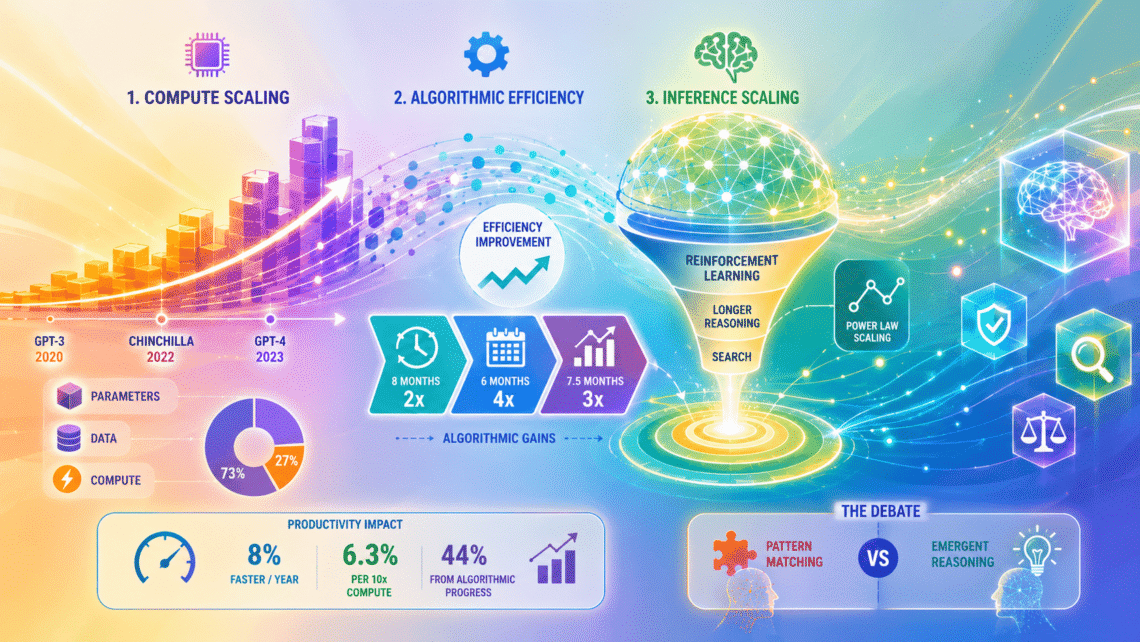
The dominant narrative of early LLM development history was straightforward and, for several years, empirically accurate. OpenAI’s 2020 scaling laws, authored by Jared Kaplan and colleagues, established that model performance improved predictably as a power law function of parameters, dataset size, and training compute.
The practical conclusion drawn from this research was specific and consequential: given a fixed compute budget, the optimal strategy allocated roughly 73 percent toward parameters and only 27 percent toward data, meaning build the largest model you can afford and do not worry excessively about data volume. GPT-3, a 175 billion parameter model trained on just 300 billion tokens, a ratio of roughly 1.7 tokens per parameter, was a direct product of this thinking and became a genuine sensation.
This phase of LLM development history proved short-lived once subjected to more rigorous testing. DeepMind’s 2022 Chinchilla paper, examined extensively elsewhere on this blog, demonstrated that Kaplan’s original scaling laws had significantly underweighted the value of training data relative to parameters. The compute-optimal ratio, Chinchilla established, was closer to 20 tokens per parameter, not 1.7, meaning GPT-3 scale models trained under the earlier Kaplan regime were substantially undertrained relative to their parameter count.
This single correction, more than any subsequent architectural innovation, explains much of the capability jump between the GPT-3 and GPT-4 generation of models, a fact that receives considerably less public attention than it deserves given its outsized practical impact on LLM development history.
Force Two: Algorithmic Efficiency, the Quieter and More Important Story
The genuinely underappreciated thread running through LLM development history is algorithmic efficiency, improvements that let a model achieve a given performance level using dramatically less compute than an earlier approach required, entirely independent of simply buying more hardware. Multiple independent research efforts, using different methodologies, have converged on a strikingly consistent estimate. Epoch AI’s analysis found that training compute required to reach a fixed performance threshold has halved approximately every eight months.
Anthropic CEO Dario Amodei separately estimated the figure at roughly four times per year. A 2025 paper titled Price of Progress, isolating algorithmic gains specifically from open models to control for competitive effects, independently estimated algorithmic efficiency progress at approximately three times per year. Three independent methodologies converging on halving times of eight months, six months, and seven and a half months respectively is a genuinely rare degree of empirical agreement in a field this contested, and it represents one of the more solid, well-evidenced conclusions available about LLM development history to date.
A more rigorous 2025 academic framework distinguishes between compute-dependent and compute-independent algorithmic advancements specifically to avoid conflating these two forces, since compute-dependent improvements only become significant at scales far beyond their original conception, while compute-independent improvements raise efficiency uniformly across every scale. This distinction matters directly for forecasting, since it clarifies that some techniques currently discussed as breakthroughs will only meaningfully matter once frontier labs deploy compute budgets an order of magnitude beyond what is currently available, while others are already delivering their full benefit today.
The Third Axis Nobody Anticipated: Inference Scaling
Perhaps the single most consequential shift in LLM development history over the past two years has been the emergence of an entirely new axis of scaling that the original Kaplan and Chinchilla frameworks never accounted for. From 2020 through 2024, frontier progress was governed almost entirely by training scale, larger datasets, larger models, larger training compute budgets. Over 2024 and 2025, the field added a fundamentally different second axis, inference scale, also called test-time compute, spending considerably more computation at the moment of generation itself, through longer deliberation and search-like reasoning strategies, to raise problem-solving performance, sometimes more cost-effectively than simply training a larger base model in the first place.
This bifurcation genuinely reframes what counts as progress within LLM development history, and it explains a pattern that confused many observers through 2025, models with similar or even smaller parameter counts than their predecessors nonetheless posting dramatically better performance on hard reasoning benchmarks, purely because they had learned, through reinforcement learning on verifiable outcomes, to generate longer, more structured internal reasoning traces before committing to a final answer.
The 2026 academic literature on reinforcement learning post-training scaling has since found that this inference-time scaling follows its own distinct power law relationship between test loss, compute, and data, structurally similar to pretraining scaling laws but with a critical difference, reinforcement learning post-training exhibits a latent saturation trend, meaning that while larger models do achieve higher learning efficiency during this phase, the returns diminish measurably faster as scale increases than they do during pretraining itself. This finding matters enormously for Part 2 of this series, since it suggests inference scaling cannot simply be scaled indefinitely as a substitute for continued pretraining progress.
What This Actually Meant for Productivity, Measured Rigorously
Separating LLM development history from marketing requires looking at controlled, preregistered economic research rather than anecdote, and the most rigorous study available offers a genuinely useful, if considerably more modest than commonly claimed, picture. A December 2025 preregistered experiment involving over 500 consultants, data analysts, and managers, each completing real professional tasks using one of thirteen different LLMs, found a robust calendar-time scaling effect, each year of frontier model progress was associated with an 8 percent reduction in task completion time.
Isolating the effect of pure compute scale specifically, a tenfold increase in model training compute was associated with only a 6.3 percent reduction in task completion time, with roughly 44 percent of total observed improvement attributable specifically to algorithmic progress rather than raw scale.
The study’s most analytically important finding, however, concerns a divergence that deserves far more public attention than it currently receives. While the quality of autonomous model output scaled essentially linearly with training compute, the quality of human-assisted output remained largely stagnant across successive model generations. This implies that human users, through the specific way they prompt, interpret, and apply model outputs, effectively cap the realized capability gains of frontier models at a fixed ceiling, a genuinely sobering finding for anyone assuming that simply deploying a more capable model automatically translates into proportionally greater organizational productivity, a theme directly consistent with the AI ROI evidence examined in our recent five-part series on AI industry economics.
The Genuine Scientific Dispute: Pattern Matching or Reasoning
No honest account of LLM development history can avoid the genuine, unresolved dispute currently dividing serious AI researchers, a dispute that has nothing to do with marketing hype and everything to do with what these systems are actually doing internally. Yann LeCun, Meta’s former chief AI scientist, has argued consistently and pointedly throughout 2025 and 2026 that autoregressive transformer models, however impressive their outputs, remain fundamentally pattern matching engines rather than genuine world models.
Yann’s critique is specific: current LLMs can describe gravity eloquently because they have ingested millions of textual descriptions of gravity, but they cannot predict that an unsupported object will fall because they possess no internal concept of falling beyond statistical token associations, no grounded representation of cause and effect that would allow genuine planning or reasoning about consequences.
Cognitive scientist Gary Marcus has raised a closely related but distinct critique, tracing his skepticism back to his own 1992 publications and his 2001 book The Algebraic Mind, which anticipated the hallucination and unreliable reasoning problems LLMs continue to exhibit decades before LLMs existed. Neuroscientist Karl Friston has framed the underlying objection even more starkly, describing LLMs as, in his words, just a mapping between content and content, with nothing genuinely in the middle representing understanding.
It is worth noting explicitly that this dispute is not settled, and reasonable, technically serious researchers occupy positions across the entire spectrum, from LeCun and Marcus’s skepticism to the position, held by many working directly on frontier reasoning models, that inference-time scaling and reinforcement learning on verifiable outcomes are already producing genuinely emergent reasoning capability that simple pattern matching could not explain.
What is measurably true, regardless of which theoretical camp proves correct, is the hallucination statistic itself. Even as of April 2026, hallucinations in court filings by prominent, sophisticated law firms using frontier AI tools continued to occur, direct evidence that the hallucination problem central to this entire LLM development history debate remains genuinely unresolved rather than a solved problem simply awaiting wider deployment.
Conclusion
The genuine, evidence-grounded account of LLM development history over the past decade is considerably more interesting, and considerably more measured, than either the breathless marketing narrative or the dismissive skeptic narrative alone would suggest. Real, repeatedly measured algorithmic efficiency gains of roughly three to four times per year compounded with genuine compute scaling to produce the capability curve the public has observed.
A genuinely new axis of progress, inference-time scaling, emerged in the past two years and has already begun exhibiting its own distinct saturation dynamics. And a serious, unresolved scientific dispute concerning LLM development history about whether the underlying architecture can ever produce genuine reasoning, rather than increasingly sophisticated pattern matching, continues to divide credible researchers rather than being settled decisively in either direction.
Part 2 of this series turns from this historical account toward the specific technical pipeline, the architectural alternatives to the transformer, the emerging training techniques, and the realistic, hype-free forecast for what these forces are actually likely to produce, in terms of cost, capability, and genuine reasoning ability, over the next five years.
Part 2: The Next Five Years, coming next in the Current Events series.