-
Is OpenAI Pricing Power Collapsing Fast? The Alarming Truth Behind the 80 Percent Cut
A Price Cut That Broke Its Own Rules
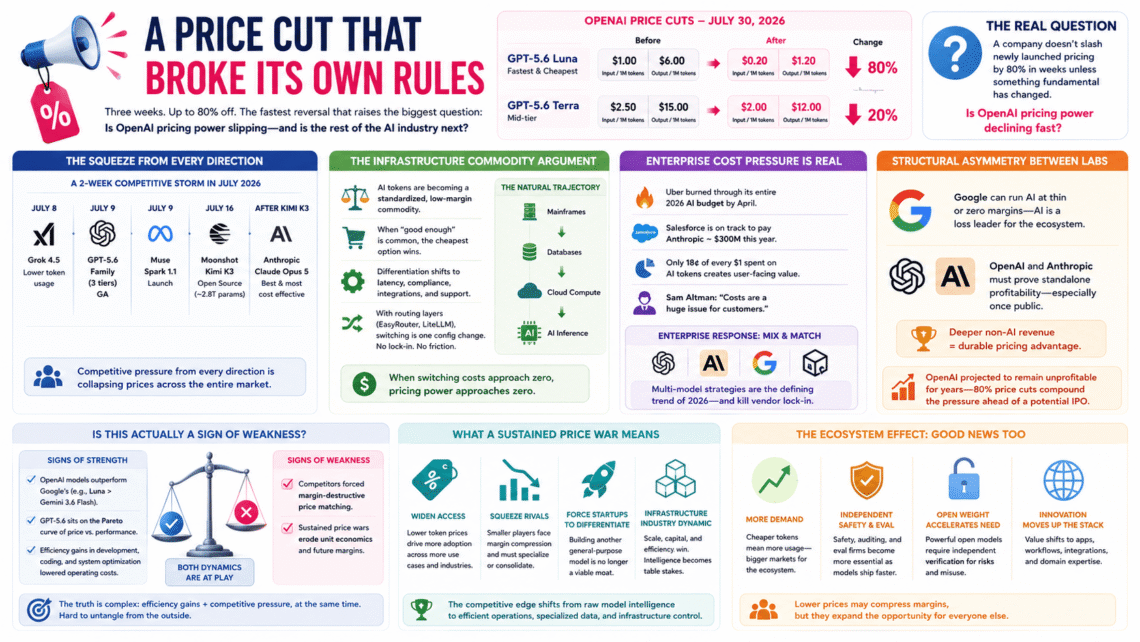
Most companies treat a pricing tier as something set carefully and revisited once a year at most. On July 30, 2026, OpenAI repriced part of its lineup roughly three weeks after launching it. GPT-5.6 Luna, the fastest and cheapest tier, dropped 80 percent from $1 and $6 per million input and output tokens down to $0.20 and $1.20. GPT-5.6 Terra, the mid-tier model, fell 20 percent from $2.50 and $15 down to $2 and $12 per million tokens.
The speed of that reversal is the story. A company does not slash its own newly launched pricing by 80 percent within weeks unless something has fundamentally shifted in its competitive position. The question worth asking directly is whether OpenAI pricing power, the ability to set prices based on value delivered rather than competitive pressure, is declining fast, and whether the same is true across the entire frontier AI industry.
The Squeeze From Every Direction
OpenAI pricing power did not erode in a vacuum. It has been squeezed from multiple directions simultaneously, in a compressed timeframe that left the company little room to maneuver. The launches came in a rush over two weeks in July 2026: xAI released Grok 4.5 on July 8 promising lower token usage, OpenAI made its GPT-5.6 family generally available in three tiers on July 9, Meta launched Muse Spark 1.1 the same day, and Moonshot released the open source Kimi K3 on July 16. Three frontier labs moving on one day rarely happens, and the result was competitive pressure that dragged prices down across the whole market, not at a single provider.
Following Moonshot’s Kimi K3 announcement, Anthropic released Claude Opus 5, touted as its best performing and most cost effective offering for many use cases. The company said it is reducing the price of Terra by 20 percent and the cost of Luna by 80 percent, facing pressure to cater to a more cost sensitive customer base and fend off competition from Chinese startups and other tech giants. OpenAI pricing power is being tested not by one rival but by an entire competitive field moving simultaneously, which is precisely the condition under which pricing power collapses fastest.
The Infrastructure Commodity Argument
The most analytically serious explanation for declining OpenAI pricing power comes from an industry framing that treats AI tokens the way earlier technology cycles treated compute and bandwidth. AI tokens become a standardised, low margin commodity where no single company can maintain pricing power. When the product is good enough, and increasingly models from different providers are converging on quality, the cheapest option wins. Differentiation shifts to latency, compliance, integrations, and support, a services game with thin margins. This is the natural trajectory of every technology market: mainframes, databases, cloud compute, and now AI inference.
The switching cost argument reinforces this. With orchestration layers like EasyRouter and LiteLLM, developers can migrate between providers with a single configuration change. There is no lock-in, no friction, just whoever is cheapest today. When switching costs approach zero, pricing power for any individual provider approaches zero as well, regardless of how capable that provider’s models are in absolute terms.
Enterprise Cost Pressure Is Real and Escalating
The demand side of this equation matters as much as the supply side competition. Enterprises are genuinely straining under AI spending that has grown faster than most budgeting processes anticipated. Uber burned through its entire 2026 AI budget by April. Salesforce is on track to pay Anthropic approximately $300 million for the year. One analysis found that for every dollar spent on AI tokens, only 18 cents generates user-facing value, with the rest going to fixing bugs, rework, and review. Sam Altman himself has acknowledged that costs are a huge issue for customers.
Enterprises are responding with the WSJ reporting that companies are mixing and matching models from OpenAI, Anthropic, Google, and open source providers to control costs, a multi-model strategy that has become the defining trend of 2026. This behaviour directly undermines OpenAI pricing power because it converts what could have been a sticky, single-vendor relationship into a continuously re-evaluated commodity purchase, exactly the dynamic that erodes pricing leverage over time.
The Structural Asymmetry Between Labs
A subtle but important dimension of the OpenAI pricing power question is that not every frontier lab faces the same commercial pressure to defend margins. Once OpenAI goes public, Wall Street will demand profitability. The same applies to Anthropic. But Google does not have this problem. Its AI subscription business does not need to be independently profitable, since it is a loss leader for the broader Google ecosystem.
This creates a structural asymmetry: Google can absorb thinner AI margins indefinitely because AI is not the core of its revenue model, while OpenAI and Anthropic must eventually demonstrate standalone profitability to public market investors, giving competitors with deeper non-AI revenue bases a durable pricing advantage that pure-play AI labs cannot easily counter.
Despite the price war, OpenAI’s own financial trajectory illustrates the stakes. The company was projected to remain unprofitable for years even before this round of price cuts, and slashing prices by up to 80 percent on its cheapest tier directly compounds that pressure, even as the company heads toward a potential public listing where profitability scrutiny will intensify sharply.
Is This Actually a Sign of Weakness
There is a genuine counter-argument worth taking seriously before concluding that declining OpenAI pricing power signals genuine competitive weakness. OpenAI’s models are more performant than Google’s according to third party analysis outfits like Artificial Analysis, with even the discounted Luna model outperforming Gemini 3.6 Flash.
As AI coding startup Cognition noted, GPT-5.6 now sits on the pareto curve of price and performance efficiency, offering among the most superior intelligence for the lowest cost on the market. OpenAI said the reductions were made possible by efficiency gains achieved during GPT-5.6 development, improved internal coding processes, and system optimisation that genuinely lowered the cost of operating its services, rather than purely defensive margin sacrifice.
This distinction matters considerably. If OpenAI pricing power is declining because competitors have forced margin-destructive price matching, that is a weakness signal. If OpenAI pricing power is declining because genuine efficiency gains allow the company to pass savings to customers while maintaining a performance lead, that is closer to a strength signal dressed in falling prices. The honest answer is that both dynamics appear to be occurring simultaneously, and untangling them precisely from outside the company is difficult with publicly available information.
What a Sustained Price War Means for the Industry
Forbes analysis frames the implication starkly: OpenAI’s 80 percent price cut signals a brutal AI price war that will widen access, squeeze rivals, and force startups to exist beyond building another general purpose model. The foundation model market is increasingly resembling an infrastructure industry, where scale, capital, and operational efficiency are paramount for dominant players, while the competitive edge shifts from raw model intelligence to efficient operations, specialised data, and infrastructure control.
For the broader AI ecosystem, declining OpenAI pricing power alongside similar pressure on Anthropic and other frontier labs is not necessarily bad news. As token prices decline, demand for supporting systems may grow because companies will run more models across more tasks. Independent firms focused on safety, auditing, and evaluation gain new relevance precisely because model providers face commercial pressure to release products quickly, leaving room for outside companies to test systems for cybersecurity risks, deceptive behaviour, and dangerous capabilities. Powerful open weight systems, discussed at length in our recent open weight AI series, make this independent verification work more urgent, since their capabilities can be modified and deployed entirely outside the controls of their original developers.
Conclusion
OpenAI pricing power is declining, and declining quickly, by any reasonable reading of the events of July 2026. The 80 percent cut to Luna and the 20 percent cut to Terra, arriving within weeks of launch, are not the actions of a company confident in its ability to charge a premium indefinitely. But the decline in OpenAI pricing power is not solely a story of weakness.
It reflects a maturing market in which frontier intelligence itself is becoming commoditised faster than almost anyone in the industry predicted eighteen months ago, a market where genuine efficiency gains and genuine competitive pressure are arriving simultaneously and are difficult to fully disentangle from outside the boardroom.
What is clear is the direction of travel. OpenAI pricing power, and pricing power across the frontier AI industry broadly, is shifting away from the model layer and toward the orchestration, integration, and trust layers that sit around it. For enterprises, that is unambiguously good news. For the labs that spent years betting that owning the best model would confer lasting pricing leverage, it is a signal that the ground beneath that bet has already started to move.