-
Solving the Critical Data Wall: How Continual Learning LLM Systems Could Improve Everything
A Constraint That Points Toward a Deeper Problem
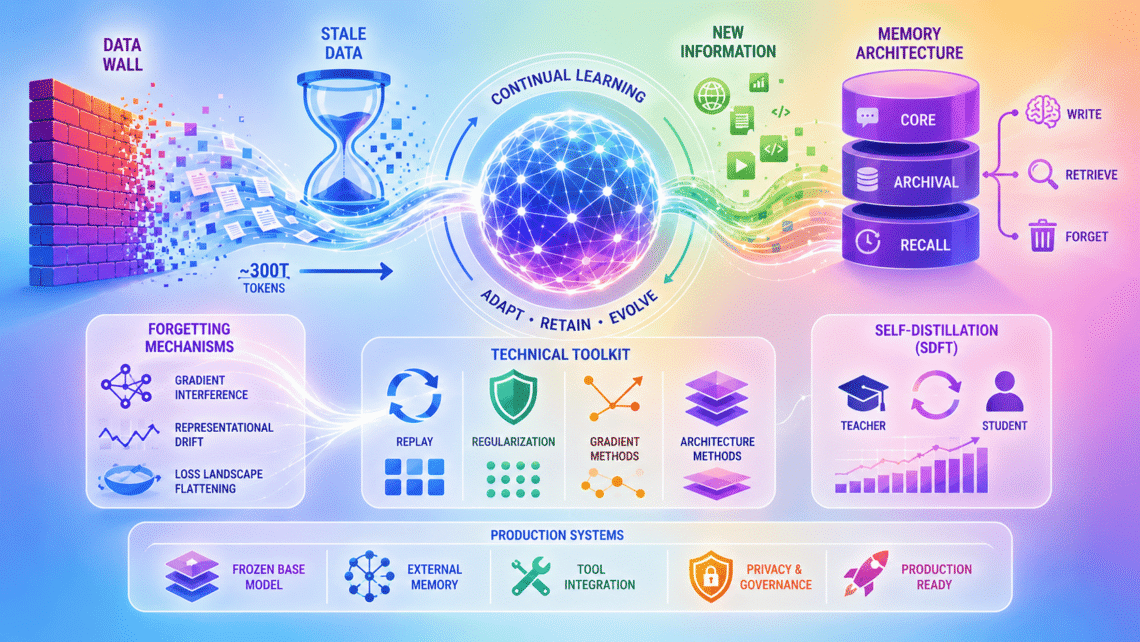
Part 2 of this blog’s recent series on the future of LLM technology established the data wall as a genuine, near-term constraint, Epoch AI’s estimate of roughly 300 trillion usable tokens of human text, against a frontier model’s growing appetite that could soon exceed even the entire unfiltered internet. But the data wall is, in an important sense, a symptom of a deeper architectural limitation rather than a standalone problem. Today’s large language models are trained once, on a fixed snapshot of data, then frozen and deployed.
Any genuinely new information the world produces after that training cutoff simply does not exist for the model, unless it is manually retrained from scratch at enormous cost, or fed in temporarily through a context window that vanishes the moment the conversation ends. A continual learning LLM, a model capable of genuinely absorbing new information after deployment without needing to be retrained wholesale, is widely regarded by researchers as the most promising structural answer to both the data wall and the deeper staleness problem it exposes.
Understanding whether continual learning LLM research is close to a genuine solution, or merely a promising research direction still years from production reliability, requires examining the specific technical obstacle that has defeated this goal for decades, the progress researchers have made against it through 2025 and 2026, and the production systems already attempting practical, if partial, workarounds.
Catastrophic Forgetting: The Obstacle That Has Defeated Every Prior Attempt
The central technical obstacle blocking a genuinely reliable continual learning LLM has a name that dates back to 1989: catastrophic forgetting, the sharp decline in performance on previously learned tasks that occurs when a neural network is trained on new data. The mechanism is straightforward to describe even if it has proven stubbornly difficult to solve. When a model updates its parameters to fit new information, those gradient updates can overwrite the specific weights that were critical for performing earlier tasks well, since knowledge in a transformer is distributed across billions of parameters in a highly entangled way, with no clean, isolated module for any single fact or skill that could simply be protected while everything else updates freely.
A comprehensive 2026 mechanistic analysis, examining twenty state-of-the-art models ranging from 109 billion to 1.5 trillion parameters, including GPT-5.1, Claude Opus 4.5, and DeepSeek-V4-Pro, identified three specific, distinct mechanisms driving this forgetting. Gradient interference in attention weights disrupts 15 to 23 percent of attention heads specifically in lower network layers, correlating directly with early-stage forgetting. Representational drift causes measurable degradation in intermediate layer representations.
And loss landscape flattening around prior task minima makes the model’s previously learned solutions unstable and easily dislodged by subsequent training. Troublingly, earlier research found that the severity of forgetting actually intensifies as model scale increases within certain parameter ranges, the opposite of what one might hope, since larger models start from a stronger initial performance baseline that has further to fall.
The Discovery That Reframed the Entire Problem
A genuinely important development shaping the continual learning LLM research agenda through 2025 and 2026 has been the discovery that a significant portion of what researchers previously labeled catastrophic forgetting may not represent genuine, permanent knowledge loss at all. Multiple independent research teams have converged on what is now called spurious or pseudo forgetting, evidence that performance degradation on previous tasks often stems from the model’s instructions failing to properly activate its inherent capabilities, rather than the model having genuinely lost those capabilities.
In several documented cases, performance believed to have been permanently destroyed by continual training could be restored simply through appropriate prompting, demonstrating that no actual forgetting had occurred at the level of the model’s underlying knowledge at all.
This reframing matters enormously for continual learning LLM research, because it suggests that at least part of the historical forgetting problem may be a task inference and instruction-following issue rather than a fundamental limitation of neural network memory itself. Researchers working from this framing have proposed a specific mitigation, a Freeze strategy that stabilizes task alignment specifically, since their controlled experiments demonstrated that maintaining task alignment matters more for preventing apparent forgetting than simply protecting raw factual knowledge retention.
The Technical Toolkit Currently in Development
Beyond the spurious forgetting reframing, continual learning LLM researchers have converged on four broad categories of genuine, complementary technical approaches, each addressing the underlying problem from a different angle.
Replay-based methods, widely considered the closest thing to a gold standard in the field, work by periodically retraining the model on a curated sample of prior task data alongside new data, ensuring old knowledge continues receiving reinforcement even as new knowledge is introduced. The genuine engineering challenge here is selecting a representative, sufficiently diverse replay buffer without needing to store or retrain on the entire original training corpus, a constraint directly connected to the data wall problem discussed earlier in this blog’s technology forecasting series. A promising 2026 refinement generates replay data synthetically, directly from the model being trained itself, reducing the storage burden considerably while preserving the stabilizing effect.
Regularization-based methods constrain how far specific parameters are allowed to drift during new training, protecting weights identified as critical to prior task performance. Gradient-based approaches, including a 2026 technique using gradient orthogonality for efficient domain adaptation, work by selecting new training data specifically chosen to minimize conflict with the gradients that encode previously learned knowledge, addressing the interference problem at its root rather than only after the fact.
Architecture-based approaches take a structurally different path entirely, using techniques such as parameter-efficient fine-tuning, low-rank adapters that can be trained on new information while the original backbone model remains entirely frozen and undisturbed. A 2026 technique called Low-Rank Circuit Projection has shown particular promise here, mitigating forgetting with genuinely minimal additional training overhead, an important practical consideration for any continual learning LLM system intended for frequent, ongoing updates rather than occasional retraining.
Self-Distillation: A Particularly Promising 2026 Development
Among the specific techniques to emerge in 2026, self-distillation fine-tuning, SDFT, deserves particular attention for how directly it addresses the practical deployment problem facing continual learning LLM systems today. Many organizations currently avoid the forgetting problem entirely by isolating each new task into a separate fine-tuned model or adapter, a workaround that increases costs substantially and adds meaningful governance complexity, since teams must continually retest every isolated model to avoid regression across an ever-growing set of fragmented, task-specific variants.
SDFT offers a genuinely different approach, using the model’s own in-context learning ability to generate on-policy training signals directly from demonstrations, with the same model playing both teacher and student roles during training. In sequential learning experiments, this approach enabled a single model to accumulate multiple skills over time without the performance regression that had defeated earlier sequential fine-tuning attempts, establishing on-policy distillation as a genuinely practical path toward the kind of accumulating, rather than fragmenting, continual learning LLM behavior the field has been pursuing since the late 1980s.
Memory Architecture as a Practical, Deployable Answer Today
While the deep technical research into solving catastrophic forgetting at the weight level continues, a parallel and considerably more mature engineering approach has already reached production deployment, treating continual learning as a memory architecture problem rather than purely a weight-update problem. Rather than updating the model’s parameters at all, these systems give a fixed, frozen base model access to external, persistent memory that it can read from and write to across sessions.
The most sophisticated production implementations now maintain three distinct memory tiers, core memory that sits directly in-context and is editable by the model itself, archival memory stored in an external, semantically searchable vector store, and recall memory, an indexed conversation history the model can query when needed. The model controls its own memory actively through tool calls, writing important facts to core memory, offloading less immediately relevant information to archival storage, and recalling specific details as the current task requires.
Mem0, a widely adopted memory layer that emerged in 2025, combines semantic consolidation, merging related information and resolving conflicts, with intelligent forgetting that deliberately deprioritizes stale or low-relevance entries, and has demonstrated accuracy gains of up to 26 percent over plain vector retrieval in benchmark testing.
This memory-based approach to continual learning LLM behavior sidesteps the catastrophic forgetting problem entirely by never actually modifying the base model’s weights at all. Its tradeoff is equally important to understand honestly, it provides the experience of a system that remembers and adapts, without providing genuine parametric learning, the kind of deep, generalizable knowledge integration that comes specifically from updating a model’s weights rather than simply retrieving relevant text at inference time.
What Production Teams Are Actually Building Toward in 2026
The practical question facing engineering teams building continual learning LLM systems today is no longer whether to support some form of ongoing learning, users increasingly expect deployed agents to remember and genuinely improve over interactions, but rather which specific combination of these techniques best matches a given system’s required update frequency, privacy constraints, and acceptable compute budget.
A February 2026 open-source release packaging memory-based continual learning as a drop-in software development kit for any LLM agent signals that this particular approach, external memory rather than weight modification, has matured into genuinely production-ready infrastructure considerably faster than the deeper parametric learning research.
Broader industry analysis places continual learning squarely among the handful of critical technical transitions expected to reshape production AI through the remainder of 2026, alongside agentic workflows maturing beyond demonstration stage and hybrid architectures increasingly replacing pure Transformer designs, a pattern directly consistent with the architectural convergence trend documented in this blog’s recent LLM technology forecast.
Conclusion
A genuinely reliable continual learning LLM, one that can absorb new information indefinitely, at the level of its actual weights rather than merely its external memory, without catastrophically degrading previously learned capabilities, remains an unsolved research problem as of mid-2026, not a deployed reality. But the honest, evidence-based picture is considerably more encouraging than that framing alone suggests. The spurious forgetting discovery has reframed a meaningful portion of the historical problem as an instruction-following issue rather than genuine, permanent knowledge loss.
Self-distillation and gradient-orthogonal training methods are showing genuine, measurable progress against the remaining, authentic forgetting that does occur. And memory-augmented architectures already provide production teams with a practical, if partial, answer available today, one that sidesteps the deepest technical challenge entirely by keeping the base model frozen while giving it genuine, persistent, actively managed memory instead.
Whether the deeper parametric version of continual learning LLM research matures into production reliability within the next several years, or whether memory-augmented architectures prove sufficient for the vast majority of practical use cases regardless, is likely to be one of the more consequential open questions determining how the data wall constraint, and the broader staleness problem underlying it, ultimately gets resolved.