-
The Critical Open Weight AI Schism: Part 2, Geopolitics, National Security, and the Global Governance Race
This is Part 2 of a two-part series analysing the open weight AI debate. Part 1 examined the enterprise financial and economic implications. Part 2 examines the geopolitical, national security, and governance dimensions of open weight AI geopolitics.
From Enterprise Ledger to National Strategy
Part 1 of this series established that open weight AI has become a rational financial choice for enterprises, driven by inference cost collapse, vendor independence, and the erosion of the proprietary foundation model moat. But the same forces reshaping corporate balance sheets are simultaneously reshaping the balance of power between nations. Open weight AI geopolitics is no longer an abstract policy conversation confined to think tanks. It is now a live, fast-moving contest with direct consequences for national security, semiconductor strategy, and global technological influence, and the decisions being made in Washington, Beijing, and dozens of smaller capitals right now will shape that contest for years.
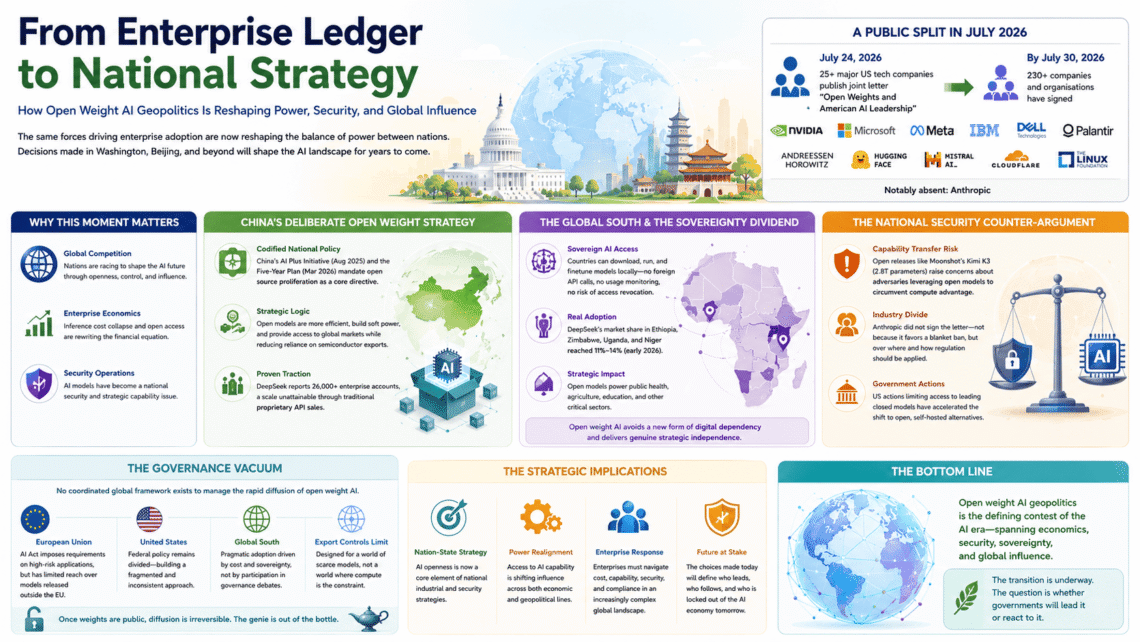
The fight over open weight AI has shifted from technical preference to national strategy. In late July 2026, it became a public split between major labs, infrastructure vendors, policymakers, and open source advocates. What made this moment different was not just louder rhetoric. It was the collision of three hard realities at once: global competition, enterprise economics, and security operations.
China’s Deliberate Open Weight Strategy
Understanding open weight AI geopolitics requires understanding that China’s embrace of open weight models is not incidental. It is codified national policy. The State Council’s AI Plus Initiative, launched in August 2025, and the national Five-Year Plan published in March 2026, explicitly codify open source proliferation as a core directive. This is a coordinated industrial strategy, not the emergent behaviour of individual companies acting independently.
The strategic logic behind this policy is multifaceted and worth examining closely, because it explains why open weight AI geopolitics has become such a central concern for US policymakers. Open models are more efficient to train and deploy than proprietary alternatives, allowing Chinese companies to compete despite potential hardware disadvantages imposed by chip export controls. This is the semiconductor hedge dimension of the strategy: by releasing open weights, China offloads global inference onto end users’ local hardware, reducing dependence on semiconductor exports and partially circumventing the effect of export controls that were specifically designed to constrain Chinese AI development.
There is also a soft power dimension to this open weight AI geopolitics calculus. Open models build goodwill and position Chinese AI companies as the accessible, generous actors in the AI ecosystem, contrasting deliberately with Western proprietary approaches that charge premium API prices. And there is a market access dimension: open models provide a beachhead in Western markets where Chinese companies face regulatory barriers to selling proprietary services directly. The strategy is demonstrably working. DeepSeek alone reports more than 26,000 enterprise accounts, a figure that would have been unreachable through conventional proprietary API sales given the regulatory scrutiny Chinese AI companies face in Western markets.
The Global South and the Sovereignty Dividend
One of the most underappreciated dimensions of open weight AI geopolitics is its effect on countries outside the US-China axis entirely. For smaller nations, open weight AI offers something genuinely new: the ability to participate in AI deployment and adaptation without needing to participate in AI development at the frontier. A government ministry in a smaller economy can download a capable open weight model, run it on local servers, and fine tune it on locally relevant data, covering local languages, legal systems, and health or agricultural challenges, without a single API call to a foreign company, without usage monitoring, and without the risk of access being revoked for geopolitical reasons.
This is not a hypothetical scenario. DeepSeek’s market share across several African countries, including Ethiopia, Zimbabwe, Uganda, and Niger, reached between 11% and 14% according to a Microsoft analysis from early 2026, figures that reflect genuine adoption rather than policy aspiration. For governments in the Global South, open weight AI geopolitics is not primarily about competing at the frontier. It is about avoiding a new form of digital dependency in which access to essential AI infrastructure can be unilaterally withdrawn by a foreign power for reasons entirely unrelated to the country’s own conduct.
Research published in Nature Health has identified open weight models as active tools in public health infrastructure in several developing economies, underscoring that the sovereignty dividend of open weight AI extends well beyond convenience into genuine strategic independence for nations that would otherwise be entirely dependent on foreign proprietary systems for critical applications.
The National Security Counter-Argument
Open weight AI geopolitics is not a one-sided story, and the American policy response reflects a genuine tension rather than a simple embrace of openness. The same week the pro-open-weights letter was published, the White House accused Moonshot AI of stealing proprietary technology that had partially motivated the letter in the first place, an allegation directly connected to the AI distillation concerns examined elsewhere on this blog. The Kimi K3 release, at approximately 2.8 trillion parameters, among the largest open weight models ever published, intensified concern that adversarial actors could use open release as a vector for capability transfer that circumvents the substantial investment the US made in maintaining a compute advantage through export controls.
Anthropic’s position within this debate is particularly instructive for understanding the genuine complexity of open weight AI geopolitics. Anthropic did not sign the pro-open-weights letter, and by late July 2026 this became a visible fault line, but Anthropic CEO Dario Amodei publicly clarified that he had never advocated a blanket ban on open weight models. This is not simply open versus closed as a binary policy choice. It is a dispute over where regulation should bite, whether at the point of model release, the point of deployment, or the point of specific high-risk application, and reasonable actors within the AI industry disagree substantively on the answer.
Compounding this, the US government’s formal designation of Anthropic as a supply chain risk in February 2026 accelerated a broader industry transition already underway, illustrating that government intervention in open weight AI geopolitics cuts in multiple directions simultaneously, sometimes restricting closed model access in ways that inadvertently strengthen the case for open alternatives, and sometimes restricting open model adoption in ways intended to protect a domestic capability advantage.
The Governance Vacuum
Perhaps the most consequential feature of open weight AI geopolitics in 2026 is the near-total absence of coordinated international governance capable of addressing it. Export controls, the primary tool the US has used to constrain Chinese AI development, are structurally ill-suited to a world where the constraining resource is compute rather than trained models. Once a capable model’s weights are published, no subsequent export control can retroactively contain its diffusion. The genie, in the most literal sense, is out of the bottle the moment weights are uploaded to a public repository.
This creates a governance vacuum that individual governments are attempting to fill unilaterally and inconsistently. The EU AI Act imposes conformity requirements on high-risk applications regardless of whether the underlying model is open or closed, but has limited practical purchase over models trained and released entirely outside EU jurisdiction.
US federal policy remains genuinely divided, as the split between the pro-open-weights coalition and Anthropic’s more cautious position demonstrates. And the governments of smaller nations, lacking the resources to develop independent frontier capability, are making pragmatic adoption decisions driven primarily by cost and sovereignty concerns rather than participating meaningfully in the governance conversation at all.
The structural academic analysis of this period frames the shift precisely: as the government asserts its historic role as gatekeeper of strategic technology, that assertion is happening reactively, in response to a transition that occurred largely outside government control, rather than proactively shaping the transition as it unfolded. Open weight AI geopolitics, in this sense, is a case study in how quickly technological diffusion can outpace the institutional capacity of governments to regulate it.
What Comes Next
Three developments are likely to define the next phase of open weight AI geopolitics. First, expect continued divergence between US policy factions, with infrastructure and cloud companies favouring openness for commercial reasons while national security agencies push for tighter controls on frontier-adjacent open releases specifically.
Second, expect China to continue treating open weight AI as codified industrial policy rather than an ad hoc corporate strategy, meaning the current trajectory of open model releases from Chinese labs is likely to accelerate rather than slow.
Third, expect the Global South to become an increasingly important battleground for AI influence, with market share statistics from Africa, Southeast Asia, and Latin America becoming meaningful indicators of geopolitical alignment in ways that were not true even two years ago.
Conclusion
Open weight AI geopolitics has moved, within a matter of months, from a niche policy question into one of the defining strategic contests of the current technological era. It sits at the intersection of semiconductor policy, industrial strategy, national security, and the genuine question of who gets to participate meaningfully in the AI economy.
The enterprise economics examined in Part 1 and the geopolitical dynamics examined here are not separate stories. They are two faces of the same underlying transformation: a technology that was assumed to confer durable, exclusive advantage on whoever built it first has instead diffused rapidly, redistributing both commercial and strategic power in ways that governments, enterprises, and international institutions are all still struggling to fully absorb.