-
The Critical Future of LLM Technology: A Hype-Free Forecast for the Next Five Years (Part 2)
This is Part 2 of a two-part series taking a rigorous, hype-free look at large language model progress. Part 1 examined what actually drove LLM development history over the past decade, scaling laws, algorithmic efficiency, and the unresolved reasoning debate. Part 2 turns to the specific pipeline of techniques currently in development and offers a grounded forecast for the future of LLM technology through roughly 2030.
Forecasting Without the Marketing Department
Part 1 of this series established the two forces that genuinely drove LLM capability forward over the past decade, compute scaling and algorithmic efficiency, alongside a third, newer axis, inference-time reasoning, that emerged only in the past two years. Any credible forecast of the future of LLM technology must build directly on that evidence base rather than product roadmap slides, and must take seriously a specific, quantifiable constraint that has received too little public attention relative to its actual significance, the finite supply of human-generated text itself.
The Data Wall Is Real, and It Is Closer Than Most Coverage Admits
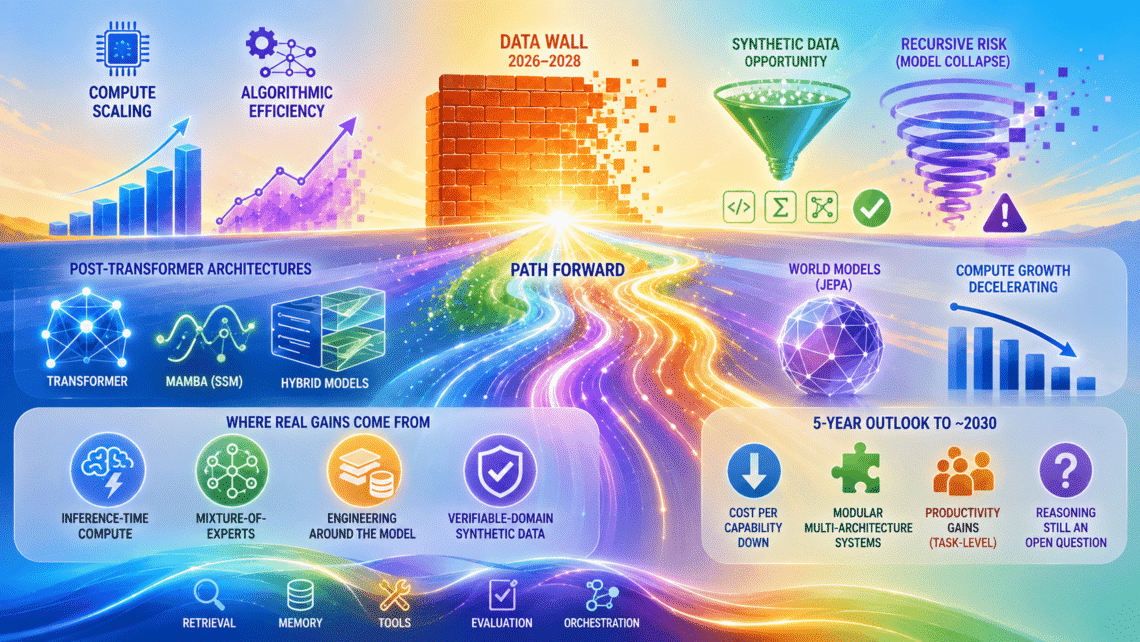
The single most consequential, best-evidenced constraint shaping the future of LLM technology over the next several years is what researchers call the data wall. Epoch AI’s careful analysis estimates the effective stock of high-quality, usable human-generated public text at roughly 300 trillion tokens, adjusted for quality and deduplication. That figure sounds enormous until it is set against actual consumption. GPT-4 was trained on somewhere between 6 and 13 trillion tokens.
A frontier model trained in 2026 using the compute available at facilities such as the Abilene Stargate site, running at roughly 240 tokens per parameter, a ratio pushed considerably higher than the original Chinchilla-optimal 20 tokens per parameter as labs squeeze more value from every available token, would want approximately 400 trillion tokens, a figure that already exceeds the entire unfiltered Common Crawl dataset.
The consensus estimate across multiple independent research groups places genuine exhaustion of easily accessible, high-quality public text somewhere between 2026 and 2028, with Epoch AI’s own analysis suggesting the timeline could compress toward the earlier end of that range if labs continue overtraining smaller models on repeated data passes, a practice already well underway. This is not a distant, speculative constraint. It is arguably the single most binding limitation on the pure scaling paradigm that dominated the first half of LLM development history, and any serious forecast of the future of LLM technology must treat it as a near-term engineering reality rather than a theoretical curiosity.
Synthetic Data: A Real Tool With a Real Failure Mode
The industry’s primary response to the data wall has been synthetic data, using models to generate additional training material rather than relying solely on scraped human text. Adoption has moved considerably faster than even optimistic 2022 forecasts anticipated. Microsoft’s Phi-4 model was trained on 400 billion synthetic tokens spanning fifty distinct dataset types and scored 91.8 percent on AMC math benchmarks, outperforming considerably larger models trained primarily on human text. Nvidia’s 320 million dollar acquisition of Gretel AI signals how seriously infrastructure providers now treat synthetic data generation as core, durable business infrastructure rather than a temporary stopgap.
But synthetic data carries a genuine, well-documented failure mode that any honest forecast of the future of LLM technology must address directly rather than glossing over. Recursive training, using one generation of model output to train the next generation of the same model family without careful filtering, causes measurable model collapse, a progressive narrowing of output diversity and a degradation in the model’s grip on the genuine statistical structure of real-world language and knowledge.
The critical distinction researchers now draw is between replacing human data wholesale, which reliably degrades model quality over successive generations, and accumulating synthetic data as a targeted supplement, filtered and verified specifically for tasks with checkable, verifiable answers such as mathematics, code, and structured reasoning, where synthetic data has shown genuine and repeated success. The future of LLM technology almost certainly depends on this distinction being respected rigorously by every major lab, since the alternative, an AI industry inadvertently training its most important systems on a slowly collapsing diet of recycled AI output, represents a genuinely serious and underappreciated risk.
The Post-Transformer Architecture Race
A second major front shaping the future of LLM technology involves the underlying architecture itself. The Transformer’s core self-attention mechanism, examined extensively elsewhere on this blog, carries a fundamental computational cost, its complexity scales quadratically with sequence length, making extremely long contexts, legal contracts, genomic sequences, entire codebases, computationally expensive in a way that becomes genuinely impractical at scale.
State Space Models, particularly the Mamba architecture and its recent Mamba-3 iteration published in March 2026, address this directly by replacing attention with a mechanism inspired by classical control theory, achieving linear rather than quadratic complexity with respect to sequence length while maintaining an explicit, continuously updated hidden state that functions as a form of persistent memory. Critically, the future of LLM technology is not shaping up as a clean architectural replacement, Mamba entirely displacing Transformers, but rather as convergence toward hybrid designs.
Nvidia’s Nemotron 3 family, released in April 2026, explicitly alternates between standard attention layers and Mamba-2 state space layers within the same model, a design chosen specifically because long-context efficiency has become increasingly critical as more LLMs get embedded into agentic systems that require maintaining and reasoning over increasingly long working contexts. Industry practitioners tracking this shift have been notably measured in their assessment, treating each new architectural release as a practical question, does this change agent loop cost, prompt caching efficiency, or cost per session, rather than as a revolutionary leap, a sober framing worth adopting for any credible forecast.
World Models and the LeCun Bet
A more architecturally radical thread shaping the future of LLM technology comes directly from the reasoning critique examined in Part 1. Yann LeCun’s Joint Embedding Predictive Architecture, JEPA, represents a genuinely different bet, one where the model learns to predict abstract representations of its input rather than predicting raw pixels or tokens one at a time, an approach LeCun argues is dramatically more efficient and more capable of producing something closer to genuine world understanding than token-level autoregressive prediction can achieve. Image and video variants, I-JEPA and V-JEPA, have already shown promising results, and a language-focused variant, LLM-JEPA, began circulating in research circles in September 2025.
Whether JEPA-style world models genuinely displace autoregressive transformers within the forecast window of this article, or remain a productive but secondary research direction, is precisely the kind of question where honest forecasting requires acknowledging genuine uncertainty rather than false confidence.
What seems considerably more likely, based on the pattern already visible in hybrid Transformer-Mamba designs, is that the future of LLM technology converges toward modular, multi-architecture systems, distinct specialized components, efficient long-context backbones, world-model style planning modules, memory-augmented systems capable of accumulating knowledge across interactions, combined deliberately within a single deployed system, rather than any single architecture winning outright and displacing all competitors.
Compute Growth Is Slowing From Its Recent Peak
A frequently overlooked but genuinely important input to any credible forecast of the future of LLM technology is that raw compute growth itself, while still substantial, is decelerating from its most extreme recent trajectory. Detailed compute accounting shows frontier training system capacity increasing roughly 160-fold across four years, or approximately 3.55 times annually, a blistering pace, but one that current chip price-performance trends, improving at roughly 1.39 times annually after inflation adjustment according to Epoch AI, cannot sustain indefinitely without continued, extraordinary capital investment of the kind examined in this blog’s recent five-part series on AI industry economics.
When the data wall constraint, the synthetic data ceiling, and a compute growth trajectory that must eventually moderate are considered together, serious forecasters increasingly anticipate a genuine slowdown in pure pretraining scale gains sometime after 2028, a specific, dated prediction considerably more grounded than vague talk of an approaching technological plateau.
Where the Real Gains Will Actually Come From
If pure pretraining scale is approaching genuine physical and data constraints, where does the future of LLM technology’s next wave of capability improvement actually come from. The evidence assembled across both parts of this series points toward four specific, already-visible directions rather than speculative breakthroughs.
Inference-time compute, examined in Part 1, will almost certainly continue growing as a share of total capability gains, even as its own scaling exhibits the latent saturation trend documented in the 2026 reinforcement learning literature, meaning gains will likely become more expensive to extract even as they continue.
Mixture-of-Experts architectures, which activate only a fraction of total parameters for any given input, will continue to improve the ratio of genuine capability to compute cost, a trend already visible in models like Nemotron 3, which pairs MoE sparsity with hybrid Mamba-Transformer layers specifically to maximize this efficiency.
Engineering built around the model, retrieval systems, persistent memory, tool use, structured evaluation, and orchestration across specialized sub-models, is where practitioners closest to production deployment increasingly locate the genuine, durable competitive advantage, precisely because effortless capability gains purely from scaling a single monolithic model are ending, a conclusion directly consistent with the AI ROI findings from our five-part economics series, where the companies capturing real value were those redesigning workflows around AI rather than simply deploying a bigger model.
And targeted, verifiable-domain synthetic data, mathematics, code, formal logic, structured reasoning, will continue delivering genuine capability gains precisely because these domains allow automated verification of correctness, sidestepping the model collapse risk that makes wholesale synthetic replacement of general text so dangerous.
A Grounded Five-Year Outlook
Bringing the full evidence base from both parts of this series together, a genuinely hype-free forecast for the future of LLM technology through roughly 2030 looks considerably more modest, and considerably more interesting, than either extreme position commonly advanced in public discussion. Costs per unit of capability will very likely continue falling, driven by the well-documented three to four times annual algorithmic efficiency gains established in Part 1, MoE sparsity, and hybrid architecture efficiency, even as headline frontier training runs continue costing more in absolute terms due to sheer scale.
Complexity will increasingly shift from monolithic scale toward modular, multi-architecture systems combining efficient long-context backbones, specialized reasoning modules, and persistent memory, rather than a single architecture simply growing larger indefinitely. Productivity gains will very likely continue showing the pattern documented in Part 1’s rigorous economic research, real and measurable at the task level, but persistently capped by how effectively humans and organizations integrate these tools into actual workflows, a human and organizational bottleneck rather than a purely technical one.
And the deeper question of whether these systems achieve anything resembling genuine human-style reasoning, as opposed to increasingly sophisticated and useful pattern matching, will very likely remain genuinely unresolved throughout this entire forecast window, continuing to divide serious, credible researchers rather than being definitively settled by any single benchmark or model release.
Conclusion
The future of LLM technology, examined honestly and against the specific, quantified evidence assembled across this two-part series, is neither the smooth, inevitable glide path toward artificial general intelligence that some industry marketing suggests, nor the dead end that the most dismissive skeptics predict. It is something more specific, more constrained, and ultimately more useful to understand precisely, a technology approaching genuine, well-documented physical and data limits on its original scaling paradigm, responding with real, measurable, but imperfect engineering solutions, synthetic data, architectural hybridization, inference-time reasoning, that each carry their own specific tradeoffs and failure modes.
Whether that combination proves sufficient to sustain the pace of capability improvement the public has grown accustomed to watching since 2020, or whether the field genuinely decelerates as several credible forecasts now anticipate sometime after 2028, is a question this series cannot resolve definitively today. What it can offer, and what the marketing narrative surrounding this technology so rarely does, is a precise, evidence-grounded account of exactly which forces will determine that answer, and why.
This concludes our two-part series on LLM development history and the future of LLM technology. Explore Part 1 for the full account of the past decade.