The Powerful Chinese AI Strategy: How a Nation Turned Restriction Into Resolve (Part 1)
This is Part 1 of a three-part series examining Chinese AI development from a genuinely Chinese vantage point. Part 1 traces the origins of the Chinese AI strategy, the philosophical shift from ambition to self-reliance, and the export control regime that reshaped everything. Part 2 will examine the specific companies, labs, and scientists who executed this strategy. Part 3 will look at where China is heading over the next five to ten years.
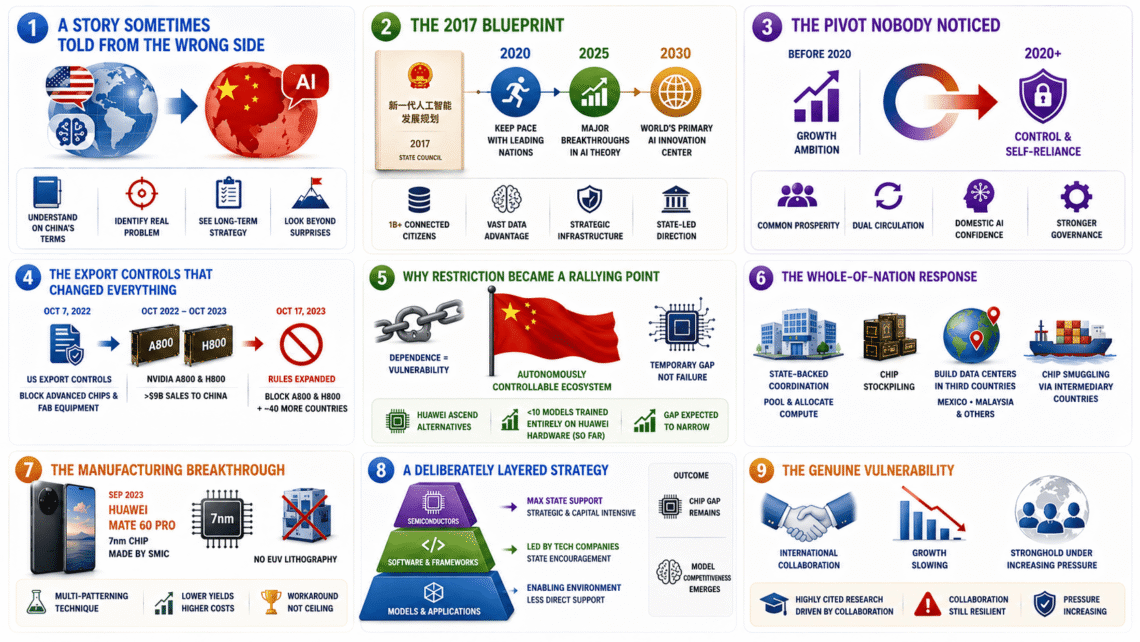
A Story Sometimes Told From the Wrong Side
Most coverage of Chinese AI treats it as a reaction to American innovation. DeepSeek gets framed as a surprise. Huawei’s chips get framed as a workaround. This series takes a different approach. It asks how China itself understands this journey, what problem its leaders believe they are actually solving, and why the country’s AI strategy looks the way it does today. Understanding the Chinese AI strategy on its own terms requires starting well before DeepSeek existed, well before ChatGPT existed, in a 2017 policy document that set the entire direction in motion.
The 2017 Blueprint
On July 20, 2017, China’s State Council released the New Generation AI Development Plan. This document remains the foundational text of the Chinese AI strategy even today. It set an explicit, three-stage timeline. By 2020, China would keep pace with the world’s leading AI nations. By 2025, China would achieve major breakthroughs in basic AI theory. By 2030, China would become the world’s primary AI innovation center.
This was not modest language. It reflected genuine confidence at the time. China had just watched its own companies build enormous consumer internet platforms. It had access to vast amounts of data from over a billion connected citizens. Its leadership believed AI represented a genuine opportunity to leapfrog decades of technological dependence on the West.
The plan also carried a specific ideological framing that matters for understanding everything that followed. AI was treated as strategic infrastructure, comparable to energy or transportation networks, not simply a commercial technology sector left to market forces alone.
The Pivot Nobody in the West Fully Noticed
Something changed inside the Chinese AI strategy around 2020, and most Western commentary missed it entirely. The Carnegie Endowment’s research on this period describes a dramatic shift in the policy ecosystem, moving from pure growth ambition toward hardline control and self-reliance. Several forces converged at once. Xi Jinping’s Common Prosperity campaign targeted tech wealth inequality directly. The Dual Circulation strategy pushed for greater domestic self-sufficiency across the entire economy. And China’s own confidence in its domestic AI capabilities had grown enough that regulators felt they could tighten oversight without derailing progress.
This pivot mattered enormously for the Chinese AI strategy going forward. It meant the government was no longer simply cheering AI development from the sidelines. It was actively steering which companies grew, which research directions received funding, and how tightly the sector would align with broader national goals. Self-reliance stopped being an aspiration. It became policy.
The Export Controls That Changed Everything
If one single external event reshaped the Chinese AI strategy more than any other, it was the United States’ semiconductor export control regime, and the timeline here deserves careful attention because most accounts compress it into a single moment. It was not one moment. It was a multi-year escalation.
On October 7, 2022, the Bureau of Industry and Security introduced the broadest semiconductor export control rule in its history. It blocked China from acquiring advanced computing chips above a specific performance threshold. It also barred the sale of the fabrication equipment needed to manufacture cutting-edge logic chips domestically.
Nvidia responded quickly. It engineered the A800 and H800, chips deliberately designed to sit just below the new threshold while still delivering strong AI performance. For roughly a year, these chips sold to China legally and in large volume. Nvidia’s own disclosed sales to China between October 2022 and October 2023 exceeded nine billion dollars.
Then, on October 17, 2023, Washington closed that gap. New rules blocked the A800 and H800 outright. They also expanded licensing requirements to roughly forty additional countries considered at risk of diverting chips into China through third parties.
Why Restriction Became a Rallying Point, Not a Dead End
Here is where the Chinese AI strategy diverges sharply from how it is often portrayed abroad. Western commentary frequently treats export controls as a technology-denial success story. Chinese policymakers and engineers describe the same events very differently. They describe a forcing function.
At an April 2025 Politburo meeting focused specifically on AI, Xi Jinping emphasized self-reliance again, this time calling for a fully “autonomously controllable” AI hardware and software ecosystem. This was not defensive language. It was framed as strategic clarity. If foreign chips could be restricted at any moment for political reasons, then dependence on them was itself a vulnerability, regardless of how capable those chips were.
This reframing runs through nearly every major Chinese AI institution today. Domestic chip alternatives such as Huawei’s Ascend series still lag behind Nvidia’s most advanced offerings in raw performance. But the Chinese AI strategy treats this gap as a temporary cost of building genuine independence, not as evidence of failure. Fewer than ten major models have been trained entirely on Huawei hardware so far. That number is expected to grow steadily rather than remain static.
The Whole-of-Nation Response
China’s answer to compute scarcity has been genuinely distinctive, and it reveals something important about how the Chinese AI strategy actually operates in practice. Rather than leaving individual companies to solve the chip shortage independently, the state has organized a coordinated, infrastructure-level response.
State-backed institutions such as the Peng Cheng Laboratory have taken on a coordinating role, pooling scarce computing resources so they can be allocated more efficiently across competing research priorities. This is a genuinely different model from the market-driven compute allocation that characterizes AI development in the United States. It reflects a belief, deeply embedded in the Chinese AI strategy, that scarce strategic resources should be centrally coordinated rather than left purely to whichever company can outbid its rivals.
Chinese firms have also pursued more improvised responses alongside this coordinated approach. Chip stockpiling accelerated sharply as export controls tightened. Companies built data centers in third countries, from Mexico to Malaysia, specifically to access compute capacity that direct import restrictions made unavailable domestically. And reporting has documented cases of chip smuggling through intermediary countries, though the scale of this activity remains genuinely difficult to verify independently.
The Manufacturing Breakthrough That Surprised Everyone
One moment deserves particular attention within this broader story, because it captures the spirit animating the Chinese AI strategy at the hardware level. In September 2023, Huawei released the Mate 60 Pro smartphone. It contained a seven-nanometer processor manufactured domestically by SMIC, well below the fourteen-nanometer threshold that export controls had assumed China could not meaningfully surpass without access to the most advanced lithography equipment.
SMIC achieved this without access to extreme ultraviolet lithography machines, the tool most experts considered essential for producing chips at this density. Instead, it used a technique called multi-patterning, layering older deep ultraviolet equipment through multiple passes to approximate results that would normally require newer tools. It was inefficient. Yields were lower than a modern EUV-based process would achieve. But it worked, and it worked well enough to genuinely surprise policymakers in Washington who had assumed this threshold was years further away for China.
This episode has become something close to a founding parable within the Chinese AI strategy circles. It is cited repeatedly as evidence that resource constraints, applied with sufficient state backing and engineering persistence, produce workarounds rather than permanent ceilings.
A Deliberately Layered Strategy
Perhaps the most sophisticated element of the Chinese AI strategy, and the one least understood outside the country, is how differently the government treats each layer of the AI technology stack. Research from the Mercator Institute for China Studies identifies this layering precisely. The most intensive state support goes to semiconductors, the most capital-intensive and strategically sensitive layer. Software frameworks and indigenization efforts are largely entrusted to major domestic technology companies, with state encouragement but less direct funding. AI models and applications, the layer where China has actually produced its most globally visible results, receive an enabling regulatory environment but comparatively less direct government support.
This layered approach reflects a specific philosophy. The Chinese AI strategy treats the semiconductor layer as an existential vulnerability requiring maximum state intervention. It treats the model and application layer as an area where Chinese companies can compete effectively on their own, provided the state simply avoids getting in the way. This distinction explains a pattern that often confuses Western observers: China’s chip industry remains years behind Nvidia, while its best language models compete credibly with American frontier systems. These are not contradictory outcomes within the Chinese AI strategy. They are the predictable result of two deliberately different resource allocation decisions.
The Genuine Vulnerability Beneath the Confidence
It would be inaccurate to present the Chinese AI strategy as a story of uninterrupted, confident execution. Genuine strain exists beneath the surface, and Chinese researchers themselves acknowledge it. AI and machine learning research has historically thrived on international collaboration. A considerable share of China’s most highly cited AI research has come from direct collaboration with American researchers, not from purely domestic efforts. That collaboration remains resilient even now, but it is no longer growing at the pace it did before 2020.
This creates a genuine tension inside the Chinese AI strategy that has not been fully resolved. Self-reliance is the stated goal. But cutting-edge research has never developed well in isolation, and Chinese policymakers know this as well as anyone. The strategy, as it stands today, tries to hold two things simultaneously: building independent domestic capability at every layer of the stack, while still preserving whatever international research connections remain politically viable. Whether that balance can hold over the next decade is one of the central open questions this series will return to directly in Part 3.
Conclusion to Part 1
The Chinese AI strategy did not begin as a response to DeepSeek’s headlines or to American export controls. It began in 2017 with genuine national ambition, then hardened through 2020 into something closer to strategic doctrine, and finally crystallized after 2022 into a specific, layered, state-coordinated response to deliberate technological restriction. What Western coverage frequently frames as constraint, Chinese policy documents and leadership statements consistently frame as clarification. The chip restrictions did not derail the plan. They sharpened it.
Part 2 of this series turns from this strategic and historical foundation toward the people and institutions actually executing it: the scientists, the companies, and the specific technical choices that turned the Chinese AI strategy from a policy document into working systems competing directly with the best models the rest of the world can produce.
Part 2: The Scientists, Companies, and Institutions Building China’s AI Future, coming next in the Current Events series.


You May Also Like
Google’s Powerful Gemini 3.6 Flash: 5 Ways It Is Transforming Enterprise AI Compute Costs
The Critical Economics of AI Data Centers: A Breakdown of Cost, ROI, and Lifecycle Risk