The Powerful Rise of Chinese AI Companies: Six Tigers, Four Dragons, and a New World Order (Part 2)
This is Part 2 of a three-part series examining Chinese AI development from a genuinely Chinese vantage point. Part 1 traced the origins of China’s AI strategy and the export control era that reshaped it. Part 2 introduces the specific scientists, labs, and companies executing that strategy. Part 3 will look at where China is heading over the next five to ten years.
A Landscape Too Complex for One Headline
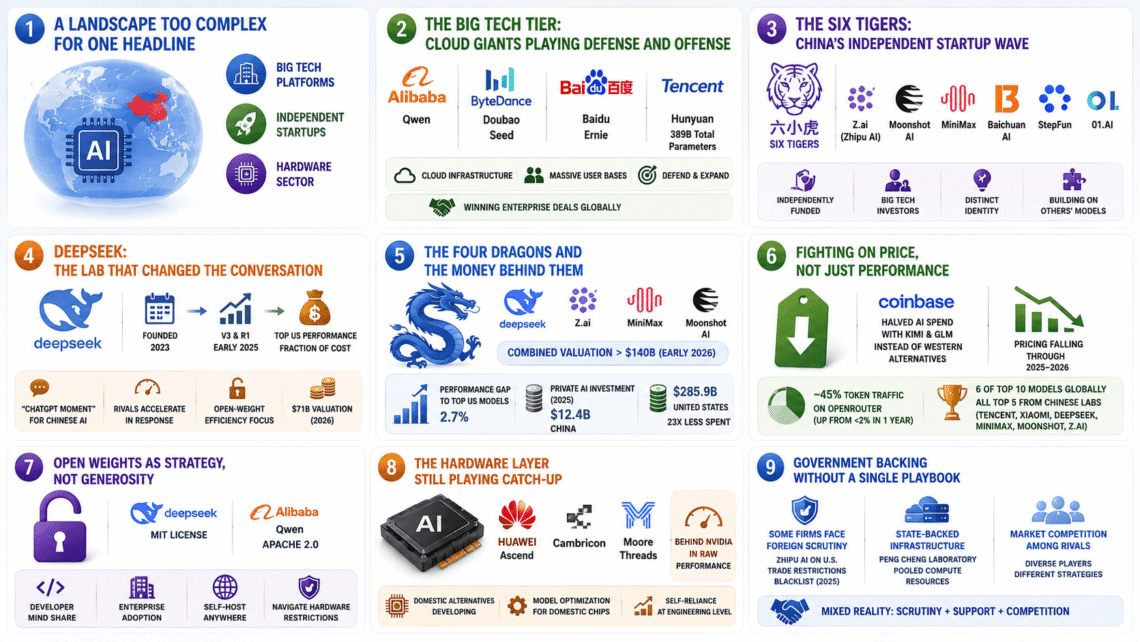
Western coverage often collapses Chinese AI into a single word: DeepSeek. That framing misses the real story. Chinese AI companies today form a layered, competitive ecosystem spanning giant technology platforms, a cluster of fiercely independent startups, and a fast-moving hardware sector trying to catch up on chips. Understanding this ecosystem means understanding how differently each layer behaves, and why.
The Big Tech Tier: Cloud Giants Playing Defense and Offense
At the top sit four companies most people already recognize by name. Alibaba runs the Qwen family, now released under the permissive Apache 2.0 license. Its top model, Qwen 2.5-Max, claims performance ahead of DeepSeek-V3 on several benchmarks. ByteDance builds Doubao and Seed. Baidu offers Ernie. Tencent runs Hunyuan, an open-source model with 389 billion total parameters.
These four companies share something important. Each already commands enormous cloud infrastructure and enormous existing user bases. For them, AI is not a bet on a new market. It is a defense of an existing one, and a genuine chance to extend it. Airbnb CEO Brian Chesky said his company uses Alibaba’s Qwen for customer service, a real signal that Chinese AI companies are winning enterprise deals outside China itself.
The Six Tigers: China’s Independent Startup Wave
Below the big tech tier sits a group Chinese media calls the Six Tigers,六小虎. These are independently funded startups, not subsidiaries of existing giants, though several count big tech firms among their investors. The group includes Zhipu AI, Moonshot AI, MiniMax, Baichuan, StepFun, and 01.AI.
Each has carved out a distinct identity. Zhipu AI, now operating as Z.ai, built the GLM model family and went public in Hong Kong in 2026. Moonshot AI built Kimi, and Cursor’s own coding startup has confirmed that Kimi provided the technical foundation for its Composer 2 model. MiniMax also completed a Hong Kong listing in 2026. And 01.AI made a striking strategic pivot. Rather than continuing to train its own frontier models, it now fine-tunes open-weight models from DeepSeek, Alibaba, and Zhipu into enterprise infrastructure products, positioning itself as something close to “China’s Palantir.”
This pivot matters. It shows that not every one of the Six Tigers believes it must win the raw model race. Some have decided the smarter fight is building products on top of models other Chinese AI companies have already released.
DeepSeek: The Lab That Changed the Conversation
DeepSeek deserves its own section, not because it represents all Chinese AI companies, but because its story genuinely reshaped how the world thinks about the entire sector. Founded in 2023 and based in Hangzhou, DeepSeek grew out of a Chinese hedge fund rather than a typical venture-backed startup path. In early 2025, it released V3 and R1, models that matched leading US systems in benchmark performance, built at a fraction of the disclosed training cost.
The effect was immediate. Reports describe this moment as a genuine “ChatGPT moment” for Chinese Chinese AI companies broadly, not just for DeepSeek itself. Alibaba and Baidu both accelerated their own model development in direct response. DeepSeek itself has stayed distinctive since, prioritizing open-weight efficiency over building consumer-facing apps, a genuinely different posture from most of its rivals. By 2026, DeepSeek was reportedly raising its first outside funding round at a 71 billion dollar valuation.
The Four Dragons and the Money Behind Them
A newer investor label has emerged to describe the four most highly valued independent Chinese AI companies: DeepSeek, Zhipu, MiniMax, and Moonshot, together called the Four Dragons, 四小龙. Their combined valuations reportedly exceeded 140 billion dollars by early 2026.
The capital efficiency story here is genuinely remarkable, and it deserves attention on its own terms. The Stanford HAI AI Index 2026 found that the performance gap between top US and Chinese models had collapsed to just 2.7 percent. China achieved this while spending roughly 23 times less on private AI investment than the United States, 12.4 billion dollars compared to 285.9 billion dollars in 2025 alone. This single statistic captures something central to how Chinese AI companies operate. They have learned to extract more capability per dollar spent, a direct consequence of the compute scarcity examined in Part 1 of this series.
Fighting on Price, Not Just Performance
One competitive weapon has proven especially effective for Chinese AI companies: aggressive pricing. Coinbase CEO Brian Armstrong publicly explained how his company halved its total AI spending simply by shifting employees toward Kimi and Z.ai’s GLM models instead of Western alternatives. This is not an isolated anecdote. Pricing across the sector has fallen sharply through 2025 and 2026, and Chinese labs have made cost efficiency a core part of their competitive identity, not an afterthought.
The scale of adoption this pricing strategy has produced is significant. Chinese models now account for roughly 45 percent of token traffic on OpenRouter, a major model routing platform, up from under 2 percent just a year earlier. At one point in mid-2026, six of the top ten most-used models globally, and all of the top five, came from Chinese Chinese AI companies: Tencent, Xiaomi, DeepSeek, MiniMax, Moonshot, and Z.ai.
Open Weights as Strategy, Not Generosity
A pattern runs consistently through nearly every major Chinese lab. DeepSeek releases under the MIT license. Qwen uses Apache 2.0. Both are genuinely permissive. This is not simply goodwill toward the developer community. It is a deliberate strategic choice.
Open weights let Chinese AI companies compete for developer mindshare and enterprise adoption without needing the massive proprietary API business models that dominate in the West. They also directly address the geopolitical hardware constraints traced in Part 1 of this series. A model released openly can be self-hosted anywhere, on any available hardware, sidestepping some of the export control friction that closed, cloud-only products would face more directly.
The Hardware Layer Still Playing Catch-Up
While Chinese AI companies at the model layer now compete credibly with the best in the world, the hardware layer underneath tells a more complicated story. Huawei’s Ascend chip stack remains the most prominent domestic alternative to Nvidia, alongside newer entrants like Cambricon and Moore Threads. These chips still lag Nvidia’s most advanced offerings in raw performance.
But the direction of travel matters here. Companies increasingly build models specifically optimized to run on domestic hardware, rather than treating it as a fallback option only. This reflects the same self-reliance philosophy Part 1 of this series traced back to 2017, now operating at the level of individual company engineering decisions rather than only national policy.
Government Backing Without a Single Playbook
It would be a mistake to imagine Chinese AI companies as simply state-directed extensions of government policy. The reality is more textured. Government backing takes different forms depending on the company and the layer of the stack involved.
Some firms have faced direct friction with foreign governments over alleged state ties. Zhipu AI was added to a US Commerce Department trade restrictions blacklist in early 2025, a designation the company has denied justifying on national security grounds. Meanwhile, state-backed institutions such as the Peng Cheng Laboratory, discussed in Part 1, provide pooled computing resources that any qualifying lab can draw on, a form of infrastructure support that benefits the wider ecosystem without picking individual corporate winners.
This mixed picture, some direct scrutiny, some infrastructure support, some genuine market competition between rival Chinese AI companies, is closer to the real texture of the sector than a simple narrative of top-down state control would suggest.
Conclusion to Part 2
Chinese AI companies today form a genuinely competitive, internally diverse ecosystem. Big tech platforms defend existing empires. The Six Tigers and Four Dragons fight for developer mindshare through open weights and aggressive pricing. DeepSeek reshaped global perception of what Chinese labs could achieve on a fraction of Western budgets. And a hardware sector still trails behind, even as it becomes increasingly central to the models being built on top of it.
Part 3 of this series turns to where this ecosystem is heading. It will examine China’s five to ten year outlook, the philosophy guiding its next strategic moves, and whether the capital efficiency this generation of Chinese AI companies has demonstrated can be sustained as the competition intensifies further.
Part 3: China’s Next Decade in AI, coming next in the Current Events series.


You May Also Like
The Critical Economics of AI Data Centers: A Breakdown of Cost, ROI, and Lifecycle Risk
The Powerful Rise of Agentic AI: Tracing Its Origins and Explosive Emergence (Part 1)