
The RAD Coding Technique That Astonishingly Predicted Vibe Coding 40 Years Before It Existed
An Old Idea Wearing a New Costume
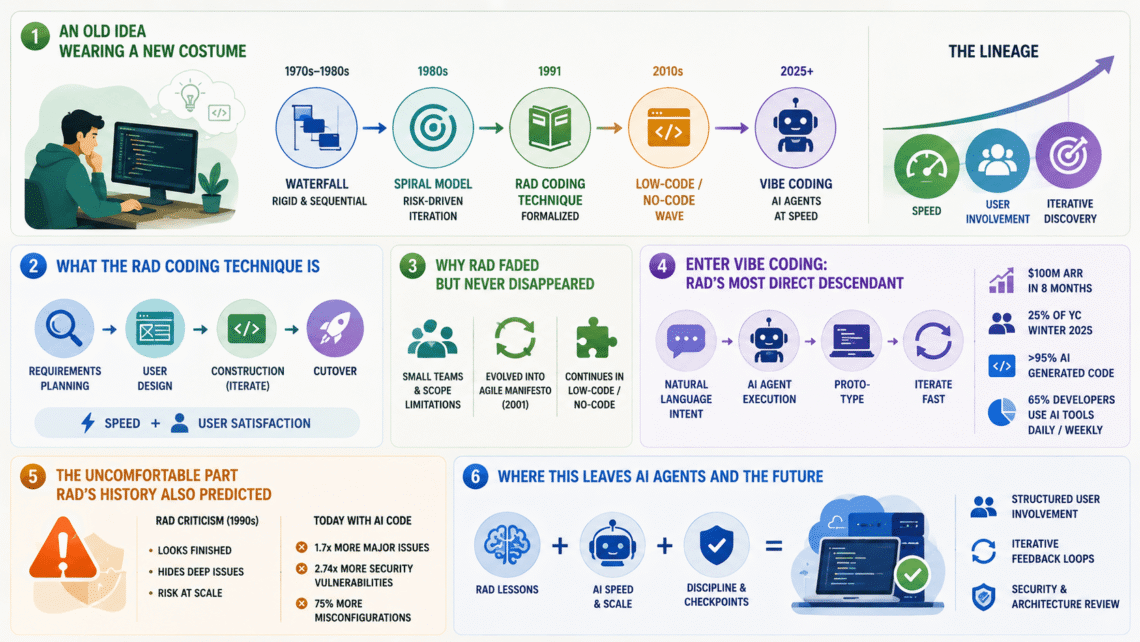
Every generation of software developers tends to believe its most disruptive innovation arrived from nowhere. Vibe coding, the practice of describing intent in natural language and letting an AI agent handle the execution, feels genuinely new, and in its literal mechanics it is. But the underlying philosophy driving it, prototype fast, involve the user immediately, treat requirements as something discovered through iteration rather than specified perfectly in advance, is considerably older than the transformer architecture powering today’s coding agents.
It is the RAD coding technique, formalized in 1991, and understanding its history is the fastest way to understand exactly what today’s AI coding tools are actually doing, and why they are succeeding and failing in precisely the ways their forty-year-old ancestor predicted they would.
What the RAD Coding Technique Actually Is
Rapid Application Development, the formal name behind the RAD coding technique, is a software development methodology that prioritizes speed and iterative prototyping over extensive upfront planning. Rather than producing a massive requirements document before writing a single line of code, RAD teams build a working prototype almost immediately, put it in front of real users, gather feedback, and refine the software through repeated, tight cycles rather than one long linear sequence.
James Martin, the British IT consultant who formalized the methodology, defined it precisely as a development lifecycle designed to give much faster development and higher quality results than those achieved with the traditional lifecycle, built on two governing priorities, speed and user satisfaction, which he treated as inseparable rather than competing goals.
The classic RAD lifecycle divides into four phases, requirements planning kept intentionally lightweight, user design built around clickable prototypes and mockups rather than written specifications, construction where developers and users work side by side refining the actual application, and cutover, the final transition into production.
What distinguishes this from earlier approaches is not any single phase but the underlying assumption running through all four, that users often do not know exactly what they want until they see it in front of them, and that gathering this knowledge in real time during development, rather than trying to extract it perfectly through upfront interviews, produces genuinely better software.
The Origin Story: A Rebellion Against Waterfall
The RAD coding technique did not emerge in a vacuum. It was a direct rebellion against the rigid, sequential Waterfall model that dominated software engineering through the 1970s and 1980s, a process in which requirements were gathered exhaustively, design was completed entirely, then coding began, then testing, each phase strictly sequential and rarely revisited. The fundamental flaw in this approach became painfully obvious to practitioners across the industry, by the time a product finally launched after months or years of Waterfall development, the business requirements that shaped its original design had frequently already changed, sometimes rendering the finished product obsolete before its first user ever touched it.
Barry Boehm and James Martin, both working at IBM in the 1980s, approached this frustration from complementary angles. Boehm’s Spiral model introduced a risk-driven, iterative process blending elements of prototyping and incremental development, each cycle focused on identifying risk, building a prototype, gathering feedback, and refining. Martin drew on his own earlier technique, Rapid Iterative Production Prototyping, and formalized the resulting synthesis in his landmark 1991 book, Rapid Application Development.
It was a book that brought the RAD coding technique fully into mainstream enterprise IT practice for the first time. The timing mattered considerably. Fourth generation languages and early visual programming environments had just made fast, genuine prototyping practically achievable for the first time, giving Martin’s philosophical argument a concrete technical foundation to stand on.
Why RAD Faded, and Why It Never Actually Disappeared
The RAD coding technique’s initial wave of enterprise adoption eventually gave way to a broader, more general philosophical successor. Some of RAD’s specific limitations, particularly its assumption of small, co-located teams and well-scoped, contained projects, contributed directly to the emergence of the Agile Manifesto in 2001, a considerably broader set of principles that absorbed RAD’s core iterative spirit while generalizing it into frameworks including Scrum, Kanban, and Extreme Programming, suitable for teams and projects RAD’s original formulation had not anticipated.
But the RAD coding technique itself never genuinely vanished. It persisted quietly through the low-code and no-code platform wave of the 2010s and early 2020s, tools that let non-programmers assemble working applications visually rather than through hand-written code, a direct technical descendant of RAD’s original insistence that speed and user involvement should take precedence over exhaustive upfront specification. What has happened through 2025 and 2026 is not RAD being replaced. It is RAD’s founding philosophy meeting a technology capable of executing it at a speed and scale James Martin himself could not have imagined in 1991.
Enter Vibe Coding: RAD’s Most Direct Descendant
The term vibe coding was coined by Andrej Karpathy, OpenAI cofounder and former Tesla AI director, in February 2025, to describe a workflow where developers describe their intent in natural language and AI agents handle the actual execution. Collins Dictionary subsequently named it the 2025 Word of the Year, a genuinely rare honor for a software engineering term, reflecting how thoroughly the concept had penetrated mainstream awareness within a single year of being coined.
Read against the history of the RAD coding technique, vibe coding is not a genuinely new philosophy at all. It is RAD’s four-phase lifecycle collapsed into something approaching real time. Where a 1990s RAD team needed days to build a clickable prototype and gather structured user feedback on it, a developer using an AI coding agent today can generate a working prototype from a natural language description in minutes, show it to a stakeholder, and iterate again before the original RAD workshop would have even finished its first requirements planning session.
The specific constraints that originally limited how fast RAD could actually move, developers still had to write every line of code by hand, prototyping remained genuinely expensive in time and specialist labor, and user feedback loops were slow because scheduling and running structured workshops took real calendar time, have each been dramatically reduced by two converging forces, mature AI-assisted development tools and low-code and no-code platforms working in tandem.
The adoption numbers bear this acceleration out concretely. Lovable, an AI-native application builder built explicitly around this compressed prototype-and-iterate loop, reached 100 million dollars in annual recurring revenue within just eight months of launch. Twenty five percent of Y Combinator’s Winter 2025 startup batch built their companies with over 95 percent AI-generated code. The 2025 Stack Overflow Developer Survey found that 65 percent of professional developers now use AI coding tools daily or weekly, a genuinely mainstream adoption curve for a workflow pattern that, viewed through the lens of the RAD coding technique’s own history, is simply the latest and fastest implementation of an idea that has been circulating in serious software engineering discourse since the 1980s.
The Uncomfortable Part RAD’s History Also Predicted
Here is where tracing the RAD coding technique’s history genuinely earns its keep, rather than serving merely as an interesting footnote. RAD was never a methodology without real, well-documented tradeoffs, and its critics identified specific weaknesses decades before vibe coding existed to inherit them. RAD’s speed-first philosophy, critics noted consistently through the 1990s, could produce prototypes that looked finished and polished to a non-technical stakeholder while concealing serious underlying architectural, security, and scalability problems that only became visible once the software reached genuine production scale and real-world load.
That exact criticism is now playing out with AI-generated code, measured with a precision James Martin’s contemporaries could never have achieved. Current 2026 data on AI-assisted development finds that AI co-authored code contains approximately 1.7 times more major issues compared to human-written code, with security vulnerabilities appearing 2.74 times more frequently and misconfigurations 75 percent more common. This is not a new failure mode invented by large language models. It is the RAD coding technique’s oldest and best-documented weakness, the gap between a prototype that looks convincingly finished and a system that is genuinely production-ready, now operating at a speed and scale that makes the gap considerably easier to fall into and considerably harder to notice before real damage occurs.
Where This Leaves AI Agents and the Future of the Discipline
The most theoretically interesting development in this lineage is happening right now, as researchers work to formalize what a genuinely disciplined successor to pure vibe coding should actually look like, explicitly drawing on RAD’s own historical lessons rather than abandoning them. Recent academic proposals, including frameworks with names like Interactive Adversarial Convergence Development Methodology, explicitly position themselves as structured responses to what their authors call the vibe coding phenomenon and its limits.
They argue that AI-assisted development needs something functionally equivalent to RAD’s original discipline, structured user involvement, iterative feedback genuinely built into the process rather than skipped, and deliberate checkpoints for security and architectural review, layered back on top of AI coding agents’ raw generative speed, rather than treating unconstrained natural language prompting as sufficient on its own.
This is, in a genuinely direct sense, history repeating itself with new tools. The RAD coding technique existed specifically because pure Waterfall planning was too slow and too disconnected from real user needs. Pure vibe coding is now revealing exactly why RAD itself was never simply speed for its own sake, but speed paired deliberately with structured, disciplined feedback loops, and the current wave of AI agent development methodology research is essentially rediscovering, refining, and re-applying that exact same lesson, compressed into a considerably faster and more automated form than James Martin could have designed for in 1991.
Conclusion
The RAD coding technique is not a historical curiosity confined to software engineering textbooks. It is the direct conceptual ancestor of vibe coding, AI-native development platforms, and the emerging generation of coding agents currently reshaping how software gets built. Its core insight, that speed and genuine user involvement are not competing priorities but mutually reinforcing ones, has proven durable across four decades and three entirely different generations of enabling technology, fourth generation languages, low-code platforms, and now large language models capable of generating working code from a plain English description.
Its core weakness, the gap between an impressively fast prototype and a genuinely production-ready system, has proven equally durable, and understanding that this specific failure mode is not new to AI coding at all, but is instead the oldest known risk of the entire RAD lineage, is precisely the kind of historical grounding that helps separate genuine engineering discipline from mere hype as the industry works out what a mature, trustworthy version of AI-assisted software development actually looks like.


You May Also Like
The ARC AGI Benchmark: 2 Powerful Tests Exposing AI’s Real Reasoning Gap
The Critical Future of LLM Technology: A Hype-Free Forecast for the Next Five Years (Part 2)