Google’s Powerful Gemma 4 Model: 5 Critical Reasons It Is Reshaping the Open-Source AI Landscape
A Release That Rewrote the Competitive Map
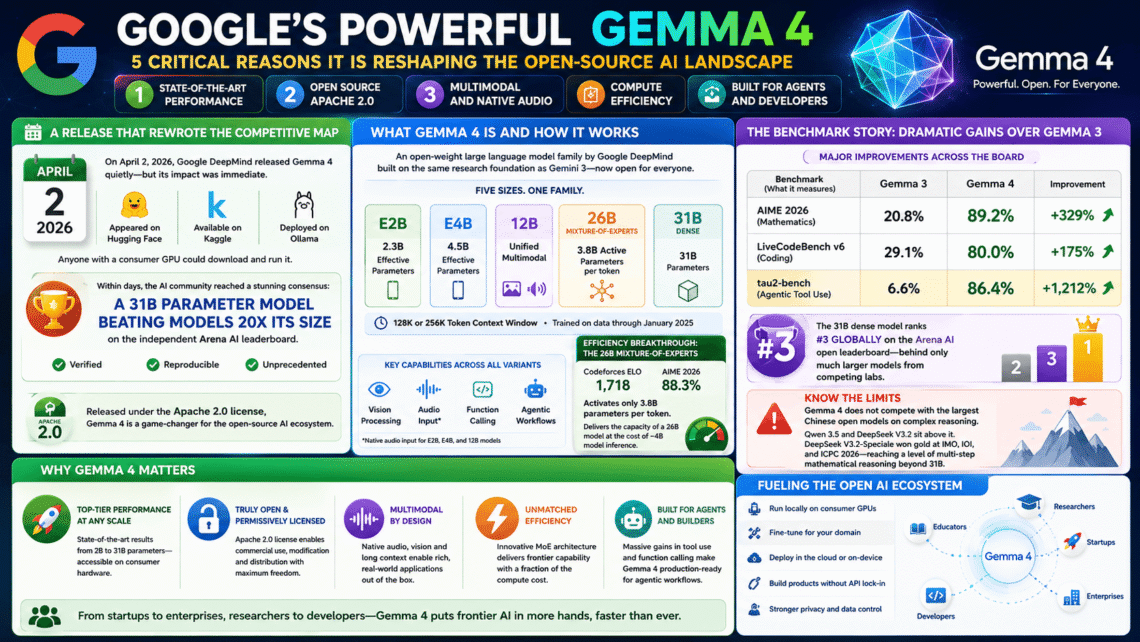
On April 2, 2026, Google DeepMind released Gemma 4 with no dramatic announcement event and no breathless product keynote. The model appeared on Hugging Face, Kaggle, and Ollama simultaneously, available for immediate download by anyone with a consumer GPU. Within days, the AI community had run every benchmark in the standard suite and reached a consensus that few had anticipated: a 31-billion parameter model beating models 20 times its size on the independent Arena AI leaderboard. That result is verified, reproducible, and the starting point for understanding why Gemma 4 is one of the most strategically significant AI releases of the year.
Google has released Gemma 4 under the Apache 2.0 license, and it threatens to upend the competitive dynamics of the open-source AI market. The performance story is impressive. The licensing story is transformative. And the strategic story, about what Google is actually doing and why, is the one that deserves the most careful attention.
What Gemma 4 Is and How It Works
Gemma 4 is an open-weight large language model family built by Google DeepMind, released April 2, 2026, under the Apache 2.0 license. The model comes in five sizes: E2B (2.3B effective parameters), E4B (4.5B effective), 12B unified multimodal, 26B Mixture-of-Experts with 3.8B active parameters per token, and 31B dense. All variants support a 128K or 256K token context window and are trained on data through January 2025.
Gemma 4 is built from the same research foundation as Google’s proprietary Gemini 3 models, but packaged for open distribution. The architectural choices deserve examination. The 26B Mixture-of-Experts variant is particularly notable from an efficiency standpoint: it achieves a Codeforces ELO of 1,718 and an AIME 2026 score of 88.3% while activating only 3.8 billion parameters per token, making it one of the most compute-efficient capable models ever released publicly. This means the model draws on the representational capacity of 26 billion parameters while performing inference at the cost of a roughly 4B model, a combination that was not practically achievable in open-weight models before this release.
All variants natively support audio input for E2B, E4B, and 12B models, vision processing for all variants, and function calling for agentic workflows. The addition of native audio input to edge-scale models is a meaningful advance: it enables voice AI on mobile devices without a separate speech-to-text preprocessing pipeline, which reduces latency and eliminates a common point of failure in on-device agent architectures.
The Benchmark Story: Dramatic Gains Over Gemma 3
The performance improvements from Gemma 3 to Gemma 4 are not incremental. Gemma 4 shows dramatic gains over Gemma 3: math jumped from 20.8% to 89.2% on AIME 2026, coding from 29.1% to 80.0% on LiveCodeBench v6, and agentic tool use from 6.6% to 86.4% on the tau2-bench benchmark.
That last figure deserves particular attention for anyone building production AI agents. The tau2-bench benchmark measures agentic tool use: the model’s ability to execute multi-step workflows involving tool calls, error handling, and sequential decision-making under uncertainty. Moving from 6.6% to 86.4% on this benchmark represents a qualitative shift, not a quantitative improvement. Gemma 3 was essentially not viable for serious agentic deployment. Gemma 4 is.
The 31B dense model ranks number three globally on the Arena AI open leaderboard, behind only much larger models from competing labs. For context: achieving a top-three position on Arena AI while fitting on a single consumer GPU is, as of this writing, unprecedented.
Gemma 4 is not without limitations. It does not compete with the largest Chinese open models on complex reasoning. Qwen 3.5 and DeepSeek V3.2 sit above it, and DeepSeek V3.2-Speciale took gold at IMO, IOI, and ICPC 2026, a level of multi-step mathematical reasoning that Gemma 4 at 31B cannot match. For enterprises with serious mathematical reasoning requirements at the frontier level, the competitive picture is more nuanced than the headline benchmarks suggest.
The Apache 2.0 Decision: The Most Consequential Part of the Release
On April 2, 2026, Google DeepMind released Gemma 4 under the Apache 2.0 license. This licensing decision, not the model’s benchmark scores, is the most consequential development in the enterprise AI landscape this quarter.
Previous Gemma releases used a custom Google licence that created legal ambiguity for commercial deployments. The shift positions Google more aggressively against Meta’s Llama and Mistral’s open offerings in the intensifying competition for enterprise AI adoption. According to Ars Technica AI, the licensing change represents Google’s most significant strategic pivot in its open model programme since launching Gemma in February 2024.
The practical consequences for enterprise legal teams are significant. Apache 2.0 provides commercial freedom to use Gemma 4 in any commercial product without royalties or licensing fees, no usage caps unlike some model licenses that restrict usage above certain revenue thresholds, and explicit patent grants protecting users from patent litigation. Llama 4, by contrast, restricts products serving more than 700 million monthly active users and requires “Built with Llama” branding. For large enterprises and cloud providers, this creates potential legal exposure that Gemma 4 entirely avoids.
Financial services firms with data residency rules, healthcare organisations under HIPAA, government agencies with sovereignty requirements, and defence contractors operating air-gapped environments now have a commercially unrestricted, locally deployable model that approaches frontier performance, an option that did not exist 30 days before the release.
Google’s Strategic Logic: The Platform Play
The most analytically interesting question about Gemma 4 is not what it can do but why Google released it. This signals Google’s commitment to compete in open-source despite owning proprietary models. The answer reveals Google’s vendor strategy: release open-source models so broadly that if a customer doesn’t adopt proprietary Gemini, they’re still using Google-derived technology. This is not new to Google — they do this with Chrome, Android, and Kubernetes — but it’s new for AI.
More than three-quarters of companies reported using two or more LLM families, including a mix of closed and open-source models, according to a 2026 Databricks report. Google’s calculus is that the enterprise AI market will increasingly be a multi-model environment, and that having Gemma 4 embedded in that environment, whether or not the enterprise is using Gemini’s paid API, keeps Google’s technology at the centre of the ecosystem and generates data, talent, and community investment that feeds back into future model development.
The Gemmaverse, Google’s term for the ecosystem of community-built Gemma derivatives, is the largest open-model derivative ecosystem ever created, with over 100,000 community-built variants across previous generations. Gemma 4’s Apache 2.0 licence directly accelerates this ecosystem by removing every commercial barrier to building derivative products, fine-tuned variants, and embedded applications on top of the base model.
Enterprise Implications: A Practical Assessment
For enterprise AI teams evaluating Gemma 4, the decision framework is clearer than it has been for any previous open-weight release.
Gemma 4 is the strongest available option for regulated industries requiring on-premise or air-gapped deployment, for enterprises running high-volume inference where per-token API costs are a significant budget line item, for agentic workflow applications where the 86.4% tau2-bench score makes it the first open-weight model genuinely competitive with closed frontier alternatives, and for multimodal applications requiring local image and audio processing without data leaving the organisation’s infrastructure.
For text-only production coding workflows where SWE-bench performance is the primary criterion, Qwen 3.5 or 3.6 remains the community preference. For massive context windows exceeding 1 million tokens, Llama 4 Scout offers capabilities Gemma 4 does not match.
The practical deployment story is also unusually accessible. Gemma 4 can be installed and running locally with a single terminal command: ollama run gemma4. For enterprise evaluation purposes, this removes the friction that has historically slowed open-weight model adoption in organisations without dedicated ML infrastructure teams.
Conclusion
Gemma 4 is the clearest demonstration yet that the era of frontier AI being exclusively accessible through expensive, proprietary, cloud-hosted APIs is ending. State-of-the-art AI no longer has to be confined to expensive, closed-cloud ecosystems. You can now host it on your own hardware. For enterprises, the combination of frontier-adjacent performance, Apache 2.0 licensing, and hardware flexibility from smartphone to workstation represents a genuinely new option in the AI procurement landscape. For the broader industry, Gemma 4 raises the floor of what open-weight models can do and intensifies the competitive pressure on every closed-model provider. The open-source AI landscape in 2026 is crowded, fast-moving, and consequential. Gemma 4 has earned a place at the top of it.


You May Also Like

The Critical Numbers Behind Data Center Electricity Consumption: A Full Calculation Guide
GPT-6 Astra: OpenAI’s Powerful New Model and the Cybersecurity Line It Just Crossed