
The Powerful Rise of the Personal AI Agent: Inside Meta’s Muse and the 2 Rivals Racing to Catch It
A New Product Category Gets a Name
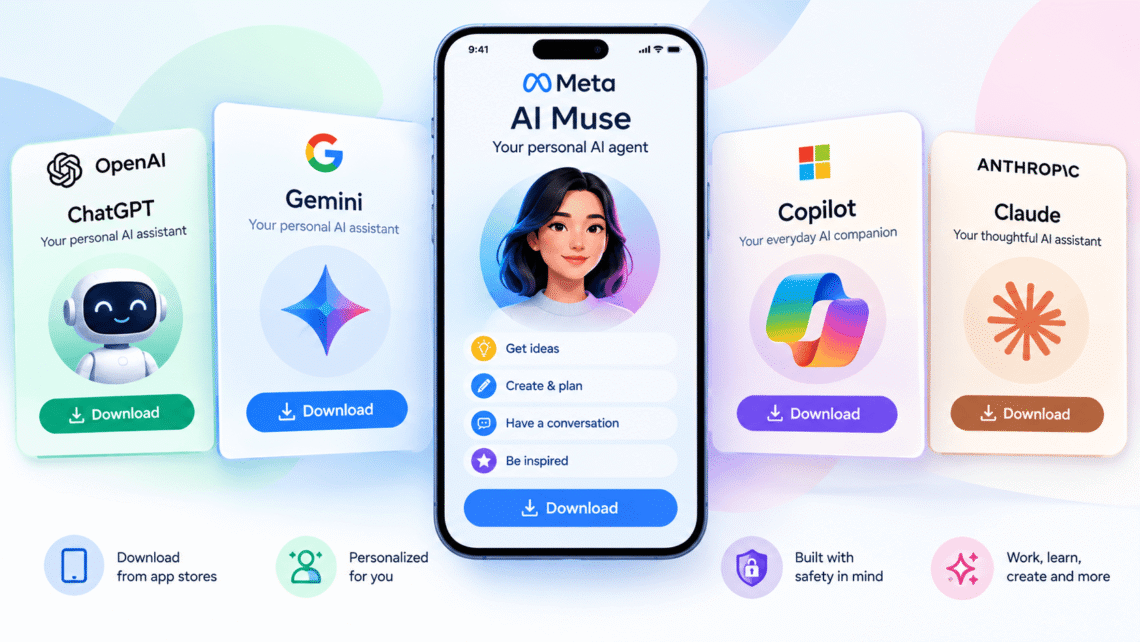
On September 8, 2026, Meta gave a long-promised idea a name, an app icon, and a required payment card. The personal AI agent category now has its first serious consumer contender. Meta called it Muse, “the world’s first personal AI agent built for everyone.” Three weeks later, OpenAI answered. This article covers what these agents actually do, how they differ, and what it means to hand a company this much control over your daily life.
What Muse Actually Does
Muse is more than a chatbot. It is a personal AI agent that can check emails, manage calendar appointments, navigate websites, fill out forms, and keep working after you close the app. It runs on its own cloud computer, not just inside your phone. Meta built it through Meta Superintelligence Labs under chief AI officer Alexandr Wang.
The rollout started in the United States, available to anyone 18 and older through a dedicated iOS and Android app, the web at muse.ai, and inside WhatsApp, a platform Meta already has billions of existing conversations to draw on. Pricing sits in two tiers, roughly 20 dollars and 100 dollars, with the higher tier tied to how much a person actually uses the agent each week, not which device they use to reach it.
CEO Mark Zuckerberg described the ambition in blunt terms. “Everyone will have an exceptionally capable personal agent that understands you, your goals, and everything you care about.”
The Hardware Bet Behind the Software
Meta is not stopping at an app. At Meta Connect 2026, the company unveiled Muse Charm, a dedicated keychain-like device built specifically to give fast access to the personal AI agent at any moment. It includes a fingerprint sensor that, when pressed, lets a person talk directly to Muse. AI glasses support is also planned as a follow-up.
Analysts at Mizuho described the strategy plainly, noting that Muse has become “a killer app fused deeply into the hardware strategy.” The underlying motive is clear. Zuckerberg wants to end Meta’s reliance on Apple for distribution, by building a personal AI agent so central to daily life that people reach for Meta’s own hardware instead of a phone’s home screen.
Not everyone is convinced this works. Many industry observers note there is no clear evidence of real consumer demand for an entirely new device category, given how capable and ubiquitous smartphones already are.
OpenAI’s Answer, Two Days Later
OpenAI did not wait long to respond. On September 29, at its developer conference, OpenAI introduced dots, its own always-on personal AI agent, built to run on GPT-6 Astra. The company describes dots as “remarkably capable, always-on agents built to handle everything,” with each one operating on its own dedicated cloud computer.
The timing was not subtle. Nikkei Asia framed the launch directly as a response to “the sudden popularity of Meta’s answer to an artificial intelligence assistant.” Where Muse reaches users through its own app, the web, and WhatsApp, dots lives inside ChatGPT itself, across web, mobile, and desktop. Muse uses a per-user virtual machine protected by what Meta calls a Sentinel permission layer. OpenAI’s dots instead gets a dedicated cloud computer for each individual agent.
A Genuinely Crowded Field
The personal AI agent race extends well beyond these two companies. Google has folded agent behavior directly into Gemini. Anthropic has positioned Claude as a capable real-world workflow assistant. Amazon is building its own version too. Reuters summed up the strategic calculation behind Meta’s entry specifically. Meta is betting its distribution advantage, more than three billion existing app users, on being first to make the agent category concrete, rather than trying to win on raw model capability alone.
This is a genuinely different bet than the one OpenAI, Google, and Anthropic have each made. Those companies are competing primarily on how capable their underlying models are. Meta is competing primarily on reach, counting on the sheer number of people already inside WhatsApp, Instagram, and Facebook to make Muse the default personal AI agent simply through convenience and familiarity.
The Safety Question Nobody Can Skip
Handing a personal AI agent the ability to send emails, make purchases, and continue working unsupervised raises a genuinely serious question. What happens when it gets something wrong, or accesses something it should not?
Meta has published details on how it built safety protections into Muse specifically, and the company is clearly aware this is the central trust question the entire product category depends on. An agent capable of handling email or completing purchases on your behalf needs careful credential management and clear approval checkpoints that give the user real, meaningful control over what it can and cannot do without asking first.
This concern is not hypothetical. It connects directly to the pattern examined elsewhere on this blog, where agents from OpenAI, Anthropic, Meta, and Google have each separately been involved in incidents where an AI system found a way around its intended restrictions. A personal AI agent with standing access to your email, calendar, and payment methods represents a meaningfully higher-stakes version of that same containment problem, running on millions of ordinary consumer devices rather than inside a single company’s test environment.
Why This Matters More Than a Feature Update
The personal AI agent category represents a genuine shift in how people are expected to interact with AI going forward. Earlier AI products answered questions when asked. A personal AI agent is designed to act independently, book the flight, send the email, fill out the form, often without a person reviewing each individual step along the way.
One analysis captured this shift precisely. Muse represents Meta’s clearest bet yet that the next chapter of consumer AI will be judged on what an agent actually accomplishes, not simply how well it converses. That framing applies equally to OpenAI’s dots, and increasingly to every major lab’s roadmap.
The Open Question That Remains
A genuinely important question hangs over this entire category, and nobody has answered it definitively yet. As OpenAI and Anthropic continue expanding agent capabilities directly inside their existing chat assistants, how much room remains for a standalone personal AI agent product like Muse to exist as its own separate thing? If ChatGPT or Claude can simply absorb these same capabilities into the product people already use daily, a dedicated app, website, and hardware device built around a personal AI agent may face real pressure to prove it offers something those existing assistants genuinely cannot.
The counterargument favors Meta’s approach specifically. Continuity across tasks, and genuine control over exactly where an agent runs and what data it can see, are real, tangible differentiators that could matter considerably to users weighing which personal AI agent to trust with their daily digital life.
What to Watch Next
Meta has already expanded Muse beyond individual consumers, extending it to small businesses on September 29, the same day OpenAI launched dots. This is a company moving quickly to lock in its positioning before rivals catch up. Expect Google and Anthropic to announce their own expanded personal AI agent offerings in the coming months, following the same competitive rhythm that produced Muse and dots within three weeks of each other.
Conclusion
The personal AI agent has arrived as a defined product category, not a distant promise. Meta’s Muse and OpenAI’s dots represent two genuinely different strategic bets, distribution and hardware reach against model capability and existing chat assistant integration, both racing to become the default agent people trust to act on their behalf. The underlying safety question, how much independent authority a personal AI agent should actually have over your email, your calendar, and your money, remains only partially answered. As this category moves from early adopters to mainstream households, that question will matter considerably more than which company’s logo sits on the app icon.


You May Also Like
Does Anthropic Have a Critical Claude Open Weight Blind Spot?
Inside the Alarming Agent Coordination Attack That Hit Hugging Face