The Fabulous Anthropic IPO Could Be 1 Record Breaker: Here Is What Investors Should Know
A Listing Unlike Any Before It
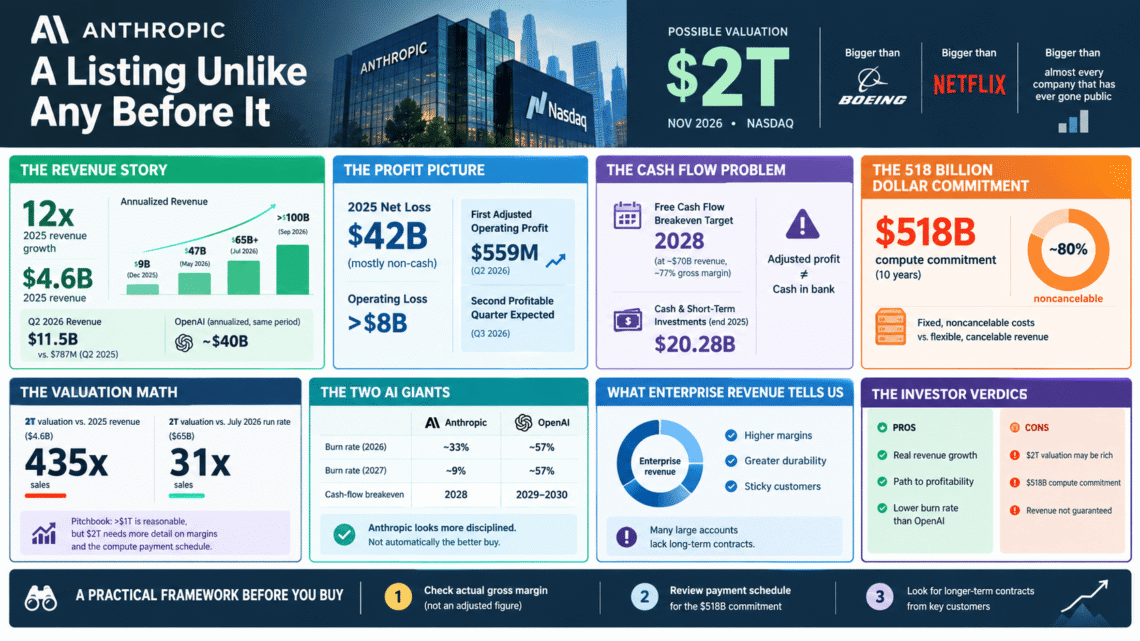
The Anthropic IPO is shaping up to be one of the largest public listings in history. Reports point to a November 2026 debut on the Nasdaq, with a possible valuation near 2 trillion dollars. That would make the Anthropic IPO larger than Boeing, larger than Netflix, and larger than almost every company that has ever gone public. This article breaks down the real numbers behind that figure and asks the question every investor actually cares about. Is it worth buying in?
The Revenue Story
Start with what is genuinely impressive. Anthropic’s revenue grew twelve-fold in 2025 alone, reaching nearly 4.6 billion dollars for the full year. That pace has only accelerated since. Annualized revenue climbed from about 9 billion dollars at the end of 2025 to roughly 47 billion dollars in May 2026, then to more than 65 billion dollars by late July. By September, the company was reportedly pacing above 100 billion dollars annualized.
Quarter over quarter, the jump is just as stark. Second quarter 2026 revenue hit 11.5 billion dollars, up from 787 million dollars in the same quarter a year earlier. For context on how the Anthropic IPO compares, rival OpenAI was running at roughly 40 billion dollars annualized over the same period.
The Profit Picture Is More Complicated
Here is where the Anthropic IPO story gets genuinely nuanced. The company posted a net loss of about 42 billion dollars for 2025, though most of that figure reflects non-cash items tied to its complex equity structure rather than pure operating losses. On an operating basis, the 2025 loss was more than 8 billion dollars.
The more encouraging signal came later. Anthropic reported its first quarter of adjusted operating profit in Q2 2026, at roughly 559 million dollars, a figure that excludes stock-based compensation. A second profitable quarter was expected in Q3. This matters for the Anthropic IPO specifically because it shows a path toward sustainable earnings, not just revenue growth funded by investor cash.
The Cash Flow Problem
Profit on an adjusted basis is not the same thing as cash in the bank, and this is where investors need to pay close attention. Anthropic’s own late-2025 plan targeted positive free cash flow only by 2028, at an expected revenue level of around 70 billion dollars and gross margins near 77 percent. Cash-flow breakeven, not adjusted operating profit, is the real milestone that determines whether a company can fund itself without constantly raising new capital.
The company held 20.28 billion dollars in cash and short-term investments at the end of 2025. That is a real cushion. It is not unlimited, especially given what the company has already committed to spend.
The 518 Billion Dollar Commitment
This is the single number that should give every prospective Anthropic IPO investor real pause. The leaked prospectus shows Anthropic has committed 518 billion dollars to computing power over the next decade. Roughly 80 percent of that commitment is noncancelable, meaning the company is locked into paying it regardless of how demand actually develops.
Set against that is a genuine vulnerability on the revenue side. Many of Anthropic’s largest customers can cut their own spending at any time, with no long-term contract locking them in. This creates a real mismatch. Fixed, noncancelable costs on one side. Flexible, cancelable revenue on the other. Pitchbook’s own analysis of the leaked filing captured this tension precisely, noting the final price should rest on how much of that revenue actually becomes cash, not simply how fast the top line is growing.
What the Valuation Math Actually Shows
The headline multiple on the Anthropic IPO depends enormously on which revenue number you use, and this is worth walking through carefully. A 2 trillion dollar valuation against 2025’s actual revenue of 4.6 billion dollars works out to roughly 435 times sales, a genuinely extreme multiple by any historical standard. Against the more recent July 2026 run rate of 65 billion dollars, the same 2 trillion dollar price works out to just under 31 times revenue, a high multiple, but one that sits closer to what fast-growing technology companies have commanded in the past.
This gap between 435 times and 31 times is not a rounding error. It is the entire debate over whether the Anthropic IPO is reasonably priced or not. Pitchbook’s own assessment lands in the middle. Their analysis supports a valuation well above 1 trillion dollars, but concludes the leaked numbers fall short of justifying the full 2 trillion dollar target, pending more detail on gross margin and the actual payment schedule tied to that 518 billion dollar compute commitment.
Comparing the Two AI Giants
For investors weighing the Anthropic IPO against OpenAI’s own expected listing, the side-by-side numbers are genuinely instructive. Anthropic’s burn rate, as a share of revenue, was projected at roughly 33 percent for 2026, falling to about 9 percent in 2027. OpenAI’s figure sits considerably higher, around 57 percent for both 2026 and 2027 under some estimates. Anthropic’s cash-flow breakeven target sits at 2028. OpenAI’s sits at 2029 or 2030.
On these specific metrics, Anthropic looks like the more disciplined business. That does not automatically make the Anthropic IPO the better buy. It simply means the company is closer to self-sufficiency, which matters enormously if public market investors grow impatient with continued losses after the listing.
What Enterprise Revenue Tells Us
One underappreciated detail in the filings is the composition of Anthropic’s revenue growth. A meaningful share comes from large enterprise accounts, and enterprise revenue tends to carry higher margins and greater durability than consumer subscriptions. This is part of why the company managed an operating profit even while infrastructure spending stayed heavy. For the Anthropic IPO specifically, this is a genuinely positive signal, since enterprise customers are typically stickier than individual subscribers paying 20 dollars a month.
The flip side, already noted above, is that many of these same large accounts do not operate under long-term contracts. Growth from enterprise customers is real and valuable, but it is not yet guaranteed revenue in the way a multi-year contract would be.
The Honest Investor Verdict
So should an ordinary investor go for the Anthropic IPO? The honest answer depends entirely on what kind of investor you are, and the math above should inform that decision directly, not marketing enthusiasm around the listing.
If you are looking for a company with genuine revenue growth, a credible path toward profitability, and a meaningfully lower burn rate than its closest rival, Anthropic’s underlying business is stronger than most companies that have ever gone public at this scale. That is a real, data-backed point in its favor.
If you are specifically weighing whether the price being discussed, up to 2 trillion dollars, fairly reflects that business, the honest answer is that nobody outside the company can know for certain yet. The 518 billion dollar compute commitment is a real, binding liability. The gap between a 31 times and 435 times revenue multiple, depending on which number you anchor to, shows just how much of this valuation rests on continued hypergrowth persisting for years, not on numbers already proven today.
A Practical Framework Before You Buy
Three things are worth checking once the full public S-1 is released, rather than relying on leaked figures alone. First, look at the actual gross margin reported, not an adjusted figure, since this determines how much of each revenue dollar can eventually become free cash flow. Second, examine the payment schedule tied to that 518 billion dollar compute commitment, since a commitment spread evenly over ten years is a very different risk than one front-loaded into the next three. Third, watch whether the company’s largest customers begin signing longer-term contracts, since that would directly address the revenue durability concern raised above.
Conclusion
The Anthropic IPO represents a genuinely rare combination, a company with revenue growing faster than almost any business in history, alongside profitability metrics that already look stronger than its closest competitor. It also carries real, quantifiable risk, a massive noncancelable spending commitment, cancelable enterprise contracts, and a valuation that could easily run several multiples apart depending on which revenue figure gets used to price it. For investors considering this one, the growth story is not in question. The price is. That distinction should guide any decision made once actual shares become available.


You May Also Like

Inside the Powerful Wave of AI Data Center Protests Sweeping Small-Town America
GPT-6 Astra: OpenAI’s Powerful New Model and the Cybersecurity Line It Just Crossed