The Critical Impact of AI Distillation on Enterprise Strategy and Global AI Competition
A Technique That Changed the Rules
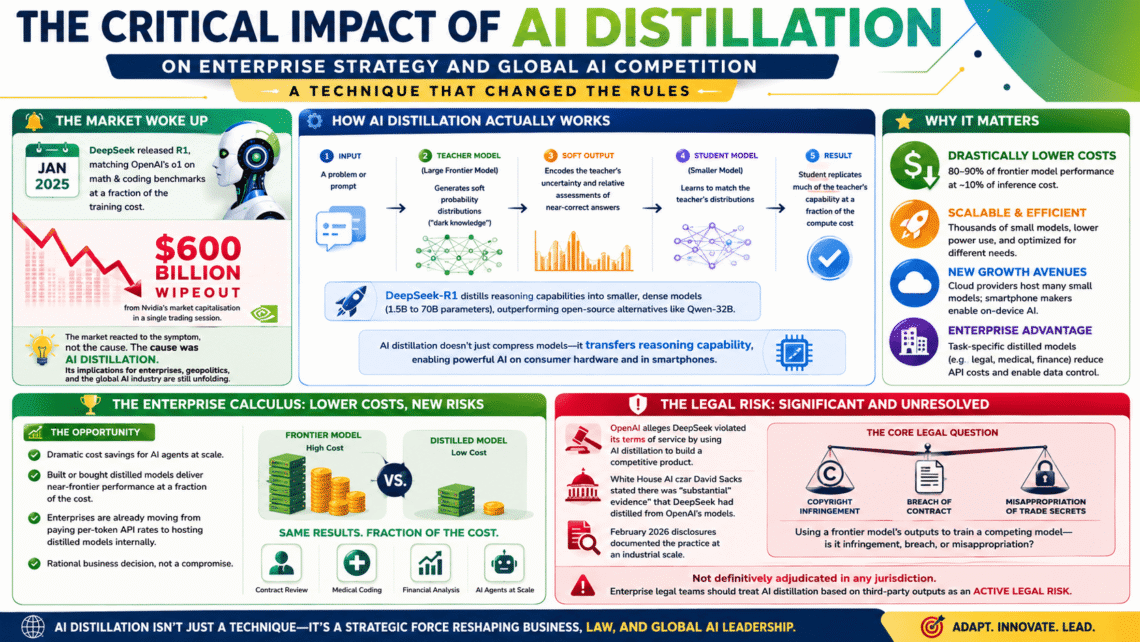
In January 2025, DeepSeek released R1, a reasoning model that matched the performance of OpenAI’s o1 on mathematics and coding benchmarks, at a fraction of the training cost. The immediate market reaction, a $600 billion wipeout from Nvidia’s market capitalisation in a single trading session, reflected the scale of what had happened. But the market was reacting to the symptom rather than the cause. The cause was AI distillation, and its implications for enterprises, geopolitics, and the structure of the global AI industry are still unfolding.
AI distillation is a method in AI development that enables a smaller “student” model to replicate or approximate the performance of a larger “teacher” model by learning from its outputs. Rather than training a frontier model from scratch on hundreds of billions of parameters at a cost of tens of millions of dollars, a team using AI distillation can train a dramatically smaller and cheaper model to behave like the frontier model by learning from its responses. The result is a model that captures much of the capability of the original at a small fraction of the compute cost.
How AI Distillation Actually Works
At a technical level, AI distillation was first formalised by Geoffrey Hinton and colleagues in 2015, though the concept of transferring knowledge between models predates the term. In the standard formulation, a large teacher model generates soft probability distributions over its output vocabulary for a given input, rather than hard single-token predictions. These soft distributions, sometimes called “dark knowledge,” encode the teacher’s uncertainty and its relative assessments of near-correct answers. The student model is trained to minimise the divergence between its own output distributions and the teacher’s, using a loss function that combines the standard cross-entropy against labelled data with a distillation term:
where balances the two objectives, is the temperature at which both teacher and student distributions are softened, is the teacher’s softened distribution, and is the student’s. The temperature parameter controls how much of the teacher’s uncertainty is transferred: higher temperatures produce softer distributions that convey more information about the teacher’s relative preferences across the vocabulary.
DeepSeek-R1 introduces a distillation pipeline, transferring its reasoning capabilities to smaller dense models ranging from 1.5 billion to 70 billion parameters, outperforming open-source alternatives like Qwen-32B. This means that AI distillation is not merely compressing a model for efficiency. It is transferring a specific form of reasoning capability, the ability to work through multi-step problems, into models small enough to run on consumer hardware or to be embedded in smartphones.
The Enterprise Calculus: Lower Costs, New Risks
For enterprises, AI distillation is simultaneously one of the most powerful cost-reduction tools available and one of the most legally and strategically ambiguous. The cost case is straightforward. The distillation of large language models into small language models could lead to thousands or tens of thousands of small language models equipped with reasoning functionality, creating hardware solutions that are more cost-effective, use less power, and are programmed to suit different design targets. Cloud companies will find new growth from hosting large numbers of small language models, and smartphone makers will benefit from on-device deployment.
For an enterprise running AI agents at scale, a distilled model that delivers 80 to 90 percent of a frontier model’s performance at 10 percent of the inference cost is not a compromise. It is a rational business decision. The emergence of task-specific distilled models, tuned on a frontier model’s outputs for a narrow professional domain such as contract review, medical coding, or financial analysis, is already reshaping enterprise AI procurement. Companies that previously paid per-token API rates to frontier providers are now building or buying distilled models trained on those providers’ outputs, hosted internally at near-zero marginal cost per query.
The legal risk attached to this practice, however, is substantial and unresolved. OpenAI alleges that DeepSeek violated its terms of service by leveraging AI distillation to build a competitive product. White House AI czar David Sacks stated publicly that there was “substantial evidence” that DeepSeek had distilled from OpenAI’s models. The February 2026 disclosures documented the practice at an industrial scale.
The core legal question, whether using a frontier model’s outputs to train a competing model constitutes copyright infringement, breach of contract, or misappropriation of trade secrets, has not been definitively adjudicated in any jurisdiction. Enterprise legal teams deploying AI distillation pipelines based on outputs from third-party models should treat this as an active legal risk, not a settled question.
The Geopolitical Dimension: AI Distillation as Strategic Leverage
Beyond the enterprise level, AI distillation has become a central instrument in the US-China competition for AI leadership, and the implications are serious enough that they have reached the level of national security policy.
The ODNI’s 2025 Annual Threat Assessment concluded that China “almost certainly has a multifaceted, national-level strategy designed to displace the United States as the world’s most influential AI power by 2030.” Dmitri Alperovitch, chairman of the Silverado Policy Accelerator and co-founder of CrowdStrike, observed: “It’s been clear for a while now that part of the reason for the rapid progress of Chinese AI models has been theft via distillation of US frontier models.”
The strategic logic of adversarial AI distillation is sobering. The United States invested hundreds of billions of dollars and imposed strict chip export controls to deny China access to the compute infrastructure needed to train frontier models. AI distillation, if conducted against US frontier models, partially circumvents that strategy: a team with access to the outputs of a frontier model and a modest cluster of less advanced chips can distil much of its reasoning capability into a smaller model without ever needing the frontier compute that export controls were designed to restrict.
The Jamestown Foundation documented dozens of People’s Liberation Army procurement contracts for systems built on DeepSeek models, and a CSET analysis of nearly 3,000 AI-related PLA defense contracts found that China’s military-civil fusion framework creates systematic pathways for capabilities developed in commercial laboratories to flow into military and intelligence applications.
The US government’s response has been reactive rather than proactive. The Department of Defense, NASA, and the US House of Representatives banned DeepSeek from government networks. State governments including Texas, New York, and Virginia followed suit. Legislatively, the No DeepSeek on Government Devices Act and the US-China AI Decoupling Bill signal a shift toward regulatory intervention. These measures address the data privacy and access dimension of the problem but do not directly confront the AI distillation mechanism through which Chinese labs have allegedly closed the capability gap.
What Enterprises Should Do Now
The AI distillation landscape in mid-2026 presents enterprises with three distinct strategic postures, and the right choice depends on the organisation’s risk tolerance, regulatory environment, and competitive position.
The first posture is aggressive adoption: use AI distillation to create proprietary, task-specific models trained on outputs from frontier providers, hosted internally, with legal review of the terms of service of each provider whose outputs are used as training data. This delivers the maximum cost benefit and creates a proprietary AI asset, but carries legal risk that will not be fully resolved until courts or legislators act.
The second posture is defensive differentiation: invest in fine-tuning open-weight distilled models, such as those released by Meta, Mistral, and the DeepSeek open-weight releases, rather than distilling from proprietary closed models. The legal risk is substantially lower, and the performance gap between open and closed models has narrowed dramatically through AI distillation techniques.
The third posture is strategic restraint: wait for the legal and regulatory landscape to clarify before building internal AI distillation pipelines, and continue to use frontier model APIs in the interim. This is the most conservative option and the most expensive operationally, but for enterprises in heavily regulated industries where IP liability could be catastrophic, it may be the appropriate choice.
Conclusion
AI distillation is not a niche research technique. It is one of the most consequential forces currently reshaping the enterprise AI market and the global balance of AI capability. Wider adoption of AI distillation could democratise AI capability and efficiency, driving up global demand for AI production and the financial and infrastructural investments required for it. For enterprises, it is a powerful tool and a legal grey zone simultaneously.
For governments, it is a strategic challenge that chip export controls alone cannot address. And for the AI industry as a whole, it is forcing a reckoning with a question that has no easy answer: when knowledge can be transferred from one model to another at low cost, what does it mean to own an AI capability at all?


You May Also Like
The Critical Economics of AI Data Centers: A Breakdown of Cost, ROI, and Lifecycle Risk
The Powerful Chinese AI Strategy: How a Nation Turned Restriction Into Resolve (Part 1)