-
The Critical Rise of Third Party Watermark Detection and What It Means for Academic Integrity
From Theory to Deployment
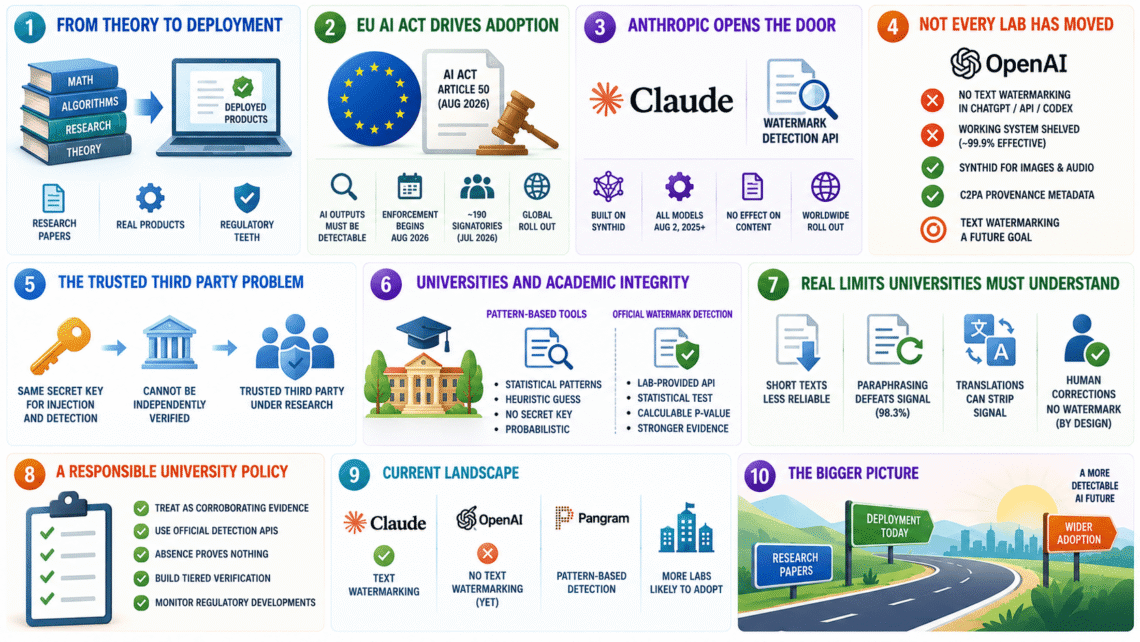
The previous article in this series covered the mathematics of LLM watermarking. Green-red lists, spike entropy, z-tests, and the elegant distortion-free Gumbel approach. That was theory. This article covers what is actually happening right now, in August 2026, as third party watermark detection moves from research papers into deployed products with real regulatory teeth behind them.
The timing matters enormously. The EU AI Act’s Article 50 requires AI outputs to be detectable as artificially generated. Enforcement began this month. That single regulatory deadline has forced every major lab to answer a question they had avoided for years. Should outsiders be allowed to check whether text came from their model?
-
The Profound Mathematics of LLM Watermarking: How AI Text Hides an Invisible Signature
A Signal Hidden in Plain Sight
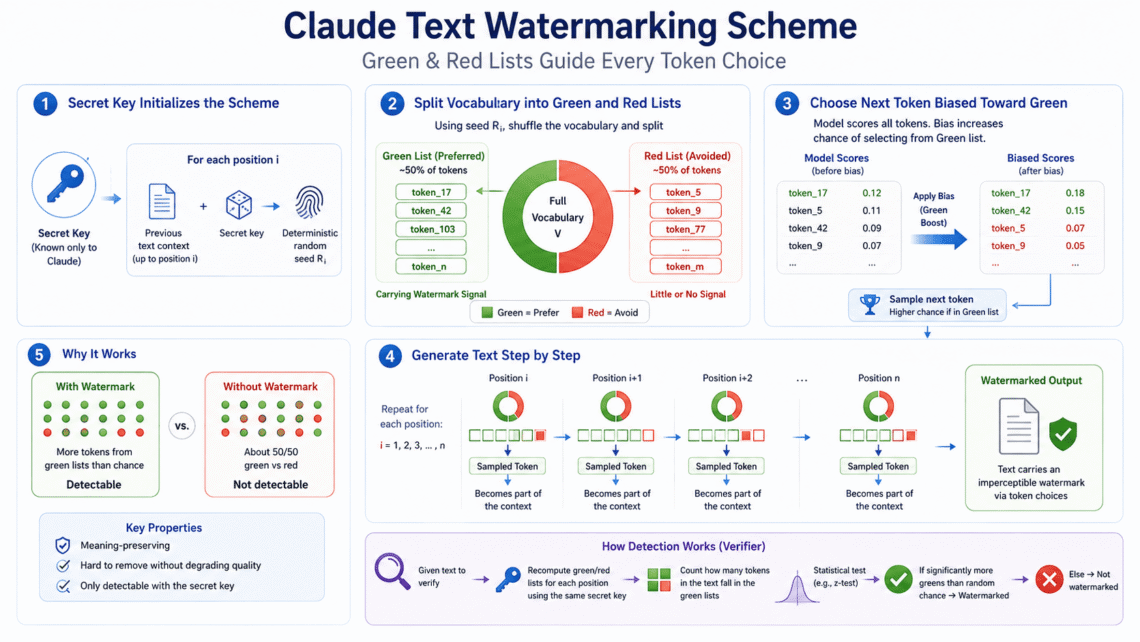
Every token a language model generates comes from a probability distribution. LLM watermarking exploits this single fact with remarkable precision. It biases that distribution just enough to leave a statistical fingerprint. Human readers cannot see it. Trained detectors can find it with near certainty. Understanding how this actually works requires going past the marketing language entirely. It requires real probability theory, real hypothesis testing, and a careful look at what “invisible” actually means in a mathematical sense.
This article goes deep. LLM watermarking sits at the intersection of cryptography, statistics, and information theory, and it deserves treatment at that level.
-
7 Critical Enterprise AI Data Privacy Risks Companies Cannot Afford to Ignore
A Trust Gap Nobody Can Ignore Anymore
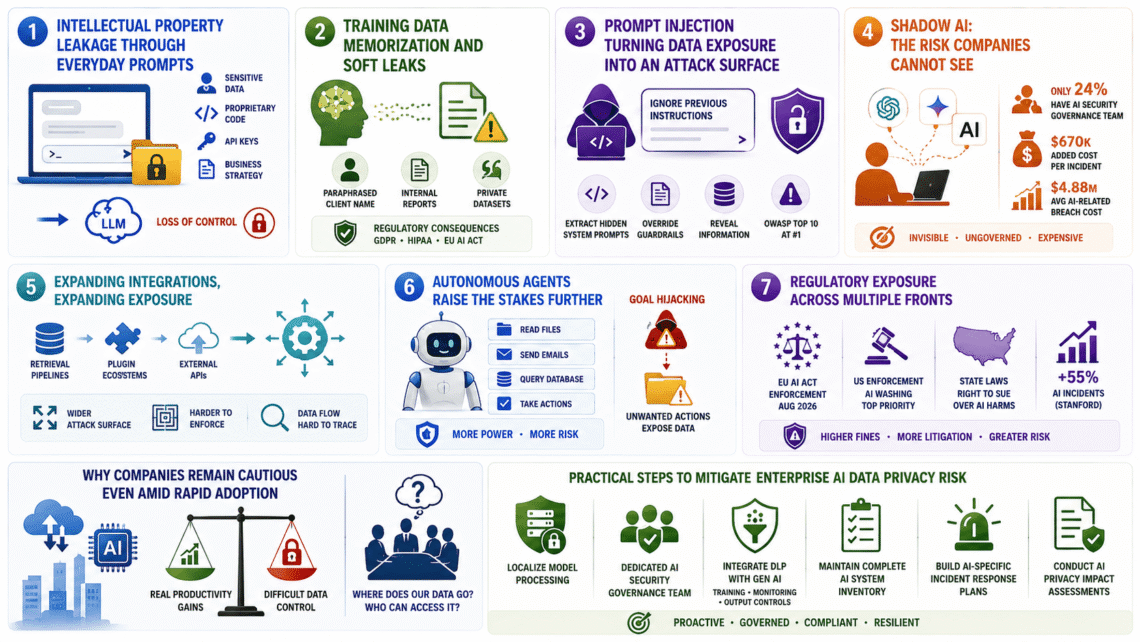
Enterprises want AI. They just do not want to hand over their crown jewels to get it. This tension defines enterprise AI data privacy in 2026. Companies are deploying LLMs into core workflows at record speed. At the same time, legal and security teams are pumping the brakes harder than ever. Both instincts are correct. The technology is genuinely useful. The risks are genuinely serious.
Understanding why companies stay wary of LLM vendors, even while adopting their products, requires looking closely at seven specific, well-documented risk categories. Each one shapes how enterprise AI data privacy decisions actually get made today.
-
The Ambitious Future of Chinese AI: Robots, Real-World Deployment, and the Next Decade (Part 3)
This is Part 3, the final part of a three-part series examining Chinese AI development from a genuinely Chinese vantage point. Part 1 traced the strategic origins and the export control era. Part 2 introduced the companies and scientists executing that strategy. Part 3 looks at where China is heading over the next five to ten years.
A Plan That Changes the Question Entirely
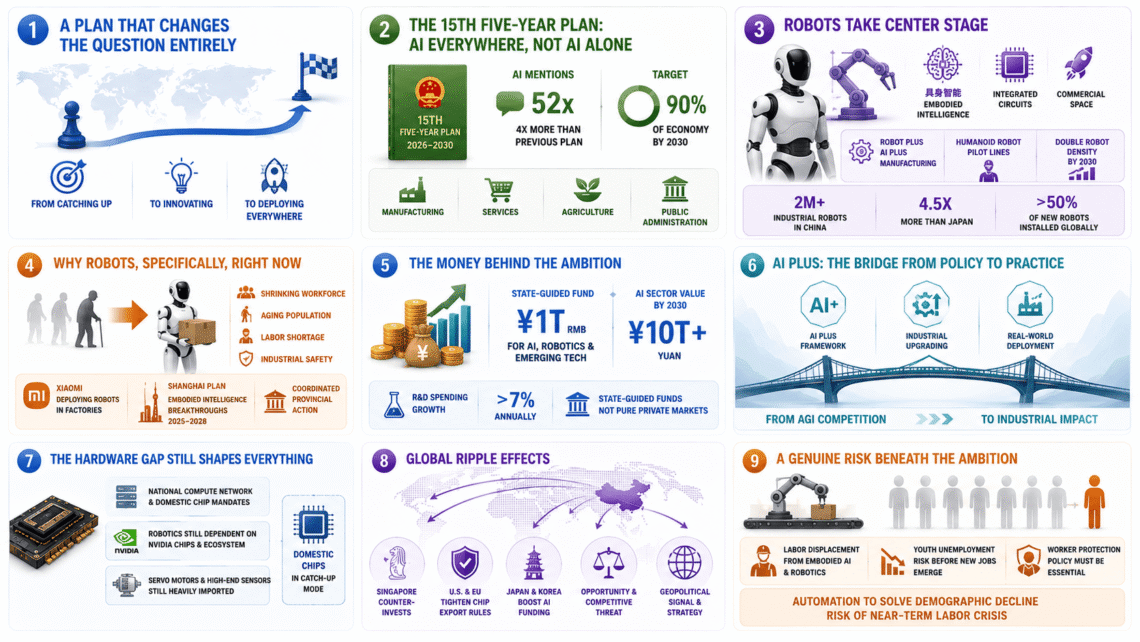
Part 1 and Part 2 of this series told a story about catching up. Export controls forced innovation. Startups closed the performance gap with Western labs. That story is now largely finished. The future of Chinese AI, as laid out in Beijing’s newest planning documents, asks a very different question. It is no longer about matching the West. It is about deploying AI everywhere, all at once, faster than any other economy on earth.
-
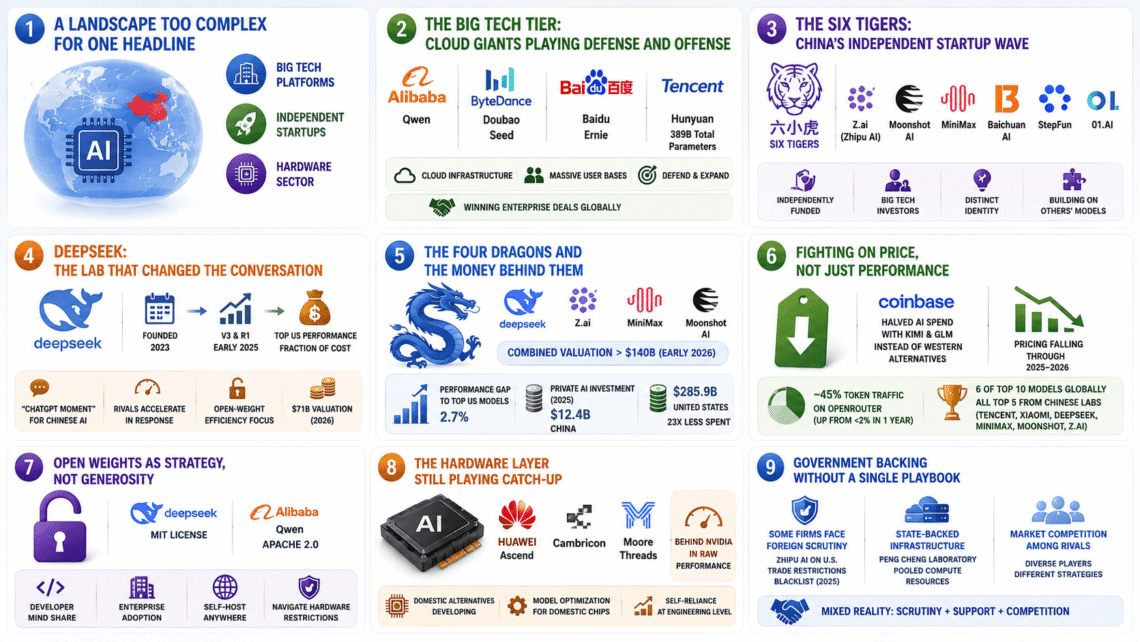
The Powerful Rise of Chinese AI Companies: Six Tigers, Four Dragons, and a New World Order (Part 2)
This is Part 2 of a three-part series examining Chinese AI development from a genuinely Chinese vantage point. Part 1 traced the origins of China’s AI strategy and the export control era that reshaped it. Part 2 introduces the specific scientists, labs, and companies executing that strategy. Part 3 will look at where China is heading over the next five to ten years.
A Landscape Too Complex for One Headline
Western coverage often collapses Chinese AI into a single word: DeepSeek. That framing misses the real story. Chinese AI companies today form a layered, competitive ecosystem spanning giant technology platforms, a cluster of fiercely independent startups, and a fast-moving hardware sector trying to catch up on chips. Understanding this ecosystem means understanding how differently each layer behaves, and why.