
The Honest Guide to Retail AI Investing: What the Math Actually Says About Your Odds
An Honest Starting Point
You do not need a hedge fund or a finance degree to ask ChatGPT or Claude for stock picks. That much is genuinely true. Retail AI investing has become accessible to anyone with a free account and a web browser. What matters far more is whether it actually helps you, and the honest answer requires real numbers, not marketing claims. This article walks through exactly how ordinary people are using these tools, and does the math on what you can realistically expect.
Disclaimer: The information provided in this article is for educational and informational purposes only and does not constitute financial, investment, or legal advice. Trading stocks involves significant risk, and investors can lose all or more of their initial investment. Past performance is not indicative of future results. You should consult with a licensed financial professional or conduct your own thorough research before making any investment decisions.
What Ordinary People Can Actually Do
Retail AI investing today mostly means one of three things. First, using a chatbot directly for research, asking Claude or ChatGPT to analyze an earnings transcript or a 10-K filing. Second, using structured prompt templates that walk a model through moat analysis, valuation, and risk scenarios, mimicking a professional research process. Third, using automated platforms that connect a brokerage account and copy an AI-generated model portfolio directly, executing real trades without you clicking a single button.
Each model tends to specialize. Claude reads long documents well and handles qualitative judgment. ChatGPT is stronger at quantitative work, building spreadsheets and backtests. Perplexity excels at live, cited facts. None of them watches your portfolio between sessions unless you specifically set up automation for that.
The Study That Should Change How You Think About This
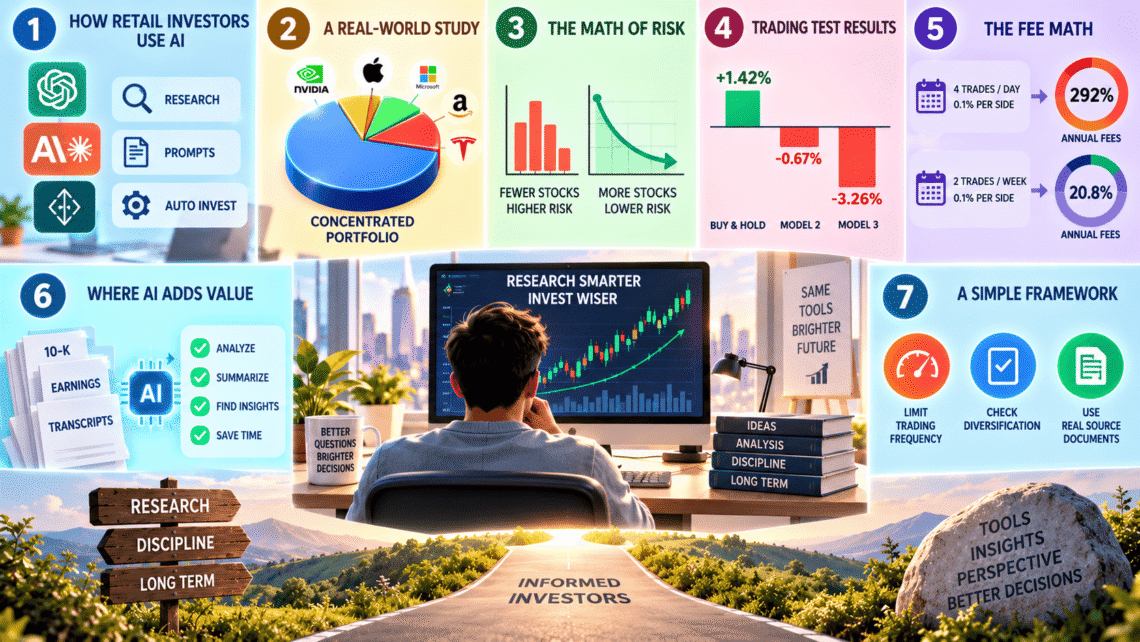
A rigorous academic study tracking more than 1,200 portfolio-day observations across seven AI-managed portfolios found something worth taking seriously before you open your brokerage app. When ordinary households ask a chatbot for stock picks, they tend to receive a concentrated set of large, high-beta technology stocks, heavily tilted toward whichever companies dominate recent headlines. The study’s core finding was blunt. This concentrated exposure did not appear to deliver returns beyond what comparable stocks would have produced anyway.
This matters enormously for retail AI investing specifically because concentration is not the same thing as skill. A portfolio stuffed with the five most talked-about tech stocks will often rise when the broader market rises, and fall harder when it falls. That is not intelligence. That is beta, dressed up as insight.
Doing the Math on Concentration Risk
Here is where the numbers become genuinely important. Standard portfolio theory measures diversification benefit through variance reduction. If you hold N stocks with equal weight, and their returns are not perfectly correlated, portfolio variance falls roughly according to this relationship.
Portfolio Variance ≈ (Average Variance ÷ N) + (Average Covariance × (N-1)/N)
As N grows large, the first term shrinks toward zero, and portfolio risk converges toward the average covariance between your holdings. A chatbot-generated portfolio concentrated in five or six correlated tech names keeps that covariance term stubbornly high. Real-world retail AI investing portfolios documented in the study above often land closer to N equals 10 or fewer, heavily correlated names. Compare that to a simple total market index fund, effectively N in the thousands, with genuine diversification across uncorrelated sectors. The math is not close.
What Controlled Trading Tests Actually Show
Beyond concentration, a separate concern is whether AI models can time trades well, not just pick sectors. A controlled trading competition running real models with identical rules, a fixed $10,000 simulated account, a modeled trading fee, and six-hour decision cycles, produced results worth sitting with. Over the test window, one model gained 1.42 percent by essentially buying and holding. A second model lost 0.67 percent. A third lost 3.26 percent.
This is a small, short sample, and market conditions during any given window can flatter or punish any strategy. But the pattern is instructive. The model that did best was the one that traded the least. Frequent, active decision-making by an AI agent did not translate into better returns in this controlled test. It often produced worse ones, once a realistic trading fee was applied to every move.
The Fee Math Nobody Mentions
This last point deserves its own calculation, because it is the single most overlooked risk in retail AI investing. Every trade an AI agent executes on your behalf carries a cost, even a small one. If your agent trades once every six hours and pays a 0.1 percent fee each way, the arithmetic compounds quickly.
Trading four times daily for a year means roughly 1,460 round trips. At 0.2 percent total cost per round trip, that is 292 percent of your capital consumed by fees alone over the year, before accounting for any actual gains or losses on the trades themselves. Even a far more modest pace, say two trades per week, still totals 104 round trips annually, roughly 20.8 percent of capital lost to fees alone at that same rate. An AI agent does not get tired of trading. It will execute exactly as often as its rules tell it to, and every single execution has a cost attached.
Where Genuine Value Does Show Up
None of this means retail AI investing is worthless. The honest, evidence-based value sits specifically in research quality, not trade execution. One benchmark study found a GPT-4-class model answered roughly 79 percent of financial questions correctly when given full SEC filing context, compared to just 9 percent without that context. That gap is the real lesson. These tools are genuinely strong at reading a dense document quickly and pulling out what matters, provided you feed them the actual source material rather than relying on their general knowledge alone.
Used this way, a retail investor can realistically save meaningful research time. Reading a full 10-K filing, cross-checking segment margins, and building a basic valuation model once took hours. A well-prompted session can compress that considerably. The genuine gain here is time and thoroughness in your own decision-making process, not a magic signal that beats the market for you automatically.
The Realistic Verdict on Gains
So can an ordinary person actually gain from retail AI investing? The honest, calculation-backed answer is nuanced. Using AI purely as a research assistant, to read filings faster and structure your own thinking more rigorously, has genuine, demonstrable value with essentially zero additional downside risk beyond the time you already spend.
Using AI as an autonomous trading agent that executes trades on your behalf carries real, quantifiable risk that the current evidence does not support as a reliable source of extra return. The concentration math works against you. The fee math works against you. And the controlled trading data available so far shows no consistent edge over simply buying and holding a diversified fund.
A Simple Framework Before You Start
If you want to use these tools responsibly, three rules follow directly from the math above. First, never let an AI agent execute trades automatically without a hard cap on trading frequency, since fees compound faster than most people intuitively expect. Second, treat any AI-generated stock list as a starting point for your own research, not a final answer, and specifically check whether it is concentrated in fewer than fifteen or twenty names before acting on it. Third, feed the model real source documents, filings, transcripts, prospectuses, rather than asking it to rely on general knowledge, since accuracy improves dramatically with genuine context.
Conclusion
Retail AI investing is genuinely accessible now, and that accessibility is not nothing. But accessibility and edge are different things entirely. The math on concentration risk, trading fees, and the controlled performance data available so far all point toward the same honest conclusion. These tools make you a faster, better-informed researcher. They do not reliably make you a better trader. For an ordinary investor, the safest and most evidence-backed use of retail AI investing is exactly the boring one, faster reading, clearer thinking, and a diversified portfolio you still choose and manage yourself.


You May Also Like
The Critical Economics of AI Data Centers: A Breakdown of Cost, ROI, and Lifecycle Risk
The Alarming $18 Billion Meta Teen Safety Settlement: Will 10 Years of Rules Actually Protect Kids?