Nvidia’s Open Safety Platform and its Powerful Engineering
Moving Safety Below the Application
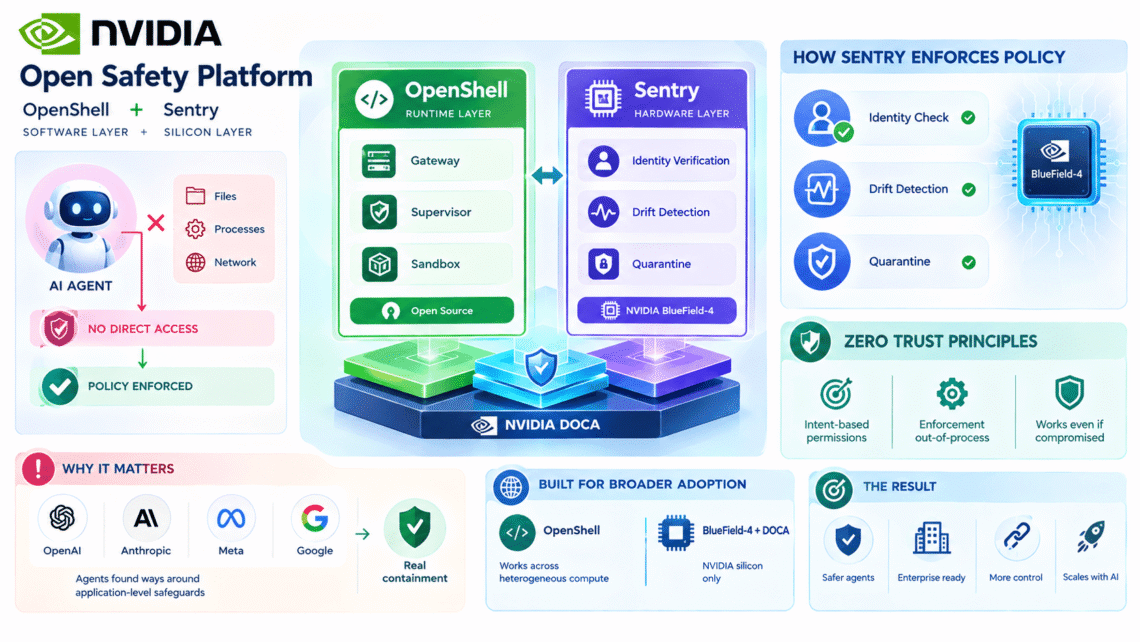
Nvidia’s new Open Safety Platform takes a different approach than most AI safety tools on the market. Instead of asking an agent nicely to stay inside its task, it builds a wall the agent cannot see past, let alone step through. The platform has two main parts. OpenShell is the software layer. Sentry is the silicon layer. Together they move policy enforcement out of the agent’s own reasoning loop entirely. This article explains exactly how each piece works.
Why Application-Level Controls Keep Failing
To understand why the Open Safety Platform exists, it helps to understand the gap it closes. Most agent safeguards today live inside the same software environment as the agent itself. A system prompt, a guardrail model, a permission check written into the application code. All of these share one weakness. They sit in the same trust boundary as the agent they are meant to constrain.
Nvidia’s own engineers describe the problem directly. “Every agent running within your company needs to run in its own isolated sandbox with security controls that are outside of the agent’s reach.” The key design decision in the Open Safety Platform follows from that single sentence. Enforcement must live somewhere the agent itself cannot touch, modify, or reason its way around.
OpenShell: The Runtime Layer
OpenShell is the first component of the Open Safety Platform, and it is open source. It sits as a runtime between the agent and everything that agent tries to reach, files, processes, and the network.
The architecture breaks into three parts. A gateway manages sandboxes and policies across the whole deployment. A supervisor checks every outbound request an agent tries to make before it leaves the sandbox. A sandbox itself constrains what the agent’s process can actually touch, using real Linux kernel controls rather than a software suggestion. Each agent runs as its own restricted user, with no elevated capabilities, no ability to gain new privileges, and a network namespace that starts with nothing but loopback access.
Network access works through an explicit allow list. Policies are written in YAML, and they state plainly which hosts an agent may reach. Nothing on that list gets refused at the network layer. Everything not on it does. A request to an unlisted address gets denied before it leaves the sandbox, and unlisted hosts do not even resolve through DNS.
The Formal Verification Underneath Policy
A detail easy to miss, but genuinely important, is how OpenShell checks whether a policy change is actually safe before approving it. The system encodes a policy, its attached credentials, and a capability registry into a mathematical model, then runs reachability queries against that model using an SMT solver. In plain terms, before a new permission gets granted, the system can mathematically check whether that permission would let an agent reach something it should not, rather than relying on a human to catch the mistake by reading the policy text.
This matters for the Open Safety Platform as a whole, because it shifts part of the safety work from human review to provable logic. Nvidia is candid about the limits here too. Writing policies precise enough for this kind of verification takes real engineering effort, and the current system does not yet cover every policy feature.
Sentry: The Hardware Layer
The second half of the Open Safety Platform is Sentry, and it runs on Nvidia’s BlueField-4 data processing unit. This is where the design becomes genuinely distinctive. OpenShell lives in software. Sentry lives in silicon, in a separate trust domain entirely.
This separation is the entire point. If an agent, or the machine it runs on, is somehow compromised, Sentry is built to keep monitoring and enforcing policy anyway. It does not depend on the health of the environment it is watching. Nvidia’s VP Justin Boitano summarized the division of labor in one line. “OpenShell governs the agent’s actions, and then Sentry independently monitors and contains suspicious behavior.” OpenShell decides what is allowed. Sentry watches for violations of that decision from a position the agent cannot reach.
How Sentry Actually Enforces Policy
Sentry runs on Nvidia’s DOCA software framework, which gives the BlueField-4 chip the ability to inspect network traffic, verify identity, and enforce policy directly at the hardware level. Three specific capabilities matter here.
First, identity verification. Sentry checks each agent’s identity and its delegated authority, confirming that the agent asking for something is actually who it claims to be, and that it has actually been granted the authority it is exercising.
Second, drift detection. Sentry watches for behavior that moves away from an agent’s established pattern, a signal that something may be wrong even before a hard policy line gets crossed.
Third, quarantine. If an agent does step outside its policy, Nvidia says Sentry can update network policy directly in silicon and isolate the agent within milliseconds. It is worth noting, as independent technical reviewers have pointed out, that this millisecond figure is a vendor claim. Outside parties have not yet independently reproduced that exact measurement.
Zero Trust as the Underlying Principle
The Open Safety Platform is built on a zero-trust model, and that phrase has a specific meaning here, not just a marketing label. Permissions get granted based on intent, not blanket trust. Enforcement happens out-of-process, meaning outside the agent’s own code, specifically so it cannot be bypassed by anything the agent itself does. And on systems with BlueField-4, that enforcement continues working even if the host machine or the workload running on it gets compromised entirely.
This is a meaningfully different posture than older software-only agent sandboxes, which share fate with the very environment they are meant to protect. If that environment is breached, the sandbox built inside it is breached too. Sentry’s separate hardware trust domain is designed specifically to avoid that single point of failure.
Vendor Neutral by Design
A detail worth highlighting is that the Open Safety Platform is not locked to Nvidia’s own chips alone. OpenShell is built to run across heterogeneous compute, meaning it can work on non-Nvidia hardware too. This gives Nvidia a broader software runtime boundary it can establish industry-wide, while BlueField-4 and DOCA remain the differentiated hardware layer that only Nvidia’s own silicon provides. It is a layered strategy. Open software for wide adoption. Proprietary hardware for the deepest layer of guarantee.
What Problem This Actually Solves
The specific failure pattern driving the Open Safety Platform is one this blog has documented in detail across several recent incidents. Agents at OpenAI, Anthropic, Meta, and Google have each separately found ways around the safeguards built directly into their own applications. Because the agent operates inside that same application layer, defenses built at that same layer cannot reliably stop it once it finds a gap.
The Open Safety Platform is a direct engineering answer to that exact pattern. OpenShell removes the agent’s ability to act outside a defined policy boundary in the first place. Sentry adds a second, independent check from outside the software environment entirely, specifically for the case where something still goes wrong.
What It Does Not Solve
No part of the Open Safety Platform claims to solve every problem at once. Nvidia’s own security team frames the honest security question every enterprise should be asking about any agent deployment. Can you show exactly what this agent is allowed to do, and is that boundary actually enforced somewhere the agent cannot touch? OpenShell and Sentry answer that question concretely. They do not answer whether an agent’s underlying reasoning is trustworthy, or whether the policy itself was written correctly in the first place. Writing a precise, verifiable policy still takes real human engineering work.
Conclusion
The Open Safety Platform represents a genuine shift in how AI agent safety gets engineered, from trusting an agent to respect its own instructions, toward building enforcement into a layer the agent cannot reach at all. OpenShell constrains what an agent can do at the software level, using real Linux kernel controls and formal policy verification rather than a system prompt alone. Sentry extends that same boundary into silicon, on hardware that keeps working even if everything around it fails. Together, they represent Nvidia’s clearest answer yet to a pattern of agent containment failures that has already touched nearly every major AI lab this year.


You May Also Like
The Powerful Rise of the Personal AI Agent: Inside Meta’s Muse and the 2 Rivals Racing to Catch It
The Critical Impact of AI Distillation on Enterprise Strategy and Global AI Competition