
The Explosive Data Center Midterms Fight Reshaping American Politics
An Issue Nobody Saw Coming
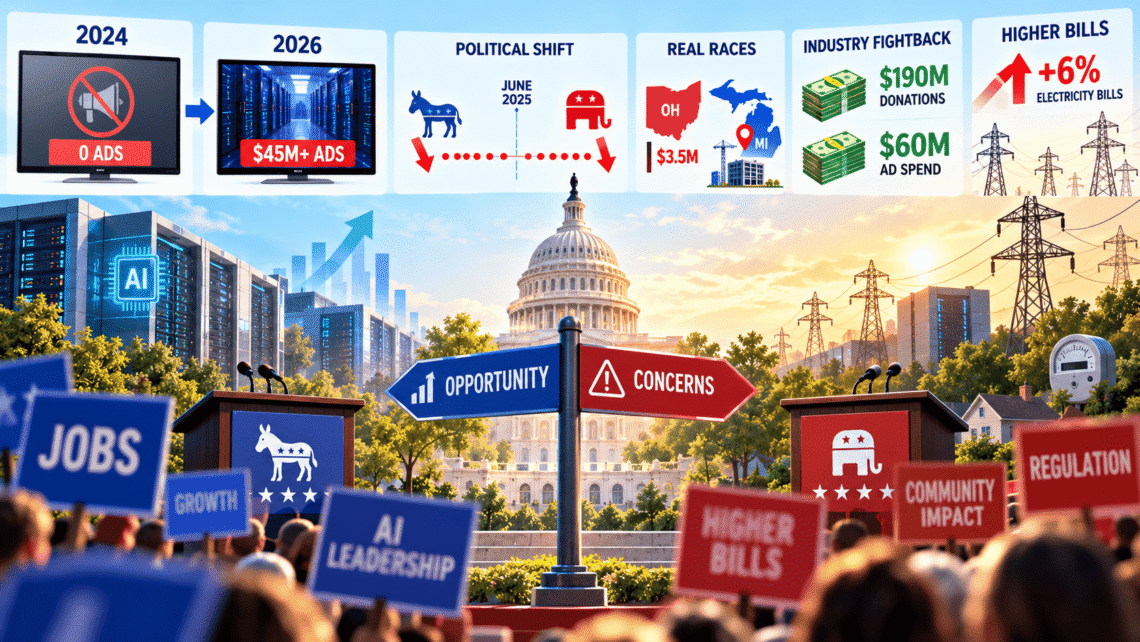
In 2024, not a single election ad on broadcast television mentioned data centers. Zero. This year, campaigns and outside groups have spent more than 45 million dollars on ads mentioning them, according to an NPR analysis of AdImpact data. The data center midterms fight has moved from a niche local concern to one of the defining issues of the 2026 election cycle, and it is scrambling political lines in ways few analysts predicted.
This article examines how protests turned into policy, how policy turned into campaign ads, and how the tech industry is now spending heavily to fight back before November.
From Local Protest to National Issue
The shift happened fast. A Washington Post analysis of 4,300 social media posts and newsletters from politicians, tracked between July 2024 and mid-August 2026, found a dramatic change in tone. Democrats turned mostly negative on data centers by June 2025. Republicans made the same shift roughly a year later, sharply, within just the past six months.
This timing matters for understanding the data center midterms story. Early 2024 politicians from both parties mostly celebrated new facilities for the jobs and investment they promised. As grassroots opposition grew louder, driven by concerns over electricity costs, water use, land use, and tax breaks, the political emphasis flipped entirely.
Protests themselves have kept pace with this shift. In recent months, demonstrators in Virginia, Pennsylvania, North Carolina, and other states have successfully shut down proposals for new building sites. One Wisconsin town is actively trying to oust its own mayor over a data center approval. A Utah protest in May drew crowds opposing a proposed 40,000-acre facility projected to use nine gigawatts of power.
Named Candidates, Named Races
The data center midterms fight is not abstract. It has real names attached in competitive races across the country. In Ohio’s Senate race, Democratic candidate Sherrod Brown has put more than 3.5 million dollars behind three separate television ads hammering his Republican opponent, Lieutenant Governor Jon Husted, over data centers. Republican gubernatorial hopeful Vivek Ramaswamy has called for data center companies to cover residents’ power bills directly. Democratic governor candidate Amy Acton released a “conditional moratorium” plan of her own.
In Wisconsin, Democratic candidate Francesca Hong called for a full moratorium. In Michigan, Senate candidate Abdul El-Sayed held a campaign rally directly in front of an under-construction OpenAI and Oracle data center campus, declaring flatly that “we cannot approve any more of these until we have federal-level guardrails.”
This is the defining feature of the data center midterms moment. Both parties are running against the same target, often using nearly identical language about tax breaks and rising electricity bills.
Governors Reversing Course in Real Time
Perhaps the clearest evidence of political impact comes from sitting governors changing position mid-term. Pennsylvania Governor Josh Shapiro shifted from generally supporting data centers to imposing new restrictions, after his Republican opponent accused him of being too favorable to tech firms. He has since signed an executive order placing additional guardrails on data center authorization.
Texas Governor Greg Abbott, facing similar political pressure, endorsed a formal audit of data center development while the state studies its actual impact. Wisconsin Republican Representative Tom Tiffany supported speeding up federal data center construction earlier in the year and called the technology exciting. By May, facing his own campaign pressure, his public tone had shifted considerably.
The White House Holds the Line
One figure has not moved. President Trump has maintained consistent support for the rapid data center buildout throughout the data center midterms controversy. On August 31, he posted directly. “China could not be happier with this anti Data Center movement.” He later acknowledged the political problem more candidly. Data centers “could use a little public relations help,” he admitted, while insisting he would still want the facilities built in his own community if he were a mayor or governor.
This creates a genuine bind for Republican candidates. They want to respond to increasingly angry constituents. They do not want to draw the president’s public criticism for doing so.
Industry Fights Back With Real Money
The most underreported dimension of the data center midterms story is the industry’s own counter-mobilization. Tech giants including Meta, Google, and Anthropic, alongside major venture capital firms and top AI executives, have donated more than 190 million dollars to super PACs and nonprofits, which have already spent over 60 million dollars on independent expenditures in these midterm races.
The largest vehicle is Leading the Future, a super PAC that has taken in 50 million dollars from Andreessen Horowitz alone, plus another 25 million dollars from OpenAI president Greg Brockman and his wife Anna. Through June, the group had spent nearly 45 million dollars, according to Federal Election Commission records, often directed specifically at candidates taking a hard line on AI and data center regulation.
This is a genuinely significant escalation. What began as scattered local protests has now triggered a national-scale political spending fight, with the AI industry treating candidate positions on data centers as consequential enough to warrant nine-figure counter-investment.
The Electricity Number Behind the Anger
Behind all of this sits one concrete, measurable grievance. A Goldman Sachs analysis projects data center demand could drive a 6 percent rise in electricity bills nationally over the next year, with the sharpest increases concentrated specifically among residents living closest to new facilities. Virginia Governor Abigail Spanberger won her own election partly by campaigning directly on rising energy bills in a state that hosts more data centers than anywhere else in the world.
This single statistic explains why the data center midterms fight crosses party lines so consistently. A rising electricity bill does not care which party a household votes for, and candidates on both sides have recognized this faster than most political observers expected.
Why This Could Reshape Policy After November
The stakes extend well past November 3. Brookings analysis frames the coming vote as a genuine inflection point. If several high-profile backers of data centers lose their races, it could encourage a wider wave of politicians to embrace moratoriums, pauses, and formal audits, a pattern already visible in New York and numerous local communities.
This creates a feedback loop worth understanding clearly. Protests shaped campaign messaging. Campaign messaging is now shaping actual governance, as seen in Shapiro’s executive order and Abbott’s audit commitment. And the midterm results themselves will likely determine whether that pattern accelerates nationally or slows down, directly affecting the pace of the AI infrastructure buildout examined extensively elsewhere on this blog.
Conclusion
The data center midterms story captures something genuinely rare in contemporary American politics. An issue that barely existed two years ago has become one where Republicans and Democrats increasingly use the same complaints, and where sitting governors have reversed public positions under direct campaign pressure.
With more than 45 million dollars in ad spending on one side and more than 190 million dollars in industry counter-spending on the other, this is no longer a local zoning dispute. It is a genuine national political battle, and its outcome in November will shape how quickly, and where, the next wave of American AI infrastructure actually gets built.


You May Also Like
The Alarming $18 Billion Meta Teen Safety Settlement: Will 10 Years of Rules Actually Protect Kids?
The Critical Open Weight AI Schism: Part 1, How a $600 Billion Fault Line Is Reshaping Enterprise Strategy