How AI Is Changing Healthcare: Diagnosis, Drug Discovery, and Patient Care
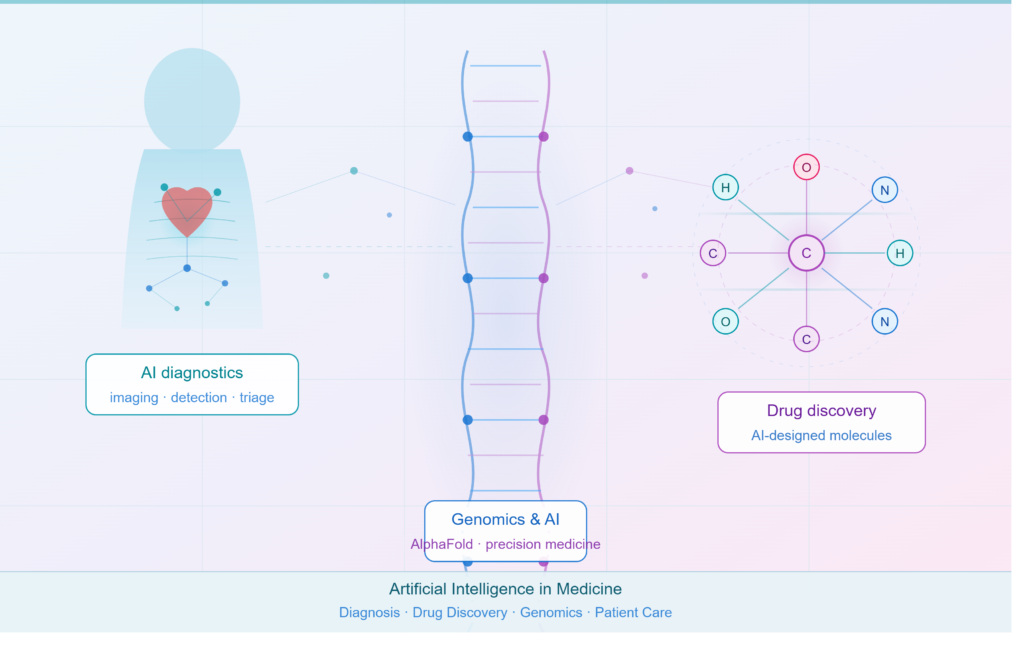
Medicine’s Quiet Revolution
Healthcare has always advanced in waves, examples being germ theory, antibiotics, the randomised controlled trial, genomic sequencing. Each wave took decades to become standard practice. Artificial intelligence is different. The pace at which AI tools have moved from research papers to clinical wards has compressed that timeline dramatically, and the breadth of the transformation, including touching diagnostics, drug development, genomics, and patient management simultaneously, has no obvious historical parallel.
This is not hype at distance. It is measurable, already underway, and raising genuinely difficult questions about how medicine will be practised, validated, and governed in the decade ahead.
Seeing What Human Eyes Miss: AI in Medical Imaging
The area where AI has achieved the most clinically validated impact is medical imaging. As of December 2025, over 1,300 AI-enabled medical devices have received FDA marketing authorisation, with 1,039 specifically for radiology — accounting for roughly 80% of all approved AI medical tools. These are not experimental prototypes; they are deployed daily in hospitals across the United States, Europe, and Asia.
The performance numbers are striking. Deep learning models can identify tumours, strokes, and fractures within seconds, with real-world studies demonstrating up to 17.6% higher breast cancer detection rates. In stroke treatment, where neurological damage accumulates with every passing minute, AI has reduced door-to-treatment intervals by as much as 30 minutes, with measurable improvements in survival rates and patient outcomes.
The mechanism is convolutional neural networks trained on tens of millions of labelled scans. These networks learn to identify statistical patterns in pixel distributions that correlate with pathology — patterns that may be too subtle or spatially diffuse for a human radiologist under time pressure to consistently detect. In breast cancer screening specifically, AI-assisted interpretations have lowered false negatives by almost 9% and decreased unnecessary recall rates — reducing both missed cancers and patient anxiety from false alarms simultaneously.
The caveat is important. AI is not a substitute for doctors: it can make mistakes or generate false positives, and over-reliance risks impairing clinicians’ skills. The clinical consensus, reflected in nearly every major radiology society’s guidance, is that AI functions best as a co-pilot — triaging the scan queue, flagging anomalies for human review, and performing automated measurements — while the radiologist retains diagnostic authority.
The AlphaFold Moment: Rewriting Drug Discovery
If imaging AI represents evolutionary improvement in existing workflows, AlphaFold represents something more fundamental: a solution to a problem that had defeated biology for half a century.
Proteins fold from linear amino acid chains into precise three-dimensional structures that determine their function. Predicting that structure from sequence alone — the protein folding problem — was considered one of the hardest open problems in science. Google DeepMind’s AlphaFold 2, published in Nature in 2021, solved it with accuracy comparable to experimental methods. Its creators Demis Hassabis and John Jumper were awarded the 2024 Nobel Prize in Chemistry for the work. By November 2025, AlphaFold was being used by over three million researchers across more than 190 countries, tackling problems including antimicrobial resistance, crop resilience, and heart disease.
AlphaFold 3, released in 2024, extended the capability beyond proteins to predict the structure and interactions of DNA, RNA, ligands, and small molecules — with at least a 50% improvement over existing methods for protein-molecule interactions, and doubled prediction accuracy for some drug-relevant interaction categories. For drug discovery, this is transformative. The traditional pipeline required experimental determination of a target protein’s structure — a process taking months or years — before rational drug design could begin. AlphaFold collapses that step to hours.
The pharmaceutical industry has responded at scale. A landmark development at the 2026 J.P. Morgan Healthcare Conference was a $1 billion co-innovation lab announced by Nvidia and Eli Lilly, aimed at creating a continuous learning system connecting agentic wet labs with computational dry labs around the clock. AstraZeneca, Bristol Myers Squibb, Roche, and Recursion Pharmaceuticals have all announced multi-hundred-million-dollar AI drug discovery partnerships in the same period.
The critical open question is clinical validation. The most advanced AI-designed drugs are now entering Phase III pivotal trials in 2026, with multiple clinical readouts expected throughout the year — the first large-scale test of whether AI genuinely improves success rates beyond the pharmaceutical industry’s persistent 90% clinical trial failure rate. Computational elegance and clinical efficacy are not the same thing. The next two years will determine whether the investment thesis is justified.
Genomics, Precision Medicine, and the Individual Patient
Beyond imaging and drug design, AI is enabling a more fundamental shift in how medicine conceptualises the patient. Traditional medicine treats populations — a drug is approved because it outperforms placebo in a trial of thousands. Precision medicine asks a different question: which treatment is most likely to work for this specific patient, given their genetic profile, biomarkers, and disease subtype?
AI-powered clinical decision support systems are stepping into the gap created by the rapid and unmanageable expansion of medical knowledge. Platforms like OpenEvidence, among the most widely adopted decision support tools in US medicine, allow physicians to rapidly search medical literature, synthesise findings, and check drug interactions at the point of care.
In genomics, models trained on population-scale genetic databases can now identify disease-causing variants with a precision that was impossible using statistical methods alone. These systems can speed up genetic diagnosis for rare and complex illnesses by frequently ranking the true disease-causing mutation within the top ten candidates, and guide personalised treatment by linking genetic variants directly to their expected clinical manifestations.
The combination of genomic data, electronic health records, and AI-driven pattern recognition is creating what researchers describe as a “learning health system” — one in which every patient encounter generates data that improves predictions for the next patient with a similar profile. This is medicine learning from itself at a scale and speed that no previous generation of clinicians could achieve.
The Governance Problem
The pace of deployment has outrun the pace of regulation, and the gap is generating legitimate concern. Roughly 200 state AI bills are being tracked in 2026 alone, and 83% of polled healthcare workers say AI needs more regulation — reflecting broad industry support for clearer governance frameworks even as the federal government takes a largely deregulatory stance.
The EU AI Act’s high-risk provisions, which take effect August 2026, classify AI systems used in medical diagnosis and drug development as high-risk — requiring conformity assessments, transparency obligations, and human oversight mechanisms. The US approach remains more fragmented, relying primarily on the FDA’s device authorisation framework, which does not require rigorous clinical validation — FDA clearance alone does not guarantee real-world effectiveness.
The algorithmic bias problem deserves specific attention. AI systems trained predominantly on data from specific demographic groups — which describes most current medical AI, given the historical composition of clinical trial populations — can perform significantly worse for underrepresented groups. A model that detects diabetic retinopathy with 95% accuracy on one ethnic population may perform at 80% on another, with no visible signal in aggregate accuracy statistics that a problem exists.
What Comes Next
The trajectory of AI in healthcare points toward three developments that are likely to define the next decade. Multimodal AI — systems that integrate imaging, genomics, clinical notes, and wearable sensor data simultaneously — will produce risk models and diagnostic tools with a richness that no single-modality system can match. Agentic AI in clinical workflows will handle administrative burden, prior authorisation, documentation, and care coordination autonomously, returning clinician time to patients. And AI-designed therapeutics will, if the current Phase III trials vindicate the approach, fundamentally alter the economics of bringing new drugs to market.
None of this makes medicine easier. It makes it more capable and correspondingly more demanding of the humans who must govern, validate, and take clinical responsibility for what these systems produce. That, ultimately, is where the most important work remains to be done.
You May Also Like
The AI IPO Race: 5 Critical Numbers Investors Cannot Ignore
Inside the Alarming AI Circular Financing Web: How Nvidia, OpenAI, and Microsoft Fund Each Other’s Growth