
AI Slop Is Eating the Internet. Here Is What We Can Do About It.
The Word That Defined an Era
In December 2025, Merriam-Webster announced its Word of the Year. It was not a technical term, a political coinage, or a neologism born in academic journals. It was “slop“, defined as low-quality digital content that is usually produced in quantity by means of artificial intelligence. The American Dialect Society followed in January 2026, with over 300 linguists voting it their Word of the Year too. Australia’s Macquarie Dictionary had reached the same conclusion a month earlier. Three major lexicographic institutions, independently, chose the same word to describe the defining cultural phenomenon of our moment.
The timing was not coincidental. In 2025, OpenAI’s Sora app, which helps users generate videos with AI, became widely available alongside other powerful generative AI platforms. Anyone could produce hundreds of videos, images, or articles with minimal effort or expertise. The floodgates had opened, and what poured through was, in large quantities, junk.
What AI Slop Actually Is
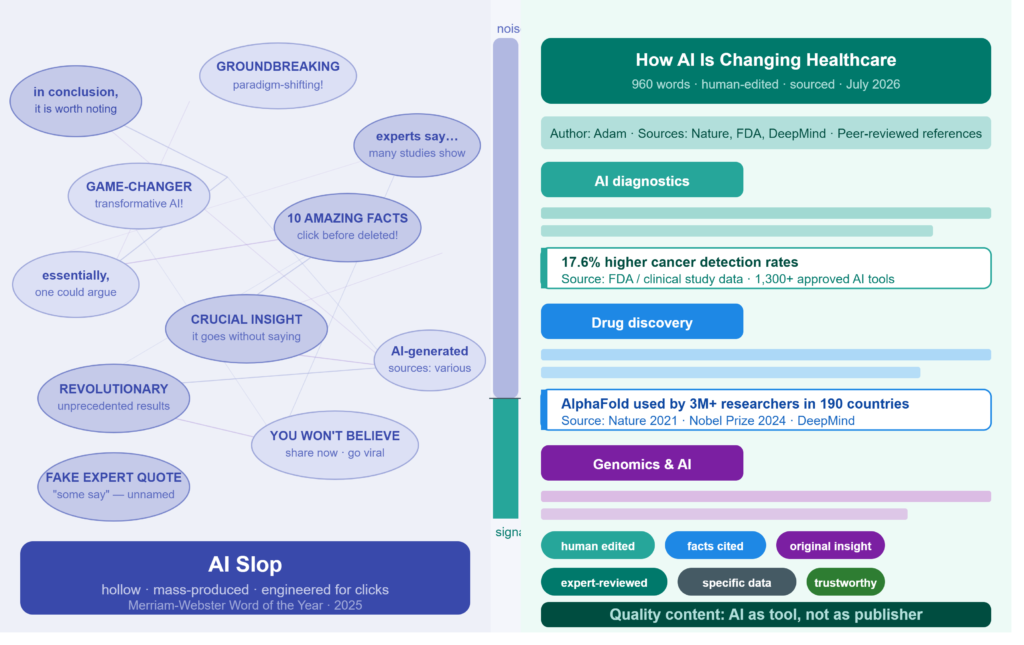
AI slop is low-quality, mass-produced content generated by artificial intelligence with minimal human oversight or editing. The term describes content that is technically coherent but practically useless: generic phrasing, recycled information, missing original insight, and a neutral tone that sounds authoritative without saying anything specific.
It manifests across every medium. On social media, AI slop is frequently used in political campaigns in an attempt at gaining attention through content farming. On YouTube, a March 2026 investigation by The New York Times found that around 40% of videos recommended to children, both on the main platform and on YouTube Kids, appear to be AI slop, often with realistic or Cocomelon-style visuals. On streaming music platforms, in June 2025, Deezer estimated that as much as 70% of streams of AI-generated tracks on its platform were fraudulent, highlighting concerns about mass low-quality output competing with human-made music.
The written web is no different. Graphite reported that 49.9% of English-language articles in its Common Crawl sample were classified as primarily AI-generated during the first quarter of 2026. NewsGuard, tracking AI content farms, had identified 3,749 AI content-farm news and information sites operating across 16 languages as of June 2026.
The economics driving this are straightforward. Social media platforms reward engagement metrics such as views, clicks, watch time, and shares. AI slop often performs because it employs techniques specifically designed to trigger algorithmic promotion. Content farms discovered they could operate profitably by flooding platforms with synthetic material. Creating quality content requires time, skill, and resources. AI slop requires almost none of these.
Why It Is More Dangerous Than Spam
It would be tempting to dismiss AI slop as a modern variant of email spam – annoying but ultimately manageable. That comparison underestimates the problem considerably. Spam was identifiable, repetitive, and explicitly intrusive. AI slop, on the other hand, is characterised by an appearance of normalcy. The content it generates is often visually polished, syntactically correct, sometimes even initially appealing.
The deeper harm is epistemic. A 2026 Internet Archive study raised a related concern: although it did not find a measurable decline in factual accuracy across its sample, its authors suggested that the growing difficulty of distinguishing human and AI writing may cause people to discount the credibility of online information more broadly. The result may not be that readers believe every falsehood. They may simply become less willing to believe anything.
The overabundance of automatically generated content creates an environment where signal is drowned in noise. Users must expend increasing cognitive effort to identify relevant, reliable, or simply human information. Several analyses now speak of attentional fatigue or AI fatigue.
There is also a self-reinforcing feedback loop at work. The process of AI slop creates a self-reinforcing cycle: platforms prioritise engagement, slop dominates search results, and displaces human-created, high-quality content. When AI training datasets are then built from the web, they ingest increasing proportions of AI-generated content — models trained on the outputs of previous models, in a degrading loop researchers call “model collapse.”
What Platforms Are — and Are Not — Doing
The platform response has been real but uneven. Google’s March 2024 core update specifically targeted AI slop, integrating the helpful content system into its core algorithm. The result: a 45% reduction in low-quality, unoriginal content in search results — exceeding their initial 40% target. Google’s stated position is that it does not penalise content for being AI-generated, but does penalise content for being unhelpful — a distinction that is meaningful in principle but difficult to enforce at scale.
In January 2026, YouTube CEO Neal Mohan declared “managing AI slop” a top priority for the year. YouTube now requires creators to disclose AI-generated content, labels AI-produced videos, and is expanding its likeness detection system to millions of creators. Meta began labelling AI-generated content in May 2024 and by 2025 was disallowing monetisation for repetitive, unoriginal AI content.
Pinterest has gone further, introducing controls that let users limit the amount of generative AI content in their feeds in select categories. It is one of the few examples of a platform giving individual users direct agency over their own AI slop exposure.
The EU AI Act, in force since August 2024, requires that generative AI outputs be marked in machine-readable format and that deepfakes be labelled, with fines reaching 3% of global turnover for violations. However, the AI Forensics Study (2025) shows a lack of enforcement of labelling — regulatory intent has outpaced regulatory capacity.
What Creators, Businesses, and Readers Can Do
The critical distinction, often lost in public debate, is between AI-generated content and AI slop. The defining quality of AI slop is not that it was made with AI. It is that it was made carelessly with AI and published without meaningful human judgment. The term “AI caviar” has been coined informally for its opposite — content where AI handled the drafting and formatting while expert humans contributed specific knowledge, original perspective, and editorial judgement.
For creators and businesses, the practical controls are clear. Treat AI output as a first draft, not a finished product. Add original research, specific data, named sources, and first-hand experience — the elements that AI cannot generate and that search engines and readers increasingly reward. Avoid the telltale patterns that mark slop: generic phrasing, repetitive structure, a lack of specific examples or concrete details, and an absence of genuine human perspective.
For readers and consumers, AI literacy is the primary defence. Recognise the signatures: unnaturally smooth images, text that sounds confident while saying nothing specific, attributions to unnamed “experts” and “studies,” and articles that describe categories of information rather than specific instances of it. Tools such as GPTZero can assist detection, but no tool replaces the judgement of a reader who has learned to notice when content rings hollow.
For platforms, the only sustainable response is restructuring the economic incentives that make slop profitable. As long as views and engagement drive revenue irrespective of content quality or origin, the production of AI slop will remain economically rational. Volume caps, quality scoring, and tying monetisation to editorial standards are the levers available — and the platforms with the largest audiences have been the slowest to pull them.
The Signal Worth Preserving
AI slop is not an argument against AI. It is an argument against carelessness. The same tools that flood the internet with hollow content are also powering genuine scientific breakthroughs, enabling new forms of creativity, and making expert knowledge accessible at unprecedented scale. What they cannot do is supply the judgement, experience, and intellectual honesty that distinguish valuable content from noise.
That judgement remains stubbornly human. The challenge of the current moment is ensuring that the economics of the internet stop punishing it.
You May Also Like
Moody’s Sounds a Critical Alarm: Is Hidden AI Debt risk a Ticking Financial Time Bomb
AI Data Centers: The Critical Strategic Assets Powering America’s Next Industrial Revolution (Part 1)