AI News & Industry Updates
Stay informed about the latest developments in artificial intelligence, generative AI, machine learning, AI agents, new model releases, industry trends, research breakthroughs, and technology innovations shaping the future of work and business.
-
The Explosive Rise of Data Center Opposition: Inside America’s Fight Over Who Pays the Price (Part 2)
This is Part 2 of a two-part series examining the current affairs debate surrounding AI data centers. Part 1 examined the case that these facilities function as genuine strategic national assets. Part 2 examines the rapidly intensifying data center opposition movement sweeping the country, the specific harms driving it, and the growing legal and political push to hold operators directly liable.
A Movement That Crossed a Threshold in 2026
Part 1 of this series took seriously the argument that AI data centers function as genuine strategic infrastructure. That argument has not disappeared. But it now sits alongside a second, equally well-documented reality that no honest account of this current affairs debate can minimize. Data center opposition has become, in the words of one recent analysis, the most bipartisan issue since beer.
-
AI Data Centers: The Critical Strategic Assets Powering America’s Next Industrial Revolution (Part 1)
This is Part 1 of a two-part series examining the current affairs debate surrounding AI data centers. Part 1 examines the case that these facilities function as genuine strategic national assets, comparable in economic significance to the automobile industry’s rise a century ago. Part 2 will examine the mounting community opposition, the growing calls to hold data center operators directly liable for local harm, and where this genuinely difficult policy tension is likely headed.
An Investment Scale That Demands Serious Analysis
Nearly 800 billion dollars in hyperscaler infrastructure spending in a single year, examined in detail in this blog’s recent five-part series on AI economics, is not a number that exists in a vacuum. It represents a deliberate, sustained national and corporate bet that AI data centers constitute genuine strategic infrastructure, not merely a speculative technology fad. Morgan Stanley’s own 2026 market research puts this framing directly: artificial intelligence is no longer just a disruption theme, it is emerging as a strategic asset, central to economic competitiveness, military capability, and energy planning, with nearly 3 trillion dollars in AI-related infrastructure investment expected to flow through the global economy by 2028.
-
The Essential Guide to Using Agentic AI Effectively While Avoiding Costly Failure (Part 2)
This is Part 2 of a two-part series examining agentic AI in depth. Part 1 traced the term’s origin and rapid emergence into the defining technology story of 2025 and 2026. Part 2 examines how agentic AI can actually be used effectively, the specific patterns separating successful deployments from the substantial share already documented as failing, and where the technology is heading next.
A Sobering Statistic That Demands Attention
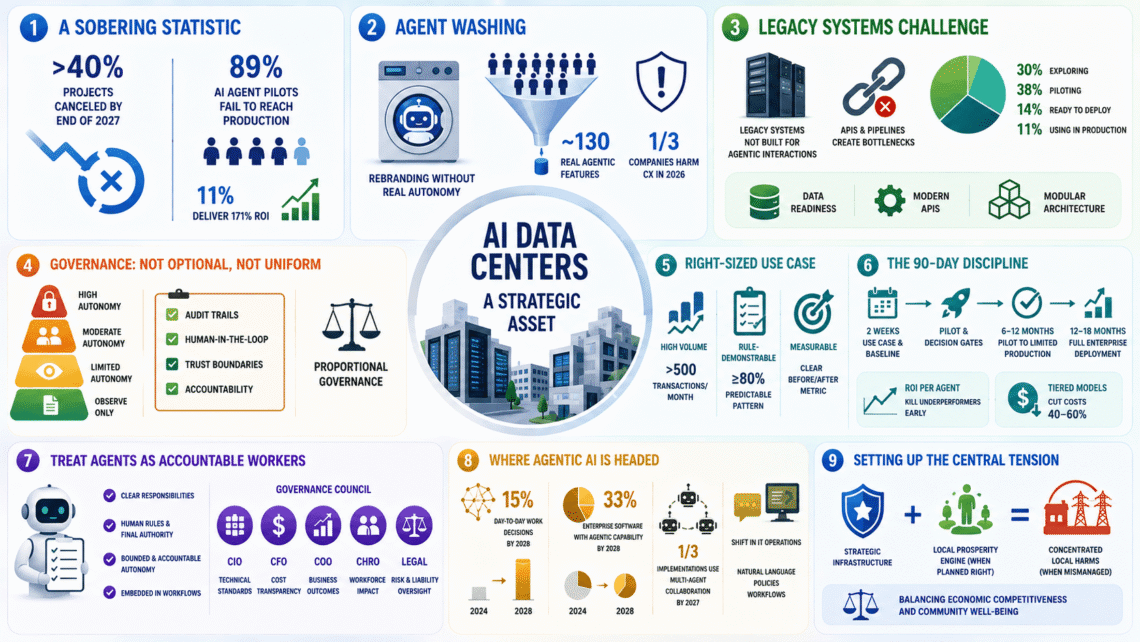
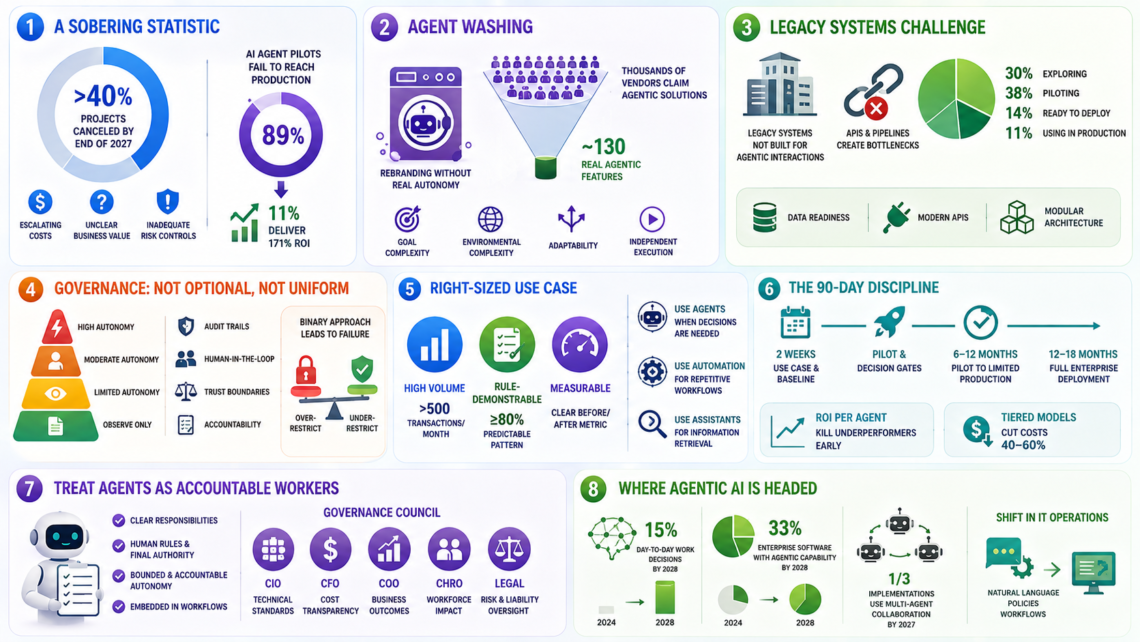
Part 1 of this series traced agentic AI from a psychology term through Andrew Ng’s 2024 reframing to Google’s formal declaration of an agentic era. That trajectory could easily suggest a technology on an uninterrupted upward path. The reality on the ground is considerably more complicated, and any honest guide to using agentic AI effectively must begin with the failure data rather than skip past it. Gartner, based on a poll of more than 3,400 organizations actively investing in the technology, predicts that over 40 percent of agentic AI projects will be canceled by the end of 2027, due specifically to escalating costs, unclear business value, or inadequate risk controls.
-
The Powerful Rise of Agentic AI: Tracing Its Origins and Explosive Emergence (Part 1)
This is Part 1 of a two-part series examining agentic AI in depth. Part 1 traces the term’s origin, defines it precisely, and follows its rapid emergence from academic obscurity to the defining technology story of 2025 and 2026. Part 2 will examine how agentic AI can be used effectively, the frameworks separating genuine success from costly failure, and where the technology is heading next.
A Word Borrowed From Psychology, Repurposed by Engineers
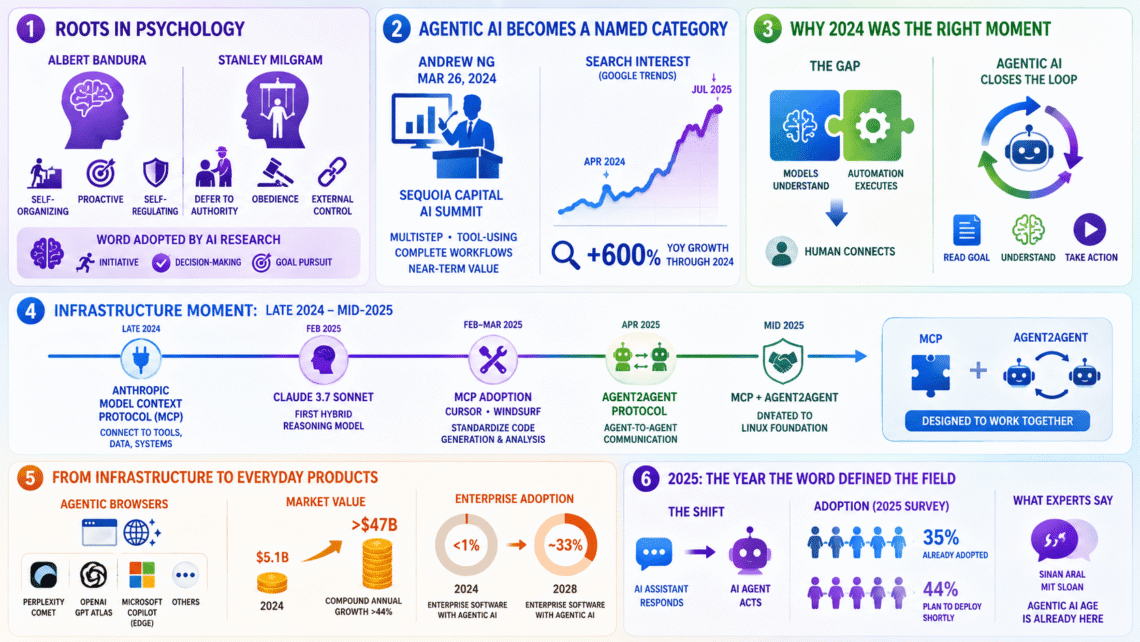
Before agentic AI became one of the fastest-growing terms in enterprise technology, agentic already had a settled meaning in an entirely different field. Psychologist Albert Bandura used the word to describe individuals who are self-organizing, proactive, and self-regulating, people who shape their own circumstances rather than merely reacting to them.
Stanley Milgram, in his famous obedience experiments, used the same root word differently still, describing an agentic state in which individuals defer their own judgment to an external authority. Both meanings, self-directed initiative and the capacity to act rather than simply respond, would eventually converge, decades later, into how the AI research community adopted the term.
The AI field itself began using agentic in the 2010s, applying it to software systems exhibiting qualities analogous to human agency, initiative, decision-making, and independent goal pursuit. But this early usage remained confined almost entirely to academic papers and specialist research circles. Merriam-Webster’s current definition, able to accomplish results with autonomy, used especially in reference to artificial intelligence, reflects how thoroughly the term has since migrated from psychology into everyday technology vocabulary, a migration that happened remarkably fast once it began in earnest.
The Moment Agentic AI Became a Named Category
While the underlying research concepts trace back decades, the specific framing of agentic AI as a distinct, named category with strategic significance has a more precise point of origin. Andrew Ng, the Stanford professor and AI pioneer, is widely credited with coining and popularizing the term in its modern usage at the Sequoia Capital AI Summit on March 26, 2024, arguing specifically that multistep, tool-using systems capable of executing complete workflows might deliver more near-term economic value than simply continuing to scale ever-larger foundation models.
This was a genuinely consequential reframing. It shifted the industry conversation away from a narrow focus on model size and benchmark scores, and toward a different question entirely, what these systems could actually accomplish when given the ability to act, not merely respond.
Google Trends data confirms just how sharply this reframing caught on. Interest in agentic AI as a search term remained minimal for years, then spiked sharply beginning in April 2024, immediately following Ng’s talk, and continued climbing to reach its peak popularity in July 2025. A separate industry analysis found search volume for the term increasing by more than 600 percent year on year through 2024, a growth curve that mirrors, and in some respects exceeds, the public fascination that greeted ChatGPT’s own release in late 2022.
Why 2024 Was the Right Moment, Not an Arbitrary One
The timing of agentic AI’s emergence as a distinct category was not coincidental. It reflected a genuine technical gap that had become obvious to practitioners across the industry roughly simultaneously. By 2024, many organizations had reached the same realization from independent directions. Large language models could understand human intent far better than any prior technology, and separate automation tools could reliably execute repeatable, predefined steps, but these two capabilities lived in entirely separate parts of the workflow, disconnected from one another. Work moved forward only when a human being manually connected the interpretation step to the execution step, reading a model’s output and then personally performing whatever action it recommended.
This specific gap, models that understood but could not act, and automation that could act but could not understand, is precisely what agentic AI was built to close. Rather than stopping at interpretation, as a standard chatbot does, agentic systems were designed to read a goal, understand its surrounding context, and then carry out the necessary actions directly within a live system, closing the loop that had previously always required manual human intervention.
The Infrastructure Moment: Late 2024 Through Mid-2025
Understanding why agentic AI moved from a promising concept to genuine production reality requires tracing a specific sequence of infrastructure milestones that unfolded across roughly eighteen months. In late 2024, Anthropic introduced the Model Context Protocol, an open standard allowing large language models to connect to external tools, databases, and live systems in a consistent, predictable way, examined extensively elsewhere on this blog. This single development is widely regarded as the key inflection point that made agentic AI practically deployable at scale, since it gave models, for the first time, a reliable and standardized way to reach beyond generating text and actually act upon the world.
The momentum continued to build rapidly through the first half of 2025. In February 2025, Anthropic released Claude 3.7 Sonnet, described as the first hybrid reasoning model on the market, and the Model Context Protocol specification itself gained widespread adoption across development tools including Cursor and WindSurf, which integrated it directly to standardize code generation and repository analysis.
In April 2025, Google introduced a complementary protocol, Agent2Agent, addressing a distinct problem from MCP, not how a single agent connects to external tools, but how multiple separate agents communicate and coordinate with one another. Crucially, the two protocols were designed from the outset to work together rather than compete, and by later in the year both had been donated to the Linux Foundation, cementing them as genuinely open, vendor-neutral industry standards rather than proprietary experiments controlled by any single company.
From Infrastructure to Everyday Products
These underlying protocol developments translated into visible consumer and enterprise products with striking speed. By mid-2025, agentic browsers began appearing across the industry, tools including Perplexity’s Comet, OpenAI’s GPT Atlas, Microsoft’s Copilot integration within Edge, and several others, each reframing the humble web browser from a passive window for displaying information into an active participant capable of completing entire tasks independently, such as booking a vacation directly, rather than merely helping a user search for flight options and leaving the actual booking to them.
The market figures accompanying this product wave were substantial by any measure. The market value of agentic AI reached approximately 5.1 billion dollars in 2024, and industry analysis from Capgemini projects that figure will exceed 47 billion dollars, growing at a compound annual rate above 44 percent. Perhaps more tellingly, in 2024 less than 1 percent of enterprise software included any agentic AI capability at all. By 2028, analysts expect close to a third of all enterprise software to incorporate it, a genuinely dramatic penetration curve for any enterprise technology category to achieve within a single decade.
2025: The Year the Word Defined the Field
By the close of 2025, agentic had become, in the words of one widely circulated year-end industry retrospective, the one word that captures the life of artificial intelligence in 2025, a term that transcended mere buzzword status to become the defining characteristic of how organizations and individuals actually experienced AI throughout the year. Where 2023 and 2024 had been dominated almost entirely by generative AI’s ability to create text, images, and code upon request, 2025 marked a genuine transition, from AI functioning as a responsive assistant waiting to be asked, toward AI functioning as an autonomous actor capable of completing complex, multi-step tasks with minimal continuous human direction.
MIT Sloan management professor Sinan Aral captured the state of the field succinctly in early 2026, stating plainly that the agentic AI age is already here, noting that agents are already deployed at scale across the economy performing all kinds of tasks. A spring 2025 survey conducted jointly by MIT Sloan Management Review and Boston Consulting Group found that 35 percent of surveyed organizations had already adopted AI agents in some form, with a further 44 percent expressing concrete plans to deploy the technology in short order, figures that place agentic AI among the fastest enterprise technology adoption curves ever measured.
Google Formalizes the Shift at I/O 2026
The clearest institutional confirmation that agentic AI had moved from emerging trend to defined industry era arrived at Google I/O 2026, where Sundar Pichai and the Google DeepMind team did not simply announce new models in the manner of prior years, but explicitly reframed what AI itself is meant to do going forward.
The shift they articulated was specific and deliberate, moving away from smarter chatbots and improved search results, toward AI that takes genuine initiative, executes multi-step tasks independently, and works on a user’s behalf without requiring continuous hand-holding throughout the process. The distinction Google drew was precise and worth repeating exactly, a chatbot answers, an agent does, a formulation that captures the entire conceptual shift this article has traced in a single, memorable sentence.
Where the Definition Stands Today
Current academic and industry consensus increasingly frames agentic AI not as a fixed, binary classification but as a continuous spectrum, a concept researchers now call agenticness, defined as the degree to which a system can adaptably achieve complex goals in dynamic environments with limited direct supervision. This spectrum encompasses four measurable dimensions, the complexity of goals a system can pursue reliably, the complexity of the environments it can operate within, its capacity to adapt to genuinely novel or unexpected circumstances, and its ability to execute independently with minimal ongoing human intervention.
OpenAI’s own internal framing treats agentic as a gradual continuum rather than a strict yes-or-no category, meaning that as any given system’s capabilities along these four dimensions cross a sufficiently high combined threshold, it naturally transitions from being simply an AI tool into being recognized, functionally, as agentic AI.
This nuanced framing matters considerably for how organizations and individuals should think about the technology going into Part 2 of this series, since it clarifies that adopting agentic AI effectively is not a matter of flipping a single switch from non-agentic to fully autonomous, but rather a matter of deliberately choosing how far along this spectrum any given task or workflow genuinely needs to sit.
Conclusion
Agentic AI’s journey from a niche psychological term, through decades of quiet academic development in robotics and multi-agent systems research, to Andrew Ng’s specific 2024 reframing, and finally to Google’s explicit declaration of an agentic era at I/O 2026, represents one of the fastest conceptual migrations in recent technology history. What makes this trajectory genuinely significant, rather than merely another cycle of industry buzzword inflation, is that it was accompanied at every stage by concrete, verifiable infrastructure milestones, the Model Context Protocol, Agent2Agent, and the resulting standardized ecosystem, each addressing a specific, previously unsolved technical gap between AI systems that could understand and automation that could act.
Part 2 of this series turns from this historical account toward the genuinely practical question this trajectory raises for any individual or organization today, how agentic AI can actually be used effectively, which specific patterns separate the deployments generating real, measurable value from the substantial share already documented as failing to deliver on their promise, and where this technology is realistically headed over the next several years.
Part 2: Using Agentic AI Effectively, coming next in the Current Events series.
-
The Powerful AI LLM Landscape 2026: Mapping the Titans, Contenders, and Rising Challengers
A $2.37 Trillion Private Market and Counting
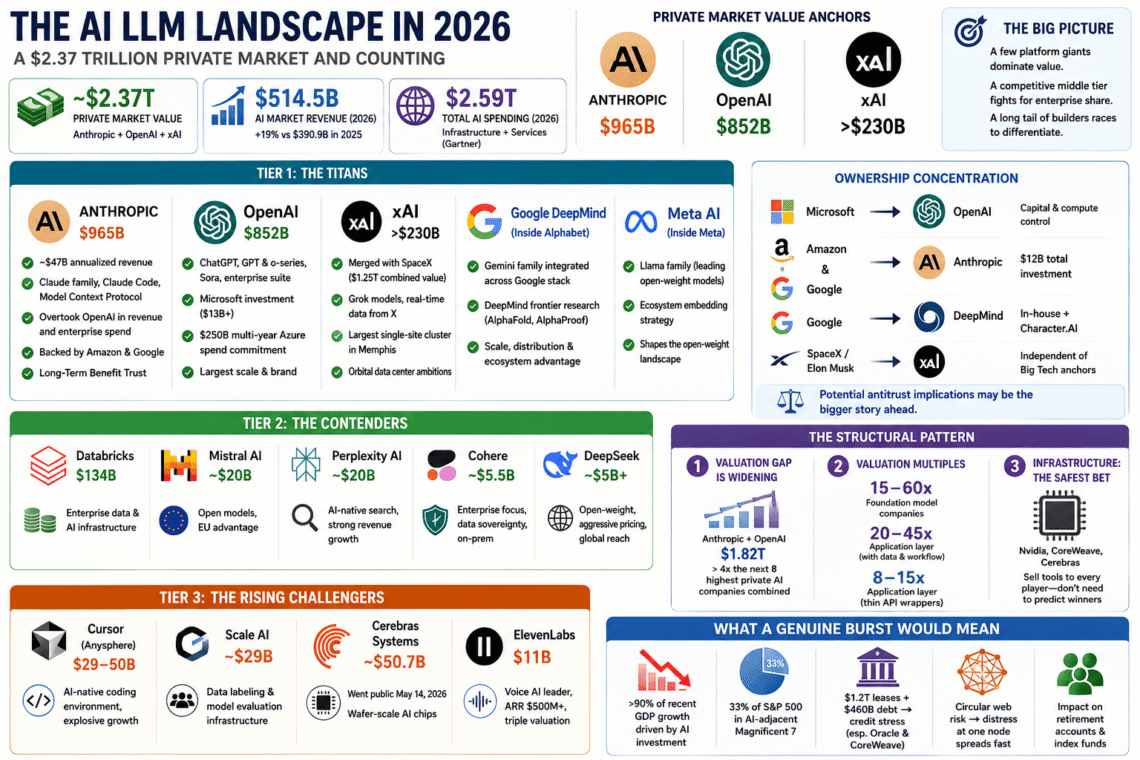
The AI LLM landscape has bifurcated sharply into a small handful of platform companies commanding valuations larger than most national economies, a competitive middle tier fighting for enterprise share, and a long tail of application builders racing to differentiate before the giants absorb their category. Anthropic, OpenAI, and xAI alone now anchor a private market worth roughly 2.37 trillion dollars, with global AI market revenue reaching approximately 514.5 billion dollars in 2026, up 19 percent from 390.9 billion dollars the prior year.
Total worldwide AI spending, including infrastructure and services, is projected by Gartner at 2.59 trillion dollars. Understanding who occupies which tier of this AI LLM landscape, and why, is now essential reading for investors, enterprise buyers, and anyone tracking where genuine value is accumulating in the industry.
Tier One: The Titans
Anthropic sits atop the current AI LLM landscape following a genuinely remarkable repricing. The company filed for its IPO on June 1, 2026, at a 965 billion dollar valuation, built on roughly 47 billion dollars in annualized revenue. Its jump from a 380 billion dollar valuation to 965 billion took roughly three months, driven by Anthropic passing OpenAI in revenue in April 2026, reaching a 30 billion dollar run rate against OpenAI’s 25 billion, after scaling from just 1 billion dollars in annual recurring revenue in only fifteen months.
Anthropic’s Claude business has separately overtaken OpenAI in enterprise business spending share, reaching 34.4 percent according to Ramp payments data. Its flagship products span the Claude model family, Claude Code for software development, and the Model Context Protocol, now the industry’s dominant agent integration standard. Governance sits with a Long-Term Benefit Trust designed to preserve mission alignment despite billions in backing from Amazon and Google.
OpenAI filed its own IPO exactly one week after Anthropic, on June 8, 2026, at an 852 billion dollar valuation. Products span ChatGPT, the GPT and o-series API models, Sora for video generation, and a rapidly expanding enterprise and agentic tooling suite. Microsoft’s 13 billion dollar plus investment anchors the relationship, with Azure serving as OpenAI’s primary compute backbone under a 250 billion dollar multi-year spending commitment discussed at length elsewhere on this blog. OpenAI’s position in the AI LLM landscape remains the largest by absolute scale and brand recognition, though its widening valuation gap with Anthropic through 2026 has become one of the year’s defining storylines.
xAI occupies a genuinely distinctive position in the AI LLM landscape following its February 2026 merger into SpaceX, creating a combined entity valued at 1.25 trillion dollars, the largest corporate merger in history, positioning the combined company for orbital data center ambitions and a blockbuster SpaceX IPO targeting up to 1.5 trillion dollars. Standalone, xAI carries a valuation north of 230 billion dollars, anchored by the Grok model family and what may be the largest single-site compute cluster in the world at its Memphis facility.
Real-time data integration with X gives xAI a genuine differentiator other labs cannot easily replicate, though its enterprise go-to-market motion remains underdeveloped relative to Anthropic and OpenAI, and Grok adoption outside the X ecosystem has been comparatively limited.
Google DeepMind and Meta AI round out the titan tier from within existing public companies rather than as standalone valuations. Google’s Gemini family benefits from full integration across Search, Workspace, and Android, alongside DeepMind’s continuing frontier research output including AlphaFold and AlphaProof, discussed extensively elsewhere on this blog. Meta’s Llama family remains the most consequential open-weight contribution from any Big Tech player in the current AI LLM landscape, a strategic bet on ecosystem embedding over proprietary API revenue that continues to shape competitive dynamics across the entire open-weight segment.
Tier Two: The Contenders
Databricks commands a 134 billion dollar valuation, positioning itself as critical infrastructure for enterprise data and AI pipelines rather than a consumer-facing model provider, a strategic niche that has proven durable precisely because it does not compete directly with the titan tier for frontier model bragging rights.
Mistral AI remains Europe’s clearest AI champion within the global AI LLM landscape, differentiated by open-weight models, a regulatory advantage under the EU AI Act, and continued strategic backing, including a two billion euro investment from ASML that helped push its valuation from six to fourteen billion dollars in under a year, with more recent figures cited near 20 billion dollars. Its principal constraints remain limited US market penetration and comparatively restricted compute access relative to its American rivals.
Perplexity AI occupies a genuinely interesting middle position, an AI-native search competitor backed by Jeff Bezos, Nvidia, and Founders Fund, currently valued near 20 billion dollars after a period of valuation stepping sideways rather than continuing to climb, reflecting intensifying competitive pressure in AI search from both Google and ChatGPT directly. Perplexity stands out specifically for revenue growth velocity even as its valuation growth has moderated.
Cohere has staked its position in the AI LLM landscape on enterprise data sovereignty and on-premise deployment, a differentiator whose durability depends heavily on whether that requirement remains genuine among regulated enterprise buyers or simply becomes a checkbox feature larger providers eventually bundle into their existing platforms at no additional cost.
DeepSeek, examined in detail in earlier coverage on this blog, remains a significant presence in the global AI LLM landscape specifically through open-weight distribution and aggressive pricing, though its Western enterprise penetration continues to be constrained by the data sovereignty and national security concerns documented in our prior coverage of its model distillation controversy.
Tier Three: The Rising Challengers
Beneath the contender tier, a genuinely crowded and fast-moving layer of application builders is racing to establish defensible positions before the titans absorb their categories directly. Cursor, built by Anysphere, has reached a valuation between 29 and 50 billion dollars on the strength of its AI-native coding environment, standing out specifically for revenue growth velocity that rivals or exceeds the titan tier on a percentage basis. Scale AI, valued near 29 billion dollars, anchors the data labeling and model evaluation infrastructure layer that every frontier lab depends on regardless of which model ultimately wins.
Cerebras Systems went public on May 14, 2026, in the year’s biggest tech IPO, and now trades at approximately 50.7 billion dollars in market capitalization following a post-earnings pullback, offering wafer-scale AI chip alternatives to Nvidia’s dominant position. ElevenLabs, focused on voice AI, tripled its valuation to 11 billion dollars following a 500 million dollar Series D, with annualized recurring revenue growing from 330 to 500 million dollars in under six months, one of the sharper growth trajectories anywhere in the current AI LLM landscape.
The Structural Pattern Investors Should Understand
Three patterns define the current AI LLM landscape and are likely to shape its second half of 2026. First, the valuation gap between foundation model companies and everyone else is widening rather than narrowing, with Anthropic and OpenAI together worth 1.82 trillion dollars, more than four times the combined value of the next eight highest-valued private AI companies. Second, foundation model companies trade at 15 to 60 times revenue, while application layer companies built on top of them trade considerably lower, 20 to 45 times revenue with proprietary data and deep workflow integration, but as low as 8 to 15 times if they function essentially as thin API wrappers with limited defensibility.
Third, infrastructure remains, in the words of one analyst, the safest bet in the entire AI LLM landscape. Nvidia, CoreWeave, and Cerebras do not need to predict which application or which model wins. They sell the tools to every side of the competition simultaneously, a structural advantage that has made chip and infrastructure providers the most consistently rewarded segment of the entire sector through 2025 and into 2026.
Ownership Concentration and the Bigger Story
Perhaps the most underappreciated dynamic within the current AI LLM landscape is how thoroughly cloud hyperscalers have won the underlying war for control of the frontier labs themselves. Microsoft effectively controls the OpenAI relationship through capital and compute dependency. Amazon and Google jointly anchor Anthropic through a combined 12 billion dollars in investment. Google maintains DeepMind entirely in-house alongside a commercial relationship with Character.AI.
The only frontier lab genuinely independent of a Big Tech anchor investor is xAI, where Elon Musk’s personal capital and now SpaceX’s balance sheet serve the equivalent function. Whatever position one takes on AI safety regulation, the antitrust implications of this concentration, a handful of trillion-dollar technology companies effectively controlling the entire frontier AI LLM landscape through capital rather than direct ownership, may prove to be the more consequential regulatory story of the coming years.
Conclusion
The AI LLM landscape in August 2026 is a market of extremes, a handful of trillion-dollar platform companies pulling further ahead of everyone else, a competitive middle tier carving out defensible enterprise niches around data sovereignty, coding, and search, and a genuinely crowded long tail of application builders whose survival increasingly depends on whether they can establish proprietary data advantages before the titans expand into their territory directly.
For investors and enterprise decision makers alike, the structural lesson emerging from this landscape is consistent with the infrastructure investment analysis developed across this blog’s recent economics series. Betting on any single model provider carries genuine concentration risk in a market this fast-moving. Betting on the infrastructure layer that serves every competitor simultaneously has, so far, proven to be the more durable position.
-
7 Alarming Warning Signs the AI Bubble Could Be Ready to Burst in 2026
Bringing the Full Picture Together
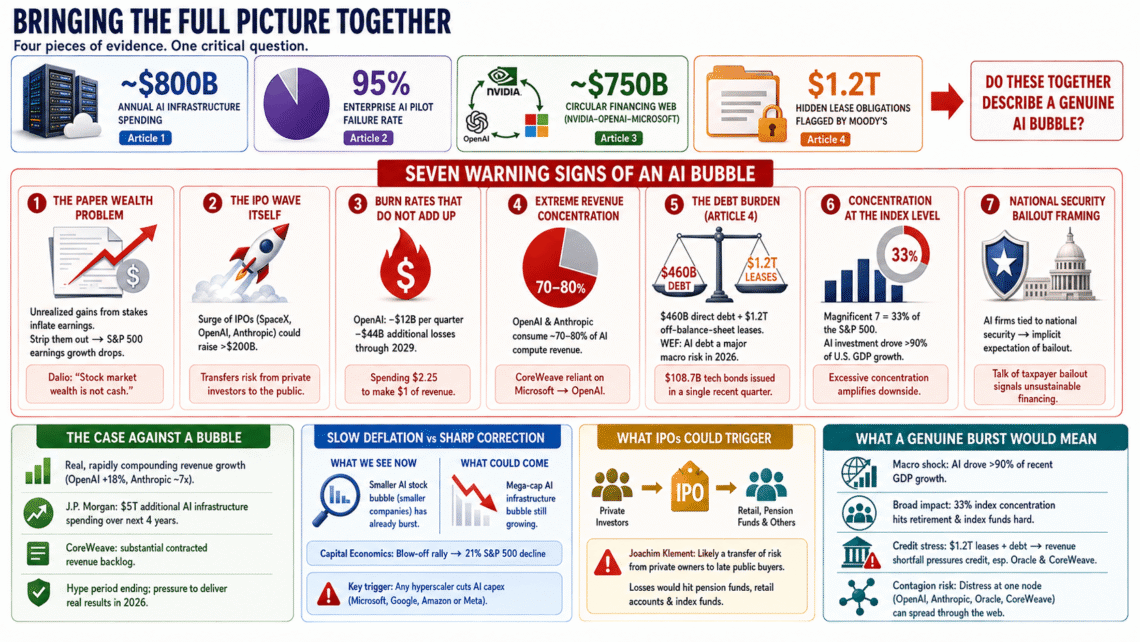
This series has traced nearly 800 billion dollars in annual hyperscaler AI infrastructure spending in Article 1, a 95 percent enterprise pilot failure rate in Article 2, a 750 billion dollar web of circular financing between Nvidia, OpenAI, and Microsoft in Article 3, and 1.2 trillion dollars in hidden lease obligations flagged by Moody’s in Article 4. Each of those articles examined one piece of the puzzle in isolation. This final article asks the question the entire series has been building toward. Taken together, do these four pieces of evidence describe a genuine AI bubble, and if so, what would its bursting actually look like.
The honest answer requires resisting both extremes that dominate public discussion. Dismissing all AI bubble concerns as reflexive skepticism from people who missed the boat ignores genuinely alarming, well-documented financial signals from serious institutions. Treating a bubble collapse as an inevitable, imminent certainty ignores substantial, equally well-documented evidence of real revenue growth and genuine underlying demand. What follows are seven specific, evidence-based warning signs, each drawn from credible financial reporting, followed by an honest look at the counter-arguments and what a genuine unwind would actually mean.
Warning Sign One: The Paper Wealth Problem
Bridgewater Associates founder Ray Dalio has issued what he describes as his most severe market warning yet, stating plainly that current conditions have pushed markets into AI bubble territory comparable to 1929 and 2000. His specific evidence is precise and easy to verify. Recent earnings from Amazon and Alphabet have been significantly inflated by unrealized investment gains from their stakes in unlisted AI companies including Anthropic, as private market valuations soared. Strip out these unrealized paper gains, and the S&P 500’s actual earnings growth rate drops sharply. Dalio’s core warning is simple and worth repeating exactly as he framed it. Stock market wealth is not cash.
Warning Sign Two: The IPO Wave Itself
Dalio identifies a second specific mechanism that has historically preceded bubble collapses. A surge in equity issuance combined with rising interest rates are the two forces that pop bubbles, and the current wave of IPOs from SpaceX, OpenAI, and Anthropic is, in his assessment, a classic warning sign. Anthropic closed a 65 billion dollar Series H round with a post-money valuation of 965 billion dollars, surpassing OpenAI, and is expected to formally launch its IPO process this fall.
Combined, the three pending mega IPOs could raise more than 200 billion dollars. Bank of America has characterized this specific pattern directly, stating that this epic IPO cycle is essentially a large-scale transfer of accumulated risk from early private investors to the public market, precisely the mechanism through which prior AI bubble style collapses have historically transmitted losses to a much broader set of investors.
Warning Sign Three: Burn Rates That Do Not Add Up
The clearest financial red flag underlying AI bubble concerns is the specific, quantifiable relationship between spending and revenue at the industry’s most prominent company. OpenAI is losing 12 billion dollars per quarter and expects 44 billion dollars in additional losses through 2029. Financial analyst Bittner summarized the arithmetic starkly, describing OpenAI as spending 2.25 dollars to make 1 dollar of revenue, and noting pointedly that no dot-com era company survived with that kind of burn rate. The comparison to the 2000 collapse is not incidental commentary. It is the specific historical benchmark analysts keep returning to.
Warning Sign Four: Extreme Revenue Concentration
A particularly concerning AI bubble signal involves how narrowly concentrated actual paying demand for AI infrastructure remains. OpenAI and Anthropic together consume roughly 70 to 80 percent of all AI compute revenue, yet both lose tens of billions of dollars annually. This concentration compounds the circular financing risk documented in Article 3 of this series. CoreWeave illustrates the downstream effect precisely. Its largest client is effectively Microsoft, purchasing capacity specifically to serve OpenAI, meaning CoreWeave’s revenue is highly concentrated in a chain that ultimately traces back to two companies, neither of which has demonstrated a clear path to profitability.
Warning Sign Five: The Debt Burden Documented in Article 4
The 1.2 trillion dollars in off-balance-sheet lease commitments and 460 billion dollars in direct debt detailed in the previous article of this series constitutes, on its own, one of the seven clearest AI bubble warning signs. Economists at the World Economic Forum have specifically flagged AI-related debt pressures as a worrying macroeconomic trend for 2026, and tech companies issued a striking 108.7 billion dollars in corporate bonds during a single recent quarter, a pace that has continued through the first half of 2026 without meaningful slowdown.
Warning Sign Six: Concentration at the Index Level
The AI bubble concern extends well beyond individual companies into the structure of the broader stock market itself. The so called Magnificent Seven technology stocks, Alphabet, Amazon, Apple, Nvidia, Meta, Microsoft, and Tesla, currently make up 33 percent of the entire S&P 500 index. AI-related investment accounted for over 90 percent of United States GDP growth in the first two quarters of the prior year, an extraordinary concentration of economic growth in a single sector. When any single theme drives this large a share of both an equity index and national economic growth simultaneously, the potential downside if that theme falters is proportionally amplified across the entire economy, not contained within the technology sector alone.
Warning Sign Seven: The National Security Bailout Framing
Perhaps the most novel AI bubble warning sign, one without a clean historical precedent from the dot-com era, is the increasing embedding of major AI companies directly into national defense contracts. Analysts have noted this could potentially lead to a future bailout request should financial conditions deteriorate sharply, since companies positioned as critical to national security infrastructure carry an implicit expectation of government backstop that purely commercial dot-com era companies never possessed. Scott Galloway has raised the same concern explicitly, noting that talk of a potential taxpayer bailout itself constitutes evidence that OpenAI lacks a sustainable financing strategy.
The Case Against a Bubble
Responsible analysis requires taking the counter-arguments equally seriously, and they are not trivial. Unlike many dot-com era companies that generated minimal revenue chasing speculative business models, today’s major AI companies show genuine, rapidly compounding revenue growth. The value of OpenAI subscriptions increased 18 percent in a recent year, while Anthropic’s Claude revenue grew nearly sevenfold over the same period.
J.P. Morgan projects 5 trillion dollars in additional AI infrastructure spending over the next four years, a figure that reflects institutional conviction in sustained demand rather than speculative excess alone. CoreWeave, despite its concentration risk, posted a substantial contracted revenue backlog, real signed commitments rather than merely aspirational projections. Chief research officer Sharyn Leaver captured the more measured institutional view precisely, noting that 2026 marks the point where the AI hype period ends as pressure to deliver real, measurable results intensifies, a description of a maturing market correcting its excesses rather than a market collapsing entirely.
Slow Deflation Versus Sharp Correction
Even among analysts convinced some form of AI bubble correction is coming, meaningful disagreement exists about its shape. Capital Economics has already observed that one narrower AI stock bubble, concentrated in smaller, less established companies, has already burst, while a larger, more consequential bubble specifically in mega-cap AI infrastructure stocks continues to grow. The firm’s own modeling anticipates a blow-off rally followed by a 21 percent S&P 500 decline once the larger AI bubble fully unwinds, a sharp correction scenario rather than a gradual one.
Benchmark’s Bill Gurley offered a similarly direct warning in March 2026, stating flatly that AI spending is about to reset. The specific trigger analysts are watching most closely is precise and observable, the moment any major hyperscaler, Microsoft, Google, Amazon, or Meta, publicly announces a cut to AI capital expenditure, an event that has not yet occurred but that multiple analysts identify as the single clearest signal an AI bubble correction has genuinely begun.
What OpenAI and Anthropic’s IPOs Could Actually Trigger
Financial analyst Joachim Klement has offered perhaps the bluntest characterization of what the pending OpenAI and Anthropic IPOs actually represent within the broader AI bubble debate, describing them as probably nothing more than a major transfer of investment risk from current private owners to retail investors, pension funds, and others willing to buy into the hype at a much later and more expensive stage of the cycle.
This framing matters considerably for anyone assessing what a genuine AI bubble collapse would mean practically. Unlike a purely private market correction, which primarily affects venture capital firms and wealthy early investors who can absorb losses, a public market collapse following these IPOs would transmit losses directly to pension funds, retail brokerage accounts, and index funds that millions of ordinary investors hold, a meaningfully different and more broadly damaging outcome than a private valuation reset alone.
What a Genuine Burst Would Mean
If the AI bubble concerns documented across all seven warning signs in this article ultimately prove correct, the consequences would extend considerably beyond the technology sector itself. Given that AI-related investment has driven over 90 percent of recent GDP growth, a sharp AI bubble correction would represent a genuine macroeconomic event, not merely a sector rotation.
Given the 33 percent index concentration in AI-adjacent Magnificent Seven stocks, the impact on retirement accounts and index funds held by ordinary investors would be immediate and significant. Given the 1.2 trillion dollars in debt and lease obligations documented in Article 4, a sharp revenue shortfall relative to expectations could trigger genuine credit stress at specific companies, particularly Oracle and CoreWeave, the two firms Moody’s already identified as facing the sharpest ratings pressure.
And given the deeply circular financing relationships documented in Article 3, distress at any single major node in that web, OpenAI, Anthropic, Oracle, or CoreWeave specifically, carries genuine potential to propagate rapidly through the tightly interconnected companies that depend on one another’s continued participation.
Conclusion
Across this five-part series, the evidence assembled points toward a genuinely mixed but increasingly concerning picture rather than a simple verdict in either direction. Real revenue growth and real infrastructure genuinely coexist alongside speculative excess, unsustainable burn rates, and dangerously concentrated financial exposure. Whether 2026 marks the beginning of the AI bubble’s gradual, manageable deflation, the kind that ultimately leaves behind genuinely valuable infrastructure the way the fiber optic bust eventually did, or a sharper, more disruptive correction triggered by the pending OpenAI and Anthropic IPOs, remains genuinely unresolved as of this writing.
What is no longer credible, based on the evidence traced across all five articles in this series, is the claim that no bubble exists at all. The specific question worth watching most closely, as multiple analysts have identified precisely, is straightforward and observable, whether and when a major hyperscaler is the first to publicly announce it is cutting AI spending. When that happens, this series suggests, the far larger unwind will already be underway.
-
Moody’s Sounds a Critical Alarm: Is Hidden AI Debt risk a Ticking Financial Time Bomb
A Warning From the Institution That Rates Trust Itself
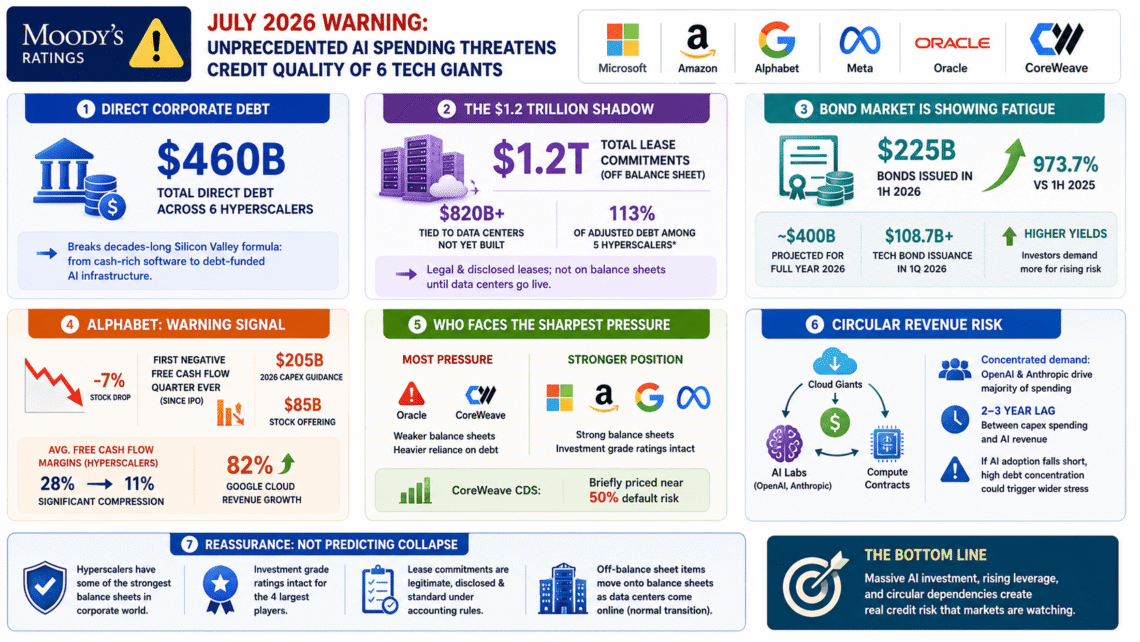
When Moody’s Ratings, one of the three institutions the entire global financial system relies on to judge whether a company can be trusted to repay what it owes, issues a formal warning about a specific industry, markets tend to pay close attention. In July 2026, Moody’s did exactly that, stating plainly that unprecedented AI spending threatens the credit quality of six of the largest technology companies in the world, Microsoft, Amazon, Alphabet, Meta, Oracle, and CoreWeave.
The core of the AI debt risk Moody’s identified is not that these companies are spending enormous sums, a fact already well documented in Article 1 of this series. It is how that spending is being financed, and how much of it remains deliberately structured to stay off the balance sheets investors actually scrutinize.
Understanding the specific mechanics of this AI debt risk, and why Moody’s chose this particular moment to sound the alarm, requires examining three distinct categories of exposure: direct corporate debt, off-balance-sheet lease commitments, and the bond market’s own increasingly nervous response to absorbing all of it at once.
The 460 Billion Dollar Direct Debt Figure
The most straightforward component of AI debt risk is direct corporate debt, borrowed money that already appears plainly on company balance sheets. According to Moody’s own analysis, direct debt across the six hyperscalers tracked in its report has reached approximately 460 billion dollars. This figure alone represents a meaningful shift for companies whose historical financial identity was built specifically on the opposite characteristic.
As Moody’s own report observes, the current moves break a decades-long Silicon Valley formula that created the world’s most valuable companies. Software cost little to replicate, yielding fat profit margins and fortress balance sheets. Generative AI, by contrast, demands a vast physical footprint, warehouses crammed with expensive and energy-hungry servers and chips, and that physical footprint is now being financed increasingly through borrowed capital rather than the internally generated cash flow that once defined these companies’ financial character.
The 1.2 Trillion Dollar Shadow
The far larger and more structurally significant component of AI debt risk sits entirely off the balance sheet, and this is where Moody’s analysis becomes genuinely alarming. Lease commitments across the six hyperscalers Moody’s tracks have ballooned to 1.2 trillion dollars, of which more than 820 billion dollars is tied to data centers that have not even finished construction yet. Moody’s accounting analysts David Gonzales and Alastair Drake calculated that an earlier snapshot of this hidden obligation, 662 billion dollars specifically tied to leases that had not yet begun among just five hyperscalers, was equivalent to 113 percent of those companies’ most recent adjusted debt, larger than everything already sitting openly on their balance sheets combined.
The accounting mechanism behind this AI debt risk is legal and well understood, but its scale is what has changed dramatically. Rather than owning every new AI data center outright, hyperscalers increasingly sign long-term leases with specialized infrastructure developers. Under generally accepted accounting principles, these lease commitments are not required to appear as current liabilities until the underlying data center actually begins operating.
Moody’s is explicit that this does not constitute deception, a Moody’s spokesperson clarified directly that this is not a case of companies avoiding a liability through structuring, simply that the obligation has not yet reached the balance sheet under standard accounting timing rules. Nonetheless, Moody’s treats these lease commitments as debt-equivalent liabilities, obligations that will bind these companies to substantial rent payments for years regardless of how AI revenue actually develops, and a separate investigation by Nikkei Asia Review found that off-balance-sheet obligations across five hyperscalers have surged eightfold in just four years to 1.65 trillion dollars, a figure that now exceeds their combined on-balance-sheet debt entirely.
The Bond Market Is Already Showing Fatigue
Perhaps the clearest real-time signal of genuine AI debt risk comes not from Moody’s report itself but from how the corporate bond market has responded to absorbing this wave of new borrowing. S&P Global calculated that hyperscalers and closely related entities including Nvidia issued 225 billion dollars in bonds during just the first half of 2026, a 973.7 percent increase compared to the same period the prior year, and they remain on pace to issue roughly 400 billion dollars for the full year.
Corporate bond issuance from technology firms specifically exceeded 108.7 billion dollars in a single quarter of 2026, a volume that would have been considered extraordinary for the entire sector across a full year just three years earlier.
The market’s appetite for absorbing this AI debt risk is showing visible strain. S&P Global’s own analysis notes that hyperscalers are now paying a meaningfully higher premium compared with yields on risk-free government bonds than they were previously required to pay, direct evidence that bond investors are demanding greater compensation for what they perceive as rising risk. As S&P put it directly in its own report, market participants are growing leery of quickly rising leverage from issuers previously characterized by strong and reliable cash flow, a notably blunt assessment from an institution not generally given to dramatic language.
Alphabet’s Negative Free Cash Flow Quarter
The clearest individual illustration of how this AI debt risk translates into immediate market consequences arrived when Alphabet reported its first negative free cash flow quarter since its initial public offering, an event that stunned even seasoned analysts given the company’s historical reputation for financial conservatism, despite Google Cloud revenue simultaneously surging 82 percent. Alphabet’s stock dropped 7 percent on the news.
The company subsequently raised its 2026 capital expenditure guidance to 205 billion dollars and announced an 85 billion dollar stock offering, one of the largest equity raises ever undertaken by a technology company, a clear signal that even one of the cash-richest companies in corporate history is now seeking additional financial flexibility specifically to sustain its AI infrastructure buildout.
Average free cash flow margins across the hyperscaler group have compressed from roughly 28 percent down to 11 percent, a genuinely dramatic deterioration in the underlying financial health metric that has historically distinguished these companies from more conventional, capital-intensive industrial businesses.
Who Faces the Sharpest Credit Rating Pressure
Not every company carrying AI debt risk faces equal exposure, and Moody’s analysis draws a meaningful distinction worth understanding precisely. Oracle and CoreWeave face the most immediate ratings pressure among the six companies tracked, reflecting their comparatively weaker underlying balance sheets and heavier relative reliance on debt financing to fund their AI infrastructure commitments.
By contrast, the four largest players, Microsoft, Amazon, Alphabet, and Meta, retain what Moody’s characterizes as fundamentally strong balance sheets even accounting for this new leverage, a distinction that matters considerably for anyone assessing which parts of this AI debt risk landscape represent genuine near-term vulnerability versus which represent a more manageable, if still historically unusual, shift in capital structure among companies with substantial existing financial cushion.
CoreWeave in particular illustrates the sharper end of this risk spectrum concretely. As documented in Article 3 of this series, CoreWeave’s own credit default swaps have briefly implied pricing consistent with something close to a coin flip probability of default, a striking market signal for a company whose infrastructure underpins a meaningful share of current AI compute capacity.
The Circular Revenue Complication
Moody’s analysis explicitly connects this AI debt risk to the circular financing dynamics examined in Article 3 of this series, flagging what it calls a circular AI ecosystem in which tech giants invest directly in AI labs including OpenAI and Anthropic, which then route significant portions of that same capital back into purchasing cloud services from the very companies that funded them.
Moody’s view is that this concentration creates a specific and identifiable systemic vulnerability, most of the AI infrastructure spending documented across this entire series is ultimately serving a remarkably small number of end customers, with OpenAI and Anthropic alone representing an outsized share of total demand, and if AI adoption falls meaningfully short of current market expectations, the concentration of debt among this small number of interconnected companies could trigger broader financial pressure that spreads well beyond any single firm.
Moody’s also flagged a specific structural timing risk embedded directly in this AI debt risk picture, a two to three year lag between when capital is actually spent on data center construction and when corresponding AI-related revenue is realized. That lag means the true test of whether this debt was prudently deployed will not arrive immediately, and current financial statements cannot yet definitively confirm or refute whether the underlying investment thesis is sound.
A Reassurance Worth Taking Seriously
It would be inaccurate to characterize Moody’s report as predicting imminent financial collapse, and the agency’s own careful language deserves to be represented faithfully. Moody’s explicitly states that hyperscalers still maintain some of the most robust balance sheets in the entire corporate world, and their investment grade ratings, while under increased scrutiny, remain intact for the four largest players specifically.
The off-balance-sheet lease commitments driving much of the headline AI debt risk figure are legitimate, disclosed practices under standard accounting rules, not hidden liabilities in any deceptive sense, and much of what currently sits off balance sheets will simply migrate onto them naturally as data centers begin operations over the coming years, a normal and expected accounting transition rather than a hidden financial trap.
Conclusion
The AI debt risk Moody’s has documented in careful, methodical detail is neither a prediction of imminent catastrophe nor a dismissible non-issue. It is a precise, quantified description of a genuine structural shift, 460 billion dollars in direct debt, 1.2 trillion dollars in off-balance-sheet lease commitments, and a bond market already showing visible signs of fatigue after absorbing an unprecedented volume of new issuance in an extraordinarily compressed timeframe.
Whether this AI debt risk resolves smoothly as the anticipated two to three year revenue lag closes, or whether it becomes the mechanism through which the broader AI investment cycle experiences genuine financial stress, is precisely the question Article 5 of this series turns to directly, examining whether the full picture assembled across this series, staggering infrastructure spending, an unresolved ROI crisis, a circular financing web, and now a mounting debt burden, adds up to a genuine AI bubble approaching its limits.
-
Inside the Alarming AI Circular Financing Web: How Nvidia, OpenAI, and Microsoft Fund Each Other’s Growth
The Web Bloomberg Mapped
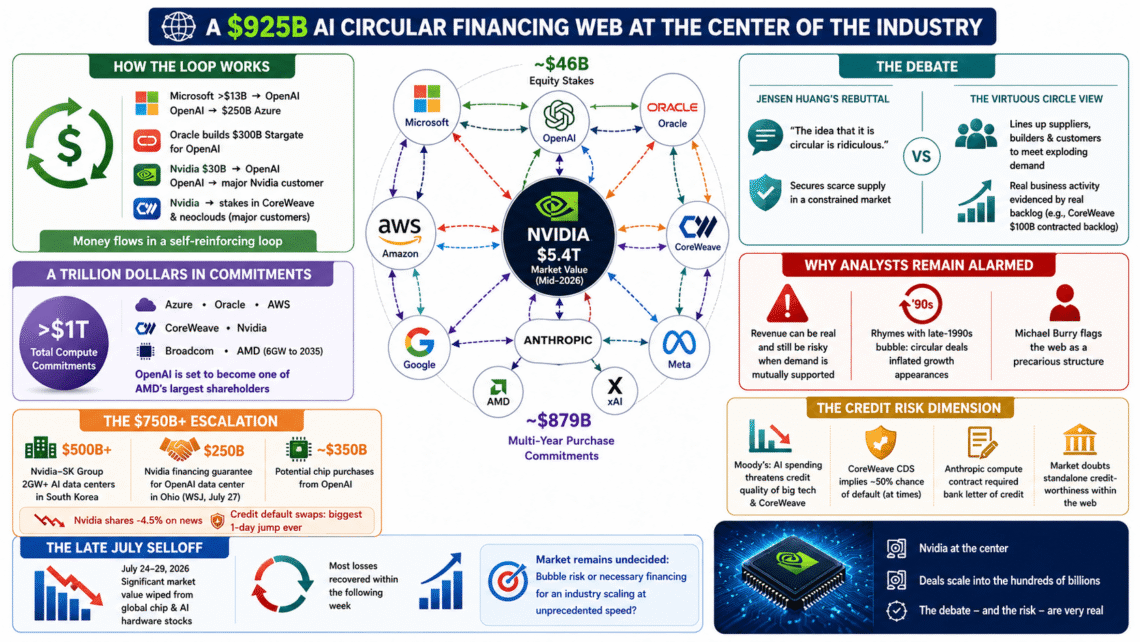
In January 2026, Bloomberg published a detailed graphics investigation that gave a name and a visual shape to a pattern industry watchers had been describing in increasingly alarmed terms for months. The map traces roughly 46 billion dollars in direct equity stakes and 879 billion dollars in multi-year purchase commitments moving between Microsoft, Oracle, Amazon, Google, Meta, OpenAI, Anthropic, xAI, CoreWeave, Nvidia, and AMD. At the center of this AI circular financing web sits Nvidia, whose market valuation reached 5.4 trillion dollars in mid-2026, a position investor Michael Burry has publicly described as sitting dead center of the entire structure.
The nearly 800 billion dollars in annual hyperscaler infrastructure spending documented in Article 1 of this series does not appear from nowhere; a significant share of it flows directly through the AI circular financing relationships examined here. Understanding whether this AI circular financing arrangement represents rational supply chain coordination in a genuinely constrained market, or the same structural warning sign that has preceded prior financial bubbles, requires tracing the actual mechanics of the deals, examining both sides of a genuinely contested debate among serious analysts, and being honest about what nobody yet knows.
How the Loop Actually Works
The mechanics of AI circular financing are, once traced carefully, straightforward enough to describe in a single sentence, even if the dollar figures involved are difficult to comprehend. Microsoft invested more than 13 billion dollars in OpenAI over several years. OpenAI committed to spending 250 billion dollars on Microsoft’s Azure cloud services. Oracle is constructing 300 billion dollars in Stargate data center infrastructure specifically for OpenAI under long-term contracts. Nvidia invested 30 billion dollars in OpenAI’s most recent 122 billion dollar funding round, while OpenAI simultaneously remains one of Nvidia’s largest chip customers. Nvidia has separately taken equity stakes in CoreWeave and other so-called neocloud providers, companies that are themselves major customers for Nvidia’s chips.
The pattern repeats with variations across nearly every major relationship in the industry. OpenAI’s total named compute commitments now sum to more than a trillion dollars across Azure, Oracle, AWS, CoreWeave, Nvidia, Broadcom, and a six gigawatt AMD deal running through 2035, a deal structured so that OpenAI is poised to become one of AMD’s largest shareholders. Amazon’s 50 billion dollar investment in OpenAI’s March 2026 funding round was structured partly as compute credits, with OpenAI simultaneously committing to spend 100 billion dollars on AWS over eight years.
Google agreed to backstop lease payments at five separate data center locations for Anthropic, effectively helping Anthropic obtain what amounts to a 35 billion dollar loan. Money moves from investor to startup and back to the investor’s own products and services through a loop that is, by construction, self-reinforcing.
The 750 Billion Dollar Escalation
Rather than slowing amid growing scrutiny, this AI circular financing pattern accelerated sharply through mid-2026. Nvidia is now working on a fresh round of infrastructure deals potentially worth more than 750 billion dollars. A partnership unveiled with South Korean conglomerate SK Group in late July 2026 alone represents more than 500 billion dollars in mutual business, tied to building more than two gigawatts of AI data centers on the Korean peninsula, enough electricity to power roughly 1.5 million homes.
More striking still, the Wall Street Journal reported on July 27, 2026, that Nvidia is in talks to provide a 250 billion dollar financing guarantee tied to OpenAI leasing a portion of a planned 500 billion dollar data center project in southern Ohio, led by SoftBank’s energy arm. The same reporting indicates the guarantee would help SoftBank raise debt on more favorable terms than it could obtain otherwise, precisely because OpenAI itself does not currently hold an investment grade credit rating.
Nvidia may also separately help finance roughly 350 billion dollars in chip purchases from OpenAI under a related arrangement. The market reacted immediately and visibly. Nvidia shares fell 4.5 percent on the news, and the price of credit default swaps on Nvidia’s own bonds, effectively a form of default insurance for bondholders, recorded their highest single day increase since active trading in the instrument began.
Jensen Huang’s Direct Rebuttal
Nvidia CEO Jensen Huang has responded to AI circular financing criticism with characteristic directness rather than deflection. Asked specifically about the vendor financing charge as Bloomberg documented the growing 750 billion dollar deal total, Huang stated flatly, the idea that it is circular is ridiculous. His underlying argument, echoed by supporters of the current deal structure across the industry, is that building frontier AI infrastructure is extraordinarily expensive and that the most advanced chips remain genuinely difficult to obtain even now.
In that kind of constrained market, Huang and his allies argue, companies do not simply place purchase orders and wait. They lock in scarce supply by pairing long-term buying commitments with financing, a practice with long precedent in genuinely capital-intensive industries from telecommunications to energy infrastructure.
The Virtuous Circle Counter-Argument
This defense of AI circular financing has a specific and influential institutional champion. Asset manager Janus Henderson has characterized the current wave of AI dealmaking as more accurately described as a virtuous circle, one that helps line up suppliers, builders, and customers to meet what the firm characterizes as genuinely exploding demand for computing power. Under this framing, what critics label circular financing is simply the efficient coordination mechanism a young, capital-intensive, rapidly scaling industry requires to align capacity investment with demand that outstrips what any single company could finance independently through conventional means.
There is a genuine kernel of truth in this defense that deserves acknowledgment. CoreWeave, one of the clearest examples of a company deeply embedded in this AI circular financing web, is at least a public company whose filings provide real numbers rather than speculation. Its first quarter 2026 results showed 2.08 billion dollars in revenue against a 740 million dollar net loss, alongside nearly 100 billion dollars in contracted revenue backlog. That backlog, if it converts to actual delivered revenue over time, represents real economic activity, not merely accounting fiction circulating between related parties.
Why Serious Analysts Remain Alarmed Regardless
Set against these defenses, a growing chorus of serious market analysts continues to treat AI circular financing as a genuine structural risk, and their concern rests on a specific, carefully stated argument rather than blanket skepticism of AI itself. As one detailed industry analysis put it precisely, none of this has to be fake to be dangerous. The revenue can be entirely real, the chips can actually ship, and the data centers can genuinely get built, all while resting on a financing structure in which the same small handful of companies are effectively supporting one another’s demand, obscuring how much of the total activity reflects genuine, independent end-user demand versus intra-industry financial engineering.
Michael Burry, the investor who famously anticipated the 2008 mortgage crisis, has invoked the AI circular financing pattern repeatedly and pointedly in 2026, sharing Bloomberg’s own diagram of the deal web as evidence of a structure he considers genuinely precarious. This concentration of financial risk sits uncomfortably alongside the AI ROI concerns detailed in Article 2 of this series, since much of the revenue circulating through this web has yet to translate into the kind of measurable enterprise value that would justify its scale.
Harvard Kennedy School senior fellow Paulo Carvao has drawn an explicit historical parallel to the late 1990s technology bubble, noting that circular deals during that era were often centered on advertising and cross-selling arrangements between startups, where companies bought each other’s services specifically to inflate the appearance of genuine growth. The concern is not that the parallel is exact in every detail, but that the underlying structural vulnerability, revenue and valuation that depend heavily on continued participation by a small, tightly interconnected group of counterparties, rhymes closely enough with prior bubble dynamics to warrant serious caution.
The Credit Risk Dimension
The AI circular financing debate connects directly to a parallel and increasingly urgent concern that will be examined in full in Article 4 of this series. Moody’s has explicitly warned that the scale of AI related spending threatens the credit quality of Microsoft, Amazon, Alphabet, Meta, Oracle, and CoreWeave specifically. CoreWeave’s own credit default swaps have briefly implied pricing consistent with something close to a coin flip probability of default.
Anthropic’s most recent major compute contract required underwriting through a bank letter of credit rather than being supported directly by its own balance sheet, a structural detail that suggests even sophisticated market participants are not fully confident in the standalone creditworthiness of companies deeply embedded in this AI circular financing web.
What Happened During the Late July Selloff
The genuine market sensitivity to AI circular financing concerns was demonstrated directly during the final week of July 2026. A significant amount of market value was wiped from global chip and AI hardware stocks between July 24 and July 29, 2026, coinciding with the intensified scrutiny of Nvidia’s expanding deal book. Notably, most of that lost value was recovered within the following week, a pattern that itself illustrates the deeply contested nature of this debate.
Investors sold first on the circularity concern, then substantially reversed course, suggesting the market itself remains genuinely undecided about whether AI circular financing represents a serious systemic vulnerability or simply the necessary financial architecture of a capital-intensive industry scaling at unprecedented speed.
Conclusion
The AI circular financing web documented by Bloomberg, and expanding rapidly through 2026 with Nvidia’s 750 billion dollar deal book at its center, is neither obviously fraudulent nor obviously benign. It is a genuinely novel financial structure, real revenue and real infrastructure resting on a foundation of relationships concentrated among a remarkably small number of counterparties, each simultaneously acting as the others’ customer, supplier, and investor.
Jensen Huang calls the circularity framing ridiculous. Michael Burry calls it a warning sign serious enough to invoke repeatedly and publicly. Both cannot be straightforwardly right, and the honest answer, at least for now, is that the structure has not yet been tested by the kind of demand slowdown or credit event that would definitively reveal which characterization is closer to the truth. Article 4 of this series turns directly to that credit risk dimension, examining Moody’s specific warnings and what a genuine stress event within this AI circular financing web would actually look like for the broader economy.
-
The Startling Truth About AI ROI: Why 95 Percent of Enterprise Projects Are Failing
A Number That Refuses to Go Away
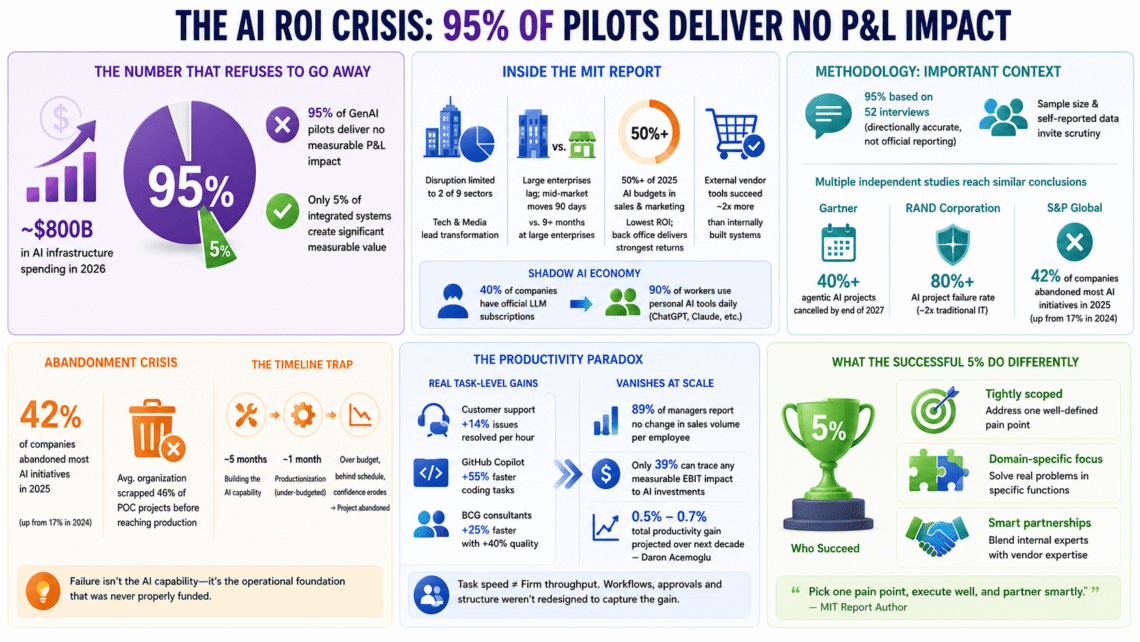
Since its publication in mid-2025, one statistic has become the single most repeated, most contested, and most consequential figure in the entire enterprise AI conversation. MIT’s Project NANDA, in a report titled The GenAI Divide: State of AI in Business 2025, found that 95 percent of generative AI pilots deliver no measurable profit and loss impact. Only 5 percent of integrated AI systems create significant, measurable value.
Given the nearly 800 billion dollars in AI infrastructure spending documented in the first article of this series, the AI ROI question this statistic raises is not academic. It is the question on which the entire economic justification for the current investment cycle ultimately rests.
Understanding whether this AI ROI crisis is real, overstated, or something more nuanced requires examining the methodology behind the headline number, the deeper productivity paradox it sits inside, and, most usefully, exactly what separates the small minority of companies that are succeeding from the large majority that are not.
Inside the MIT Report
The GenAI Divide report, based on 52 executive interviews, a survey of roughly 150 business leaders, and analysis of 300 public AI deployments, draws a sharp distinction the authors call the GenAI Divide, a split between widespread adoption and genuine business transformation. Over 80 percent of organizations have piloted tools such as ChatGPT or Copilot, and nearly 40 percent report some form of deployment. Yet these systems overwhelmingly boost individual productivity rather than delivering measurable enterprise level AI ROI.
The report identifies four structural factors behind this divide. Disruption remains limited to just two of nine major sectors, technology and media, that show genuine business transformation from generative AI use. Large enterprises paradoxically lead in pilot volume but lag significantly in successful deployment, while mid-market companies move from pilot to full implementation in roughly 90 days compared to nine months or longer at large enterprises.
AI budgets are allocated in a way that actively works against AI ROI, with over 50 percent of spending in 2025 directed toward sales and marketing pilots, precisely the category the report finds delivers the weakest returns, while the strongest AI ROI consistently comes from back office automation in finance, compliance, and document processing, categories that receive comparatively little budget attention. Finally, tools built by external vendors succeed roughly twice as often as internally built systems, a genuinely important finding for any enterprise weighing a build versus buy decision.
Perhaps the most striking finding is the emergence of what the report calls a shadow AI economy. While only 40 percent of companies maintain official LLM subscriptions, roughly 90 percent of workers surveyed report daily use of personal AI tools such as ChatGPT or Claude for actual job tasks, tools that frequently deliver better performance and faster adoption than the sanctioned systems built specifically to replace them.
The Methodology Question Worth Taking Seriously
Before accepting the 95 percent AI ROI failure figure uncritically, it is worth noting that the report itself has faced genuine methodological scrutiny. The finding of zero measurable return was based on just 52 interviews that the report’s own authors describe as directionally accurate based on individual interviews rather than official company reporting. Marketing AI Institute founder Paul Roetzer has argued publicly that a closer reading of the study’s methodology reveals a considerably more nuanced picture than the viral headline suggests, noting the sample size and self-reported nature of much of the underlying data.
This caveat does not invalidate the broader AI ROI concern, particularly because the MIT figure has since been corroborated, directionally if not precisely, by entirely independent research using different methodologies. Gartner separately predicts that over 40 percent of agentic AI projects will be cancelled by the end of 2027, citing escalating costs and unclear business value.
RAND Corporation’s independent research puts the broader AI project failure rate above 80 percent, roughly double the failure rate of conventional enterprise IT projects, itself a meaningful baseline given how notoriously difficult large-scale enterprise software rollouts already are. When multiple independent research organizations using different methods converge on directionally similar conclusions, the underlying AI ROI concern deserves to be taken seriously even if the precise 95 percent figure carries some uncertainty.
S&P Global and the Abandonment Crisis
A separate and independently sourced data point adds further weight to the AI ROI concern. S&P Global Market Intelligence, surveying over 1,000 IT and business leaders across North America and Europe for its 2025 Voice of the Enterprise report, found that 42 percent of companies abandoned most of their AI initiatives in 2025, a dramatic jump from just 17 percent the prior year. The average organization scrapped 46 percent of its proof of concept projects before they ever reached production.
The mechanism behind this abandonment pattern is instructive for understanding the AI ROI problem more precisely. Organizations that budget six months for an AI project typically allocate roughly five months to building the AI capability itself and only one month to what practitioners call productionization, the unglamorous but essential work of hardening a system for real operational use.
Production infrastructure, if built properly, takes roughly as long as the AI capability itself. By the time this reality becomes apparent, usually around month five, the project is over budget, behind schedule, and executive confidence has eroded. The project gets abandoned, not because the underlying AI capability failed, but because the operational foundation required to sustain it in production was never adequately budgeted for in the first place.
The Productivity Paradox: Real Gains That Vanish at Scale
Perhaps the most conceptually important dimension of the AI ROI debate is what researchers now call the AI productivity paradox, the widening gap between clearly documented task level gains and the near invisible effect of those same gains on company wide and national productivity statistics. The paradox is genuinely puzzling because both halves of it are independently well supported by evidence.
Customer service agents using AI resolve 14 percent more issues per hour. GitHub Copilot users complete coding tasks 55 percent faster. BCG consultants using AI finish work 25 percent quicker with 40 percent higher quality scores. These task level AI ROI gains, ranging from roughly 14 to 55 percent depending on the specific study and task, are real, controlled, and repeatedly replicated.
And yet, at the organizational level, this AI ROI evaporates almost entirely. NBER researchers tracking AI adoption from 61 to 71 percent of surveyed firms between early 2025 and early 2026 found that 89 percent of managers reported no change whatsoever in sales volume per employee over that same period. Only 39 percent of enterprises can trace any measurable EBIT impact to their AI investments at all. Nobel laureate economist Daron Acemoglu has projected a strikingly modest 0.5 to 0.7 percent total productivity gain from AI over the entire next decade, a figure he describes candidly as disappointing relative to the promises the industry has made.
The explanation researchers increasingly converge on is that task level speed is simply not the same thing as firm level throughput. An individual worker completing a task 55 percent faster does not automatically translate into an organization producing 55 percent more output, because the surrounding workflow, approval processes, quality checks, and organizational structure were never redesigned to actually capture that individual speed gain at scale.
What the Successful 5 Percent Actually Do Differently
The most practically useful finding across this entire body of AI ROI research is not the failure statistic itself but the consistent pattern separating the minority that succeed from the majority that do not. McKinsey’s 2025 AI survey found that organizations reporting significant financial returns were twice as likely to have redesigned their end to end workflows before selecting any AI tool, confirming that organizational change, not the underlying technology, is the actual differentiator.
MIT’s own data on the successful minority is similarly specific. Pilots that blended internal AI specialists with external vendor expertise achieved a 67 percent success rate, compared to just 22 percent for projects built entirely in-house. The winning 5 percent consistently shared three traits: tightly scoped initiatives focused on a single, well-defined pain point rather than broad transformation ambitions, domain specific focus rather than generic tooling, and smart partnerships with vendors who understood both the technology and the specific operational context it was being deployed into.
As one MIT report author put it directly, describing successful startups, they pick one pain point, execute well, and partner smartly, a strikingly simple formula against the backdrop of billions of dollars in more diffuse enterprise spending that has failed to replicate it.
Conclusion
The honest verdict on AI ROI in 2026 is neither the total failure the viral 95 percent statistic suggests in isolation, nor the seamless transformation the marketing around generative AI has promised since 2023. It is a genuine and well documented paradox: real, measurable, repeatedly replicated task level productivity gains that are, for the overwhelming majority of enterprises, failing to survive the jump from individual workflow to organizational output.
The 5 percent of companies that are succeeding are not doing so because they have access to better models. They are succeeding because they redesigned the underlying work itself before deploying AI into it, a lesson that costs considerably less to implement than the infrastructure billions documented in Article 1 of this series, and one that most of the market has still not learned.
-
The Staggering $775 Billion AI Infrastructure Spending Race: Where All the Money Is Actually Going
A Number Larger Than Most National Economies
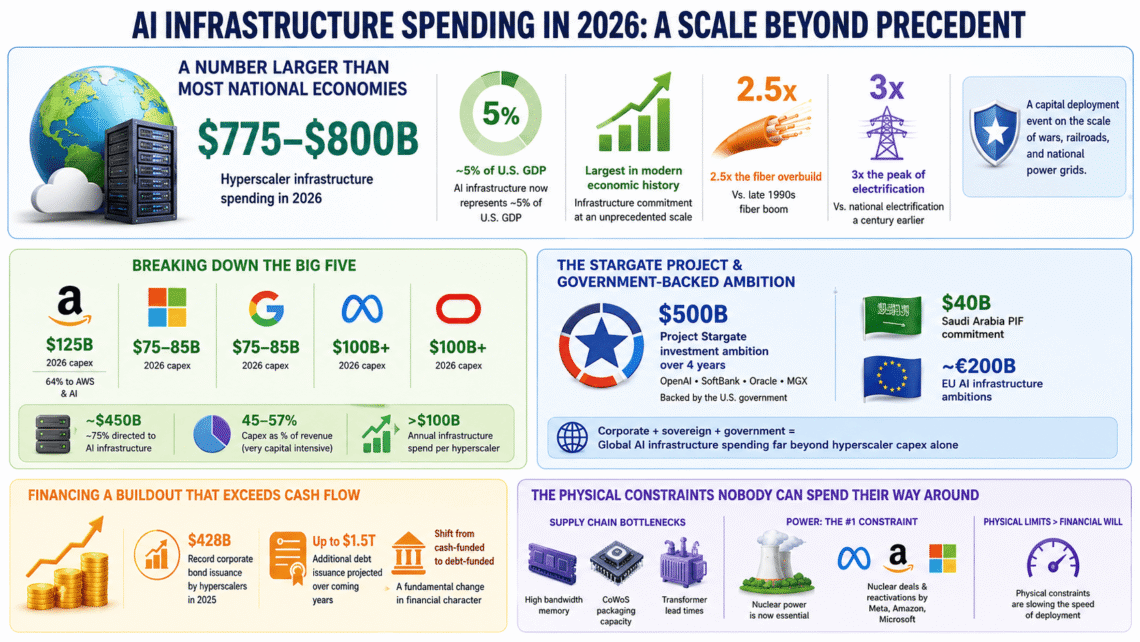
In 2026, the five largest hyperscalers, Amazon, Microsoft, Alphabet, Meta, and Oracle, are on track to spend between 775 and 800 billion dollars on infrastructure, according to CFA analysis published in August 2026. To put that figure in perspective, AI infrastructure spending in the United States now represents roughly 5 percent of national GDP, a level of infrastructure commitment that analysts describe as the largest in modern economic history, 2.5 times the scale of the fiber optic overbuild of the late 1990s and three times the peak of national electrification a century earlier. This is not a niche technology investment cycle. It is a capital deployment event on a scale usually reserved for wars, railroads, and national power grids.
Understanding where this staggering sum of AI infrastructure spending is actually going, and whether the historical parallel to prior infrastructure booms is reassuring or alarming, requires looking closely at the individual commitments, the financing mechanisms behind them, and the physical constraints that are already beginning to bite.
Breaking Down the Big Five
The scale of individual hyperscaler AI infrastructure spending commitments in 2026 is difficult to grasp in isolation. J.P. Morgan estimates aggregate hyperscaler capital expenditure will reach 697 billion dollars this year, while separate analysis from Goldman Sachs projects total hyperscaler capex from 2025 through 2027 will reach 1.15 trillion dollars, more than double the 477 billion dollars spent across the entire 2022 to 2024 period. Roughly 75 percent of this spending, approximately 450 billion dollars, is directed specifically at AI infrastructure, servers, GPUs, data centers, and specialized equipment, rather than traditional cloud computing capacity.
Individual company figures illustrate the intensity of this AI infrastructure spending race. Amazon has guided to approximately 125 billion dollars in 2026 capital expenditure, a 61 percent increase over the prior year, with 64 percent of that spending allocated to AWS and AI initiatives specifically. Alphabet has guided toward 75 to 85 billion dollars. Each of the four largest hyperscalers now individually exceeds 100 billion dollars in annual infrastructure spending, a threshold that would have seemed implausible even eighteen months earlier. Capital intensity, capex as a share of company revenue, has reached 45 to 57 percent at several of these companies, a ratio historically associated with capital intensive industrial and utility companies rather than software businesses.
The Stargate Project and Government-Backed Ambition
Layered on top of individual company AI infrastructure spending is Project Stargate, a joint venture between OpenAI, SoftBank, Oracle, and MGX announced in January 2025 and publicly backed by the Trump administration, with an ambition to invest up to 500 billion dollars in United States data centers and energy infrastructure over four years. J.P. Morgan’s John Servidea, global co-head of Investment Grade Finance, described the moment plainly: AI financing is the biggest secular theme in our professional lifetimes.
The Stargate project illustrates a broader pattern within AI infrastructure spending in 2026: the blurring of lines between corporate capital expenditure, sovereign investment, and government policy. Sovereign programs beyond Stargate itself, including a 40 billion dollar commitment from Saudi Arabia’s Public Investment Fund and roughly 200 billion euros in European Union AI infrastructure ambitions, push the true global figure for AI infrastructure spending considerably higher than hyperscaler capex alone would suggest.
Financing a Buildout That Exceeds Cash Flow
Perhaps the most consequential shift within this AI infrastructure spending cycle is how it is being financed. For most of the past decade, hyperscalers funded capital expenditure primarily from internal operating cash flow, a position of financial strength that distinguished them from more leveraged industries. That era has ended. Hyperscalers issued a record 428 billion dollars in corporate bonds during 2025 alone, with projections suggesting up to 1.5 trillion dollars in additional debt issuance over the coming years as AI infrastructure spending continues to outpace what internal cash generation can support.
This transition from cash funded to debt funded infrastructure spending represents a fundamental change in the financial character of companies that were, until recently, among the most conservatively financed in the entire economy. Analysts at IEEE ComSoc noted the shift directly, observing that hyperscalers are increasingly leaning on debt markets to bridge the gap between rapidly rising AI capex budgets and internal free cash flow, transforming historically cash funded business models into ones utilizing meaningful leverage, even while balance sheets remain nominally strong for now.
The Physical Constraints Nobody Can Spend Their Way Around
A critical dimension of AI infrastructure spending in 2026 that pure dollar figures obscure is the extent to which physical, rather than financial, constraints are now the binding limitation on deployment speed. Critical supply chain bottlenecks, including high bandwidth memory, advanced chip packaging capacity known as CoWoS, and transformer lead times for electrical equipment, threaten to constrain how quickly this enormous volume of AI infrastructure spending can actually translate into operational data center capacity.
Power availability has emerged as perhaps the single most significant constraint. The scale of the AI infrastructure spending buildout has pushed hyperscalers toward power sources that would have seemed exotic for a technology company just a few years ago. Meta’s nuclear power purchase agreement, Amazon’s expanding nuclear power offtake commitments, and Microsoft’s agreement to restart the Three Mile Island nuclear facility all confirm that nuclear power has become an operational requirement for AI infrastructure at this scale, not merely an environmental preference. This same theme, examined in detail in our earlier coverage of AI data centers and their environmental impact, is intensifying rather than resolving as spending accelerates.
The Historical Parallel: Reassuring or Alarming
The comparison between current AI infrastructure spending and prior infrastructure overbuild cycles cuts in two directions simultaneously, and reasonable analysts disagree sharply about which direction should dominate the interpretation. On one hand, every prior infrastructure overbuild cycle identified by historical analysis, the railroad network of the 1880s, the national electrical grid built around 1929, and the global internet backbone constructed during the fiber optic boom of the late 1990s, despite producing bankruptcies, market crashes, and significant excess capacity in the near term, ultimately produced infrastructure that became genuinely foundational to the next era of economic productivity.
Under this framing, current AI infrastructure spending, however excessive it may appear relative to near-term AI revenue, may simply be the necessary and historically consistent overbuilding phase that precedes durable long-term value creation.
On the other hand, the fiber optic comparison specifically carries an uncomfortable warning that industry commentators invoke repeatedly. As one industry analysis put it directly, referencing the stupendous increase in fiber optic spending from 1998 to 2001 until that particular bubble burst, the parallel is not merely rhetorical. Fiber optic capacity built during that boom did eventually prove valuable, but only after a wrenching financial crash wiped out the equity value of the companies that built it, transferred the physical assets to new owners at steep discounts, and left an entire generation of telecom bondholders with significant losses.
Whether the AI infrastructure spending cycle of 2026 follows the same trajectory, useful infrastructure ultimately, but only after a genuinely painful financial reckoning for the companies and investors who financed the initial buildout, is precisely the question this five-part series is built to examine.
What This Means Going Forward
The scale of AI infrastructure spending documented here sets the stage for the four articles that follow in this series. Article 2 will examine whether this extraordinary capital deployment is actually generating measurable returns for the enterprises purchasing AI capability, a question where the evidence, drawn from MIT, Gartner, and RAND research, is considerably more sobering than the raw spending figures might suggest.
Article 3 will trace the increasingly circular financing relationships between Nvidia, OpenAI, Microsoft, and Oracle that are helping fund this buildout, relationships that several analysts argue obscure the true underlying demand signal for AI infrastructure spending itself. Article 4 will examine the credit and debt risk this financing structure is creating, drawing on Moody’s own recent warnings. And Article 5 will bring the full picture together to assess whether the AI infrastructure spending boom documented in this article represents durable economic transformation or a bubble approaching its limits.
Conclusion
What is beyond dispute is the sheer scale of what is being built. Nearly 800 billion dollars in hyperscaler spending in a single year, financed increasingly through debt rather than cash, chasing physical constraints in power and semiconductor supply that money alone cannot immediately solve, and layered with sovereign and government backed commitments that add hundreds of billions more to the global total. Whether this AI infrastructure spending ultimately proves as foundational as the railroads and the electrical grid, or as painful in its near-term unwinding as the fiber optic bust, is a question that will be answered not by this article, but by the years of actual demand, revenue, and repayment that follow it.