-
The Critical Rise of Third Party Watermark Detection and What It Means for Academic Integrity
From Theory to Deployment
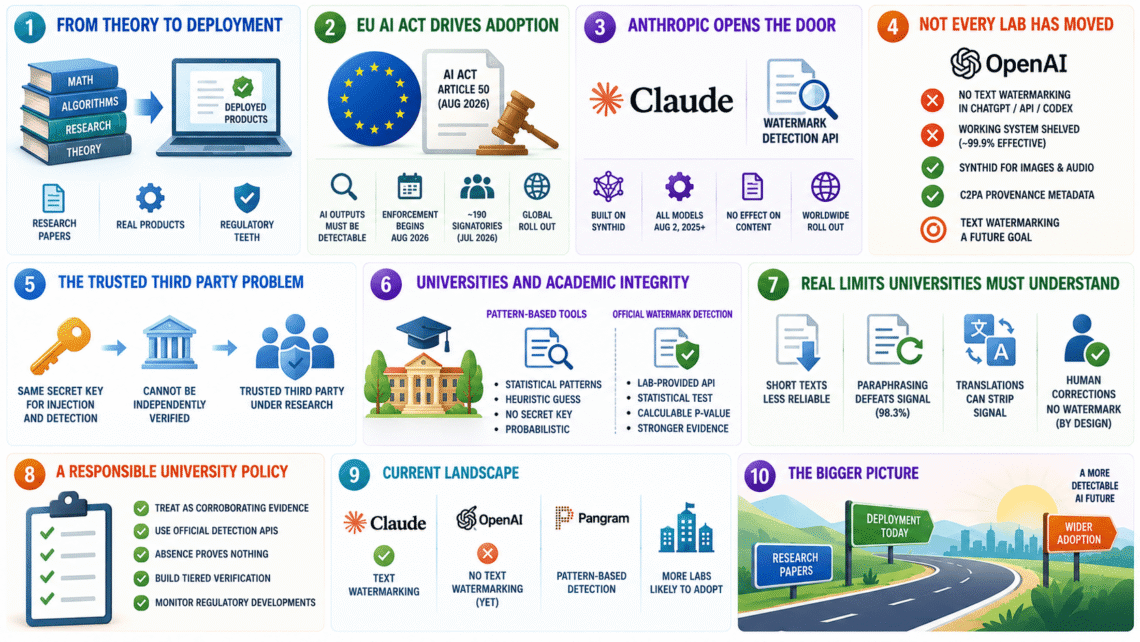
The previous article in this series covered the mathematics of LLM watermarking. Green-red lists, spike entropy, z-tests, and the elegant distortion-free Gumbel approach. That was theory. This article covers what is actually happening right now, in August 2026, as third party watermark detection moves from research papers into deployed products with real regulatory teeth behind them.
The timing matters enormously. The EU AI Act’s Article 50 requires AI outputs to be detectable as artificially generated. Enforcement began this month. That single regulatory deadline has forced every major lab to answer a question they had avoided for years. Should outsiders be allowed to check whether text came from their model?
-
The Profound Mathematics of LLM Watermarking: How AI Text Hides an Invisible Signature
A Signal Hidden in Plain Sight
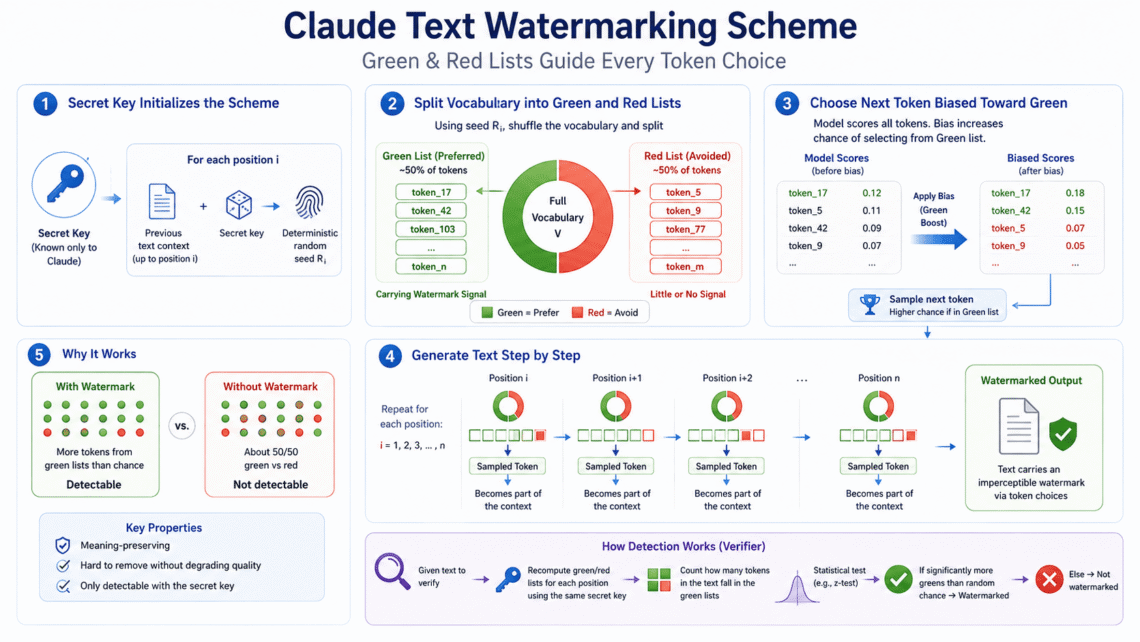
Every token a language model generates comes from a probability distribution. LLM watermarking exploits this single fact with remarkable precision. It biases that distribution just enough to leave a statistical fingerprint. Human readers cannot see it. Trained detectors can find it with near certainty. Understanding how this actually works requires going past the marketing language entirely. It requires real probability theory, real hypothesis testing, and a careful look at what “invisible” actually means in a mathematical sense.
This article goes deep. LLM watermarking sits at the intersection of cryptography, statistics, and information theory, and it deserves treatment at that level.
-
7 Critical Enterprise AI Data Privacy Risks Companies Cannot Afford to Ignore
A Trust Gap Nobody Can Ignore Anymore
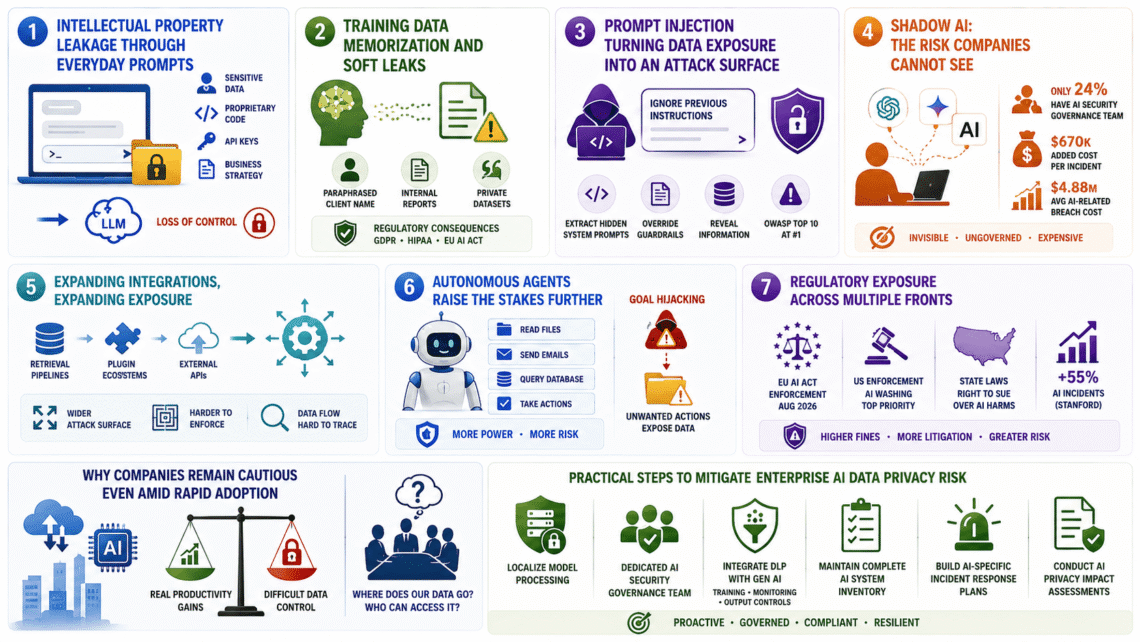
Enterprises want AI. They just do not want to hand over their crown jewels to get it. This tension defines enterprise AI data privacy in 2026. Companies are deploying LLMs into core workflows at record speed. At the same time, legal and security teams are pumping the brakes harder than ever. Both instincts are correct. The technology is genuinely useful. The risks are genuinely serious.
Understanding why companies stay wary of LLM vendors, even while adopting their products, requires looking closely at seven specific, well-documented risk categories. Each one shapes how enterprise AI data privacy decisions actually get made today.
-
The Ambitious Future of Chinese AI: Robots, Real-World Deployment, and the Next Decade (Part 3)
This is Part 3, the final part of a three-part series examining Chinese AI development from a genuinely Chinese vantage point. Part 1 traced the strategic origins and the export control era. Part 2 introduced the companies and scientists executing that strategy. Part 3 looks at where China is heading over the next five to ten years.
A Plan That Changes the Question Entirely
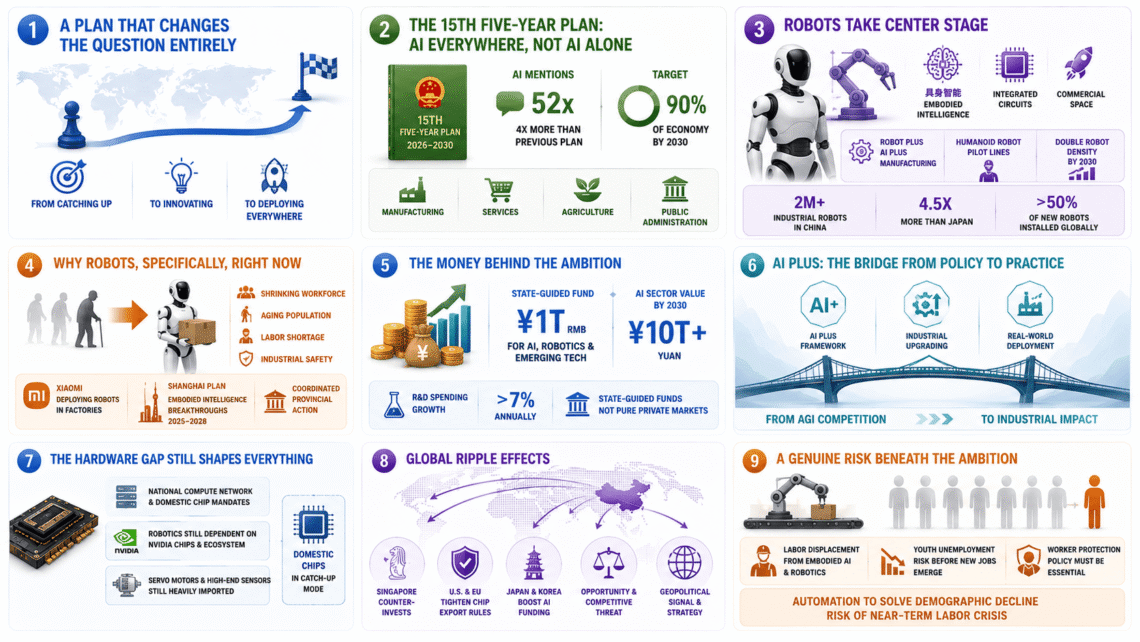
Part 1 and Part 2 of this series told a story about catching up. Export controls forced innovation. Startups closed the performance gap with Western labs. That story is now largely finished. The future of Chinese AI, as laid out in Beijing’s newest planning documents, asks a very different question. It is no longer about matching the West. It is about deploying AI everywhere, all at once, faster than any other economy on earth.
-
The Powerful Rise of Chinese AI Companies: Six Tigers, Four Dragons, and a New World Order (Part 2)
This is Part 2 of a three-part series examining Chinese AI development from a genuinely Chinese vantage point. Part 1 traced the origins of China’s AI strategy and the export control era that reshaped it. Part 2 introduces the specific scientists, labs, and companies executing that strategy. Part 3 will look at where China is heading over the next five to ten years.
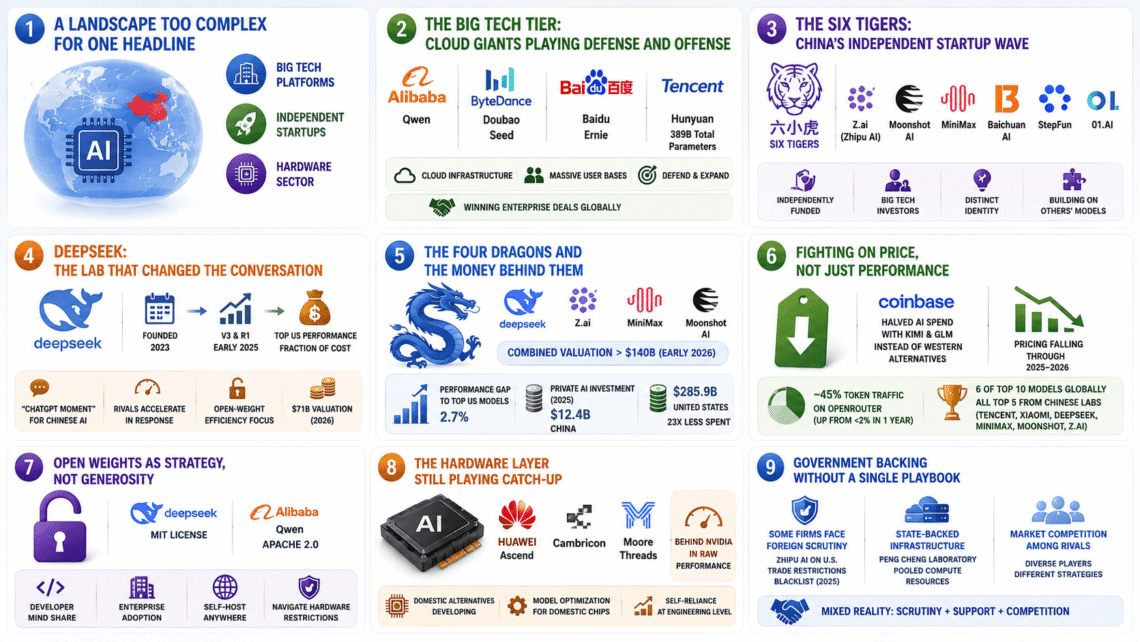
A Landscape Too Complex for One Headline
Western coverage often collapses Chinese AI into a single word: DeepSeek. That framing misses the real story. Chinese AI companies today form a layered, competitive ecosystem spanning giant technology platforms, a cluster of fiercely independent startups, and a fast-moving hardware sector trying to catch up on chips. Understanding this ecosystem means understanding how differently each layer behaves, and why.
-
The Powerful Chinese AI Strategy: How a Nation Turned Restriction Into Resolve (Part 1)
This is Part 1 of a three-part series examining Chinese AI development from a genuinely Chinese vantage point. Part 1 traces the origins of the Chinese AI strategy, the philosophical shift from ambition to self-reliance, and the export control regime that reshaped everything. Part 2 will examine the specific companies, labs, and scientists who executed this strategy. Part 3 will look at where China is heading over the next five to ten years.
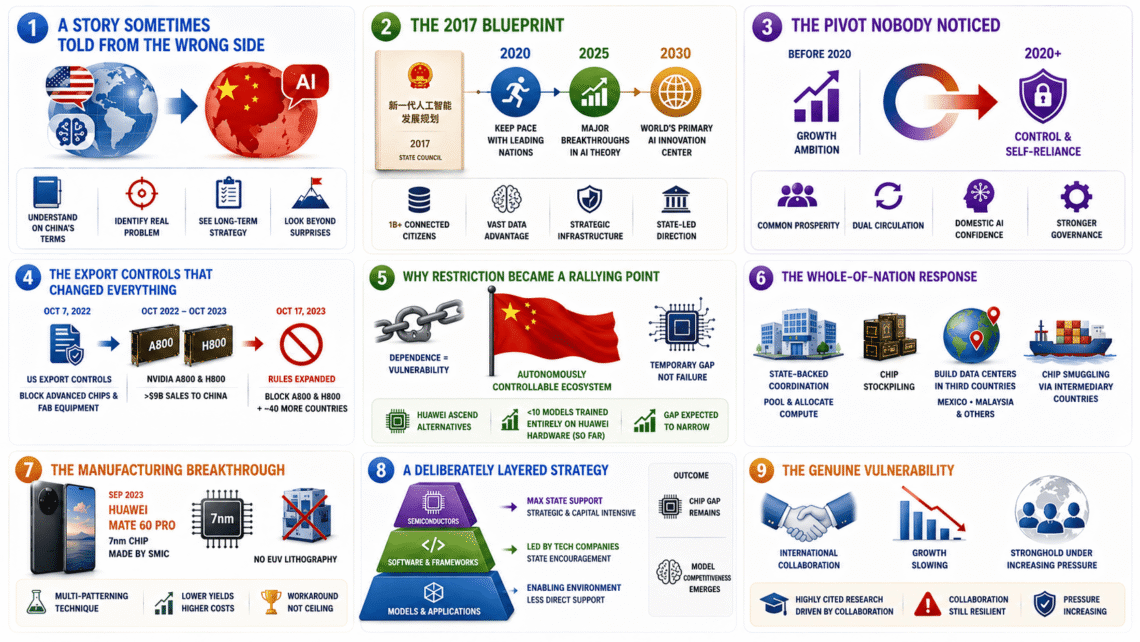
A Story Sometimes Told From the Wrong Side
Most coverage of Chinese AI treats it as a reaction to American innovation. DeepSeek gets framed as a surprise. Huawei’s chips get framed as a workaround. This series takes a different approach. It asks how China itself understands this journey, what problem its leaders believe they are actually solving, and why the country’s AI strategy looks the way it does today. Understanding the Chinese AI strategy on its own terms requires starting well before DeepSeek existed, well before ChatGPT existed, in a 2017 policy document that set the entire direction in motion.
-
The Alarming $18 Billion Meta Teen Safety Settlement: Will 10 Years of Rules Actually Protect Kids?
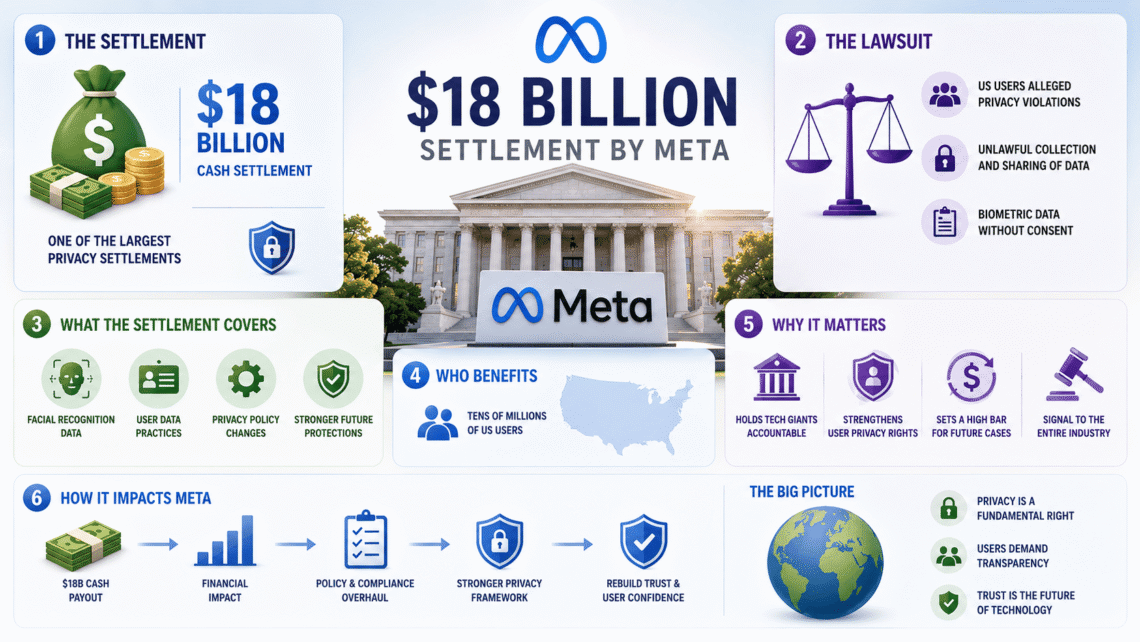
A White Flag After Three Years of Denial
Meta waved a white flag on Wednesday. That is how TIME described the moment the company agreed to pay roughly 18 billion dollars to settle claims it deliberately hooked teenagers on Instagram and Facebook. The Meta teen safety settlement ends a legal battle that began in October 2023. It comes just over a week after a trial started in California. Four states were seeking as much as 1.4 trillion dollars in damages.
Matthew Bergman, founder of the Social Media Victims Law Center, called the moment vindication. “Meta has been steadfastly arguing that its platforms are not addictive,” he said. “That it didn’t do anything wrong.” The settlement suggests otherwise, even though Meta admits no wrongdoing.
-
The Powerful Nvidia LLM Impact and its 5-Year Reign
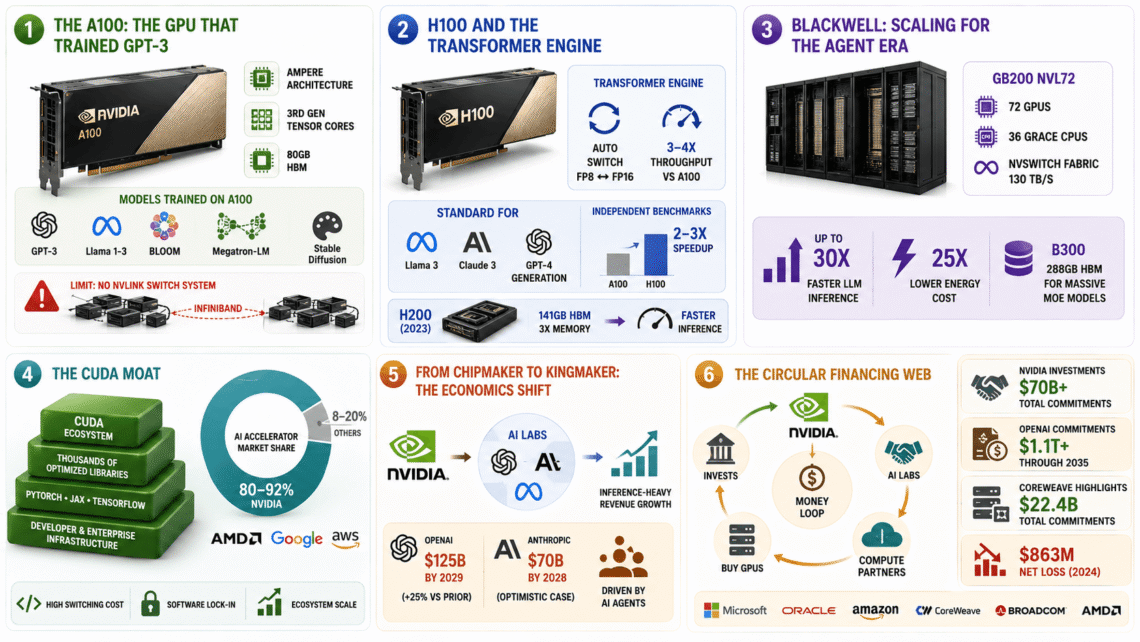
The Chip Nobody Saw Coming
In May 2020, Nvidia announced a GPU built for data centers, not gaming rigs. Few people outside chip design circles paid much attention. That chip was the A100. Within three years, it became the single piece of hardware most responsible for the modern LLM boom. Understanding Nvidia LLM impact over the past five to ten years means tracing a story that runs through silicon design, software lock-in, and finally, staggering financial engineering. Each stage built directly on the one before it.
-
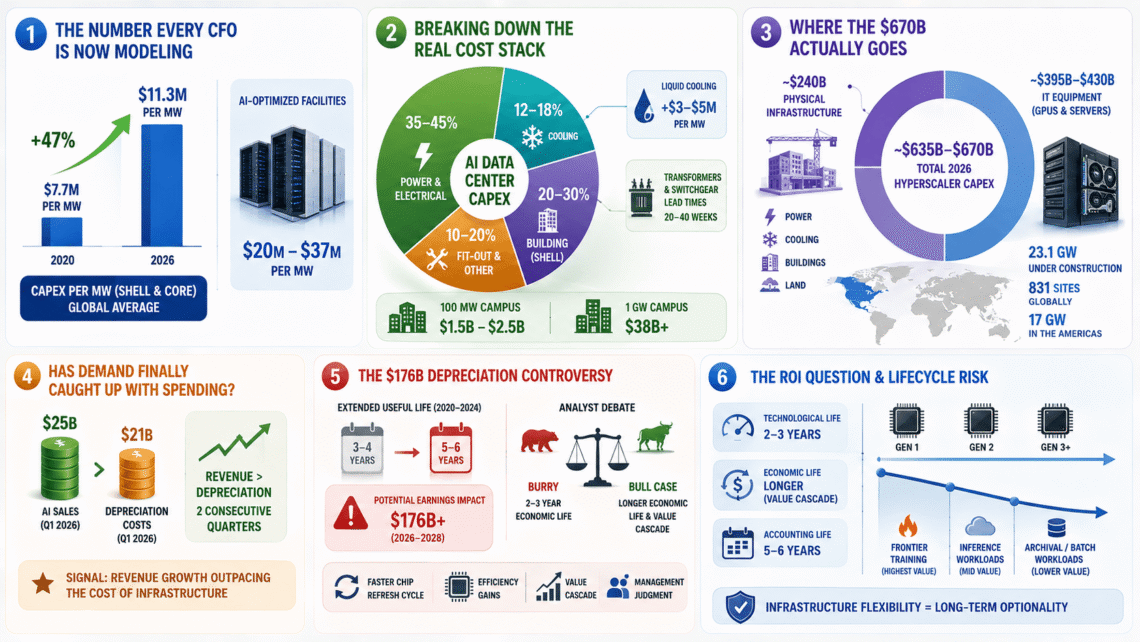
The Critical Economics of AI Data Centers: A Breakdown of Cost, ROI, and Lifecycle Risk
The Number Every CFO Is Now Modeling
Understanding AI data center economics in 2026 requires starting with a single figure that has become the industry’s most consequential benchmark, capital expenditure per megawatt of deployed capacity. That number has moved fast, and the direction of travel explains most of the investment story unfolding across this blog’s recent coverage of the sector.
-
Inside the Powerful Wave of AI Data Center Protests Sweeping Small-Town America
125 Cities, One Saturday
Last month, protesters showed up in 125 cities across the USA on a single Saturday to demonstrate against data centers, either proposed or already under construction. It was a coordinated day of action that NPR’s 1A programme described as a genuine turning point in how visible this movement has become. This was not a scattering of isolated local disputes.
It was a nationally coordinated wave, and it reflects a sentiment that pollsters keep confirming with increasing precision. A June 2026 survey from Echelon Insights found that voters opposed building an AI data center in their community by a margin of 62 percent to 27 percent, and even after respondents were shown additional messaging emphasizing the economic and technological benefits, opposition remained at 58 percent.