The Complete Data Analytics Stack: Part 1, From Raw Sources to Warehouse Architecture
This is Part 1 of a three-part series on the modern data analytics stack. Part 1 covers data sources, ingestion, and storage architecture. Part 2 will cover processing, transformation, and modeling. Part 3 will cover visualization, deployment, and orchestration.
Why the Stack Exists at All
Every analytics system solves the same underlying problem. Data is born scattered, messy, and structurally inconsistent. A production database, a sensor feed, and a spreadsheet an analyst maintains by hand share almost nothing in common technically. The data analytics stack exists specifically to move raw, heterogeneous data through a series of transformations until it becomes something a human or a model can actually reason about. This first article covers the foundation. Where data originates, how it gets captured, and how it gets stored once captured.
Layer One: Data Sources
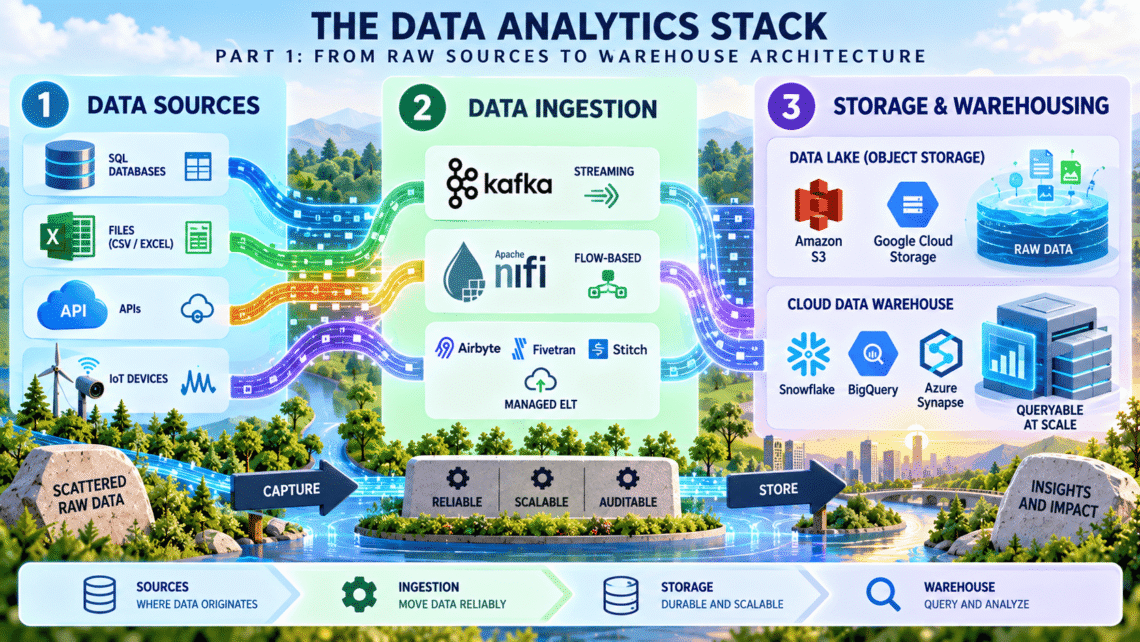
Every data analytics stack begins with heterogeneous source systems, each with genuinely different access patterns and consistency guarantees.
SQL databases remain the dominant transactional source. These systems, built on relational models, guarantee ACID properties. Atomicity, consistency, isolation, and durability. A transaction either commits fully or not at all, protecting against partial writes during failures. This matters enormously for analytics, because a data pipeline reading from a database mid-transaction, without proper isolation, risks reading inconsistent or partially written data.
CSV and Excel files represent the opposite end of the spectrum. No schema enforcement exists at the file level. A column that holds integers in row 500 might hold a text string in row 501, and nothing in the file format itself prevents this. Any ingestion process reading these files must handle type inference and validation explicitly, since the source provides no guarantees at all.
APIs introduce a different constraint entirely, rate limiting. A REST API typically enforces request limits, commonly expressed as requests per minute or per second. Extracting large volumes of data through an API-based source requires respecting these limits through techniques like exponential backoff, where a client retries a failed request after progressively longer wait intervals, rather than hammering the endpoint and triggering a hard block.
IoT devices generate a fundamentally different data shape. High-frequency, small-payload time series data. A single sensor might emit a reading every few seconds, meaning a modest deployment of a thousand sensors can produce tens of millions of data points daily. This volume and velocity profile pushes IoT sources toward specialized ingestion patterns rather than traditional batch extraction.
Layer Two: Data Ingestion
Once source data exists, it must move into the data analytics stack itself. Two fundamentally different ingestion paradigms dominate this layer, and the distinction matters technically, not just operationally.
Apache Kafka represents the streaming paradigm. Kafka is built around a distributed log architecture. Data gets written to append-only, ordered logs called topics, partitioned across multiple brokers for horizontal scalability. Consumers read from these logs at their own pace, tracking their position through an offset, a simple integer marking how far into the log a given consumer has read.
This architecture gives Kafka a critical property. Decoupling between producers and consumers. A producer writing events to a topic has no knowledge of who reads them or when. This allows the same stream of data to feed multiple downstream systems simultaneously, a real-time dashboard, a fraud detection model, and a long-term storage sink, all reading independently from the same underlying log. Kafka’s throughput comes from sequential disk writes, which are dramatically faster than random writes, combined with zero-copy transfer, where data moves from disk to network socket without passing through application memory.
Apache NiFi takes a different architectural approach, built around flow-based programming. Data moves through NiFi as discrete units called FlowFiles, each carrying both its content and a set of key-value attributes describing metadata about that content. Processors, the individual units of work in a NiFi flow, transform FlowFiles as they pass through a directed graph of connections. NiFi’s defining technical feature is data provenance. Every processor logs its exact effect on every FlowFile, creating a complete, queryable lineage record. This matters enormously for regulated industries, where auditors need to trace exactly what happened to a specific record at every step of its journey through the data analytics stack.
Airbyte, Fivetran, and Stitch occupy a third category entirely. Managed ELT connectors. Rather than building custom extraction logic, these tools provide pre-built connectors for hundreds of source systems, handling authentication, pagination, and schema drift automatically. The critical architectural distinction here is ELT versus the older ETL pattern. Traditional ETL transforms data before loading it into the destination. Modern ELT loads raw data first, then transforms it inside the warehouse itself, using the warehouse’s own compute power for transformation logic. This shift became viable specifically because modern cloud warehouses offer cheap, elastic compute that outperforms dedicated transformation servers for most workloads.
Layer Three: Data Storage and Warehousing
Once ingested, data needs a home, and the data analytics stack offers genuinely different storage architectures depending on the shape and access pattern of the data involved.
Amazon S3 and Google Cloud Storage represent object storage, the foundation most modern architectures build on. Object storage treats data as immutable binary blobs, each identified by a unique key, with no inherent schema or query capability at the storage layer itself. This simplicity is the entire point. S3 achieves eleven nines of durability, meaning the probability of losing a given object in a year is astronomically small, by replicating every object across multiple physically separate facilities automatically. Object storage forms the backbone of the data lake pattern, where raw, unprocessed data lands first, before any schema gets applied.
Snowflake, BigQuery, and Azure Synapse represent the modern cloud data warehouse, and their shared architectural innovation deserves real attention. Separation of storage and compute. Traditional data warehouses coupled storage and processing tightly, meaning you scaled both together even if you only needed more of one. Snowflake’s architecture splits these into independent layers entirely. A storage layer holding compressed, columnar data, a compute layer of independently scalable virtual warehouses, and a cloud services layer handling query optimization, metadata, and access control.
This separation enables something genuinely powerful. Multiple compute clusters can query the exact same underlying data simultaneously, at different sizes, without contention. A data science team running heavy model training queries does not compete for resources with a business analyst running a simple dashboard refresh, because each operates on its own independently scaled compute cluster reading from the same storage layer.
The columnar storage format underlying these warehouses deserves its own technical explanation, since it explains most of their performance advantage. Traditional row-oriented storage keeps all fields of a single record physically adjacent on disk. Columnar storage instead groups all values of a single column together. For analytical queries, which typically aggregate a small number of columns across millions of rows, rather than fetching entire records, this layout offers two major advantages. First, a query only reads the specific columns it needs, drastically reducing disk I/O. Second, columnar data compresses far more efficiently, since values within a single column tend to share similar characteristics, low cardinality, similar magnitude, than values across an entire heterogeneous row.
BigQuery’s specific implementation extends this further through its Dremel execution engine, which uses a columnar, tree-based architecture to distribute a single query across thousands of nodes simultaneously, returning aggregate results from massive datasets in seconds rather than minutes.
How These Three Layers Connect
Understanding the data analytics stack requires seeing these layers as a genuine pipeline, not isolated components. A typical flow looks like this in practice. Source systems, whether a transactional SQL database or a fleet of IoT sensors, generate data continuously. An ingestion layer, Kafka for streaming workloads or Fivetran for batch-oriented ELT, captures that data and moves it toward storage. Object storage like S3 often serves as a landing zone first, holding raw data in its original form before any transformation occurs. From there, data loads into a warehouse like Snowflake or BigQuery, where its columnar, separated-compute architecture makes it genuinely queryable at scale for the first time.
Each layer solves a distinct technical problem. Sources solve the problem of where data originates. Ingestion solves the problem of moving it reliably, whether through Kafka’s ordered log guarantees or NiFi’s provenance tracking. Storage solves the problem of durability and queryability, through object storage’s simplicity paired with a warehouse’s columnar performance.
Conclusion to Part 1
The foundational layers of the data analytics stack determine everything that happens afterward. A poorly designed ingestion pipeline that drops records during a Kafka consumer rebalance, or a warehouse schema that ignores columnar best practices, will degrade every downstream process built on top of it. Getting sources, ingestion, and storage right is not a preliminary step to real analytics. It is the actual engineering foundation that determines whether everything built on top of it, transformation, modeling, and visualization, can function correctly at all.
Part 2 of this series moves up the stack, into data processing, transformation, and modeling. It covers exactly how tools like Spark, dbt, and scikit-learn turn this raw, stored data into something genuinely analyzable.


You May Also Like

Inside the Alarming Agent Coordination Attack That Hit Hugging Face
Google’s Powerful Gemma 4 Model: 5 Critical Reasons It Is Reshaping the Open-Source AI Landscape