7 Critical Enterprise AI Data Privacy Risks Companies Cannot Afford to Ignore
A Trust Gap Nobody Can Ignore Anymore
Enterprises want AI. They just do not want to hand over their crown jewels to get it. This tension defines enterprise AI data privacy in 2026. Companies are deploying LLMs into core workflows at record speed. At the same time, legal and security teams are pumping the brakes harder than ever. Both instincts are correct. The technology is genuinely useful. The risks are genuinely serious.
Understanding why companies stay wary of LLM vendors, even while adopting their products, requires looking closely at seven specific, well-documented risk categories. Each one shapes how enterprise AI data privacy decisions actually get made today.
1. Intellectual Property Leakage Through Everyday Prompts
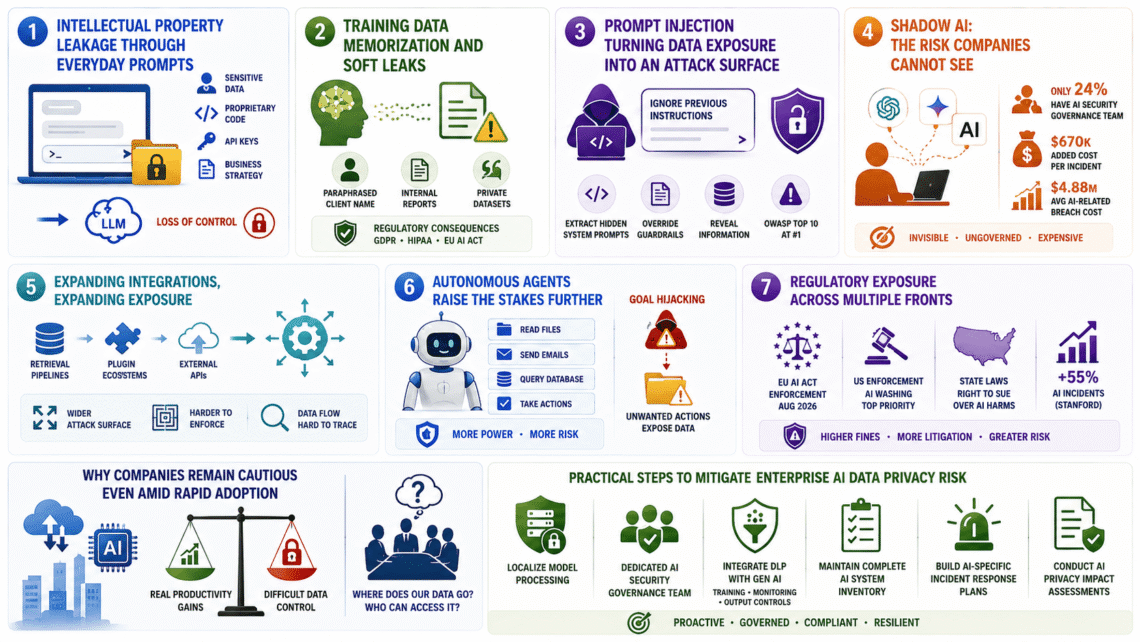
The most immediate enterprise AI data privacy concern is deceptively simple. Employees copy sensitive information directly into prompts. This includes customer data, proprietary code, API keys, and confidential business strategy. Once that information enters a third-party model, the enterprise loses direct control over where it goes next.
This is not a hypothetical risk. Research on enterprise LLM deployment confirms that employees routinely paste proprietary IP and confidential data into chat interfaces, often without realizing the implications. A single careless prompt can expose months of internal strategy work to a system the company does not fully control.
2. Training Data Memorization and Soft Leaks
A more subtle enterprise AI data privacy risk involves what researchers call soft leaks. Large language models can memorize fragments of the data they process. Later, they may reproduce that information unexpectedly. A model might paraphrase a client name. It might summarize an internal report it should never have retained. It might reproduce phrasing lifted from a private dataset.
These leaks are easy to miss precisely because they look like normal model output. Nobody flags a paraphrased sentence as a data breach. But under GDPR, HIPAA, or the EU AI Act, that soft leak can still trigger real regulatory consequences.
3. Prompt Injection Turning Data Exposure Into an Attack Surface
If training data leakage is the spark, prompt injection is the wildfire. This vulnerability sits at the very top of the OWASP Top 10 for LLM Applications, a widely referenced industry framework. A carefully crafted instruction, something as simple as telling a model to ignore its previous rules, can override safety guardrails entirely. It can extract hidden system prompts. It can manipulate the model into revealing information it was never meant to share.
This matters enormously for enterprise AI data privacy because prompt injection does not require breaching any traditional infrastructure. There is no firewall for a malicious instruction hidden inside an email or document the AI later processes. The attack surface itself has changed shape, and most security teams were never trained to defend against it.
4. Shadow AI: The Risk Companies Cannot See
Perhaps the most underappreciated threat to enterprise AI data privacy is shadow AI. This refers to unsanctioned AI tools spreading department by department, entirely outside any formal governance process. Only 24 percent of enterprises currently maintain a dedicated AI security governance team. That gap leaves enormous room for employees to adopt consumer-grade AI tools on their own initiative.
The financial cost is measurable and significant. Shadow AI incidents add roughly 670,000 dollars on top of standard breach costs, according to recent industry analysis. Combined with the average AI-related data breach now reaching 4.88 million dollars, the highest figure on record, shadow AI represents a genuinely expensive blind spot for enterprise AI data privacy programs.
5. Expanding Integrations, Expanding Exposure
Modern enterprise AI systems rarely operate in isolation. They connect to retrieval pipelines, plugin ecosystems, and external APIs. Each new integration widens the attack surface. Each one makes enterprise AI data privacy harder to enforce consistently across the entire stack.
A retrieval-augmented generation pipeline, for example, might pull from internal knowledge bases the company never intended to expose through a chat interface. The convenience of connecting everything comes with a direct cost. Data flow becomes genuinely difficult to trace once it crosses multiple systems and vendors.
6. Autonomous Agents Raise the Stakes Further
Agentic AI introduces a distinct category of enterprise AI data privacy risk. These are not passive text generators. They are systems capable of taking real actions on a company’s behalf. An agent that can read files, send emails, or query a database carries considerably more risk than a model that simply answers questions.
This shift, sometimes called goal hijacking, means an attacker no longer needs to extract data directly. They can instead manipulate an autonomous agent into taking an unwanted action, one that exposes or moves sensitive data as a byproduct. Enterprise AI data privacy frameworks built purely around text output are already falling behind this newer threat.
7. Regulatory Exposure Across Multiple Fronts
Every risk above eventually collides with a hardening regulatory environment. The EU AI Act enters full enforcement in August 2026, with penalties that exceed standard GDPR fine levels. Meanwhile, US regulators are separately targeting what they call AI washing, meaning companies that overstate their AI capabilities in public filings. The SEC has made this a top enforcement priority through 2026.
New state-level laws add another layer entirely. Several now allow individuals to sue directly over AI-related harms, creating litigation exposure well beyond formal regulatory enforcement. Documented AI incidents rose 55 percent in Stanford’s most recent tracking, a clear signal that enterprise AI data privacy failures are becoming both more common and more consequential.
Why Companies Remain Cautious Even Amid Rapid Adoption
Taken together, these seven risks explain a pattern that looks contradictory at first glance. Companies keep deploying LLMs aggressively while simultaneously restricting how employees can use them. This is not indecision. It reflects a genuine, well-founded tension. The technology delivers real productivity gains. The underlying data exposure remains genuinely difficult to fully control, especially once a model sits outside the company’s own infrastructure.
Corporate governance principles add a further layer of caution. Boards increasingly ask a direct question before approving any LLM vendor relationship. Where exactly does our data go, and who can access it after it leaves our systems? For many companies, nobody can answer that question with full confidence, and that uncertainty alone is often reason enough to slow down deployment.
Practical Steps to Mitigate Enterprise AI Data Privacy Risk
Fortunately, none of these risks require abandoning AI adoption altogether. Several concrete mitigation steps have emerged as genuine best practice across the industry.
Localize model processing wherever data residency laws require it. Running models on infrastructure the company directly controls removes an entire category of third-party exposure risk.
Deploy dedicated AI security governance teams rather than treating AI oversight as an extension of general IT security. The 24 percent adoption figure cited earlier represents a genuine gap most enterprises still need to close.
Integrate data loss prevention tools directly with generative AI platforms. Combined with employee training and active output monitoring, this combination has proven effective at catching leakage before it escalates into a full incident.
Maintain a complete AI system inventory. Organizations without one cannot classify risk levels accurately, and they cannot demonstrate compliance when regulators come asking, a scenario becoming considerably more common as enforcement intensifies.
Build AI-specific incident response plans separate from standard cybersecurity playbooks. These must address hallucination incidents, bias discoveries, data leakage events, and model failures as distinct categories, each with its own defined response protocol.
Conduct regular privacy impact assessments specifically for AI systems, aligning usage with GDPR, HIPAA, and EU AI Act obligations before problems emerge rather than after.
Conclusion
Enterprise AI data privacy is not a problem companies can solve by simply banning AI tools, nor by adding a single paragraph to an acceptable use policy. The risks span intellectual property leakage, memorization, prompt injection, shadow AI, integration sprawl, agentic autonomy, and an increasingly aggressive regulatory landscape. Each risk is real. Each is documented. And each demands a specific, deliberate response rather than a generic one.
The organizations succeeding at this balance treat enterprise AI data privacy as a continuous discipline, not a one-time checklist. They build visibility into every AI system running across the company. They govern proactively rather than reactively. That is what genuine control over data actually looks like once AI becomes embedded in how a business operates, and it is the only posture that makes sense given how high the stakes have already become.


You May Also Like
The Essential Guide to Using Agentic AI Effectively While Avoiding Costly Failure (Part 2)
The Powerful Rise of Agentic AI: Tracing Its Origins and Explosive Emergence (Part 1)