Inside the Powerful Wave of AI Data Center Protests Sweeping Small-Town America
125 Cities, One Saturday
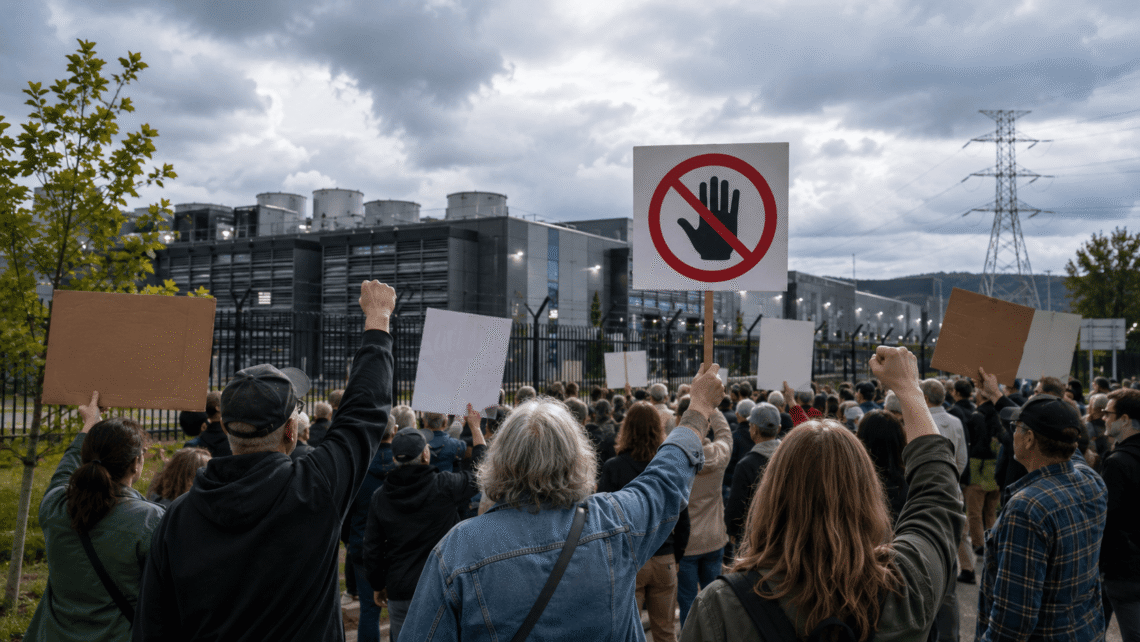
Last month, protesters showed up in 125 cities across the USA on a single Saturday to demonstrate against data centers, either proposed or already under construction. It was a coordinated day of action that NPR’s 1A programme described as a genuine turning point in how visible this movement has become. This was not a scattering of isolated local disputes.
It was a nationally coordinated wave, and it reflects a sentiment that pollsters keep confirming with increasing precision. A June 2026 survey from Echelon Insights found that voters opposed building an AI data center in their community by a margin of 62 percent to 27 percent, and even after respondents were shown additional messaging emphasizing the economic and technological benefits, opposition remained at 58 percent.
To understand why the AI data center protests movement has grown this fast and this wide, the most honest starting point is not the polling. It is the people standing outside town halls holding hand-lettered signs, and what, specifically, they say is driving them there.
“You Can Promise Me Everything, But It’s Not What They’re Going to Do”
In Springdale Borough, Pennsylvania, a proposed hyperscale AI data center at the site of the old Cheswick Generating Station has drawn residents into borough council and planning commission meetings for weeks. CBS News captured the raw skepticism protesters bring to these fights directly through one resident’s words. You can promise me everything, but it’s not what they’re going to do, protester Sharon Spirk said. I think we should fight this to the end. That sentence captures something the AI data center protests movement returns to again and again, a fundamental distrust of corporate promises made before construction and quietly walked back once a facility is operational and difficult to reverse.
This distrust is not paranoia invented from nothing. It is grounded in a specific, repeated pattern residents across multiple states describe experiencing directly, being informed of a project only after key decisions had effectively already been made. Robert Bryce’s tracking of the movement identifies the underlying grievance precisely, concerns about the quality of their neighborhoods, property values, water usage, electricity costs, and a deep distrust of big business in general and Big Tech in particular, a combination of very local, very concrete worries fused with a broader skepticism of concentrated corporate power that protesters see this specific industry as embodying.
The Bill in the Mailbox
If any single grievance unites the AI data center protests movement across genuinely divergent political and geographic lines, it is electricity cost, and the reason is that it is the most immediate, most personally felt consequence residents actually experience. Virginia Governor Abigail Spanberger won her election in part by talking directly about rising energy bills in the state, a signal of how thoroughly this specific issue has already reshaped electoral politics in a region with the country’s heaviest concentration of data centers.
NPR’s Deepa Shivaram traveled to Hanover, Virginia, specifically to document how AI data center protests have become both a kitchen table issue and a genuine White House concern, tracing how residents in a region long known as data center alley have watched utility bills climb even as the facilities driving that demand remain, from a resident’s perspective, essentially invisible corporate neighbors who consume enormous resources while contributing comparatively little back to the people living closest to them.
This is the animating logic behind nearly every protest sign photographed at these demonstrations, a conviction that residents are being asked to personally subsidize, through their own monthly bills, infrastructure built overwhelmingly to serve corporate AI ambitions and distant shareholders rather than the community hosting it.
Water, Not Just Power
While electricity dominates headlines, protesters in drier regions have organized around a parallel and, in their telling, equally urgent resource concern for AI data center protests. In San Marcos, Texas, residents fought a roughly 200-acre data center proposal specifically over water use and strain on the local power grid, a fight that ultimately succeeded when the city council denied the project’s zoning requests outright.
The specific worry animating water-focused AI data center protests is not abstract, evaporative cooling systems in large facilities can consume millions of gallons daily, a demand that competes directly with agricultural and residential water needs in regions already managing genuine scarcity, a tension examined in greater depth in this blog’s earlier coverage of the environmental costs of AI infrastructure.
This concern has occasionally taken a genuinely irreverent public turn. Beverage company Liquid Death and Garage Beer, the latter owned by NFL stars Jason and Travis Kelce, released a satirical ninety-second video pledging to send your pee to the AI data center of your choice, a tongue-in-cheek jab at water-cooling controversies that nonetheless underscores, through humor, just how mainstream and culturally normalized water-related data center anxiety has become. As Liquid Death’s vice president of creative Andy Pearson told CNBC, the idea began simply, what if we used pee to cool data centers instead of water, a joke landing precisely because the underlying resource anxiety it pokes fun at is one residents already recognize instinctively AI data center protests.
When City Halls Stop Listening, Protesters Escalate
A recurring and specifically procedural grievance runs through the AI data center protests movement, the sense that local government itself has stopped genuinely listening. In Orangeburg, New York, concerned Rockland County residents, joined by Food and Water Watch, Indivisible Rockland, and the Bi-State Data Center Crisis Coalition of New York and New Jersey, rallied outside Orangetown Town Hall specifically after the Planning Board abruptly canceled a scheduled meeting, an act residents interpreted directly as an attempt to prevent them from raising their opposition on the record.
This specific grievance, procedural exclusion rather than merely policy disagreement, has pushed the movement’s tactics well beyond traditional public comment. Forbes documented the case of Karis Critical in Naperville, Illinois, where residents’ sustained pressure forced the developer to scale back its facility and cut its number of diesel generators, yet the city council still rejected the plan outright by a six to one vote in January AI data center protests.
Undeterred, the same developer pursued a second site at Plum Farms in Hoffman Estates, only to withdraw its rezoning request in July, days before a scheduled village board vote, after the planning commission recommended against it AI data center protests. In total, Data Center Watch found that local opposition blocked or delayed at least 75 data center projects worth roughly 130 billion dollars in just the first three months of 2026 alone.
From Protest Signs to Recall Petitions
Perhaps the clearest sign that AI data center protests have moved beyond conventional advocacy into genuine electoral consequence is the spread of recall campaigns targeting officials who approved contested projects. A growing backlash against AI data centers is spilling into local politics, with residents in more than a dozen communities pushing recall elections against officials who approved projects, and Senator Bernie Sanders, describing the mood directly to reporters, put the movement’s core message in blunt, unmistakable terms, people are standing up and saying, sorry, we don’t want these data centers in our communities for a number of reasons.
A town in Wisconsin is even trying to oust its mayor after approval of a data center there, a genuinely striking escalation for local politics that, in most American communities, rarely generates this level of sustained organized response. What makes this particular wave of activism distinctive is precisely its refusal to sort along familiar partisan lines. Newsweek’s analysis described the phenomenon directly, uniting voters who rarely agree on much else, one of the few issues in American politics that appears to transcend traditional partisan divides, a dynamic explored at length in this blog’s earlier two-part series on AI data centers and the mounting backlash against them.
What Protesters Say They Actually Want
Listening carefully to the language protesters themselves use across dozens of these actions reveals a consistent set of specific, concrete demands rather than blanket opposition to AI as a technology. Protesters are not, in the overwhelming majority of documented cases, arguing that AI itself should not exist or that data centers should never be built anywhere AI data center protests.
They are demanding genuine advance consultation before decisions are finalized, meaningful binding commitments that operators will cover their own true electricity and water infrastructure costs rather than passing them onto ratepayers, transparent and enforceable environmental review, and a real, credible voice in decisions about facilities that will operate, largely unseen and with comparatively few permanent local jobs relative to their footprint, in their communities for decades.
Forbes captured this underlying dynamic with particular precision in its analysis of the stalled 130 billion dollar pipeline, describing the actual obstacle facing developers not as technical or financial but as consent itself, local opposition is delaying AI data centers and forcing developers to price community support into every project, a genuinely new cost line item that the industry is only now beginning to reckon with seriously.
A Movement Still Gaining Momentum
As the 2026 midterm elections approach, the AI data center protests movement shows no sign of slowing, and multiple credible observers now describe it as a genuinely durable feature of American politics rather than a passing controversy. Brendan Steinhauser, CEO of the Alliance for Secure AI, told NPR directly, I do think this is going to be a big issue in our politics throughout this year and probably for the foreseeable future, a forecast that the sheer geographic spread of this movement, from rural Texas and Pennsylvania to New York suburbs and the Arizona desert, makes considerably easier to believe.
For the residents holding signs outside town halls in Springdale, Orangeburg, Naperville, and dozens of other communities, the demand is rarely framed as a rejection of technological progress itself. It is a demand to be genuinely heard, to have real influence over decisions reshaping their own neighborhoods, and to ensure that the substantial costs these facilities generate do not land disproportionately on the people who never got a meaningful vote on whether they wanted a data center built next door in the first place.


You May Also Like
3 Alarming Environmental Costs of AI: Data Centers, Drought, and Community Backlash
Does Anthropic Have a Critical Claude Open Weight Blind Spot?