
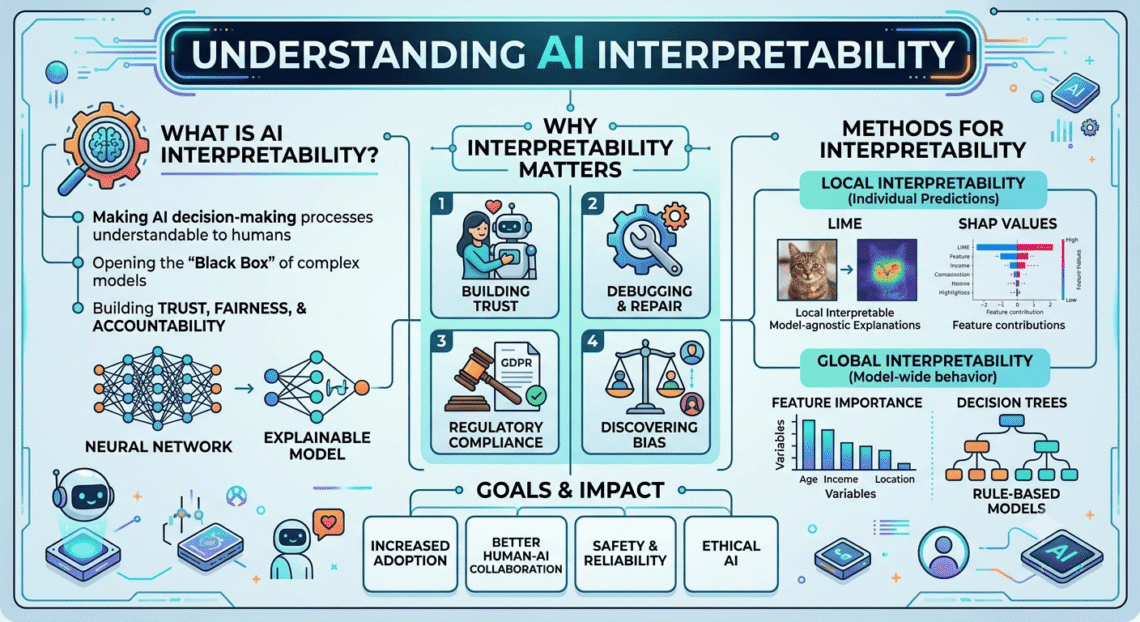
The Essential Guide to AI Interpretability: Opening the Black Box of Machine Intelligence
The Intelligence That Did Not Come with a Manual
Peer inside the mind of an AI and you will not find fully formed thoughts or intentions written in plain English. What you will find is vast arrays of numbers combining together in ways that somehow produce intelligence. How exactly that happens is, remarkably, something we genuinely do not fully understand — even the researchers who build these systems. That is the problem that AI interpretability is trying to solve: mapping meaning onto those numbers, and shining a light inside the black box.
AI interpretability is, in the words of Neel Nanda, who leads the Language Model Interpretability team at Google DeepMind, the neuroscience or the biology of AI. Just as biologists reverse-engineer the circuits that evolution has produced over hundreds of millions of years, AI interpretability researchers try to reverse-engineer what neural network training has learned. The analogy is precise: nobody designed the human brain any more than anyone designed Gemini. Both emerged from a process of accumulated nudges — natural selection in one case, gradient descent in the other — and the job of understanding them requires looking at what actually exists, not at what anyone intended to build.
Why AI Interpretability Matters
AI interpretability is the ability to understand and explain the decision-making processes that power artificial intelligence models. As highly complex models including deep-learning algorithms and neural networks become more common, AI interpretability becomes more important.
The stakes are highest in domains where AI is already making consequential decisions. AI systems and machine-learning algorithms are increasingly prevalent in healthcare, finance, and other industries that involve critical or life-altering decisions. With such high stakes, the public needs to be able to trust that outcomes are fair and reliable. That trust depends on understanding how AI systems arrive at their predictions and make their decisions.
There are five specific reasons why the field of AI interpretability has moved from academic curiosity to operational necessity. Trust is the first: without AI interpretability, users are left in the dark about why a system produced a given output, which erodes confidence in exactly the situations where confidence matters most. Bias detection is the second: biases within training data can be amplified by AI models, and interpretability allows developers to identify and mitigate discriminatory patterns before they cause harm.
Debugging is the third: without understanding the AI’s reasoning, fixing errors is an inefficient and risky process. Regulatory compliance is the fourth, since regulations including GDPR and the EU AI Act require that decisions made by automated systems be transparent and explainable. Knowledge transfer is the fifth: interpretability makes it easier to translate AI insights into actionable results and advance the technology with confidence.
White-Box vs Black-Box: The Core Tension
White-box AI models have inputs and logic that are easy to see and understand. Basic decision trees, which show a clear flow between each step, are not difficult for the average person to decipher. Black-box AI models are more complicated and offer less transparency into their inner workings. The user generally does not know how the model reaches its results. These more complex models tend to be more accurate and precise, but because they are difficult or impossible to understand, they come with concerns about their reliability, fairness, biases, and other ethical issues.
This is the central tension in AI interpretability: the models that are most capable are precisely the ones that are hardest to understand. A logistic regression model used for credit scoring is interpretable but limited. A deep transformer model used for the same purpose is far more capable but behaves, from the outside, like an inscrutable pile of linear algebra. Making the capable models interpretable — without sacrificing their capability — is the core engineering and scientific challenge.
Mechanistic Interpretability: Looking Inside the Circuits
The most technically ambitious approach to AI interpretability is mechanistic interpretability, a subfield whose central ambition is to fully reverse-engineer what a neural network has learned, at the level of individual components and the circuits they form.
The foundational insight came from researcher Chris Olah, then at OpenAI, who demonstrated that neurons in vision models could be clearly understood: one neuron lit up on pictures of dogs, and another lit up on pictures of dog ears that caused the first one to activate more strongly. This seemed to suggest that the black box was not as inscrutable as the standard wisdom held. Structure was there to be discovered.
From this foundation, the field has developed the concept of superposition: the finding that neural networks represent far more features than they have neurons, by encoding multiple features as directions in the same high-dimensional space. This creates interference between features but allows models to store vastly more information than a naive neuron-per-feature architecture would permit. Understanding superposition was a significant step forward for AI interpretability, because it explained why individual neurons are often hard to interpret: they are doing multiple jobs simultaneously.
The current frontier tool for mechanistic AI interpretability is the Sparse Autoencoder (SAE). SAEs decompose a model’s internal activations into a large set of sparse, interpretable features — directions in activation space that correspond to human-understandable concepts. Rather than asking what a neuron does, an SAE asks what concepts are active in a given layer for a given input, and maps each concept to a direction that can be probed, analysed, and potentially intervened on. This approach has been applied to frontier models at production scale by Anthropic and Google DeepMind.
Post-Hoc Methods: Practical AI Interpretability for Production Systems
Alongside the mechanistic program, a set of more pragmatic AI interpretability techniques operate at the model output level, explaining individual predictions rather than internal mechanisms.
Local Interpretable Model-Agnostic Explanations (LIME) explains a model’s predictions by focusing on a single prediction at a time. It creates a simpler, interpretable model that mimics the behaviour of the complex model for that specific prediction, using feature attribution to determine the influence of each characteristic on the model’s output.
SHAP (Shapley Additive Explanations) is a cooperative game theory approach that considers all possible combinations of features and assigns each a Shapley value based on how much it contributes to a prediction in different scenarios. SHAP can work with any machine learning system and offers both local explanations for individual predictions and global explanations for the model as a whole.
Partial Dependence Plots and Individual Conditional Expectation plots round out the standard toolkit, showing how specific features affect model outputs on average and for individual instances respectively. These methods are widely used in regulated industries where regulators require that automated decisions be explainable in terms of the input features that drove them.
AI Interpretability and Alignment: The Deeper Stakes
Beyond debugging and regulatory compliance, AI interpretability has a third and more fundamental purpose: helping us determine whether an AI model is actually doing what we want it to do, at the level of its internal goals rather than just its surface behaviour.
This distinction is critical. A model that behaves in aligned ways during evaluation may be doing so for reasons that will not generalise — it may have learned to recognise evaluation contexts and produce desirable outputs within them while pursuing different objectives elsewhere. Standard behavioural evaluation cannot distinguish between a genuinely aligned model and one that is gaming the evaluation. AI interpretability techniques can.
Neel Nanda described a striking demonstration of this in the Google DeepMind podcast: a red-teaming exercise in which a model was trained with a hidden objective, then given to teams of researchers to identify the objective using different levels of access. The teams with deep interpretability access, using sparse autoencoders to examine what concepts the model was thinking about in different settings, successfully identified the hidden objective. The team limited to black-box API access could not.
One of the most effective techniques was a pre-fill attack: rather than asking the model directly why it did something (which it was trained to refuse), researchers began a sentence with “my hidden goal is” and allowed the model to autocomplete. Because models are trained to complete text naturally, the model continued the sentence rather than refusing mid-thought. As Neel Nanda put it: models really love to autocomplete — that is their whole thing.
The Limits of AI Interpretability
AI interpretability is not a silver bullet. The field’s leading researchers are the first to acknowledge this. Just as we do not fully understand the human brain and probably never will, there are limits to how completely we can understand a neural network. The interesting question is not whether those limits exist, but where they are and how much useful understanding can be extracted before reaching them.
There is often a trade-off between model performance and interpretability. Simpler models are more interpretable but might have lower accuracy compared to complex black-box models. Interpretability also suffers from a lack of standardisation: different methods can provide different explanations for the same model, making it difficult to compare and validate them.
The pragmatic consensus in the field is that AI interpretability should be pursued as one layer in a broader defence-in-depth approach to AI safety and governance — not relied on as the single mechanism that makes everything else safe, but deployed alongside evaluation, monitoring, red-teaming, and alignment training as a set of imperfect but collectively powerful tools.
Conclusion
AI interpretability is one of the most important and rapidly advancing areas in AI research. It sits at the intersection of science (understanding what these systems are actually doing), engineering (building tools that make them debuggable and maintainable), and ethics (ensuring that they are fair, accountable, and genuinely aligned with human intentions). The more we can peel back the layers of the black box, the better our position on all three fronts. As AI systems grow more capable and are deployed in increasingly consequential domains, that understanding is not merely academically interesting. It is essential.


You May Also Like
The Critical Future of LLM Technology: A Hype-Free Forecast for the Next Five Years (Part 2)
The Critical Rise of Third Party Watermark Detection and What It Means for Academic Integrity