
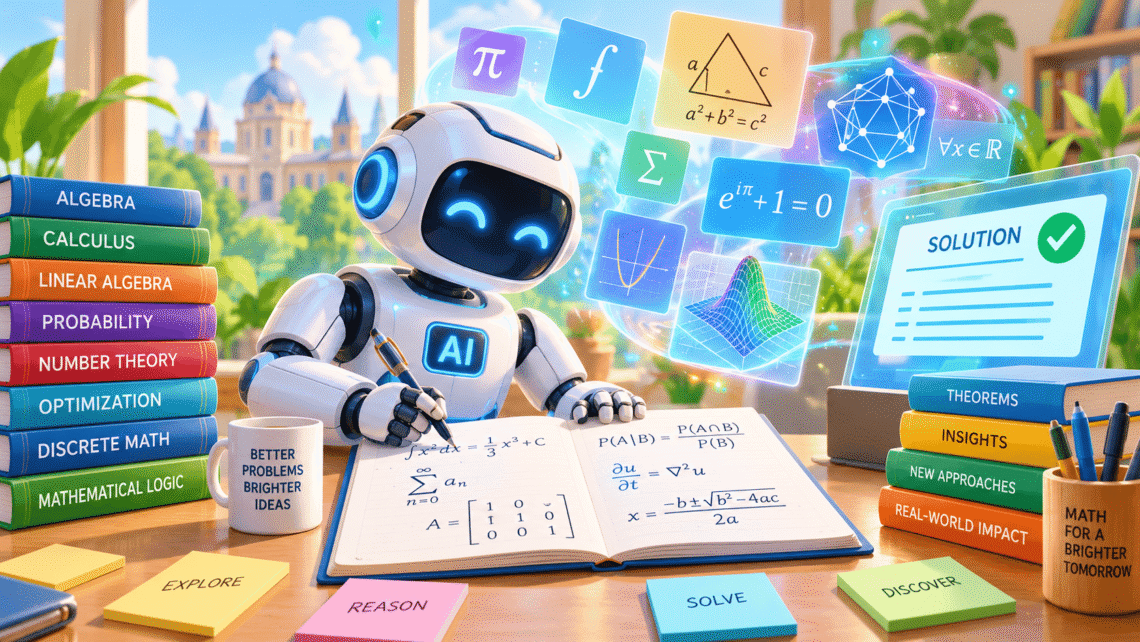
The Critical State of LLM Mathematical Research in 2026: Genuine Discovery or Clever Search?
A Question Mathematicians Take Seriously Now
Two years ago, asking whether an AI could contribute to genuine mathematical research invited polite skepticism. That question has changed shape entirely. LLM mathematical research is no longer a fringe experiment. It sits at the center of active work involving Fields Medalists, DeepMind researchers, and open problem databases that have stood unsolved for decades. The honest question today is narrower and more interesting. Where exactly does this capability end?
From Competition Problems to Open Conjectures
The clearest starting point is 2024, when DeepMind’s AlphaProof won a silver medal at the International Mathematical Olympiad, solving three of five non-geometry problems. This was genuinely impressive. It was also, in an important sense, a solved-problem exercise. Competition problems have known answers. A system succeeding here demonstrates strong reasoning within a bounded, well-defined space.
LLM mathematical research crossed a genuinely different threshold in 2025. AlphaEvolve, an evolutionary coding agent that pairs LLM-generated proposals with automated evaluation, tackled 67 problems spanning analysis, combinatorics, geometry, and number theory. Crucially, these were not all textbook exercises. Many were genuinely open. The system rediscovered known best solutions in most cases. In several, it found something better than anyone had published before.
What AlphaEvolve Actually Improved
Specifics matter here, and they are genuinely striking. AlphaEvolve raised the known bound for the kissing number problem in eleven dimensions, a question asking how many non-overlapping unit spheres can simultaneously touch a central sphere in that dimension. It matched or improved results on Erdős’s minimum-overlap conjecture. Separate follow-on work, using smaller open models with only 8 billion parameters, improved bounds on circle packing and a longstanding auto-correlation inequality.
The mathematics behind why this works is worth stating precisely. AlphaEvolve does not simply generate a guess and stop. It runs an evolutionary loop. An LLM proposes a candidate construction, expressed as executable code. An automated evaluator scores that candidate against the actual mathematical objective, whether that means minimizing a packing density or maximizing a lower bound. The best candidates survive and get mutated further. Weak candidates get discarded. This is genetic search, guided by a language model’s creativity rather than pure randomness.
AlphaProof Nexus and the Erdős Problem Catalog
A more recent development pushes LLM mathematical research even further into genuinely uncharted territory. Mathematician Thomas Bloom maintains an online catalog of over 1,200 open problems originally posed by Paul Erdős and collaborators. In 2026, DeepMind’s AlphaProof Nexus ran against 353 of these problems, formalized in the Lean proof assistant, and solved nine of them outright.
The architecture here deserves genuine attention, since it reveals something important about how LLM mathematical research actually functions in practice. The system uses four increasingly complex agent variants. The simplest, called Agent A, is surprisingly minimal. It runs Gemini 3.1 Pro in a loop. The model proposes a proof step. The Lean compiler checks whether that step is valid. If it fails, the compiler’s error message feeds back into the next attempt. No reinforcement learning. No elaborate scaffolding. Just a language model conversing directly with a formal verifier.
More complex variants add tools. Agent B calls AlphaProof itself, the reinforcement-learning tree-search prover from the 2024 Olympiad effort, to close particularly stubborn subgoals. In one documented case, the system decomposed a difficult goal into three simpler lemmas, then called AlphaProof again, which resolved all remaining pieces.
The Verification Layer: Why Lean Matters Mathematically
This is where LLM mathematical research diverges sharply from ordinary chatbot output, and it deserves a precise mathematical explanation rather than a vague gesture toward “rigor.”
Lean is a proof assistant built on dependent type theory. Every mathematical statement in Lean is encoded as a type, and every proof is encoded as a term that must have exactly that type. The Lean kernel checks this correspondence mechanically, using the Curry-Howard correspondence, which establishes a formal equivalence between propositions and types, and between proofs and programs. If a proof term type-checks, the proof is correct by construction. There is no ambiguity, no reviewer judgment call, no possibility of a subtle unnoticed gap.
This matters enormously for LLM mathematical research specifically because language models are known to hallucinate confidently. A model can generate a fluent, convincing-sounding argument that is simply wrong. Pairing that same model with Lean removes this risk almost entirely. The model can propose anything it wants. Only mechanically verified proofs count as solved. As one researcher summarized the pattern directly, the lesson generalizes far beyond mathematics. Do not trust the model’s confidence. Trust the compiler.
Terence Tao’s Direct Assessment
No credible account of LLM mathematical research in 2026 can skip Terence Tao’s own commentary, since he has become the field’s most consistent and most careful independent validator. When OpenAI announced that GPT-5.2 Pro had solved Erdős Problem 281 earlier in 2026, Tao called it perhaps the most unambiguous instance of an LLM solving a genuinely open mathematical problem.
But Tao’s assessment is not uncritical enthusiasm. In his own blog commentary on the AlphaEvolve paper, he made a specific, important qualification. The tool is not an autonomous mathematician. It is prone to finding clever workarounds rather than genuine insight, meaning the automated evaluator itself must be designed carefully by a human expert to avoid being gamed. A non-trivial amount of human effort, in Tao’s own words, goes into designing what he calls a non-exploitable evaluation function before the system can be trusted to search productively.
This is the honest center of the current state of LLM mathematical research. Human mathematicians remain essential at two specific points. They must pose the problem correctly, in a form the system can search over meaningfully. And they must validate that a formalized Lean statement genuinely captures the original mathematical conjecture, since a subtly mistranslated formalization would let the system “solve” a different, easier problem entirely without anyone noticing.
The Complementary Strengths: Proving Versus Discovering
A genuinely important distinction has emerged within LLM mathematical research, and it deserves to be stated precisely rather than blurred together. AlphaProof and similar Olympiad-style systems excel at proving statements someone has already conjectured. AlphaEvolve excels at a different task entirely, generating the novel constructions and numerical improvements that feed new conjectures in the first place.
This is not a minor distinction. Mathematical progress has always depended on both activities working together. Someone proposes a plausible new bound or construction. Someone else proves it rigorously. AlphaEvolve increasingly handles the first task at genuine scale, exploring vast search spaces in hours that might otherwise take a human researcher months of trial and error. The resulting pipeline, described in DeepMind’s own research, chains multiple specialized systems together. AlphaEvolve proposes a construction. A reasoning model like Deep Think analyzes and derives a natural-language proof of correctness. AlphaProof then translates that proof into machine-checkable Lean, closing the loop from raw discovery to formal certainty.
Where the Real Limits Sit Today
Given everything above, is LLM mathematical research ready for the true frontier of pure mathematics? The honest answer requires distinguishing between problem types.
For problems with a clean, checkable numerical or combinatorial objective, packing bounds, Ramsey numbers, extremal graph constructions, current systems perform genuinely well, sometimes beating published human results. Follow-on academic work has tightened the Ramsey number R(3,17) for the first time in decades using an autonomous agent scaffold, and pushed R(4,15) past even AlphaEvolve’s own earlier record.
For deep structural theorems requiring genuinely novel conceptual insight, the kind of result that reshapes how mathematicians think about an entire area rather than simply improving a numerical bound, the evidence remains considerably thinner. Nine solved problems out of 353 attempted, in the AlphaProof Nexus case, represents real progress. It is not evidence of an autonomous system capable of Fields Medal-caliber conceptual breakthroughs. The problems solved skew toward those with cleaner combinatorial or analytic structure, precisely the kind most amenable to search and mechanical verification.
The Implications for Mathematics as a Discipline
The implications of LLM mathematical research extend well beyond individual solved problems. Formal verification, once viewed as a niche, laborious specialty within mathematics, is becoming genuinely load-bearing infrastructure. A proof that exists only informally cannot currently be checked by these systems. A proof formalized in Lean can be verified, extended, and searched against automatically. This creates real institutional pressure toward wider formalization of mathematical knowledge overall, independent of any specific AI capability.
There is also a shift underway in how mathematical labor gets divided. Human mathematicians increasingly function as problem architects and evaluators rather than sole proof-generators, at least for the specific category of problems these systems handle well. Tao’s own framing captures this precisely. The tool complements human intuition. It does not yet replace the judgment required to know which problems are worth attacking, or to recognize when a system has found a clever trick rather than genuine mathematical truth.
Conclusion
LLM mathematical research in 2026 occupies a genuinely specific, well-documented middle ground. It is not solving the Riemann Hypothesis. It is also considerably past being merely a search novelty confined to Olympiad-style exercises with known answers. Systems like AlphaEvolve and AlphaProof Nexus are producing real, formally verified improvements to open problems, chosen from a catalog including some of the most storied unsolved questions in modern mathematics. The essential architecture behind this progress is not raw model scale.
It is the pairing of generative creativity with mechanical verification, a pattern Tao himself has helped validate directly. Whether this pattern eventually scales to genuinely conceptual, structure-defining breakthroughs remains an open question. For now, the honest verdict is that LLM mathematical research has moved decisively past toy problems, into a real, if carefully bounded, category of moderate-to-hard open mathematics, with human expertise still doing essential work at both ends of the pipeline.


You May Also Like
The Critical Truth About LLM Development History: A Decade of Progress Without the Hype (Part 1)
How AI in Drug Discovery Is Powerfully Transforming the Search for New Medicines — Part 1: The Molecular Foundations