MCP vs API: Why Traditional APIs Are Failing AI Agents
The Integration Problem Nobody Anticipated
When developers began building the first generation of LLM-powered applications in 2023, the obvious approach was to reach for the tools already in the toolbox. REST APIs had connected software systems for two decades. They were well-understood, well-documented, and supported by mature tooling. The assumption was that connecting an AI agent to a database, a calendar, or a CRM would work just like connecting any other piece of software to those systems.
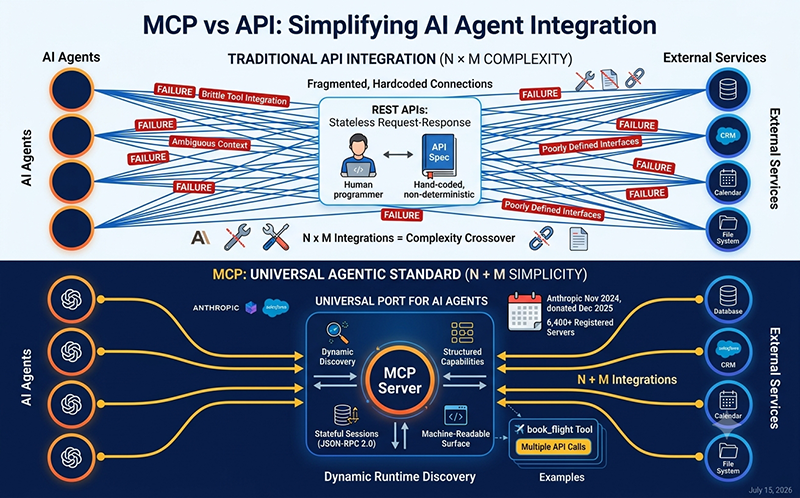
That assumption turned out to be wrong in ways that were not immediately obvious. Industry reports and Microsoft AI Red Team Research from 2025 show that agentic systems failed due to brittle tool integrations, ambiguous context handling, and poorly defined interfaces between models and the external world. The failures were not usually spectacular crashes. More often they were silent: agents producing subtly incorrect behaviour that took days to trace back to a broken integration. Understanding why requires looking at what REST APIs were actually designed for, and why that design is a poor match for how AI agents operate.
What REST APIs Were Built to Do
A REST API is a contract between a developer and a service. The developer writes code that calls a specific endpoint with specific parameters in a specific format, and the service returns a predictable response. The entire model is built around a human programmer who knows in advance what action needs to be taken, which endpoint handles it, and what the response structure means.
APIs let developers write deterministic code that calls specific endpoints. The distinction reshapes integration architecture for every team deploying AI in production. This is precisely the property that makes APIs unsuitable for agentic systems. An AI agent does not know in advance what actions it will need to take. It discovers the appropriate actions at runtime, based on its reasoning about the current state of a task. Asking an LLM to navigate a traditional REST API is like handing a new employee a 400-page API specification document and asking them to memorise it before making any decisions.
The second problem is statefulness. REST APIs use stateless HTTP. Each request carries its own authentication, parameters, and context. The server processes the request and forgets the caller. Stateless communication is excellent for web applications where millions of independent clients send independent requests. It is a poor fit for an agent executing a multi-step task over minutes or hours, where context from earlier steps needs to be maintained and referenced throughout.
The third problem is the integration explosion. Without a standardized protocol, each AI application must integrate directly with every external service, creating N times M separate integrations where N represents the number of tools and M represents the number of clients. This approach quickly becomes impossible to scale. An enterprise deploying five agents across ten internal tools would need fifty bespoke integrations, each hand-coded, each requiring its own maintenance, and each breaking independently when either the agent or the tool changes.
Enter MCP: The USB-C Port for AI
The Model Context Protocol (MCP) was introduced by Anthropic on November 25, 2024, and donated to the Linux Foundation’s Agentic AI Foundation (AAIF) in December 2025, co-governed by Anthropic, OpenAI, and Block as a vendor-neutral open standard. Think of MCP as a USB-C port for AI systems: just as USB-C standardises how devices connect to computers, MCP standardises how AI agents access external resources like databases, APIs, file systems, and knowledge bases.
The architectural difference from REST is fundamental. Rather than hardcoded connections to each external service, AI agents using MCP can dynamically discover available tools, understand their capabilities through structured calls, and invoke them with proper permissions. Instead of requiring the agent to know the endpoint, the parameter schema, and the response format for every possible tool call in advance, an MCP server exposes a machine-readable capability surface that the agent can query at runtime. The agent asks “what can you do?” before deciding what to do, which maps far more naturally onto how LLM reasoning actually works.
The session model is equally important. MCP maintains stateful JSON-RPC 2.0 sessions, whereas REST APIs are stateless request-response. A stateful session means the agent and the tool can maintain shared context across the entire duration of a multi-step task, with the server able to push progress updates and partial results directly into the agent’s reasoning loop rather than waiting for the agent to poll.
The N times M integration problem is solved structurally. MCP solves this by requiring each client and each server to implement the protocol just once, reducing total integrations from N times M to N plus M. Build one MCP server for your database, and every MCP-compatible agent can use it immediately, with no additional integration work on either side.
Tools, Not Endpoints: A Critical Distinction
One of the most important conceptual shifts MCP introduces is the distinction between a tool and an API endpoint. These sound similar but are architecturally different. Tools are not designed to be an abstraction over API calls but rather an abstraction over functionality. A tool may include multiple API calls in its implementation to achieve the desired outcome.
This distinction matters because it aligns with how agents reason. An agent does not want to know which HTTP endpoint to call. It wants to know what it can accomplish. A tool called book_flight that internally makes three API calls to a pricing service, an availability checker, and a booking system is far more useful to an agent than three separate REST endpoints that the agent must learn to orchestrate itself. The tool encapsulates the implementation; the agent sees only the capability.
An agent will review the list of available tools to automatically select the most appropriate tools and determine the appropriate order of execution. This is exactly the kind of dynamic, context-driven decision-making that REST APIs, designed for deterministic developer-written code, cannot support natively.
Industry Adoption: The Tipping Point Has Passed
The signal that MCP had won the integration standard debate came in March 2025, when OpenAI officially adopted it. For years, OpenAI had cultivated its own walled garden via the Assistants API. However, the friction of maintaining proprietary integrations against a rapidly expanding open ecosystem became untenable. OpenAI’s adoption was accompanied by the announcement of the deprecation of the Assistants API, scheduled for sunset in mid-2026, compelling the entire developer ecosystem to migrate toward MCP-based architectures. Google followed with its own MCP support shortly after.
The growth of the ecosystem since then has been rapid. As of February 2026, the official MCP registry has over 6,400 MCP servers already registered. The November 2025 MCP specification update added critical enterprise capabilities: asynchronous operations so agents can initiate long-running tasks and retrieve results later, formal server identity verification, and structured audit trails. These additions directly addressed the governance concerns that slowed enterprise adoption through 2025.
Salesforce reported 4.5 million MCP calls processed through its Headless 360 platform within weeks of launch. The MCP Dev Summit North America in April 2026 drew approximately 1,200 attendees. The protocol is no longer experimental infrastructure; it is production reality at scale.
MCP Does Not Replace APIs. It Wraps Them.
A common misconception is that MCP makes REST APIs obsolete. The more accurate picture is that MCP does not replace APIs. It wraps them into a standardised layer that LLMs can navigate, turning the N times M integration problem into N plus M. The underlying services still expose REST endpoints. MCP sits in front of them as an intelligent, agent-friendly abstraction layer. Atlan
The practical decision rule is straightforward: use traditional APIs when a human developer is writing deterministic application code that calls a known endpoint. Use MCP when an AI agent needs to discover and invoke tools dynamically at runtime across multiple systems. For teams running three or more AI-connected integrations, the complexity crossover point where MCP reduces total integration cost is typically reached quickly.
What This Means for AI Engineers
For practitioners building agent systems today, MCP is no longer optional infrastructure to consider for future projects. It is the current standard. Every new data source requiring its own custom implementation makes truly connected systems difficult to scale. MCP addresses this challenge by providing a universal, open standard for connecting AI systems with data sources, replacing fragmented integrations with a single protocol. Anthropic
The engineering implication is direct: if you are building an AI agent that needs to connect to more than one external system, build or adopt MCP servers rather than hand-coding REST integrations. The ecosystem already contains over 6,400 servers covering databases, file systems, version control, CRMs, calendars, and hundreds of SaaS platforms. The connective tissue for the agentic web has been standardised. The remaining work is building the agents capable of using it well.

You May Also Like
Complete RAG Pipelines from Scratch in 4 Steps: Chunking, Embedding, and Retrieval
Can AI Become a Powerful AI Hardware Component You Simply Plug In?