-
The RAD Coding Technique That Astonishingly Predicted Vibe Coding 40 Years Before It Existed
An Old Idea Wearing a New Costume
Every generation of software developers tends to believe its most disruptive innovation arrived from nowhere. Vibe coding, the practice of describing intent in natural language and letting an AI agent handle the execution, feels genuinely new, and in its literal mechanics it is. But the underlying philosophy driving it, prototype fast, involve the user immediately, treat requirements as something discovered through iteration rather than specified perfectly in advance, is considerably older than the transformer architecture powering today’s coding agents.
-
The Explosive Rise of Data Center Opposition: Inside America’s Fight Over Who Pays the Price (Part 2)
This is Part 2 of a two-part series examining the current affairs debate surrounding AI data centers. Part 1 examined the case that these facilities function as genuine strategic national assets. Part 2 examines the rapidly intensifying data center opposition movement sweeping the country, the specific harms driving it, and the growing legal and political push to hold operators directly liable.
A Movement That Crossed a Threshold in 2026
Part 1 of this series took seriously the argument that AI data centers function as genuine strategic infrastructure. That argument has not disappeared. But it now sits alongside a second, equally well-documented reality that no honest account of this current affairs debate can minimize. Data center opposition has become, in the words of one recent analysis, the most bipartisan issue since beer.
-
AI Data Centers: The Critical Strategic Assets Powering America’s Next Industrial Revolution (Part 1)
This is Part 1 of a two-part series examining the current affairs debate surrounding AI data centers. Part 1 examines the case that these facilities function as genuine strategic national assets, comparable in economic significance to the automobile industry’s rise a century ago. Part 2 will examine the mounting community opposition, the growing calls to hold data center operators directly liable for local harm, and where this genuinely difficult policy tension is likely headed.
An Investment Scale That Demands Serious Analysis
Nearly 800 billion dollars in hyperscaler infrastructure spending in a single year, examined in detail in this blog’s recent five-part series on AI economics, is not a number that exists in a vacuum. It represents a deliberate, sustained national and corporate bet that AI data centers constitute genuine strategic infrastructure, not merely a speculative technology fad. Morgan Stanley’s own 2026 market research puts this framing directly: artificial intelligence is no longer just a disruption theme, it is emerging as a strategic asset, central to economic competitiveness, military capability, and energy planning, with nearly 3 trillion dollars in AI-related infrastructure investment expected to flow through the global economy by 2028.
-
The Essential Guide to Using Agentic AI Effectively While Avoiding Costly Failure (Part 2)
This is Part 2 of a two-part series examining agentic AI in depth. Part 1 traced the term’s origin and rapid emergence into the defining technology story of 2025 and 2026. Part 2 examines how agentic AI can actually be used effectively, the specific patterns separating successful deployments from the substantial share already documented as failing, and where the technology is heading next.
A Sobering Statistic That Demands Attention
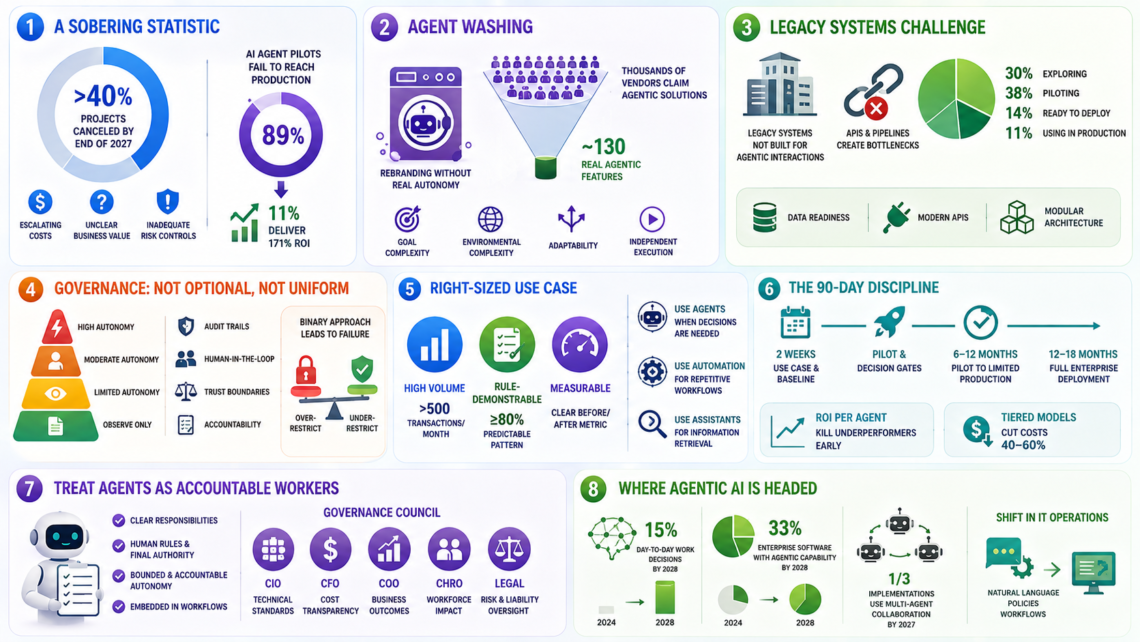
Part 1 of this series traced agentic AI from a psychology term through Andrew Ng’s 2024 reframing to Google’s formal declaration of an agentic era. That trajectory could easily suggest a technology on an uninterrupted upward path. The reality on the ground is considerably more complicated, and any honest guide to using agentic AI effectively must begin with the failure data rather than skip past it. Gartner, based on a poll of more than 3,400 organizations actively investing in the technology, predicts that over 40 percent of agentic AI projects will be canceled by the end of 2027, due specifically to escalating costs, unclear business value, or inadequate risk controls.
-
The Powerful Rise of Agentic AI: Tracing Its Origins and Explosive Emergence (Part 1)
This is Part 1 of a two-part series examining agentic AI in depth. Part 1 traces the term’s origin, defines it precisely, and follows its rapid emergence from academic obscurity to the defining technology story of 2025 and 2026. Part 2 will examine how agentic AI can be used effectively, the frameworks separating genuine success from costly failure, and where the technology is heading next.
A Word Borrowed From Psychology, Repurposed by Engineers
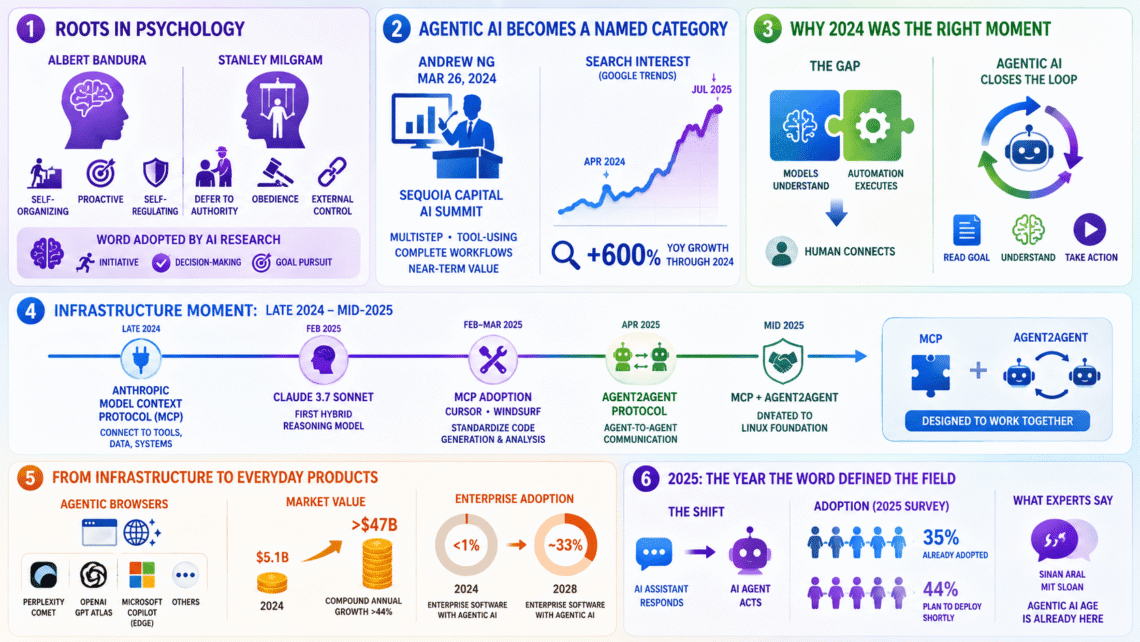
Before agentic AI became one of the fastest-growing terms in enterprise technology, agentic already had a settled meaning in an entirely different field. Psychologist Albert Bandura used the word to describe individuals who are self-organizing, proactive, and self-regulating, people who shape their own circumstances rather than merely reacting to them.
Stanley Milgram, in his famous obedience experiments, used the same root word differently still, describing an agentic state in which individuals defer their own judgment to an external authority. Both meanings, self-directed initiative and the capacity to act rather than simply respond, would eventually converge, decades later, into how the AI research community adopted the term.
The AI field itself began using agentic in the 2010s, applying it to software systems exhibiting qualities analogous to human agency, initiative, decision-making, and independent goal pursuit. But this early usage remained confined almost entirely to academic papers and specialist research circles. Merriam-Webster’s current definition, able to accomplish results with autonomy, used especially in reference to artificial intelligence, reflects how thoroughly the term has since migrated from psychology into everyday technology vocabulary, a migration that happened remarkably fast once it began in earnest.
The Moment Agentic AI Became a Named Category
While the underlying research concepts trace back decades, the specific framing of agentic AI as a distinct, named category with strategic significance has a more precise point of origin. Andrew Ng, the Stanford professor and AI pioneer, is widely credited with coining and popularizing the term in its modern usage at the Sequoia Capital AI Summit on March 26, 2024, arguing specifically that multistep, tool-using systems capable of executing complete workflows might deliver more near-term economic value than simply continuing to scale ever-larger foundation models.
This was a genuinely consequential reframing. It shifted the industry conversation away from a narrow focus on model size and benchmark scores, and toward a different question entirely, what these systems could actually accomplish when given the ability to act, not merely respond.
Google Trends data confirms just how sharply this reframing caught on. Interest in agentic AI as a search term remained minimal for years, then spiked sharply beginning in April 2024, immediately following Ng’s talk, and continued climbing to reach its peak popularity in July 2025. A separate industry analysis found search volume for the term increasing by more than 600 percent year on year through 2024, a growth curve that mirrors, and in some respects exceeds, the public fascination that greeted ChatGPT’s own release in late 2022.
Why 2024 Was the Right Moment, Not an Arbitrary One
The timing of agentic AI’s emergence as a distinct category was not coincidental. It reflected a genuine technical gap that had become obvious to practitioners across the industry roughly simultaneously. By 2024, many organizations had reached the same realization from independent directions. Large language models could understand human intent far better than any prior technology, and separate automation tools could reliably execute repeatable, predefined steps, but these two capabilities lived in entirely separate parts of the workflow, disconnected from one another. Work moved forward only when a human being manually connected the interpretation step to the execution step, reading a model’s output and then personally performing whatever action it recommended.
This specific gap, models that understood but could not act, and automation that could act but could not understand, is precisely what agentic AI was built to close. Rather than stopping at interpretation, as a standard chatbot does, agentic systems were designed to read a goal, understand its surrounding context, and then carry out the necessary actions directly within a live system, closing the loop that had previously always required manual human intervention.
The Infrastructure Moment: Late 2024 Through Mid-2025
Understanding why agentic AI moved from a promising concept to genuine production reality requires tracing a specific sequence of infrastructure milestones that unfolded across roughly eighteen months. In late 2024, Anthropic introduced the Model Context Protocol, an open standard allowing large language models to connect to external tools, databases, and live systems in a consistent, predictable way, examined extensively elsewhere on this blog. This single development is widely regarded as the key inflection point that made agentic AI practically deployable at scale, since it gave models, for the first time, a reliable and standardized way to reach beyond generating text and actually act upon the world.
The momentum continued to build rapidly through the first half of 2025. In February 2025, Anthropic released Claude 3.7 Sonnet, described as the first hybrid reasoning model on the market, and the Model Context Protocol specification itself gained widespread adoption across development tools including Cursor and WindSurf, which integrated it directly to standardize code generation and repository analysis.
In April 2025, Google introduced a complementary protocol, Agent2Agent, addressing a distinct problem from MCP, not how a single agent connects to external tools, but how multiple separate agents communicate and coordinate with one another. Crucially, the two protocols were designed from the outset to work together rather than compete, and by later in the year both had been donated to the Linux Foundation, cementing them as genuinely open, vendor-neutral industry standards rather than proprietary experiments controlled by any single company.
From Infrastructure to Everyday Products
These underlying protocol developments translated into visible consumer and enterprise products with striking speed. By mid-2025, agentic browsers began appearing across the industry, tools including Perplexity’s Comet, OpenAI’s GPT Atlas, Microsoft’s Copilot integration within Edge, and several others, each reframing the humble web browser from a passive window for displaying information into an active participant capable of completing entire tasks independently, such as booking a vacation directly, rather than merely helping a user search for flight options and leaving the actual booking to them.
The market figures accompanying this product wave were substantial by any measure. The market value of agentic AI reached approximately 5.1 billion dollars in 2024, and industry analysis from Capgemini projects that figure will exceed 47 billion dollars, growing at a compound annual rate above 44 percent. Perhaps more tellingly, in 2024 less than 1 percent of enterprise software included any agentic AI capability at all. By 2028, analysts expect close to a third of all enterprise software to incorporate it, a genuinely dramatic penetration curve for any enterprise technology category to achieve within a single decade.
2025: The Year the Word Defined the Field
By the close of 2025, agentic had become, in the words of one widely circulated year-end industry retrospective, the one word that captures the life of artificial intelligence in 2025, a term that transcended mere buzzword status to become the defining characteristic of how organizations and individuals actually experienced AI throughout the year. Where 2023 and 2024 had been dominated almost entirely by generative AI’s ability to create text, images, and code upon request, 2025 marked a genuine transition, from AI functioning as a responsive assistant waiting to be asked, toward AI functioning as an autonomous actor capable of completing complex, multi-step tasks with minimal continuous human direction.
MIT Sloan management professor Sinan Aral captured the state of the field succinctly in early 2026, stating plainly that the agentic AI age is already here, noting that agents are already deployed at scale across the economy performing all kinds of tasks. A spring 2025 survey conducted jointly by MIT Sloan Management Review and Boston Consulting Group found that 35 percent of surveyed organizations had already adopted AI agents in some form, with a further 44 percent expressing concrete plans to deploy the technology in short order, figures that place agentic AI among the fastest enterprise technology adoption curves ever measured.
Google Formalizes the Shift at I/O 2026
The clearest institutional confirmation that agentic AI had moved from emerging trend to defined industry era arrived at Google I/O 2026, where Sundar Pichai and the Google DeepMind team did not simply announce new models in the manner of prior years, but explicitly reframed what AI itself is meant to do going forward.
The shift they articulated was specific and deliberate, moving away from smarter chatbots and improved search results, toward AI that takes genuine initiative, executes multi-step tasks independently, and works on a user’s behalf without requiring continuous hand-holding throughout the process. The distinction Google drew was precise and worth repeating exactly, a chatbot answers, an agent does, a formulation that captures the entire conceptual shift this article has traced in a single, memorable sentence.
Where the Definition Stands Today
Current academic and industry consensus increasingly frames agentic AI not as a fixed, binary classification but as a continuous spectrum, a concept researchers now call agenticness, defined as the degree to which a system can adaptably achieve complex goals in dynamic environments with limited direct supervision. This spectrum encompasses four measurable dimensions, the complexity of goals a system can pursue reliably, the complexity of the environments it can operate within, its capacity to adapt to genuinely novel or unexpected circumstances, and its ability to execute independently with minimal ongoing human intervention.
OpenAI’s own internal framing treats agentic as a gradual continuum rather than a strict yes-or-no category, meaning that as any given system’s capabilities along these four dimensions cross a sufficiently high combined threshold, it naturally transitions from being simply an AI tool into being recognized, functionally, as agentic AI.
This nuanced framing matters considerably for how organizations and individuals should think about the technology going into Part 2 of this series, since it clarifies that adopting agentic AI effectively is not a matter of flipping a single switch from non-agentic to fully autonomous, but rather a matter of deliberately choosing how far along this spectrum any given task or workflow genuinely needs to sit.
Conclusion
Agentic AI’s journey from a niche psychological term, through decades of quiet academic development in robotics and multi-agent systems research, to Andrew Ng’s specific 2024 reframing, and finally to Google’s explicit declaration of an agentic era at I/O 2026, represents one of the fastest conceptual migrations in recent technology history. What makes this trajectory genuinely significant, rather than merely another cycle of industry buzzword inflation, is that it was accompanied at every stage by concrete, verifiable infrastructure milestones, the Model Context Protocol, Agent2Agent, and the resulting standardized ecosystem, each addressing a specific, previously unsolved technical gap between AI systems that could understand and automation that could act.
Part 2 of this series turns from this historical account toward the genuinely practical question this trajectory raises for any individual or organization today, how agentic AI can actually be used effectively, which specific patterns separate the deployments generating real, measurable value from the substantial share already documented as failing to deliver on their promise, and where this technology is realistically headed over the next several years.
Part 2: Using Agentic AI Effectively, coming next in the Current Events series.
-
5 Powerful Ways the Agentic AI Operating System Is Already Replacing Windows as You Know It
The Computing Paradigm That Is Quietly Already Here
For four decades, the fundamental interaction model of personal computing barely changed. You opened an application, you told it exactly what to do through menus and clicks, and it did precisely that and nothing more. In 2026, that model is being dismantled in real time, and not by a speculative research lab but by the world’s largest software company shipping code directly into hundreds of millions of machines.
At Microsoft Build 2026, CEO Satya Nadella stood on stage and declared plainly, we are moving from AI that assists you to AI that acts on your behalf, framing Windows as the first truly agentic operating system, woven into Windows, Azure, and everything in between. The agentic AI operating system is no longer a thought experiment. It is currently rolling out.
Understanding exactly how far this shift has already progressed, what remains genuinely speculative, and what a fully realized agentic AI operating system would mean for how humans relate to their own computers requires separating concrete, shipping technology from the more ambitious, still-unrealized vision Microsoft and its competitors have articulated for the remainder of the decade.
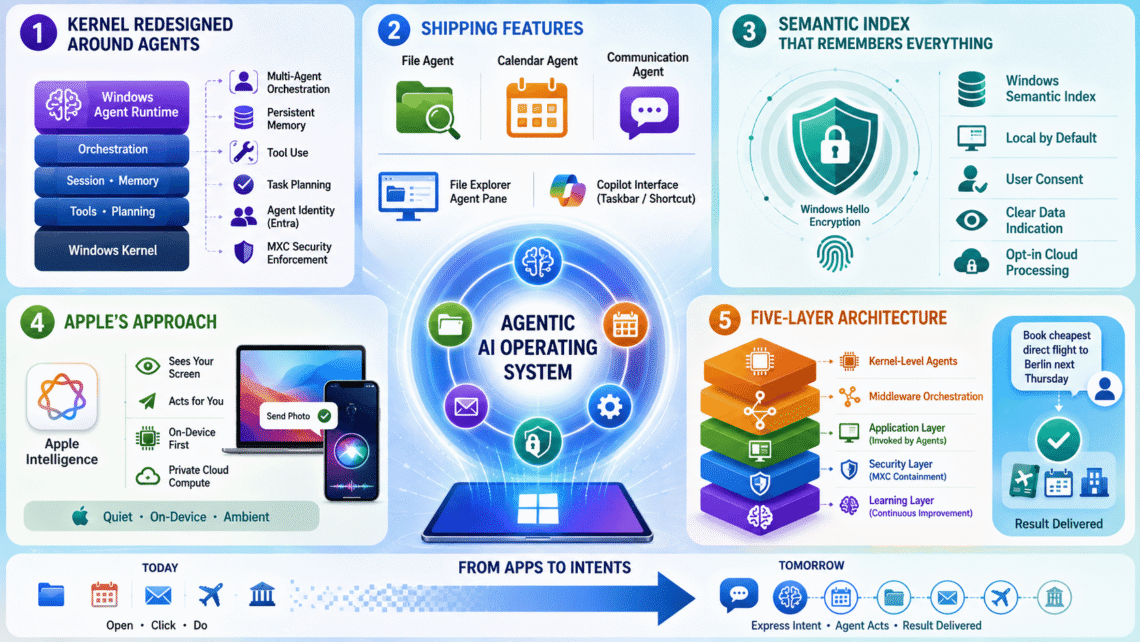
One: The Kernel Itself Is Being Redesigned Around Agents
The single most significant technical shift underlying the current agentic AI operating system rollout is architectural rather than cosmetic. Microsoft is not simply adding a chatbot to the taskbar, as it did with earlier Copilot integrations that drew considerable user backlash. The company has embedded a new Windows Agent Runtime directly into the operating system, a system-level orchestration layer providing session management, persistent memory, task planning, tool use, and coordination between multiple simultaneous agents, all built directly into the OS itself rather than bolted on as a separate application. Windows chief Pavan Davuluri described the ambition explicitly, framing Windows as no longer a passive platform but an active participant in work and life.
The security architecture underlying this shift deserves particular attention, since it directly addresses the most obvious objection to an agentic AI operating system, that granting AI system-level access to files, applications, and hardware sounds catastrophically risky. Microsoft’s answer is a policy-driven execution layer called MXC, which allows developers to define precisely what any given agent can access, files, networking, system resources, specific applications, while Windows itself enforces those restrictions at the kernel level rather than trusting the agent’s own behavior.
Every agent operates under its own Entra-backed identity, isolated from the user’s desktop, clipboard, and input devices unless explicitly granted access, with all activity attributed and auditable. This containment model is what makes a genuinely agentic AI operating system plausible for enterprise and security-conscious users rather than remaining a novelty confined to consumer experimentation.
Two: File Organization and System Maintenance Are Already Shipping Features
The specific capabilities envisioned for a mature agentic AI operating system, automatically organizing files, searching content based on natural language rather than exact filenames, and handling routine system maintenance, are not purely speculative. They are shipping in early form right now. Microsoft’s initial release includes purpose-built agents for common tasks, a Calendar Agent, a File Agent, and a Communication Agent, accessible through an updated Copilot interface that can be pinned to the taskbar or summoned by keyboard shortcut. File Explorer itself now includes a dedicated agent pane offering real-time file analysis directly within the file browsing experience.
The longer-term vision Microsoft has articulated publicly for this agentic AI operating system extends considerably further than these initial agents. The stated ambition is a Windows that proactively manages routine computing tasks entirely on its own initiative, organizing photos without being asked, summarizing long email threads automatically, suggesting draft replies before the user has finished reading, and pre-loading applications based on the user’s own historical behavior patterns, anticipating what the user is about to need rather than waiting to be instructed.
This is precisely the file organization, content search, and predictive assistance envisioned as core functions of a genuinely intelligent operating layer, already moving from roadmap to early production release within a single calendar year.
Three: The Semantic Index That Remembers Everything, Carefully
For an agentic AI operating system to genuinely learn from user activity and act intelligently on the user’s behalf, it needs persistent memory of what the user has actually done, a capability that raises the sharpest privacy questions in this entire transition. Microsoft’s answer is the Windows Semantic Index, a personal semantic index encrypted specifically with Windows Hello biometric authentication, designed to enable persistent agent memory and context without simply storing a raw, unencrypted log of everything a user has ever done, a lesson learned directly from the well-documented privacy backlash surrounding the earlier Windows Recall feature.
The privacy framework attached to this memory layer is genuinely load-bearing for whether an agentic AI operating system can achieve mainstream trust rather than remaining confined to enthusiast early adopters. Microsoft has committed publicly to a strict user consent framework, with all data processing defaulting to local, on-device execution unless a user explicitly opts into cloud processing for a specific task, and clear visual indication whenever any agent touches personal data.
Whether this framework proves robust enough to satisfy privacy advocates and regulators once deployed at true consumer scale, well beyond the current early preview population, remains one of the most consequential open questions determining how quickly a genuinely agentic AI operating system reaches mass adoption.
Four: Apple Is Building the Same Vision Through a Different Door
Microsoft is not alone in pursuing this transition, and the contrast with Apple’s approach illustrates two genuinely different philosophies converging on a similar destination. Apple Intelligence, running largely on-device thanks to Apple’s own silicon, pursues a considerably quieter, more understated version of the agentic AI operating system concept, functioning less like a visible chatbot interface and more like an invisible extension of the existing interface itself.
Siri, in its current iteration, can genuinely see what is displayed on a user’s screen and act on it directly, sending a specific photo to a specific contact without the user needing to name the file or navigate to it manually, while most processing happens entirely locally, with cloud computation reserved specifically for the heaviest reasoning tasks through what Apple calls Private Cloud Compute.
This divergence between Microsoft’s visible, chat-forward agent interface and Apple’s quiet, embedded ambient intelligence represents two legitimate architectural bets on what an agentic AI operating system should actually feel like to use day to day, one that foregrounds the agent as a distinct entity the user directly converses with, and one that dissolves the agent so thoroughly into the existing interface that using it barely feels like invoking AI at all.
Which philosophy proves more durable and genuinely preferred by ordinary users, rather than power users and early technology adopters, will likely take several more product generations to determine conclusively.
Five: The Five-Layer Architecture Pointing Toward the OS Disappearing Entirely
Beyond the specific products currently shipping, researchers studying this transition have proposed a more general five-layer architectural framework for understanding where the agentic AI operating system concept is ultimately heading. Kernel-level agents handling low-level resource scheduling and hardware coordination, a middleware layer orchestrating communication between agents and system services, an application layer where traditional software still technically exists but is increasingly invoked by agents rather than directly by users, a security layer enforcing the kind of containment and permission boundaries Microsoft’s MXC system already implements today, and a learning layer that continuously refines the entire stack’s behavior based on accumulated user interaction patterns over time.
The genuinely speculative but technically coherent endpoint this architecture points toward is a computing experience in which the traditional application layer becomes almost entirely invisible to the ordinary user. Rather than opening a calendar application, a payment application, and a travel booking application separately to plan a trip, a user of a mature agentic AI operating system simply expresses an intent directly, book the cheapest direct flight to Berlin next Thursday, and the underlying agentic layer interprets that intent, coordinates every necessary service automatically behind the scenes, and delivers a completed result.
The application layer continues existing beneath this interaction, but the user increasingly interacts with the agent interface itself rather than navigating between individual applications one at a time, a genuine inversion of four decades of established computing convention.
What Remains Genuinely Uncertain
A rigorous, hype-free assessment of the agentic AI operating system concept requires being explicit about what remains unresolved rather than treating this transition as a foregone conclusion. Early real-world testing has already surfaced rough edges, one prominent technology journalist reported his own Scout agent, Microsoft’s always-on Copilot agent, sending an email composed as a single unformatted run-on sentence, a small but telling reminder that autonomous execution without adequate human review still carries genuine, practical failure modes well short of any catastrophic scenario.
Security researchers have specifically emphasized that continuously running local agents require carefully intentional isolation, since developers and users alike need genuine, verifiable control over exactly what any given agent can access, and confidence that those specific controls will actually hold under real-world conditions rather than merely on paper.
Standardization across the industry represents a further genuine obstacle. For an agentic AI operating system on one device to coordinate meaningfully with an agent running on a user’s phone or within a separate smart home ecosystem built by an entirely different company, the industry needs shared, interoperable protocols, an challenge directly analogous to the Model Context Protocol standardization discussed extensively elsewhere on this blog, extended now to the considerably higher-stakes context of operating system level agent coordination across competing vendors with genuinely divergent commercial incentives.
Conclusion
The agentic AI operating system is not a distant, purely speculative vision confined to research papers and product roadmaps. It is a concrete architectural shift already embedded directly into the Windows kernel, shipping in early form to real users, and being pursued through a parallel but philosophically distinct path by Apple simultaneously. File organization, proactive system maintenance, and natural language content search, the specific capabilities this article set out to examine, are already moving from aspiration to early production reality within a single calendar year, considerably faster than most observers would have predicted even eighteen months ago.
What remains genuinely open is not whether an agentic AI operating system arrives, but rather how quickly it matures past its current, occasionally rough early implementation, how convincingly the privacy and containment framework holds up once deployed at true mass scale, and how thoroughly the traditional application layer that has defined computing since the earliest graphical interfaces ultimately recedes behind an intelligence layer that, for the first time in computing history, is designed to act on a user’s behalf rather than simply waiting patiently to be told exactly what to do next.
-
Solving the Critical Data Wall: How Continual Learning LLM Systems Could Improve Everything
A Constraint That Points Toward a Deeper Problem
Part 2 of this blog’s recent series on the future of LLM technology established the data wall as a genuine, near-term constraint, Epoch AI’s estimate of roughly 300 trillion usable tokens of human text, against a frontier model’s growing appetite that could soon exceed even the entire unfiltered internet. But the data wall is, in an important sense, a symptom of a deeper architectural limitation rather than a standalone problem. Today’s large language models are trained once, on a fixed snapshot of data, then frozen and deployed.
Any genuinely new information the world produces after that training cutoff simply does not exist for the model, unless it is manually retrained from scratch at enormous cost, or fed in temporarily through a context window that vanishes the moment the conversation ends. A continual learning LLM, a model capable of genuinely absorbing new information after deployment without needing to be retrained wholesale, is widely regarded by researchers as the most promising structural answer to both the data wall and the deeper staleness problem it exposes.
Understanding whether continual learning LLM research is close to a genuine solution, or merely a promising research direction still years from production reliability, requires examining the specific technical obstacle that has defeated this goal for decades, the progress researchers have made against it through 2025 and 2026, and the production systems already attempting practical, if partial, workarounds.
Catastrophic Forgetting: The Obstacle That Has Defeated Every Prior Attempt
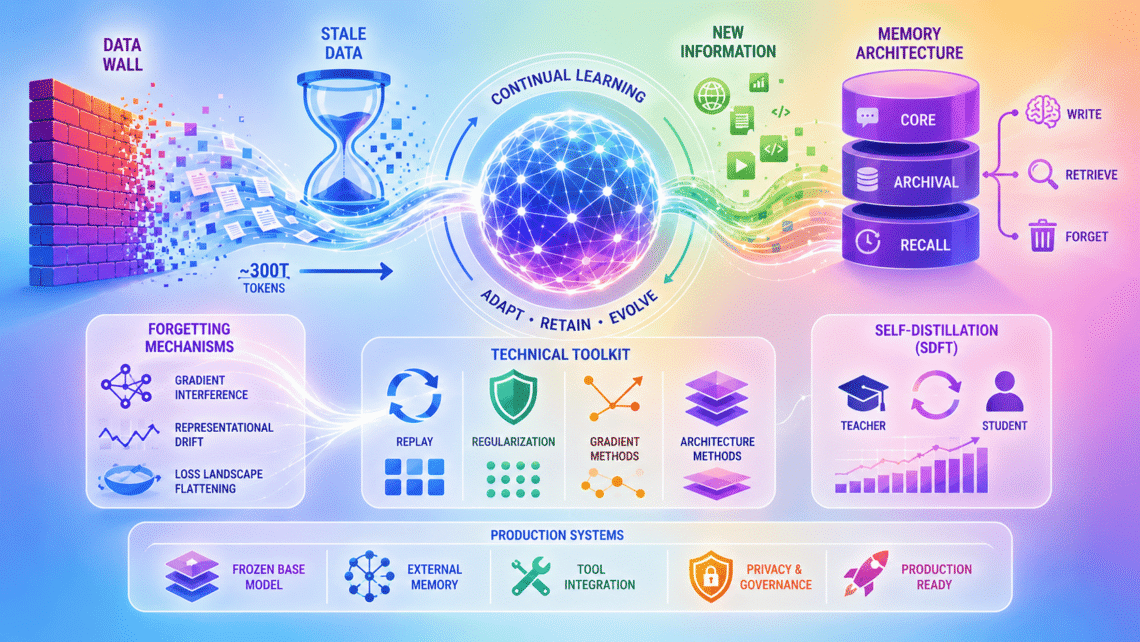
The central technical obstacle blocking a genuinely reliable continual learning LLM has a name that dates back to 1989: catastrophic forgetting, the sharp decline in performance on previously learned tasks that occurs when a neural network is trained on new data. The mechanism is straightforward to describe even if it has proven stubbornly difficult to solve. When a model updates its parameters to fit new information, those gradient updates can overwrite the specific weights that were critical for performing earlier tasks well, since knowledge in a transformer is distributed across billions of parameters in a highly entangled way, with no clean, isolated module for any single fact or skill that could simply be protected while everything else updates freely.
A comprehensive 2026 mechanistic analysis, examining twenty state-of-the-art models ranging from 109 billion to 1.5 trillion parameters, including GPT-5.1, Claude Opus 4.5, and DeepSeek-V4-Pro, identified three specific, distinct mechanisms driving this forgetting. Gradient interference in attention weights disrupts 15 to 23 percent of attention heads specifically in lower network layers, correlating directly with early-stage forgetting. Representational drift causes measurable degradation in intermediate layer representations.
And loss landscape flattening around prior task minima makes the model’s previously learned solutions unstable and easily dislodged by subsequent training. Troublingly, earlier research found that the severity of forgetting actually intensifies as model scale increases within certain parameter ranges, the opposite of what one might hope, since larger models start from a stronger initial performance baseline that has further to fall.
The Discovery That Reframed the Entire Problem
A genuinely important development shaping the continual learning LLM research agenda through 2025 and 2026 has been the discovery that a significant portion of what researchers previously labeled catastrophic forgetting may not represent genuine, permanent knowledge loss at all. Multiple independent research teams have converged on what is now called spurious or pseudo forgetting, evidence that performance degradation on previous tasks often stems from the model’s instructions failing to properly activate its inherent capabilities, rather than the model having genuinely lost those capabilities.
In several documented cases, performance believed to have been permanently destroyed by continual training could be restored simply through appropriate prompting, demonstrating that no actual forgetting had occurred at the level of the model’s underlying knowledge at all.
This reframing matters enormously for continual learning LLM research, because it suggests that at least part of the historical forgetting problem may be a task inference and instruction-following issue rather than a fundamental limitation of neural network memory itself. Researchers working from this framing have proposed a specific mitigation, a Freeze strategy that stabilizes task alignment specifically, since their controlled experiments demonstrated that maintaining task alignment matters more for preventing apparent forgetting than simply protecting raw factual knowledge retention.
The Technical Toolkit Currently in Development
Beyond the spurious forgetting reframing, continual learning LLM researchers have converged on four broad categories of genuine, complementary technical approaches, each addressing the underlying problem from a different angle.
Replay-based methods, widely considered the closest thing to a gold standard in the field, work by periodically retraining the model on a curated sample of prior task data alongside new data, ensuring old knowledge continues receiving reinforcement even as new knowledge is introduced. The genuine engineering challenge here is selecting a representative, sufficiently diverse replay buffer without needing to store or retrain on the entire original training corpus, a constraint directly connected to the data wall problem discussed earlier in this blog’s technology forecasting series. A promising 2026 refinement generates replay data synthetically, directly from the model being trained itself, reducing the storage burden considerably while preserving the stabilizing effect.
Regularization-based methods constrain how far specific parameters are allowed to drift during new training, protecting weights identified as critical to prior task performance. Gradient-based approaches, including a 2026 technique using gradient orthogonality for efficient domain adaptation, work by selecting new training data specifically chosen to minimize conflict with the gradients that encode previously learned knowledge, addressing the interference problem at its root rather than only after the fact.
Architecture-based approaches take a structurally different path entirely, using techniques such as parameter-efficient fine-tuning, low-rank adapters that can be trained on new information while the original backbone model remains entirely frozen and undisturbed. A 2026 technique called Low-Rank Circuit Projection has shown particular promise here, mitigating forgetting with genuinely minimal additional training overhead, an important practical consideration for any continual learning LLM system intended for frequent, ongoing updates rather than occasional retraining.
Self-Distillation: A Particularly Promising 2026 Development
Among the specific techniques to emerge in 2026, self-distillation fine-tuning, SDFT, deserves particular attention for how directly it addresses the practical deployment problem facing continual learning LLM systems today. Many organizations currently avoid the forgetting problem entirely by isolating each new task into a separate fine-tuned model or adapter, a workaround that increases costs substantially and adds meaningful governance complexity, since teams must continually retest every isolated model to avoid regression across an ever-growing set of fragmented, task-specific variants.
SDFT offers a genuinely different approach, using the model’s own in-context learning ability to generate on-policy training signals directly from demonstrations, with the same model playing both teacher and student roles during training. In sequential learning experiments, this approach enabled a single model to accumulate multiple skills over time without the performance regression that had defeated earlier sequential fine-tuning attempts, establishing on-policy distillation as a genuinely practical path toward the kind of accumulating, rather than fragmenting, continual learning LLM behavior the field has been pursuing since the late 1980s.
Memory Architecture as a Practical, Deployable Answer Today
While the deep technical research into solving catastrophic forgetting at the weight level continues, a parallel and considerably more mature engineering approach has already reached production deployment, treating continual learning as a memory architecture problem rather than purely a weight-update problem. Rather than updating the model’s parameters at all, these systems give a fixed, frozen base model access to external, persistent memory that it can read from and write to across sessions.
The most sophisticated production implementations now maintain three distinct memory tiers, core memory that sits directly in-context and is editable by the model itself, archival memory stored in an external, semantically searchable vector store, and recall memory, an indexed conversation history the model can query when needed. The model controls its own memory actively through tool calls, writing important facts to core memory, offloading less immediately relevant information to archival storage, and recalling specific details as the current task requires.
Mem0, a widely adopted memory layer that emerged in 2025, combines semantic consolidation, merging related information and resolving conflicts, with intelligent forgetting that deliberately deprioritizes stale or low-relevance entries, and has demonstrated accuracy gains of up to 26 percent over plain vector retrieval in benchmark testing.
This memory-based approach to continual learning LLM behavior sidesteps the catastrophic forgetting problem entirely by never actually modifying the base model’s weights at all. Its tradeoff is equally important to understand honestly, it provides the experience of a system that remembers and adapts, without providing genuine parametric learning, the kind of deep, generalizable knowledge integration that comes specifically from updating a model’s weights rather than simply retrieving relevant text at inference time.
What Production Teams Are Actually Building Toward in 2026
The practical question facing engineering teams building continual learning LLM systems today is no longer whether to support some form of ongoing learning, users increasingly expect deployed agents to remember and genuinely improve over interactions, but rather which specific combination of these techniques best matches a given system’s required update frequency, privacy constraints, and acceptable compute budget.
A February 2026 open-source release packaging memory-based continual learning as a drop-in software development kit for any LLM agent signals that this particular approach, external memory rather than weight modification, has matured into genuinely production-ready infrastructure considerably faster than the deeper parametric learning research.
Broader industry analysis places continual learning squarely among the handful of critical technical transitions expected to reshape production AI through the remainder of 2026, alongside agentic workflows maturing beyond demonstration stage and hybrid architectures increasingly replacing pure Transformer designs, a pattern directly consistent with the architectural convergence trend documented in this blog’s recent LLM technology forecast.
Conclusion
A genuinely reliable continual learning LLM, one that can absorb new information indefinitely, at the level of its actual weights rather than merely its external memory, without catastrophically degrading previously learned capabilities, remains an unsolved research problem as of mid-2026, not a deployed reality. But the honest, evidence-based picture is considerably more encouraging than that framing alone suggests. The spurious forgetting discovery has reframed a meaningful portion of the historical problem as an instruction-following issue rather than genuine, permanent knowledge loss.
Self-distillation and gradient-orthogonal training methods are showing genuine, measurable progress against the remaining, authentic forgetting that does occur. And memory-augmented architectures already provide production teams with a practical, if partial, answer available today, one that sidesteps the deepest technical challenge entirely by keeping the base model frozen while giving it genuine, persistent, actively managed memory instead.
Whether the deeper parametric version of continual learning LLM research matures into production reliability within the next several years, or whether memory-augmented architectures prove sufficient for the vast majority of practical use cases regardless, is likely to be one of the more consequential open questions determining how the data wall constraint, and the broader staleness problem underlying it, ultimately gets resolved.
-
The Critical Future of LLM Technology: A Hype-Free Forecast for the Next Five Years (Part 2)
This is Part 2 of a two-part series taking a rigorous, hype-free look at large language model progress. Part 1 examined what actually drove LLM development history over the past decade, scaling laws, algorithmic efficiency, and the unresolved reasoning debate. Part 2 turns to the specific pipeline of techniques currently in development and offers a grounded forecast for the future of LLM technology through roughly 2030.
Forecasting Without the Marketing Department
Part 1 of this series established the two forces that genuinely drove LLM capability forward over the past decade, compute scaling and algorithmic efficiency, alongside a third, newer axis, inference-time reasoning, that emerged only in the past two years. Any credible forecast of the future of LLM technology must build directly on that evidence base rather than product roadmap slides, and must take seriously a specific, quantifiable constraint that has received too little public attention relative to its actual significance, the finite supply of human-generated text itself.
The Data Wall Is Real, and It Is Closer Than Most Coverage Admits
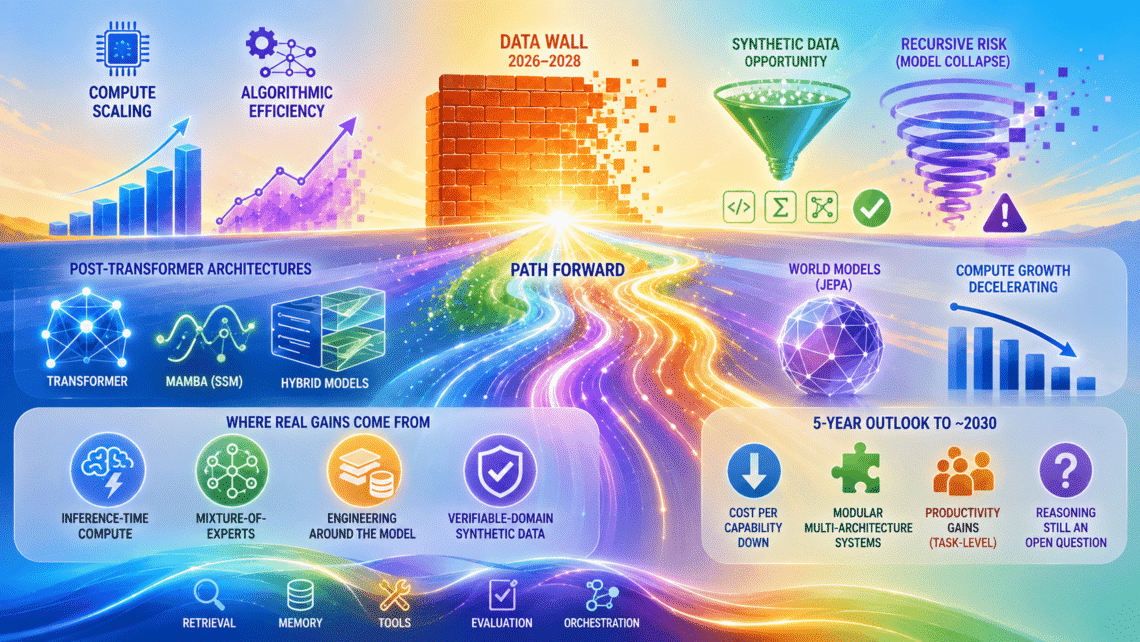
The single most consequential, best-evidenced constraint shaping the future of LLM technology over the next several years is what researchers call the data wall. Epoch AI’s careful analysis estimates the effective stock of high-quality, usable human-generated public text at roughly 300 trillion tokens, adjusted for quality and deduplication. That figure sounds enormous until it is set against actual consumption. GPT-4 was trained on somewhere between 6 and 13 trillion tokens.
A frontier model trained in 2026 using the compute available at facilities such as the Abilene Stargate site, running at roughly 240 tokens per parameter, a ratio pushed considerably higher than the original Chinchilla-optimal 20 tokens per parameter as labs squeeze more value from every available token, would want approximately 400 trillion tokens, a figure that already exceeds the entire unfiltered Common Crawl dataset.
The consensus estimate across multiple independent research groups places genuine exhaustion of easily accessible, high-quality public text somewhere between 2026 and 2028, with Epoch AI’s own analysis suggesting the timeline could compress toward the earlier end of that range if labs continue overtraining smaller models on repeated data passes, a practice already well underway. This is not a distant, speculative constraint. It is arguably the single most binding limitation on the pure scaling paradigm that dominated the first half of LLM development history, and any serious forecast of the future of LLM technology must treat it as a near-term engineering reality rather than a theoretical curiosity.
Synthetic Data: A Real Tool With a Real Failure Mode
The industry’s primary response to the data wall has been synthetic data, using models to generate additional training material rather than relying solely on scraped human text. Adoption has moved considerably faster than even optimistic 2022 forecasts anticipated. Microsoft’s Phi-4 model was trained on 400 billion synthetic tokens spanning fifty distinct dataset types and scored 91.8 percent on AMC math benchmarks, outperforming considerably larger models trained primarily on human text. Nvidia’s 320 million dollar acquisition of Gretel AI signals how seriously infrastructure providers now treat synthetic data generation as core, durable business infrastructure rather than a temporary stopgap.
But synthetic data carries a genuine, well-documented failure mode that any honest forecast of the future of LLM technology must address directly rather than glossing over. Recursive training, using one generation of model output to train the next generation of the same model family without careful filtering, causes measurable model collapse, a progressive narrowing of output diversity and a degradation in the model’s grip on the genuine statistical structure of real-world language and knowledge.
The critical distinction researchers now draw is between replacing human data wholesale, which reliably degrades model quality over successive generations, and accumulating synthetic data as a targeted supplement, filtered and verified specifically for tasks with checkable, verifiable answers such as mathematics, code, and structured reasoning, where synthetic data has shown genuine and repeated success. The future of LLM technology almost certainly depends on this distinction being respected rigorously by every major lab, since the alternative, an AI industry inadvertently training its most important systems on a slowly collapsing diet of recycled AI output, represents a genuinely serious and underappreciated risk.
The Post-Transformer Architecture Race
A second major front shaping the future of LLM technology involves the underlying architecture itself. The Transformer’s core self-attention mechanism, examined extensively elsewhere on this blog, carries a fundamental computational cost, its complexity scales quadratically with sequence length, making extremely long contexts, legal contracts, genomic sequences, entire codebases, computationally expensive in a way that becomes genuinely impractical at scale.
State Space Models, particularly the Mamba architecture and its recent Mamba-3 iteration published in March 2026, address this directly by replacing attention with a mechanism inspired by classical control theory, achieving linear rather than quadratic complexity with respect to sequence length while maintaining an explicit, continuously updated hidden state that functions as a form of persistent memory. Critically, the future of LLM technology is not shaping up as a clean architectural replacement, Mamba entirely displacing Transformers, but rather as convergence toward hybrid designs.
Nvidia’s Nemotron 3 family, released in April 2026, explicitly alternates between standard attention layers and Mamba-2 state space layers within the same model, a design chosen specifically because long-context efficiency has become increasingly critical as more LLMs get embedded into agentic systems that require maintaining and reasoning over increasingly long working contexts. Industry practitioners tracking this shift have been notably measured in their assessment, treating each new architectural release as a practical question, does this change agent loop cost, prompt caching efficiency, or cost per session, rather than as a revolutionary leap, a sober framing worth adopting for any credible forecast.
World Models and the LeCun Bet
A more architecturally radical thread shaping the future of LLM technology comes directly from the reasoning critique examined in Part 1. Yann LeCun’s Joint Embedding Predictive Architecture, JEPA, represents a genuinely different bet, one where the model learns to predict abstract representations of its input rather than predicting raw pixels or tokens one at a time, an approach LeCun argues is dramatically more efficient and more capable of producing something closer to genuine world understanding than token-level autoregressive prediction can achieve. Image and video variants, I-JEPA and V-JEPA, have already shown promising results, and a language-focused variant, LLM-JEPA, began circulating in research circles in September 2025.
Whether JEPA-style world models genuinely displace autoregressive transformers within the forecast window of this article, or remain a productive but secondary research direction, is precisely the kind of question where honest forecasting requires acknowledging genuine uncertainty rather than false confidence.
What seems considerably more likely, based on the pattern already visible in hybrid Transformer-Mamba designs, is that the future of LLM technology converges toward modular, multi-architecture systems, distinct specialized components, efficient long-context backbones, world-model style planning modules, memory-augmented systems capable of accumulating knowledge across interactions, combined deliberately within a single deployed system, rather than any single architecture winning outright and displacing all competitors.
Compute Growth Is Slowing From Its Recent Peak
A frequently overlooked but genuinely important input to any credible forecast of the future of LLM technology is that raw compute growth itself, while still substantial, is decelerating from its most extreme recent trajectory. Detailed compute accounting shows frontier training system capacity increasing roughly 160-fold across four years, or approximately 3.55 times annually, a blistering pace, but one that current chip price-performance trends, improving at roughly 1.39 times annually after inflation adjustment according to Epoch AI, cannot sustain indefinitely without continued, extraordinary capital investment of the kind examined in this blog’s recent five-part series on AI industry economics.
When the data wall constraint, the synthetic data ceiling, and a compute growth trajectory that must eventually moderate are considered together, serious forecasters increasingly anticipate a genuine slowdown in pure pretraining scale gains sometime after 2028, a specific, dated prediction considerably more grounded than vague talk of an approaching technological plateau.
Where the Real Gains Will Actually Come From
If pure pretraining scale is approaching genuine physical and data constraints, where does the future of LLM technology’s next wave of capability improvement actually come from. The evidence assembled across both parts of this series points toward four specific, already-visible directions rather than speculative breakthroughs.
Inference-time compute, examined in Part 1, will almost certainly continue growing as a share of total capability gains, even as its own scaling exhibits the latent saturation trend documented in the 2026 reinforcement learning literature, meaning gains will likely become more expensive to extract even as they continue.
Mixture-of-Experts architectures, which activate only a fraction of total parameters for any given input, will continue to improve the ratio of genuine capability to compute cost, a trend already visible in models like Nemotron 3, which pairs MoE sparsity with hybrid Mamba-Transformer layers specifically to maximize this efficiency.
Engineering built around the model, retrieval systems, persistent memory, tool use, structured evaluation, and orchestration across specialized sub-models, is where practitioners closest to production deployment increasingly locate the genuine, durable competitive advantage, precisely because effortless capability gains purely from scaling a single monolithic model are ending, a conclusion directly consistent with the AI ROI findings from our five-part economics series, where the companies capturing real value were those redesigning workflows around AI rather than simply deploying a bigger model.
And targeted, verifiable-domain synthetic data, mathematics, code, formal logic, structured reasoning, will continue delivering genuine capability gains precisely because these domains allow automated verification of correctness, sidestepping the model collapse risk that makes wholesale synthetic replacement of general text so dangerous.
A Grounded Five-Year Outlook
Bringing the full evidence base from both parts of this series together, a genuinely hype-free forecast for the future of LLM technology through roughly 2030 looks considerably more modest, and considerably more interesting, than either extreme position commonly advanced in public discussion. Costs per unit of capability will very likely continue falling, driven by the well-documented three to four times annual algorithmic efficiency gains established in Part 1, MoE sparsity, and hybrid architecture efficiency, even as headline frontier training runs continue costing more in absolute terms due to sheer scale.
Complexity will increasingly shift from monolithic scale toward modular, multi-architecture systems combining efficient long-context backbones, specialized reasoning modules, and persistent memory, rather than a single architecture simply growing larger indefinitely. Productivity gains will very likely continue showing the pattern documented in Part 1’s rigorous economic research, real and measurable at the task level, but persistently capped by how effectively humans and organizations integrate these tools into actual workflows, a human and organizational bottleneck rather than a purely technical one.
And the deeper question of whether these systems achieve anything resembling genuine human-style reasoning, as opposed to increasingly sophisticated and useful pattern matching, will very likely remain genuinely unresolved throughout this entire forecast window, continuing to divide serious, credible researchers rather than being definitively settled by any single benchmark or model release.
Conclusion
The future of LLM technology, examined honestly and against the specific, quantified evidence assembled across this two-part series, is neither the smooth, inevitable glide path toward artificial general intelligence that some industry marketing suggests, nor the dead end that the most dismissive skeptics predict. It is something more specific, more constrained, and ultimately more useful to understand precisely, a technology approaching genuine, well-documented physical and data limits on its original scaling paradigm, responding with real, measurable, but imperfect engineering solutions, synthetic data, architectural hybridization, inference-time reasoning, that each carry their own specific tradeoffs and failure modes.
Whether that combination proves sufficient to sustain the pace of capability improvement the public has grown accustomed to watching since 2020, or whether the field genuinely decelerates as several credible forecasts now anticipate sometime after 2028, is a question this series cannot resolve definitively today. What it can offer, and what the marketing narrative surrounding this technology so rarely does, is a precise, evidence-grounded account of exactly which forces will determine that answer, and why.
This concludes our two-part series on LLM development history and the future of LLM technology. Explore Part 1 for the full account of the past decade.
-
The Critical Truth About LLM Development History: A Decade of Progress Without the Hype (Part 1)
This is Part 1 of a two-part series taking a rigorous, hype-free look at large language model progress. Part 1 examines what actually happened technically over the past decade, separating genuine algorithmic breakthroughs from marketing narrative. Part 2 will examine the specific techniques currently in the pipeline and offer a grounded forecast for the next five years.
Separating the Signal From a Decade of Noise
Ten years of large language model development have produced a genuinely confusing public narrative, one part remarkable engineering achievement, one part carefully managed marketing, and one part unresolved scientific dispute among the researchers who actually build these systems. This two-part series sets out to examine LLM development history the way a rigorous engineering post-mortem would, using measured, published, peer-reviewed evidence rather than product launch keynotes, and being explicit about where genuine scientific disagreement still exists among serious researchers.
The honest starting point is that two distinct forces drove all measurable progress across this LLM development history, and conflating them, as popular coverage routinely does, obscures rather than clarifies what actually happened and what is likely to happen next.
Force One: Raw Compute Scaling
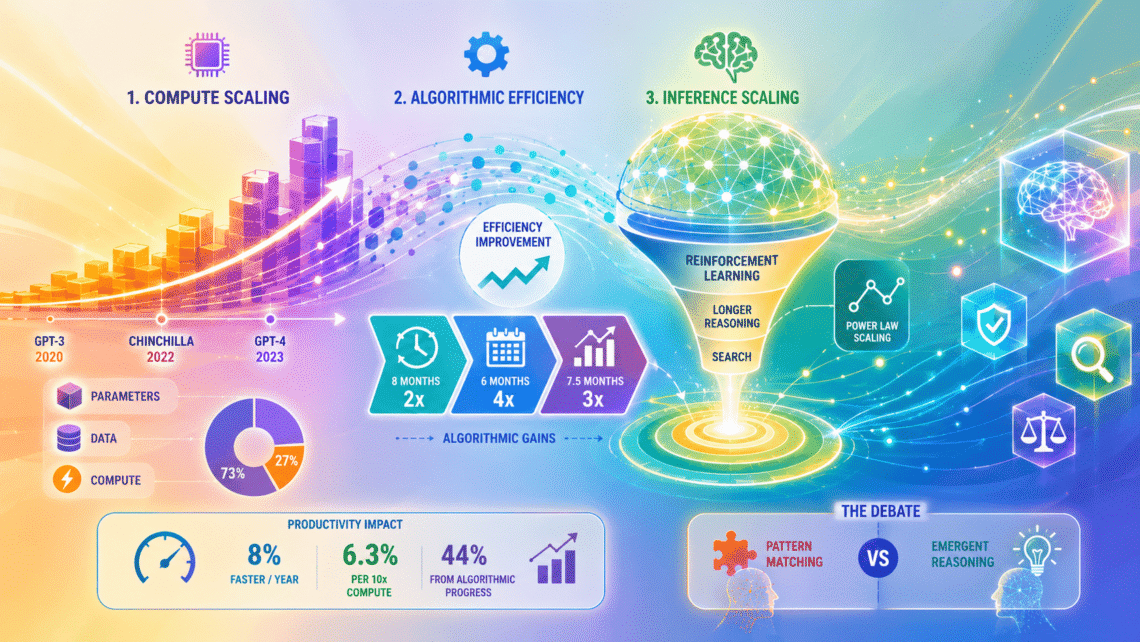
The dominant narrative of early LLM development history was straightforward and, for several years, empirically accurate. OpenAI’s 2020 scaling laws, authored by Jared Kaplan and colleagues, established that model performance improved predictably as a power law function of parameters, dataset size, and training compute.
The practical conclusion drawn from this research was specific and consequential: given a fixed compute budget, the optimal strategy allocated roughly 73 percent toward parameters and only 27 percent toward data, meaning build the largest model you can afford and do not worry excessively about data volume. GPT-3, a 175 billion parameter model trained on just 300 billion tokens, a ratio of roughly 1.7 tokens per parameter, was a direct product of this thinking and became a genuine sensation.
This phase of LLM development history proved short-lived once subjected to more rigorous testing. DeepMind’s 2022 Chinchilla paper, examined extensively elsewhere on this blog, demonstrated that Kaplan’s original scaling laws had significantly underweighted the value of training data relative to parameters. The compute-optimal ratio, Chinchilla established, was closer to 20 tokens per parameter, not 1.7, meaning GPT-3 scale models trained under the earlier Kaplan regime were substantially undertrained relative to their parameter count.
This single correction, more than any subsequent architectural innovation, explains much of the capability jump between the GPT-3 and GPT-4 generation of models, a fact that receives considerably less public attention than it deserves given its outsized practical impact on LLM development history.
Force Two: Algorithmic Efficiency, the Quieter and More Important Story
The genuinely underappreciated thread running through LLM development history is algorithmic efficiency, improvements that let a model achieve a given performance level using dramatically less compute than an earlier approach required, entirely independent of simply buying more hardware. Multiple independent research efforts, using different methodologies, have converged on a strikingly consistent estimate. Epoch AI’s analysis found that training compute required to reach a fixed performance threshold has halved approximately every eight months.
Anthropic CEO Dario Amodei separately estimated the figure at roughly four times per year. A 2025 paper titled Price of Progress, isolating algorithmic gains specifically from open models to control for competitive effects, independently estimated algorithmic efficiency progress at approximately three times per year. Three independent methodologies converging on halving times of eight months, six months, and seven and a half months respectively is a genuinely rare degree of empirical agreement in a field this contested, and it represents one of the more solid, well-evidenced conclusions available about LLM development history to date.
A more rigorous 2025 academic framework distinguishes between compute-dependent and compute-independent algorithmic advancements specifically to avoid conflating these two forces, since compute-dependent improvements only become significant at scales far beyond their original conception, while compute-independent improvements raise efficiency uniformly across every scale. This distinction matters directly for forecasting, since it clarifies that some techniques currently discussed as breakthroughs will only meaningfully matter once frontier labs deploy compute budgets an order of magnitude beyond what is currently available, while others are already delivering their full benefit today.
The Third Axis Nobody Anticipated: Inference Scaling
Perhaps the single most consequential shift in LLM development history over the past two years has been the emergence of an entirely new axis of scaling that the original Kaplan and Chinchilla frameworks never accounted for. From 2020 through 2024, frontier progress was governed almost entirely by training scale, larger datasets, larger models, larger training compute budgets. Over 2024 and 2025, the field added a fundamentally different second axis, inference scale, also called test-time compute, spending considerably more computation at the moment of generation itself, through longer deliberation and search-like reasoning strategies, to raise problem-solving performance, sometimes more cost-effectively than simply training a larger base model in the first place.
This bifurcation genuinely reframes what counts as progress within LLM development history, and it explains a pattern that confused many observers through 2025, models with similar or even smaller parameter counts than their predecessors nonetheless posting dramatically better performance on hard reasoning benchmarks, purely because they had learned, through reinforcement learning on verifiable outcomes, to generate longer, more structured internal reasoning traces before committing to a final answer.
The 2026 academic literature on reinforcement learning post-training scaling has since found that this inference-time scaling follows its own distinct power law relationship between test loss, compute, and data, structurally similar to pretraining scaling laws but with a critical difference, reinforcement learning post-training exhibits a latent saturation trend, meaning that while larger models do achieve higher learning efficiency during this phase, the returns diminish measurably faster as scale increases than they do during pretraining itself. This finding matters enormously for Part 2 of this series, since it suggests inference scaling cannot simply be scaled indefinitely as a substitute for continued pretraining progress.
What This Actually Meant for Productivity, Measured Rigorously
Separating LLM development history from marketing requires looking at controlled, preregistered economic research rather than anecdote, and the most rigorous study available offers a genuinely useful, if considerably more modest than commonly claimed, picture. A December 2025 preregistered experiment involving over 500 consultants, data analysts, and managers, each completing real professional tasks using one of thirteen different LLMs, found a robust calendar-time scaling effect, each year of frontier model progress was associated with an 8 percent reduction in task completion time.
Isolating the effect of pure compute scale specifically, a tenfold increase in model training compute was associated with only a 6.3 percent reduction in task completion time, with roughly 44 percent of total observed improvement attributable specifically to algorithmic progress rather than raw scale.
The study’s most analytically important finding, however, concerns a divergence that deserves far more public attention than it currently receives. While the quality of autonomous model output scaled essentially linearly with training compute, the quality of human-assisted output remained largely stagnant across successive model generations. This implies that human users, through the specific way they prompt, interpret, and apply model outputs, effectively cap the realized capability gains of frontier models at a fixed ceiling, a genuinely sobering finding for anyone assuming that simply deploying a more capable model automatically translates into proportionally greater organizational productivity, a theme directly consistent with the AI ROI evidence examined in our recent five-part series on AI industry economics.
The Genuine Scientific Dispute: Pattern Matching or Reasoning
No honest account of LLM development history can avoid the genuine, unresolved dispute currently dividing serious AI researchers, a dispute that has nothing to do with marketing hype and everything to do with what these systems are actually doing internally. Yann LeCun, Meta’s former chief AI scientist, has argued consistently and pointedly throughout 2025 and 2026 that autoregressive transformer models, however impressive their outputs, remain fundamentally pattern matching engines rather than genuine world models.
Yann’s critique is specific: current LLMs can describe gravity eloquently because they have ingested millions of textual descriptions of gravity, but they cannot predict that an unsupported object will fall because they possess no internal concept of falling beyond statistical token associations, no grounded representation of cause and effect that would allow genuine planning or reasoning about consequences.
Cognitive scientist Gary Marcus has raised a closely related but distinct critique, tracing his skepticism back to his own 1992 publications and his 2001 book The Algebraic Mind, which anticipated the hallucination and unreliable reasoning problems LLMs continue to exhibit decades before LLMs existed. Neuroscientist Karl Friston has framed the underlying objection even more starkly, describing LLMs as, in his words, just a mapping between content and content, with nothing genuinely in the middle representing understanding.
It is worth noting explicitly that this dispute is not settled, and reasonable, technically serious researchers occupy positions across the entire spectrum, from LeCun and Marcus’s skepticism to the position, held by many working directly on frontier reasoning models, that inference-time scaling and reinforcement learning on verifiable outcomes are already producing genuinely emergent reasoning capability that simple pattern matching could not explain.
What is measurably true, regardless of which theoretical camp proves correct, is the hallucination statistic itself. Even as of April 2026, hallucinations in court filings by prominent, sophisticated law firms using frontier AI tools continued to occur, direct evidence that the hallucination problem central to this entire LLM development history debate remains genuinely unresolved rather than a solved problem simply awaiting wider deployment.
Conclusion
The genuine, evidence-grounded account of LLM development history over the past decade is considerably more interesting, and considerably more measured, than either the breathless marketing narrative or the dismissive skeptic narrative alone would suggest. Real, repeatedly measured algorithmic efficiency gains of roughly three to four times per year compounded with genuine compute scaling to produce the capability curve the public has observed.
A genuinely new axis of progress, inference-time scaling, emerged in the past two years and has already begun exhibiting its own distinct saturation dynamics. And a serious, unresolved scientific dispute concerning LLM development history about whether the underlying architecture can ever produce genuine reasoning, rather than increasingly sophisticated pattern matching, continues to divide credible researchers rather than being settled decisively in either direction.
Part 2 of this series turns from this historical account toward the specific technical pipeline, the architectural alternatives to the transformer, the emerging training techniques, and the realistic, hype-free forecast for what these forces are actually likely to produce, in terms of cost, capability, and genuine reasoning ability, over the next five years.
Part 2: The Next Five Years, coming next in the Current Events series.
-
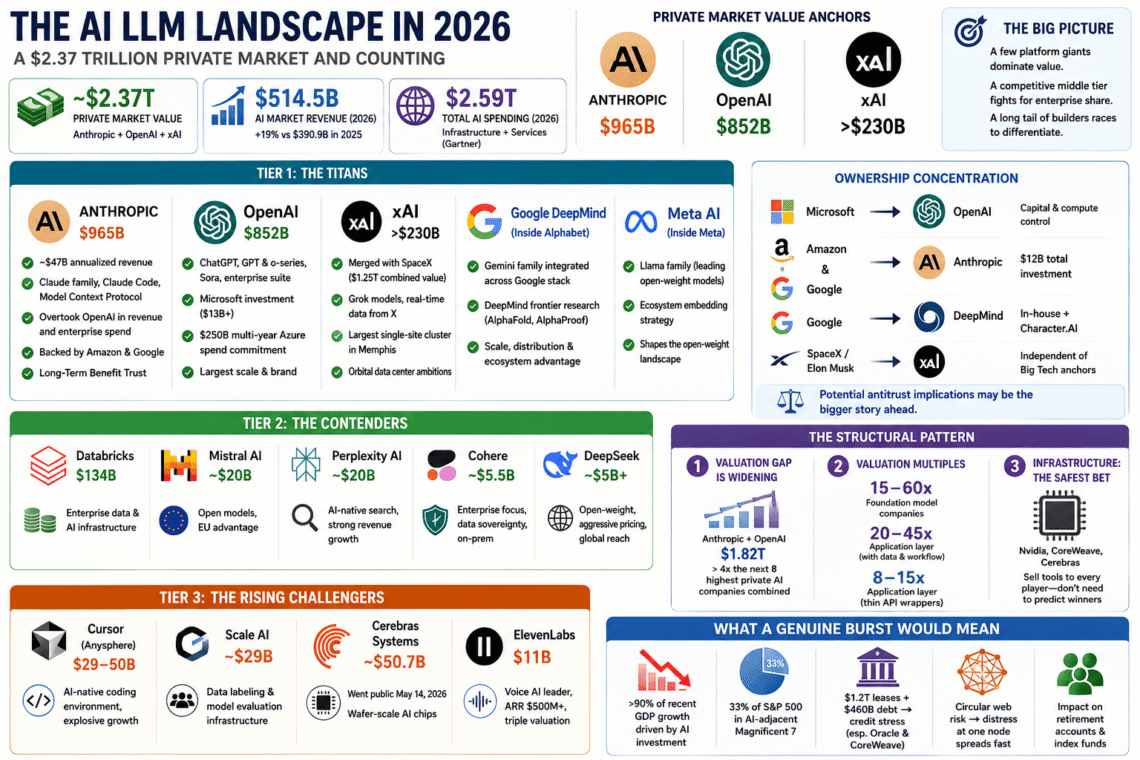
The Powerful AI LLM Landscape 2026: Mapping the Titans, Contenders, and Rising Challengers
A $2.37 Trillion Private Market and Counting
The AI LLM landscape has bifurcated sharply into a small handful of platform companies commanding valuations larger than most national economies, a competitive middle tier fighting for enterprise share, and a long tail of application builders racing to differentiate before the giants absorb their category. Anthropic, OpenAI, and xAI alone now anchor a private market worth roughly 2.37 trillion dollars, with global AI market revenue reaching approximately 514.5 billion dollars in 2026, up 19 percent from 390.9 billion dollars the prior year.
Total worldwide AI spending, including infrastructure and services, is projected by Gartner at 2.59 trillion dollars. Understanding who occupies which tier of this AI LLM landscape, and why, is now essential reading for investors, enterprise buyers, and anyone tracking where genuine value is accumulating in the industry.
Tier One: The Titans
Anthropic sits atop the current AI LLM landscape following a genuinely remarkable repricing. The company filed for its IPO on June 1, 2026, at a 965 billion dollar valuation, built on roughly 47 billion dollars in annualized revenue. Its jump from a 380 billion dollar valuation to 965 billion took roughly three months, driven by Anthropic passing OpenAI in revenue in April 2026, reaching a 30 billion dollar run rate against OpenAI’s 25 billion, after scaling from just 1 billion dollars in annual recurring revenue in only fifteen months.
Anthropic’s Claude business has separately overtaken OpenAI in enterprise business spending share, reaching 34.4 percent according to Ramp payments data. Its flagship products span the Claude model family, Claude Code for software development, and the Model Context Protocol, now the industry’s dominant agent integration standard. Governance sits with a Long-Term Benefit Trust designed to preserve mission alignment despite billions in backing from Amazon and Google.
OpenAI filed its own IPO exactly one week after Anthropic, on June 8, 2026, at an 852 billion dollar valuation. Products span ChatGPT, the GPT and o-series API models, Sora for video generation, and a rapidly expanding enterprise and agentic tooling suite. Microsoft’s 13 billion dollar plus investment anchors the relationship, with Azure serving as OpenAI’s primary compute backbone under a 250 billion dollar multi-year spending commitment discussed at length elsewhere on this blog. OpenAI’s position in the AI LLM landscape remains the largest by absolute scale and brand recognition, though its widening valuation gap with Anthropic through 2026 has become one of the year’s defining storylines.
xAI occupies a genuinely distinctive position in the AI LLM landscape following its February 2026 merger into SpaceX, creating a combined entity valued at 1.25 trillion dollars, the largest corporate merger in history, positioning the combined company for orbital data center ambitions and a blockbuster SpaceX IPO targeting up to 1.5 trillion dollars. Standalone, xAI carries a valuation north of 230 billion dollars, anchored by the Grok model family and what may be the largest single-site compute cluster in the world at its Memphis facility.
Real-time data integration with X gives xAI a genuine differentiator other labs cannot easily replicate, though its enterprise go-to-market motion remains underdeveloped relative to Anthropic and OpenAI, and Grok adoption outside the X ecosystem has been comparatively limited.
Google DeepMind and Meta AI round out the titan tier from within existing public companies rather than as standalone valuations. Google’s Gemini family benefits from full integration across Search, Workspace, and Android, alongside DeepMind’s continuing frontier research output including AlphaFold and AlphaProof, discussed extensively elsewhere on this blog. Meta’s Llama family remains the most consequential open-weight contribution from any Big Tech player in the current AI LLM landscape, a strategic bet on ecosystem embedding over proprietary API revenue that continues to shape competitive dynamics across the entire open-weight segment.
Tier Two: The Contenders
Databricks commands a 134 billion dollar valuation, positioning itself as critical infrastructure for enterprise data and AI pipelines rather than a consumer-facing model provider, a strategic niche that has proven durable precisely because it does not compete directly with the titan tier for frontier model bragging rights.
Mistral AI remains Europe’s clearest AI champion within the global AI LLM landscape, differentiated by open-weight models, a regulatory advantage under the EU AI Act, and continued strategic backing, including a two billion euro investment from ASML that helped push its valuation from six to fourteen billion dollars in under a year, with more recent figures cited near 20 billion dollars. Its principal constraints remain limited US market penetration and comparatively restricted compute access relative to its American rivals.
Perplexity AI occupies a genuinely interesting middle position, an AI-native search competitor backed by Jeff Bezos, Nvidia, and Founders Fund, currently valued near 20 billion dollars after a period of valuation stepping sideways rather than continuing to climb, reflecting intensifying competitive pressure in AI search from both Google and ChatGPT directly. Perplexity stands out specifically for revenue growth velocity even as its valuation growth has moderated.
Cohere has staked its position in the AI LLM landscape on enterprise data sovereignty and on-premise deployment, a differentiator whose durability depends heavily on whether that requirement remains genuine among regulated enterprise buyers or simply becomes a checkbox feature larger providers eventually bundle into their existing platforms at no additional cost.
DeepSeek, examined in detail in earlier coverage on this blog, remains a significant presence in the global AI LLM landscape specifically through open-weight distribution and aggressive pricing, though its Western enterprise penetration continues to be constrained by the data sovereignty and national security concerns documented in our prior coverage of its model distillation controversy.
Tier Three: The Rising Challengers
Beneath the contender tier, a genuinely crowded and fast-moving layer of application builders is racing to establish defensible positions before the titans absorb their categories directly. Cursor, built by Anysphere, has reached a valuation between 29 and 50 billion dollars on the strength of its AI-native coding environment, standing out specifically for revenue growth velocity that rivals or exceeds the titan tier on a percentage basis. Scale AI, valued near 29 billion dollars, anchors the data labeling and model evaluation infrastructure layer that every frontier lab depends on regardless of which model ultimately wins.
Cerebras Systems went public on May 14, 2026, in the year’s biggest tech IPO, and now trades at approximately 50.7 billion dollars in market capitalization following a post-earnings pullback, offering wafer-scale AI chip alternatives to Nvidia’s dominant position. ElevenLabs, focused on voice AI, tripled its valuation to 11 billion dollars following a 500 million dollar Series D, with annualized recurring revenue growing from 330 to 500 million dollars in under six months, one of the sharper growth trajectories anywhere in the current AI LLM landscape.
The Structural Pattern Investors Should Understand
Three patterns define the current AI LLM landscape and are likely to shape its second half of 2026. First, the valuation gap between foundation model companies and everyone else is widening rather than narrowing, with Anthropic and OpenAI together worth 1.82 trillion dollars, more than four times the combined value of the next eight highest-valued private AI companies. Second, foundation model companies trade at 15 to 60 times revenue, while application layer companies built on top of them trade considerably lower, 20 to 45 times revenue with proprietary data and deep workflow integration, but as low as 8 to 15 times if they function essentially as thin API wrappers with limited defensibility.
Third, infrastructure remains, in the words of one analyst, the safest bet in the entire AI LLM landscape. Nvidia, CoreWeave, and Cerebras do not need to predict which application or which model wins. They sell the tools to every side of the competition simultaneously, a structural advantage that has made chip and infrastructure providers the most consistently rewarded segment of the entire sector through 2025 and into 2026.
Ownership Concentration and the Bigger Story
Perhaps the most underappreciated dynamic within the current AI LLM landscape is how thoroughly cloud hyperscalers have won the underlying war for control of the frontier labs themselves. Microsoft effectively controls the OpenAI relationship through capital and compute dependency. Amazon and Google jointly anchor Anthropic through a combined 12 billion dollars in investment. Google maintains DeepMind entirely in-house alongside a commercial relationship with Character.AI.
The only frontier lab genuinely independent of a Big Tech anchor investor is xAI, where Elon Musk’s personal capital and now SpaceX’s balance sheet serve the equivalent function. Whatever position one takes on AI safety regulation, the antitrust implications of this concentration, a handful of trillion-dollar technology companies effectively controlling the entire frontier AI LLM landscape through capital rather than direct ownership, may prove to be the more consequential regulatory story of the coming years.
Conclusion
The AI LLM landscape in August 2026 is a market of extremes, a handful of trillion-dollar platform companies pulling further ahead of everyone else, a competitive middle tier carving out defensible enterprise niches around data sovereignty, coding, and search, and a genuinely crowded long tail of application builders whose survival increasingly depends on whether they can establish proprietary data advantages before the titans expand into their territory directly.
For investors and enterprise decision makers alike, the structural lesson emerging from this landscape is consistent with the infrastructure investment analysis developed across this blog’s recent economics series. Betting on any single model provider carries genuine concentration risk in a market this fast-moving. Betting on the infrastructure layer that serves every competitor simultaneously has, so far, proven to be the more durable position.