A History of Artificial Intelligence — Part 1: From Ancient Dreams to the Birth of a Field
This is Part 1 of a three-part series tracing the history of artificial intelligence, from its philosophical roots to the creation of OpenAI and ChatGPT. Part 1 covers the early foundations of AI through the AI winters of the 1970s and 80s.
Before the Machines: A Question, Not a Technology
Long before computers existed, humans imagined artificial beings capable of thought — from mechanical automatons in ancient myth to philosophical debates about the nature of mind. But the scientific story of AI begins not with a machine, but with a question. In the 1950s, researchers started exploring whether intelligence could be formalized, tested, and eventually built into machines.
The foundations were laid even earlier than most people realise. In 1943, Warren McCulloch and Walter Pitts published a paper proposing the first mathematical model of a neural network, a concept that would lie mostly dormant for decades before becoming the backbone of modern deep learning. It is a useful reminder that AI’s history is rarely linear; many of its most important ideas were proposed long before the technology existed to realize them.
Alan Turing and the Question “Can Machines Think?”
Alan Turing, often considered the father of modern computing, made many important contributions to artificial intelligence. In 1950, he published his landmark paper “Computing Machinery and Intelligence,” introducing what would later be known as the Turing Test.
Rather than getting tangled in unanswerable philosophical debates about consciousness, Turing proposed something practical: if a machine could convincingly communicate like a human in conversation, its intelligence should be taken seriously. In his proposed experiment, a human evaluator interacts with both a human and a machine without knowing which is which; if the evaluator cannot reliably distinguish between them, the machine is said to have passed the test.
This was a deliberately pragmatic move. It set the tone for decades of AI research: intelligence would be measured by what a system could do, not by philosophical claims about what was happening inside it. That framing of behavior over inner experience would later become the central fault line in one of AI’s most enduring philosophical debates, which we’ll return to shortly.
1956: The Dartmouth Conference and the Birth of a Field
In the summer of 1956, a small group of researchers gathered at Dartmouth College for a workshop proposed by John McCarthy, Marvin Minsky, Nathaniel Rochester, and Claude Shannon. Their proposal stated the conjecture plainly: that every aspect of learning or any other feature of intelligence could in principle be so precisely described that a machine could be made to simulate it.
It was McCarthy’s coinage of “artificial intelligence” that appeared in that proposal, and the phrase stuck partly because the alternatives on offer were worse: “machine intelligence” was vague, and “cybernetics” was already associated with control theory rather than cognition. The workshop was loosely organized and not everyone stayed the full two months, but it established the field’s founding ambition: to simulate, in a machine, every aspect of human intelligence.
Remarkably, one team arrived with a working demonstration already in hand. Allen Newell and Herbert Simon, working with programmer Cliff Shaw, had built the Logic Theorist, a program designed to prove theorems from Whitehead and Russell’s Principia Mathematica. It successfully proved 38 of the first 52 theorems, and one of its proofs was, according to its creators, more elegant than the original. This is widely considered the first true AI program.
The momentum continued quickly. In 1958, John McCarthy developed the Lisp programming language, which became a primary tool for AI research for decades. In 1966, Joseph Weizenbaum created ELIZA, an early natural language program that simulated conversation and famously convinced some users they were talking to a sympathetic listener, despite running on simple pattern-matching rules.
Strong AI, Weak AI, and the Debate That Followed
As programs like ELIZA grew more convincing, a deeper question resurfaced: were these systems actually thinking, or just simulating the appearance of thought? This is the distinction between what philosophers call strong AI and weak AI.
Strong AI is the view that a suitably programmed computer can genuinely understand language and possess mental capabilities similar to a human’s and not merely simulate them. Weak AI, by contrast, holds that computers are useful tools for modeling or simulating mental processes, without making any claim that they actually understand or are truly intelligent.
This distinction became the center of one of the most famous thought experiments in the philosophy of AI: John Searle’s Chinese Room argument, published in 1980.
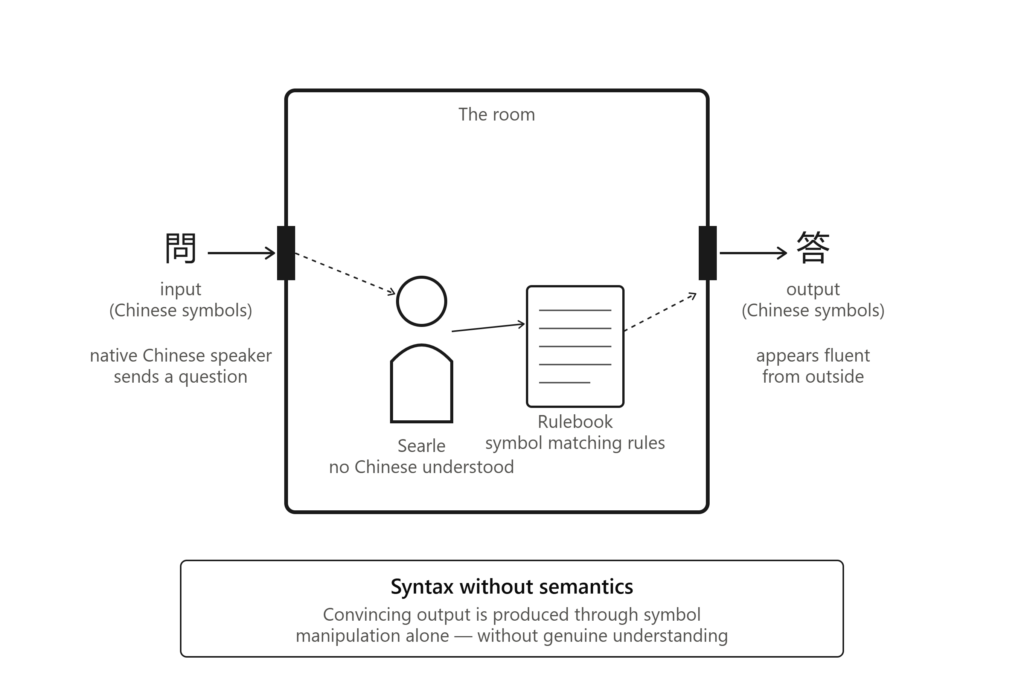
Searle asked readers to imagine a person who does not understand Chinese, sealed inside a room. This person is given Chinese characters through a slot in the door, along with a detailed rulebook (written in a language they do understand) for manipulating those symbols and producing appropriate Chinese characters in response. By following the rules precisely, the person can produce convincing Chinese replies (enough to pass a Turing Test) without ever understanding a single word of Chinese.
Searle’s point was that the person in the room and a computer running a program are not meaningfully different: both follow step-by-step instructions to produce outputs that appear intelligent, without any genuine understanding occurring. The argument was specifically directed at strong AI’s claim that an appropriately programmed computer, given the right inputs and outputs, would have a mind in exactly the same sense humans do. Searle aimed to show that information processing alone, no matter how sophisticated, cannot by itself produce genuine thought or understanding.
The argument was controversial and it remains so. One major line of response, known as the “Systems Reply,” concedes that the person inside the room doesn’t understand Chinese, but argues that some larger system: the room, the rulebook, and the person together might understand, even if no individual component does. A related “Virtual Mind” reply argues the real claim of strong AI isn’t that the computer itself understands, but that the process running on the computer creates a mind that understands, much like a character in a video game. Importantly, the Chinese Room argument was never meant as an attack on AI’s practical capabilities; it does not claim there is a limit to how intelligent a machine’s behavior can appear. Its target was narrower: the philosophical claim that computation alone is sufficient to produce genuine understanding.
Decades later, as language models like ChatGPT produce remarkably fluent conversation, Searle’s question has only grown more relevant, and we’ll return to it directly in Part 3 of this series.
The AI Winters: When Promises Outpaced Reality
The optimism of the 1950s and 60s could not last forever. The field experienced periods of decline known as “AI winters” in the 1970s and late 1980s, driven by unmet expectations and limited computational power. AI winters happened when expectations outpaced reality. Limitations in compute, data, and real-world performance made it difficult to deliver on the bold promises researchers had made, and funding agencies pulled back accordingly.
There was a partial revival before the deepest freeze set in. A resurgence in the 1980s was driven by the development of expert systems — programs that encoded the knowledge of human experts as explicit if-then rules, which found genuine commercial applications in narrow domains like medical diagnosis and chemical analysis. But even expert systems proved brittle and expensive to maintain at scale, and by the late 1980s, a second, harsher AI winter set in.
It would take a very different approach, one centered on learning from data rather than hand-coded rules, to pull the field out of its second winter and toward the breakthroughs that would eventually make modern AI possible. That story, including the rise of machine learning, deep learning, and the neural networks that power today’s chatbots, is where Part 2 picks up.
This is Part 1 of a 3-part series on the history of AI. Part 2 will cover the rise of machine learning and deep learning, leading up to the founding of OpenAI. Part 3 will trace the path from GPT to ChatGPT and discuss what these developments mean for the strong AI vs. weak AI debate today.
You May Also Like
Is AI Making Us Dumber? Part 1: The Alarming Evidence Behind Cognitive Offloading

The Critical Future of AI Mathematics: Literature Mining, Crisis Debates, and What Comes Next (Part 2)