The Governance Imperative: Why Agentic AI Deployment Is Outpacing Enterprise Readiness
From Pilot Fatigue to Production Reality
Enterprise AI has crossed a threshold. Gartner forecasts that 40% of enterprise applications will embed task-specific AI agents by end of 2026, up from under 5% in 2025. That is not incremental adoption, it is a structural reconfiguration of how enterprises orchestrate work. The transition from isolated generative AI experiments to production-grade, multi-agent architectures is no longer a roadmap item. It is happening now, unevenly, and largely ahead of the governance frameworks designed to contain it.
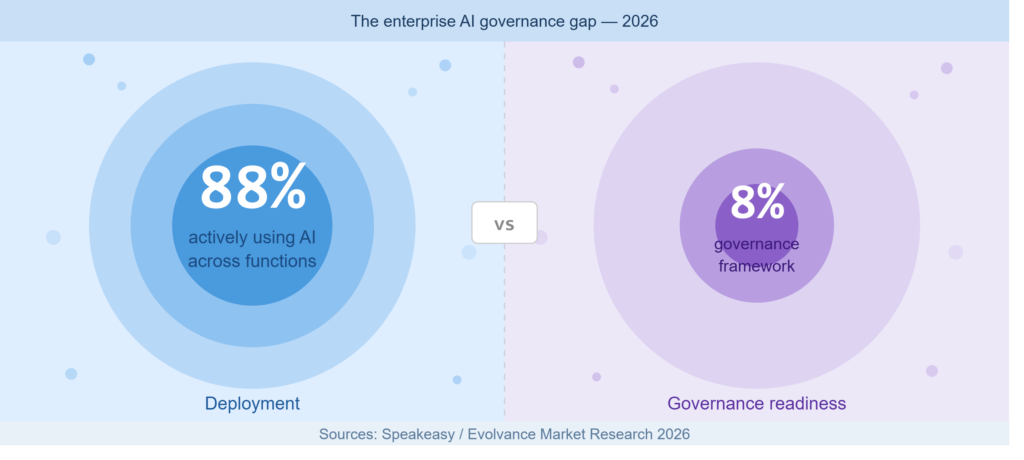
The numbers are unambiguous about the asymmetry. Only 8% of organisations globally have a comprehensive AI governance framework, while 88% are actively using AI across business functions. That eighty-point gap is not a compliance footnote but the operating risk profile of most enterprises deploying agentic systems today.
The Governance Gap Is a Performance Variable, Not a Compliance Checkbox
Enterprise leaders who still frame AI governance as a risk management exercise are misreading the data. Companies using AI governance tools get over 12 times more AI projects into production. Organisations that use evaluation tools move nearly six times more AI systems to production. Governance, in other words, is the primary determinant of deployment velocity, not a constraint on it.
PwC research finds that 74% of all AI-generated economic value is captured by just 20% of organisations, and those AI leaders invest in governance infrastructure at rates significantly higher than the market average. The value concentration this represents is not coincidental. Mature governance programs eliminate the rework cycles, incident responses, and regulatory interventions that bleed velocity from under-governed programs.
The EU AI Act’s full enforcement provisions for high-risk AI systems take effect August 2, 2026, covering credit scoring, employment decisions, and insurance underwriting, with fines reaching €15 million or 3% of global annual turnover for non-compliance. For heavily regulated industries, this regulatory pressure compounds what is already an operational imperative.
Agentic Architecture Introduces an Entirely New Attack Surface
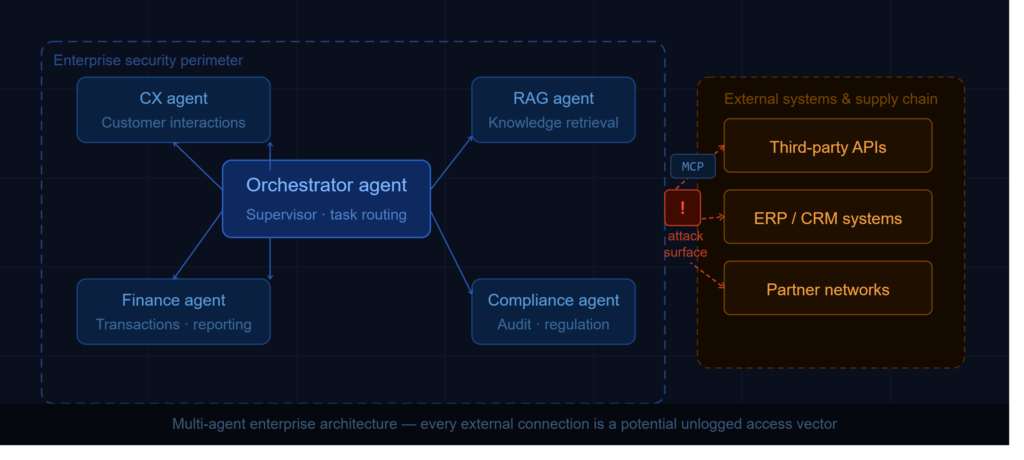
The shift to multi-agent systems does not merely scale existing risk. It introduces qualitatively new categories of it. Agents have identity, privileges, and access to systems and data across the business and out into the extended supply chain, either directly or through interfacing with other agents indirectly. This makes them a new and unexplored security risk, which is an entirely new non-deterministic attack surface.
The NSA released MCP security guidance in May 2026, signaling that federal regulatory requirements are a matter of when, not whether. The Model Context Protocol, which has rapidly matured into a common foundation for agent-to-tool connectivity, enables agents to interact with tools and data sources through standardised interfaces, a vital step toward portability, security, and observability. But standardisation alone does not constitute governance.
Uber’s deployment at scale offers the most instructive production case study available. By early 2026, 84% of Uber’s developers were using agentic coding tools daily, with AI generating between 65% and 72% of all code written inside their IDEs. Uber reached that scale because it built three governance layers before scaling adoption: an LLM gateway handling PII redaction, access control, and audit logging across every model interaction; an MCP gateway governing every agent-to-tool connection across 10,000+ internal services; and an agent identity system extending Zero Trust infrastructure to multi-agent workflows. The sequencing matters: governance infrastructure preceded scale, not the other way around.
Vendor Architecture Is a Strategic Decision, Not a Procurement Decision
Choosing an agentic AI vendor in 2026 is a different kind of decision. The model you select shapes how your agents reason, what they can and cannot do, how your data is handled, and how deeply you become entangled in a vendor’s ecosystem.
The compounding lock-in risk deserves particular attention. If agents run on a vendor’s proprietary orchestration layer, lock-in compounds at every layer of the stack. Enterprises that have not yet defined their agentic AI architecture strategy are already making a default choice. And that default is usually determined by whichever vendor has the best marketing rather than the best governance posture.
Sovereign AI considerations are now reshaping vendor selection in regulated industries. Sovereignty spans infrastructure, security, governance, lifecycle management, hiring policies, supply chains, service contracts, and partnerships, well beyond a one-time infrastructure decision. For European enterprises in particular, open-weight models with EU jurisdictional alignment offer a combination of flexibility and data sovereignty that hyperscaler-tied deployments cannot match.
What Separates Scaling Organisations from Those That Stall
Only 25% of AI initiatives deliver expected ROI, and only 16% reach enterprise-wide scale. Gartner expects over 40% of agentic AI projects to be cancelled by end of 2027 due to with escalating costs, unclear business value, and inadequate risk controls cited as primary drivers.
The distinguishing variable across the data is consistent: enterprises where senior leadership actively shapes AI governance achieve significantly greater business value than those delegating the work to technical teams alone. Governance, in the highest-performing organisations, is not a CISO concern or a legal review but a board-level operating discipline.
For enterprise AI leaders, the strategic question in the second half of 2026 is no longer whether to deploy agentic systems. It is whether the governance, evaluation, and observability infrastructure already in place is commensurate with the autonomy being granted. The organisations that answer that question honestly (and close the gap before scaling further) are precisely the ones that will capture the disproportionate share of value the data consistently points to.
You May Also Like
Google’s Powerful Gemini 3.6 Flash: 5 Ways It Is Transforming Enterprise AI Compute Costs
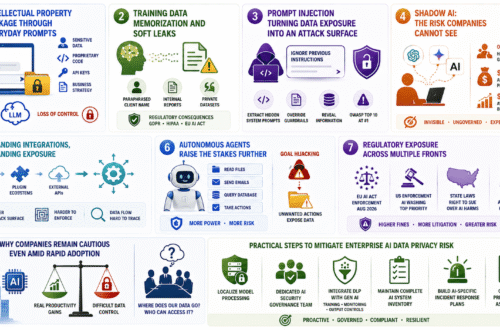
7 Critical Enterprise AI Data Privacy Risks Companies Cannot Afford to Ignore