Why AI Engineering Is Becoming One of the Most In-Demand Technology Skills
The Rise of AI Engineering
Artificial Intelligence has moved far beyond research laboratories and technology giants. Businesses of every size, from startups to global enterprises, are now actively looking for practical ways to integrate AI into their daily operations. As a result, AI Engineering has emerged as one of the fastest-growing and most in-demand career paths in the technology industry.
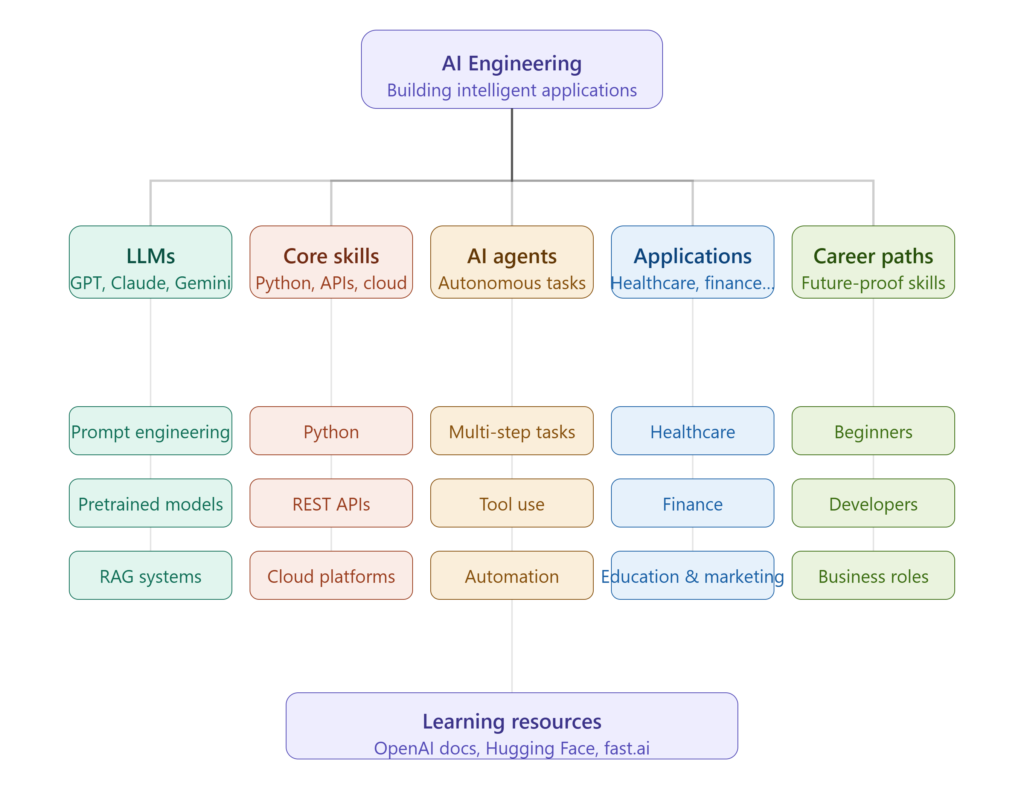
Unlike traditional software development, AI engineering focuses on building applications that can understand language, generate content, analyze data, and automate complex tasks using modern AI models. AI engineers combine software engineering skills with machine learning tools, APIs, cloud services, and prompt engineering to design intelligent applications that solve real business problems at scale.
How Large Language Models Changed Everything
One of the most significant shifts in AI engineering over the past two years has been the widespread adoption of Large Language Models (LLMs) such as ChatGPT, Claude, Gemini, and other generative AI systems. These pretrained models have fundamentally changed how developers build AI-powered applications.
Rather than training a model entirely from scratch, a process that previously required enormous datasets, specialized hardware, and months of work, developers can now integrate powerful LLMs into websites, mobile applications, business workflows, and customer support systems through simple API calls. This dramatically reduces development time, lowers the barrier to entry, and opens exciting new opportunities for innovation across every industry.
What Does an AI Engineer Actually Do?
AI engineering is a broad and evolving discipline. Depending on the organization and project, an AI engineer’s responsibilities may include:
- Designing and building AI-powered applications that leverage LLMs, computer vision, or speech recognition
- Integrating external AI services via REST APIs and cloud platforms such as AWS, Google Cloud, and Microsoft Azure
- Managing and optimizing prompts to improve the accuracy, reliability, and safety of AI outputs
- Building Retrieval-Augmented Generation (RAG) systems that connect AI models to internal databases and knowledge bases
- Testing and evaluating AI outputs to ensure quality, consistency, and alignment with business requirements
- Ensuring solutions remain secure, ethical, and compliant with data privacy regulations
Core technical skills such as Python, REST APIs, SQL databases, and version control remain essential. However, the ability to communicate effectively with AI models — through clear, well-structured prompts and thoughtful system design — has become an equally important and increasingly sought-after skill.
The Growing Role of AI Agents
A particularly exciting trend in AI engineering is the rise of AI agents. Unlike simple chatbots that answer individual questions, AI agents can execute sequences of tasks autonomously. These tasks include retrieving information from the web, analyzing uploaded documents, drafting reports, sending notifications, and interacting with multiple software systems in a coordinated workflow.
Organizations across industries are already exploring agent-based automation to improve productivity, reduce repetitive work, and enable their teams to focus on higher-value activities. For AI engineers, understanding how to design, deploy, and manage multi-step agent workflows is quickly becoming one of the most valuable skills in the field.
Career Opportunities in AI Engineering
For students and professionals looking to build future-proof careers, AI engineering offers a compelling combination of programming, creativity, problem-solving, and continuous learning. The demand for qualified AI engineers is expected to grow significantly across sectors including healthcare, finance, education, manufacturing, marketing, and government.
You do not need to have a traditional machine learning background to enter this field. Many successful AI engineers come from web development, data analysis, or business backgrounds and build their AI skills progressively. They start with APIs and prompt engineering before advancing to more complex topics like fine-tuning, embeddings, and agent frameworks.
Where to Start Learning AI Engineering
If you want to explore AI engineering in greater depth, two of the best starting points are the OpenAI Developer Platform and the Hugging Face Documentation. Both offer practical tutorials, code examples, and up-to-date guidance for developers building modern AI applications.
The most important step is simply to start building. Experiment with APIs, explore open-source models, and work on small projects that solve real problems. Practical experience, more than any certification, is what will set you apart in this fast-moving field.
You May Also Like
Can AI Become a Powerful AI Hardware Component You Simply Plug In?
Google’s Powerful Gemma 4 Model: 5 Critical Reasons It Is Reshaping the Open-Source AI Landscape